


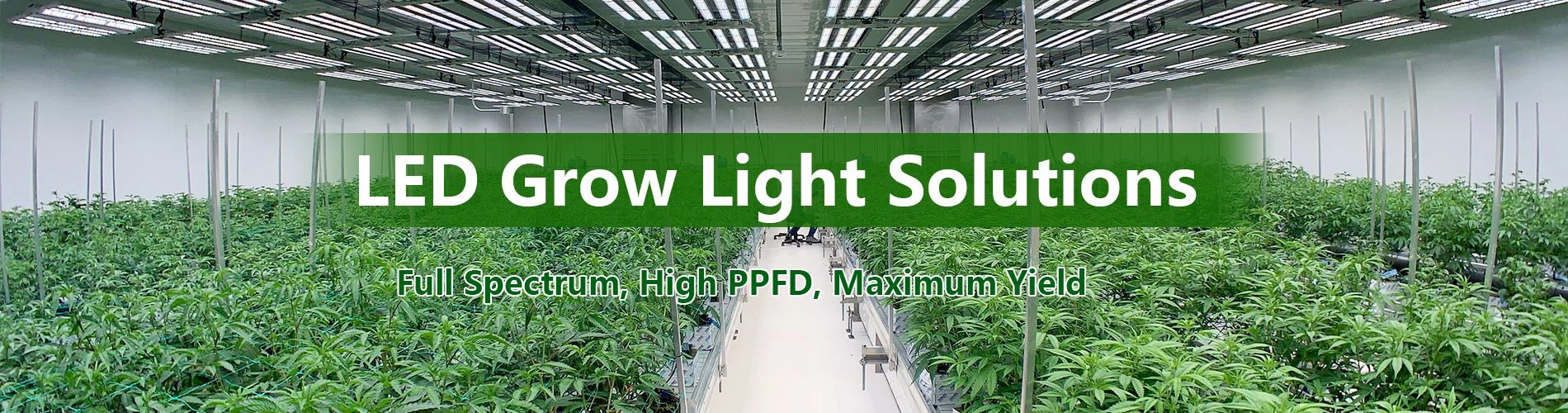
Have you noticed how much hype surrounding "full-spectrum" grow lights is flying around in the market these days? Many seasoned growers and newbies alike are baffled by the concept. When buying LED grow lights, everyone has a simple idea in mind: "Full spectrum" means a light that perfectly mimics sunlight, right?
We all know that sunlight appears white, but it's actually a multicolored spectrum, containing seven shades of light: red, orange, yellow, green, blue, indigo, and violet. So, according to common sense, if an LED grow light claims to be "sun-mimicking" and "full-spectrum," its light composition should be identical to sunlight. This is the subconscious assumption.
But the truth is, this simple assumption is precisely the first step in being misled by marketing! Don't worry, let's start with a little science experiment to uncover this cognitive bias.


The Truth About the "Prism" Mismeasurement Incident
A while ago, a friend of mine did something quite interesting. He bought a so-called "full-spectrum" LED supplemental grow light and then dug out a small prism. He wanted to imitate scientists and use the principle of light refraction to decompose the light from the grow light into seven colored bands, just like sunlight, to see if the composition was correct.
As soon as he finished the test, he panicked! He discovered that after the light passed through the prism, the seven-color bands that emerged weren't distinct, or rather, the compositional ratios differed significantly from what he'd imagined for sunlight. He immediately came to a "shocking" conclusion: this full-spectrum grow light was a scam!
I have to say, I admire this friend's critical thinking and his ability to apply middle school knowledge to real-life situations. While his testing method was sound, his "standard answer" was wrong. He mistook "industry standards" for "scientific truth."
It's time to correct the significant misconceptions between the average person and those in the horticultural lighting industry about full-spectrum lighting.
In the horticultural lighting industry, when factories, manufacturers, or traders refer to "full-spectrum horticultural lights," they don't mean that the light composition is identical to sunlight.
The true industry definition is that this type of light "includes" all wavelengths of visible light, from blue to red.
The key is "inclusion," not "abundance"!
- Sunlight: Components across all visible light bands are abundant.
- LED grow lights: While they "include" all visible light colors, their light energy is still concentrated in the two "main" bands of red and blue. Other colors are merely supporting, weaker, and less abundant.
So, returning to the prism experiment, because the light from a grow light "includes" all visible light bands, it will certainly produce seven colors after scattering. However, because many light components (such as yellow and green) are very weak and scarce, it doesn't appear as balanced and abundant as sunlight. The industry's term "full spectrum" actually covers all visible light bands on a spectrum graph, but the intensity is far inferior!


Why can't grow lights have a "sunlight" spectrum?
You might ask, if it's impossible to replicate sunlight, why not strive for it?
This touches on a core question of "commercial efficiency" and "scientific purpose."
Let's get back to the basics: What are grow lights used for?
Growth lights aren't for you to admire; they provide energy and signals for plant growth. Simply put, plants absorb light energy much like humans eat; the "nutrients" they need are specific.
The light components required for plant growth are mostly concentrated in the visible spectrum:
- Red light: This primarily affects flowering, fruiting, and photosynthesis efficiency.
- Blue light: This primarily affects stem and leaf growth, chlorophyll synthesis, and morphological development.
Since plants' diet primarily consists of red and blue light, the research and design of grow lights naturally emphasize these two highly efficient components! If lighting is designed to mimic sunlight, it means consuming a vast amount of electricity to produce yellow and green light, which plants have a low utilization rate of.
From a return on investment (ROI) perspective, this is a colossal waste! In business, we strive to maximize output with minimal cost. Grow lights should minimize electricity and concentrate light energy in the red and blue wavelengths that plants need most, achieving optimal growth efficiency. Therefore, LED grow lights should not resemble sunlight!
The Commercialization of "Full Spectrum" in the LED Era
In the early days of grow light development, efficiency was paramount. The light composition of grow lights back then was very simple and crude: a pure combination of red and blue light, resulting in a pinkish-purple hue. This was called a red-blue ratio lamp.
However, while highly efficient, this red-blue ratio lamp had two major issues:
- Unfriendly to the human eye: Long-term exposure to purple light is uncomfortable for workers, making it difficult to observe the true color and health of plants.
- Incomplete spectrum: While red and blue light are important, other wavelengths (such as green) also play a role in plant secondary metabolism and morphological balance.
With the maturity of LED chip technology, "black technology" has emerged! Manufacturers can now use a specific phosphor formula on the same LED chip to produce light that contains all visible light components while maintaining the intensity advantages of the red and blue wavelengths.
This new technology, which combines full-spectrum coverage with high red and blue efficiency, has propelled the market to the forefront of full-spectrum lamps. This is the technology and LED used in most grow lights on the market today. It's a compromise between business and science, resolving the conflict between efficiency and visual perception.

New Purchasing Standards
The key takeaway today is this: Full spectrum is an industry term for light that covers all visible light wavelengths, not a synonym for a perfect replica of sunlight.
- Ordinary people's expectation: Perfectly mimic sunlight, with balanced intensity across all seven colors.
- Industry reality: Covers all visible light wavelengths, but with light energy concentrated in the high-efficiency red and blue wavelengths.
So, next time you purchase or evaluate LED grow lights, your new criteria should be:
- Don't focus on color: Don't obsess over whether it looks perfectly "white."
- Read the report: Focus on the spectrum chart and light parameter test data. Confirm whether the light energy is efficiently concentrated in the red (600-700nm) and blue (400-500nm) wavelengths that plants need most.
- Look at the purpose: Your goal is to achieve yield, not to "resemble the sun."
Efficiency, efficiency, and efficiency! This is the ultimate goal of our business. Now your understanding of "full spectrum" is far superior to most people!
JT Grow Lights is a professional manufacturer of LED grow lights. We offer full-spectrum LED grow lights for greenhouses, vertical farms, commercial, indoor, and cannabis growing environments. We also customize specialized spectrum solutions based on your plant species, ensuring you receive the specialized spectrum your plants need while reducing energy consumption and costs. Are you interested? Contact us today!


