Under Canopy Lighting
The Yield Upgrade Most Commercial Growers Haven't Tried Yet
You've invested in the best top lights money can buy. Your canopy PPFD is hitting target. Your veg looks strong. And then you harvest — and 20–30% of your flower weight is popcorn buds, larfy lower bud sites, and underdeveloped material that sells for a fraction of your top-shelf product.
Here's the thing: that's not a genetics problem. It's not a nutrient problem. It's a light problem — specifically, a lower canopy light problem. And it's one of the most fixable yield issues in commercial cultivation, with one of the fastest payback periods of any equipment investment you'll make.
This guide covers everything you need to know about under canopy lighting — why top lights physically cannot solve this problem, how under canopy LED grow lights work, what results commercial operations are seeing, and how to spec and source the right system for your facility.
|
Already running a dense canopy and want to know exactly what under canopy lighting would add to your yield? Jump to Section 5 — or send us your canopy dimensions and current top light setup. We'll model the PPFD gain at lower bud sites and estimate the yield impact for your specific operation. |
-
![Dual Side Emission Under Canopy Lighting For Commercial Grow Rooms]() Dual Side Emission Under Canopy Lighting For Commercial G...Product Highlightsview more
Dual Side Emission Under Canopy Lighting For Commercial G...Product Highlightsview more
1.Dual side emission — light reaches both faces of the canopy in one pass
2.20–25% yield increase reported by commercial growers
3.Upgrades lower canopy from loose larf/B-grade to dense,... -
![Triple Side Under Canopy LED Light For Full Canopy Penetration]() Triple Side Under Canopy LED Light For Full Canopy Penetr...Product Highlightsview more
Triple Side Under Canopy LED Light For Full Canopy Penetr...Product Highlightsview more
1. Triple side emission — surrounds the plant with light from three directions in a single pass
2. Built for dense, wide canopies and multi-sided planting layouts
3. IP66 waterproof rated for... -
![8ft Under Canopy LED Grow Light For Larger Grow Rooms]() 8ft Under Canopy LED Grow Light For Larger Grow RoomsProduct Highlightsview more
8ft Under Canopy LED Grow Light For Larger Grow RoomsProduct Highlightsview more
1. Available in double side (180°) and 3 side (270°) beam angle
2. 8ft length, 250W — covers more canopy per fixture, fewer units per row
3. 20–25% yield increase reported by clients
4.... -
![Dual Side Under Canopy Light For The North American Market]() Dual Side Under Canopy Light For The North American MarketProduct Highlightsview more
Dual Side Under Canopy Light For The North American MarketProduct Highlightsview more
1.Dual side emission — lights up both faces of the canopy in a single pass
2.Weighted red-dominant spectrum built for flowering performance
3.High efficacy Samsung LED chips — more light per... -
![6ft Under Canopy Grow Lights With Wide Beam Angle]() 6ft Under Canopy Grow Lights With Wide Beam AngleProduct Highlightsview more
6ft Under Canopy Grow Lights With Wide Beam AngleProduct Highlightsview more
1. Available in double-sided (180°) and 3-sided (270°) emission
2. 150W / 180W / 200W wattage options for different canopy density
3. 6ft length — fits standard commercial row spacing
4.... -
![120W LED Under Canopy Grow Lights With 240° Wide Angle Three-Sided Lighting]() 120W LED Under Canopy Grow Lights With 240° Wide Angle Th...240° wide-angle under-canopy LED grow lights designed for uniform lower canopy coverage. Reduce shading, improve crop consistency, and maximize yield per watt.view more
120W LED Under Canopy Grow Lights With 240° Wide Angle Th...240° wide-angle under-canopy LED grow lights designed for uniform lower canopy coverage. Reduce shading, improve crop consistency, and maximize yield per watt.view more -
![Under Canopy LED Grow Lights With 240 Degree Wide Angle For Indoor Cultivation]() Under Canopy LED Grow Lights With 240 Degree Wide Angle F...Product Highlightsview more
Under Canopy LED Grow Lights With 240 Degree Wide Angle F...Product Highlightsview more
1. 240°Beam Angle — light reaches 3 faces of the canopy in one pass
2. 20–25% yield increase reported by commercial growers
3. Upgrades lower canopy from loose larf/B-grade to dense, A-grade flower... -
![Under Canopy Supplemental Grow Light]() Under Canopy Supplemental Grow Light✅ Benefits Of IP65 Rating: Dustproof And Waterproofview more
Under Canopy Supplemental Grow Light✅ Benefits Of IP65 Rating: Dustproof And Waterproofview more
✅ Fast And Secure Connect Technology
✅ High Safety And Durability
✅ Linear Structure, Uniform Illumination -
![Full Spectrum Under Canopy Grow Lights]() Full Spectrum Under Canopy Grow LightsProducts Feature 🌞 Good light transmittance Using a high-transmittance PC shell with a light penetration rate of more than 90% than conventional glass materials, Full Spectrum Under Canopy Grow Lights Simultaneously, this lampshade may...view more
Full Spectrum Under Canopy Grow LightsProducts Feature 🌞 Good light transmittance Using a high-transmittance PC shell with a light penetration rate of more than 90% than conventional glass materials, Full Spectrum Under Canopy Grow Lights Simultaneously, this lampshade may...view more -
![Under Canopy Strip Plant Lighting]() Under Canopy Strip Plant Lighting1.Compatibility and modular expansionview more
Under Canopy Strip Plant Lighting1.Compatibility and modular expansionview more
2.Excellent heat dissipation performance
3.Integrated structure, good waterproof performance
4.Flexible suspension and bracket installation -
![Under-Canopy LED Grow Light]() Under-Canopy LED Grow LightBring your lower canopy back to life. JTGL under-canopy LED grow lights push full-spectrum light into shaded branches, boosting bud density, plant uniformity, and total yield with true IP65 durability.view more
Under-Canopy LED Grow LightBring your lower canopy back to life. JTGL under-canopy LED grow lights push full-spectrum light into shaded branches, boosting bud density, plant uniformity, and total yield with true IP65 durability.view more -
![Under Canopy Grow Lights]() Under Canopy Grow Lights1. Strip appearance, compact structure, does not occupy the planting area;view more
Under Canopy Grow Lights1. Strip appearance, compact structure, does not occupy the planting area;view more
2. 2 Installation methods, suitable for a variety of planting environments and plant species;
3. Full-spectrum design with strong and uniform light...


Why Your Top Lights Are Failing the Bottom Half of Your Canopy
Most commercial growers understand that PPFD matters. What fewer growers fully account for is how dramatically PPFD drops as you move down through a dense cannabis canopy – and what that means for the lower bud sites that represent a significant portion of total plant yield.
Your top lights are doing exactly what they were designed to do. The problem is that dense canopy leaves were also designed to do their job — and their job is to absorb light before it reaches the lower plant.
The physics of light penetration through a cannabis canopy
A healthy cannabis plant in full flower has 4–8 layers of leaves between the top of the canopy and the lower bud sites. Each leaf layer absorbs approximately 85–95% of the light that hits it. The math is brutal: if your top light delivers 1,000 µmol/m²/s at the canopy surface, the bud sites at 60 cm below that surface may be receiving as little as 50–150 µmol/m²/s — well below the light saturation point needed for meaningful flower development.
This is not a failure of your top lights. It's the fundamental physics of how light interacts with plant tissue. No amount of extra power at the top changes what happens inside the canopy. The only solution is to put light inside the canopy — which is exactly what under canopy LED grow lights are designed to do.
What low under canopy PPFD actually costs you
Lower bud sites operating at 50–150 µmol/m²/s produce exactly what you'd expect from a plant growing in low light conditions: small, airy, underdeveloped flowers — what the industry calls popcorn buds. These aren't just cosmetically inferior. In most commercial cannabis markets, popcorn and larfy material sells at 30–60% of the price of top-shelf flower. In a facility producing 500 kg per cycle, if 20% of that weight is popcorn-grade material, that's 100 kg selling at $2/gram instead of $5/gram — a $300,000 annual revenue gap from a single fixable light problem.
The most expensive part of this problem is that it looks like a genetics or nutrient issue — until you measure PPFD at the lower canopy. We've seen operations spend months adjusting nutrient programs and environmental controls before someone finally put a quantum sensor at lower bud site level and found 80 µmol/m²/s. The lights were fine. The canopy penetration wasn't.
How Light Actually Moves Through a Dense Canopy
And What You Can Do About It
Understanding the physics makes the solution obvious. Supplemental grow lights placed within or below the canopy bypass the absorption problem entirely — instead of trying to push more light through 6 layers of leaves from the top, they deliver photons directly to the bud sites that need them.
You can double your top light intensity and still not fix a lower canopy PPFD problem. The leaves absorb it before it gets there.
PPFD attenuation through canopy layers
|
Canopy Level |
Approx. PPFD (1,000 µmol/m²/s top) |
% of Top-Canopy PPFD |
Bud Development Impact |
|
Top canopy (0–15 cm) |
800–1,000 µmol/m²/s |
80–100% |
Optimal — top cola development |
|
Mid canopy (15–35 cm) |
300–600 µmol/m²/s |
30–60% |
Acceptable — secondary bud development |
|
Lower mid (35–55 cm) |
100–250 µmol/m²/s |
10–25% |
Below optimal — smaller, less dense buds |
|
Lower canopy (55–75 cm) |
40–120 µmol/m²/s |
4–12% |
Poor — popcorn bud zone |
|
Base of plant (75+ cm) |
10–50 µmol/m²/s |
1–5% |
Effectively unlit — minimal development |
These are representative figures for a healthy mid-flower cannabis canopy with training (topping, LST, or SCROG). Untrained plants with more vertical leaf density will show even steeper PPFD attenuation with depth.
What under canopy lighting adds to this picture
An under canopy LED grow light placed at 30–50 cm height within the canopy — between the mid and lower zones — delivers its output directly to the bud sites in the 40–150 µmol/m²/s natural PPFD range. Adding 150–200 µmol/m²/s of supplemental PPFD from below brings lower bud sites from popcorn-development territory into productive flower development range.
The result isn't just more weight. It's better quality weight. Lower bud sites receiving adequate PPFD develop denser, better-formed flowers with higher trichome density — because the plant is allocating resources to development rather than survival. This is what the yield data from commercial operations using under canopy grow lights consistently shows: not just 10–25% more total weight, but a meaningful shift in the grade distribution of that weight.
Beam Angle, Power, and Physical Design
What Makes a Good Under Canopy Light
Not every LED grow light can function as an under canopy grow light. The physical environment inside a dense cannabis canopy — humid, confined, with limited airspace — creates design requirements that standard top lights don't meet. Here's what to look for.
Installing a standard top light at lower canopy height doesn't make it an under canopy light. The beam angle, power level, IP rating, and physical profile are completely different requirements.
Beam angle— covering row width without blinding adjacent plants
Under canopy lighting needs to distribute light laterally — across the row width and into the canopy interior. For most commercial cannabis under canopy applications, 120° beam angle is the standard — sufficient lateral spread to cover a standard row width from a single fixture per row. Under canopy LED grow lights with a 120° beam are the workhorse format for dense canopy work. JTGL also offers 240° 3-sided under canopy grow lights — emitting from three surfaces simultaneously to activate both sides of the row and the lower canopy zone in a single fixture, without doubling your hardware count.
Power range— matching intensity to lower canopy needs
Under canopy lighting doesn't need the same intensity as top lighting. Your lower bud sites are operating at 40–150 µmol/m²/s from natural top light penetration. You need to bring them to 200–350 µmol/m²/s — a supplemental addition of 100–250 µmol/m²/s. That requires much less wattage than top lighting. For most commercial cannabis under canopy lighting applications, the 100W–150W range is standard. Overdoing intensity at lower canopy level can cause light stress on leaves and stems that aren't adapted to high-intensity direct illumination — the goal is supplemental, not saturating.
IP65— not optional in a cannabis grow room
Commercial cannabis grow rooms are high-humidity environments. Irrigation, transpiration, and cleaning protocols create persistent moisture exposure for any fixture inside the canopy. IP65 under canopy grow lights are the minimum specification — dust-tight and protected against low-pressure water jets. Waterproof under-canopy LED lighting rated IP65 or IP66 will operate reliably in these conditions for the full rated lifespan. Fixtures without this rating will fail earlier, create electrical safety risks, and void most commercial facility insurance policies.
Low profile design—linear form that disappears inside the canopy
The right under canopy LED grow light for dense canopy work isn't just thin — it's linear. A slim bar-format fixture, typically 3–5 cm wide and 5–7 cm deep, sits cleanly along the row without creating the shading footprint that wider panel-style fixtures leave on the canopy below. The linear form factor distributes light evenly along the full row length from a single installation point, rather than concentrating output at one spot the way a compact square fixture does.
|
Our under canopy LED grow lights: 120–150W range, 120° beam angle standard (90° and 240° available), IP65 rated as standard with IP66 option, full spectrum including far-red, 0–10V dimmable, slim 5-7 cm profile. ETL, CE, DLC, and RoHS certified. From 1 unit with 20–25 day lead time for custom configurations. |
Under Canopy Lighting for Cannabis
The Commercial ROI Case
Under canopy grow light for cannabis is where this technology has the most compelling commercial case. Cannabis is the crop where the economics of lower bud site quality are most visible — the price differential between top-shelf flower and popcorn material is large, the canopy density is extreme, and the production cycle is fast enough that ROI from an under canopy investment shows up within 1–2 harvests.
In commercial cannabis, the difference between 'runs okay' and 'runs profitably' often comes down to what percentage of your total weight is top-grade flower. Under canopy lighting moves that percentage.
What commercial cannabis operations see from under canopy lighting
Based on results from commercial licensed cannabis facilities using cannabis under canopy lighting systems:
- +10–25% total sellable flower weight per cycle — from lower bud sites that previously produced only popcorn or trim
- Significant reduction in popcorn bud formation — lower bud sites receiving 200+ µmol/m²/s develop full flower structure instead of small, airy popcorn
- Improved trichome density at lower sites — consistent with better PPFD stimulating secondary metabolite production
- Better batch-to-batch consistency — more predictable harvest weight when lower canopy yield is stabilised
- Grade distribution shift — more product grading at top-shelf vs. mid/lower tier in facilities with quality grading programs
The ROI calculation for under canopy LED grow lights for cannabis is straightforward. A 500 m² flowering facility running 6 cycles per year, producing 2 kg/m² per cycle (1,000 kg total), with 20% currently grading as popcorn/lower quality:
|
Scenario |
Total Yield (kg/cycle) |
Top-Grade % |
Popcorn % |
Revenue at $4/g top / $1.50/g popcorn |
|
Before under canopy lighting |
1,000 kg |
80% (800 kg) |
20% (200 kg) |
~$3,500,000/yr (6 cycles) |
|
After under canopy lighting (+15% total, grade shift) |
1,150 kg |
88% (1,012 kg) |
12% (138 kg) |
~$4,136,400/yr |
|
Annual revenue increase |
+150 kg total |
+212 kg top-grade |
−62 kg popcorn |
~+$636,000/yr |
This model uses conservative yield improvement assumptions. Capital cost for under canopy lighting at this facility scale: approximately $30,000–$60,000 depending on row count and fixture density. At $636,000 annual revenue uplift, payback period: 3–5 weeks.
Under trellis lighting — SCROG and training system integration
For facilities using SCROG (Screen of Green) or other horizontal training systems, under trellis lighting positions fixtures directly below the trellis net — delivering light upward into the bud sites developing beneath the screen. This is the most effective placement for SCROG grows because the fixture is positioned exactly at the point where light attenuation becomes severe, and the horizontal growth pattern means consistent fixture-to-bud-site distance across the entire row.
Standard specification for under trellis applications: 100W–150W per fixture, 120° beam angle, positioned 20–35 cm below the trellis net, spaced at 60–90 cm intervals along the row depending on fixture output and row width.
|
Running a commercial cannabis facility and want the actual numbers for your specific setup? Tell us your room dimensions, plant count, current top light PPFD, and canopy training method. We'll model the expected PPFD gain at lower bud sites and estimate the revenue impact for your operation — before you spend a dollar on fixtures. |
Types of Under Canopy Grow Lights
This is the standard for most commercial rows. Light emits from two surfaces at 120°, covering the row width and lower canopy zone from a single fixture position. Straightforward to install, effective for standard commercial row widths, and the baseline specification for most professional under canopy grow light applications.

3-Sided / Multi-Angle Under Canopy Lights (240°~270°)

This is maximum coverage for wide rows and dense canopies. Three-sided emission activates bud sites on both sides of the row and directly below the fixture simultaneously. Shadow zones are significantly reduced compared to double-side configurations. JTGL's 240° three-sided under canopy grow lights are designed for high-density commercial grows, wide-row SCROG setups, and tall plant structures where a single fixture needs to cover more canopy area without increasing fixture count.
Full Technical Specifications Of Under Canopy LED Grow Lights
Here is the complete specification for our under canopy lighting range — what the numbers mean, why they were chosen, and what to compare when evaluating alternatives.
|
Product |
|
|
|
Wattage |
120W |
120W/150W |
|
Full Spectrum |
Full spectrum+660nm+730nm (Customized) |
Full spectrum+660nm+730nm (Customized) |
|
Light Source |
Samsung 281B/301B/301H/301H EVO |
Samsung 281B/301B/301H/301H EVO |
|
PPE |
2.8~3.0 umol/J |
2.8~3.0 umol/J |
|
PPFD Uniformity |
≥ 0.85 |
≥ 0.85 |
|
PF |
≥0.97 |
≥0.95 |
|
Beam angle |
120° |
240° |
|
ROI |
Energy saving vs HPS: up to 40–50% |
Energy saving vs HPS: up to 40–50% |
|
Support Dimmer |
0~10V |
0~10V |
|
IP Rating |
IP54 |
IP65 |
|
Lifespan (hours) |
>50,000 |
>50,000 |
|
Working Time (hours) |
>50,000 |
>50,000 |
|
Product Weight(kg) |
2 |
2 |
|
Input Voltage(V) |
AC110-277/50/60Hz |
AC110-277/50/60Hz |
|
Working Temperature(℃) |
-20°C~+45°C |
-20°~+45°C |
|
Lamp Body Material |
6063 aluminum |
6063 aluminum |
|
Color Rendering Index(Ra) |
90 |
90 |
|
Cooling method |
passive cooling |
passive cooling |
|
Customization |
OEM & ODM |
OEM & ODM |
|
Certification |
CE FC RoHS |
|
|
Warranty |
5-Year |
5-Year |
|
Application |
Cannabis Cultivation, indoor plant |
Cannabis Cultivation, indoor plant |

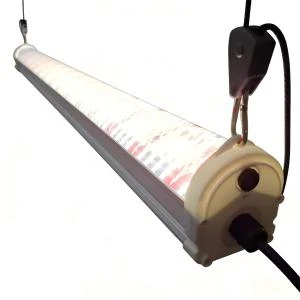
All under canopy LED grow lights in our range are manufactured in-house at our factory with 100% aging test before shipment. ETL, CE, DLC, and RoHS certifications are standard — not premium add-ons. Custom full spectrum under canopy grow lights with specific beam angle, power, or spectrum configurations are available from 1 unit.
Under Canopy Lighting Installation
The best under canopy LED grow light installed in the wrong position delivers disappointing results. Installation geometry determines how much of the lower canopy actually benefits from the supplemental light — and whether you get 10% yield improvement or 25%. Here's how to get it right.
Under-canopy lighting positioned incorrectly can create hot spots, uneven bud-site activation, and airflow restrictions. Geometry matters as much as power.
Under canopy lighting height positioning
Position your LED under canopy grow lights at the point where PPFD from top lights drops below 200 µmol/m²/s. In practice, this is typically 35–55 cm below the top of the canopy for a fully trained commercial cannabis plant, or 40–60 cm below the trellis in a SCROG setup. Use a quantum sensor to verify — don't estimate. The 5 minutes it takes to measure is worth more than any rule of thumb.
Row spacing and fixture density
There is no universal spacing rule for under canopy grow lights — the right interval depends on your row width, beam angle, fixture output, and target supplemental PPFD. What works in a 90 cm wide row with 120° under canopy lighting will underperform in a 140 cm wide row with the same setup.
The practical approach: install a test fixture at your planned position, measure actual PPFD at lower bud site level with a quantum sensor, and adjust spacing based on what the numbers show — not on a chart. A 5-minute sensor reading tells you more than any installation guide.
Airflow and cable management
Mount fixtures with minimum 3–5 cm clearance from the main stem and adjacent branches. Tight mounting against plant structure restricts the lateral airflow that humidity management in dense canopies depends on — and creates microclimates that encourage Botrytis and powdery mildew. Cable management should run vertically along trellis stakes or training stakes, not horizontally across the canopy where they create additional shading and airflow restriction. For large commercial installations, a dedicated under canopy lighting circuit separate from top lighting allows independent control
|
Need a layout specification for your specific room or greenhouse? Send us your room dimensions, row layout, canopy height, and current top light setup. We'll produce a complete under canopy lighting layout — fixture positions, heights, spacing, circuit design, and PPFD model at lower bud sites — at no charge. |
Sourcing Our Under Canopy LED Grow Lights
Wholesale, OEM, and Factory Direct
Under canopy lighting is one of the fastest-growing segments in commercial horticultural lighting — and one where product quality varies most significantly. The operational environment inside a dense canopy is demanding: high humidity, limited airflow, regular plant contact, and years of continuous operation. Sourcing from a reliable under canopy LED grow lights manufacturer with verified IP ratings, real L90 lifespan data, and system-level certifications makes the difference between a yield upgrade that pays for itself in weeks and a maintenance problem that costs you more than you gained.
The cheapest under canopy lighting is rarely the cheapest under canopy system. Low-quality fixtures in a commercial grow room create electrical safety risks, insurance problems, and replacement costs that dwarf the initial saving.

Factory direct
Buying directly from JTGL — a dedicated under canopy LED grow lights manufacturer with 4 in-house production lines — removes distribution margin from every order. For commercial operations expanding capacity phase by phase, direct factory pricing and production scheduling visibility means each expansion phase is budgeted accurately — not subject to distributor stock availability and margin fluctuations. For most commercial orders, the factory-direct price advantage runs 20–35% compared to distributor pricing.
Wholesale programs
For under canopy lighting wholesale buyers — distributors, system integrators, and commercial lighting consultants supplying multiple facilities — JTGL offers wholesale pricing programs with volume tiers, stable production allocation, and technical support for installation design. Standard product lead time: 10–15 days. Production capacity: 8,000–12,000 units/month. Full in-house testing and IP65 seal validation before shipment.


OEM under canopy grow lights
OEM under canopy grow lights with custom specifications are available from 1 unit with 20–25 day lead time. Common OEM configurations include:
•Custom beam angle — 120°, 150°, or 240°
•Custom power level — 100W, 120W, 150W
•Custom spectrum
•Private label
•IP66 upgrade
•Market certifications
Our Certifications

CE
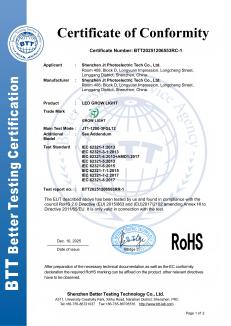
RoHS
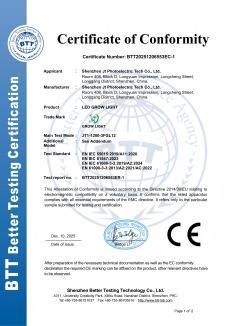
EMC
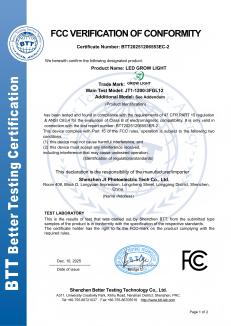
FCC
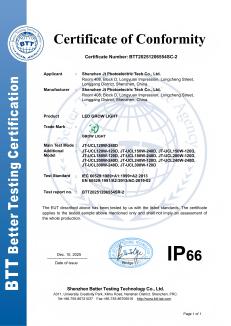
IP66

CE
|
Specifying under canopy lighting for a commercial cannabis or greenhouse facility? Tell us your canopy type, row width, plant count, and current PPFD levels at lower bud sites. We'll spec the right fixture, produce a layout, and send pricing within 24 hours. |
FAQ
Q: What is under canopy lighting and how does it work?
A: Under canopy lighting places low-profile, wide-beam LED fixtures within or below the main plant canopy — at heights where top light penetration has dropped to sub-optimal levels. Instead of trying to push more light through leaf layers from above, it delivers supplemental PPFD directly to lower bud sites and fruiting zones. Typical supplemental addition: 150–250 µmol/m²/s, bringing lower plant zones from popcorn-development PPFD levels into productive flower development range.
Q: How much yield improvement can I expect from under canopy lighting?
A: Commercial cannabis operations using under canopy LED grow lights consistently report 10–25% total sellable flower weight improvement per cycle, significant reduction in popcorn bud formation, and improved grade distribution. The range is wide because results depend on canopy density, training method, current lower canopy PPFD, and crop variety. Dense, heavily trained canopies with significant lower light attenuation see the largest gains.
Q: What wattage do I need for under canopy lighting?
A: For most commercial cannabis applications: 100W–150W per fixture at 120° beam angle. A 100W LED grow light at 35 cm delivers approximately 160–220 µmol/m²/s supplemental PPFD — sufficient for most lower canopy applications. A 150W LED grow light or 150W full spectrum LED grow light is appropriate for wider rows or high-density canopies where more lateral spread is needed. Under-powering is rarely a problem; overshooting intensity at lower canopy level can cause light stress on leaves adapted to lower light.
Q: Do under canopy grow lights need to be waterproof?
A: Yes. IP65 waterproof under canopy grow lights are the minimum specification for commercial cannabis facilities. Grow rooms are high-humidity environments — condensation, irrigation, and cleaning create persistent moisture exposure. IP65 ensures the fixture survives this environment for its rated lifespan. Waterproof under canopy LED fixtures without IP65 rating will fail earlier and create electrical safety risks in commercial facilities.
Q: What beam angle is best for under canopy lighting?
A: 120° is the standard for most commercial cannabis rows (90–120 cm wide). 90° is better for very narrow rows or when you need more depth penetration. 150° works well for wide rows or where a single fixture needs to cover both sides of a wide canopy structure. For SCROG setups, 120° positioned directly below the trellis net is the most common specification.
Q: Can I use under canopy lighting for greenhouse tomatoes?
A: Yes — intra-canopy lighting for tomatoes is a well-established practice in commercial greenhouse horticulture, particularly in the Netherlands and Belgium. 30W–80W linear bar fixtures positioned at 1–1.5 metre intervals along the crop row deliver supplemental PPFD to lower fruiting trusses, improving marketable yield by 10–20% and enhancing fruit quality (Brix, colour) in lower truss positions. Inter canopy lighting for tomatoes and cucumbers works on the same principle as cannabis under canopy lighting — different crop, same physics.
Q: How do I install under canopy lighting in a SCROG setup?
A: Position under trellis lighting 15–25 cm below the trellis net, spaced at 60–80 cm intervals along the row. At 120° beam angle, this position activates bud sites developing directly below the net — the zone where light attenuation is most severe in a SCROG canopy. Use adjustable mounting brackets to allow repositioning as the plant structure develops through the early flower stage.
Q: What is the minimum order for under canopy LED grow lights?
A: No minimum for standard products. Custom and OEM configurations — beam angle, power, spectrum, private label — are available from 1 unit with 20–25 day lead time. For under canopy lighting wholesale programs with volume pricing, contact us with your target quantity and market.
Q: How do I know if my canopy needs under canopy lighting?
A: Take a quantum sensor reading at lower bud site level (50–70 cm below the canopy top, or 20–30 cm above the base of the plant) during your top lights' operating hours. If PPFD is below 200 µmol/m²/s, your lower canopy is operating in sub-optimal light conditions. If you're seeing significant popcorn bud formation at lower sites and lower-quality material in your harvest grading, that's confirming evidence. The measurement takes 5 minutes and tells you everything the visual assessment doesn't.
Q: What is the difference between double-side and 3-sided under canopy lights?
A: Double-side fixtures emit at 120°, covering standard row widths up to 120 cm from a single position. 3-sided fixtures emit at 240°, activating bud sites on both sides of the row and below simultaneously — significantly reducing shadow zones. JTGL's 240° three-sided design is recommended for wide rows, SCROG setups, and high-density grows.
Q: Can under canopy lighting replace top lighting?
A: No — under canopy lighting is supplemental, not a replacement. Top lights provide primary PPFD for the upper canopy; under canopy lighting deliver the additional 150–250 µmol/m²/s needed to bring lower bud sites into productive development range. Both are required.
Q: How long do under canopy LED grow lights last?
A: JTGL under canopy grow lights are rated 50,000+ hours at L90 — approximately 7–8 years at 18 hours/day. IP65 sealing is pressure-tested on every unit before shipment to ensure the humid grow room environment doesn't shorten that lifespan.
Q: Can I connect under canopy lights to my existing grow light controller?
A: Yes. All JTGL under canopy LED grow lights support 0–10V dimming, compatible with most commercial grow light controllers. They can run on the same schedule as your top lights or independently on a separate zone. Send us your controller model and we'll confirm compatibility before you order.
Q: What certifications do under canopy LED grow lights need?
A: USA: ETL listing and IP65 minimum; DLC listing for utility rebate eligibility. EU/UK: CE and RoHS are legal requirements. All JTGL fixtures carry ETL, CE, DLC, RoHS, and IP65 as standard — documentation available immediately on request.
Q: Do you offer OEM or private label under canopy grow lights?
A: Yes, from 1 unit. Custom beam angle, power, spectrum, private label branding, and market-specific certifications (ETL for USA, CE+RoHS for Europe) under your brand name. Lead time: 20–25 days.Sonnet 4.6
Your Lower Canopy Is Already Growing
The Question Is How Much It's Worth
Under canopy lighting is not a speculative investment. It's a targeted fix for a known, measurable problem — lower bud site PPFD deficiency — with predictable, well-documented results. Here's what we bring to every under canopy lighting project:
- 100W–150W range, 120° beam angle standard — matched to your canopy geometry and row width
- Full spectrum with far-red, 0–10V dimmable — optimised for lower canopy flower development and quality
- IP65 standard, IP66 available — built for commercial grow room conditions
- ETL + CE + DLC + RoHS — certified for USA and European commercial facilities
- Low profile 4 cm body — fits within canopy without restricting airflow or damaging plant structure
- Custom beam angle, power, and spectrum from 1 unit — 20–25 day lead time
- Wholesale programs and factory direct pricing — 10–15 day standard lead time
|
Tell us your canopy type, row dimensions, current top light PPFD, and training method. We'll model the expected PPFD gain at your lower bud sites, estimate the yield and revenue impact for your specific facility, and produce a complete installation layout — fixture positions, spacing, circuit design — within 24 hours. No obligation. No sales pitch. Just the data that tells you whether under canopy lighting makes sense for your operation — and what it's worth when it does. |
← Back to: LED Grow Lights — Complete Buyer's Guide
→ Related: Commercial LED Grow Lights | Greenhouse LED Grow Lights | Vertical Farming LED Lighting | Quantum Board Grow Lights
We're well-known as one of the leading under canopy lighting manufacturers and suppliers in China. Please rest assured to buy cheap under canopy lighting for sale here from our factory. Contact us for customized service and discount information.
storage under canopy lighting, under canopy lighting supplies, under canopy light filters