LED Grow Lights for Commercial Cultivation
Most growers who switch to LED grow lights do so 12–18 months later than they should. Not because they didn't know LED existed — but because the information they found was either too technical to act on, or too vague to trust.
Whether you're running a commercial cannabis facility in the USA, scaling a greenhouse operation in Europe, building a vertical farm, or sourcing as a wholesale LED grow lights distributor — you'll find here exactly what you need to make a confident decision: what to look for, what to avoid, and why.
We're a direct LED grow lights manufacturer and factory. We'll give you the honest version — including where other suppliers cut corners and what it costs you when they do. We’ve worked with projects from small-scale facilities to multi-room commercial operations across the USA and Europe.
Short on time? Skip straight to Section 6 — share your canopy size, crop, and location. We'll send you a complete photometric layout and pricing within 24 hours.
What Are LED Grow Lights — And Why Has the Industry Shifted to Them?
Plants don't see what we see. They respond to specific wavelengths in the 400–700 nm range that drive photosynthesis — blue, red, and far-red. Standard lighting wastes most of its energy on wavelengths plants can't use. LED grow lights concentrate output precisely where plant biology demands it. The result is more growth per watt — by a significant margin.
This is not a technology preference. It's a cost structure shift that compounds every month you delay.
The shift from HPS to LED grow lights for indoor farming and commercial cultivation has been driven entirely by growers doing the math: lower electricity bills, less heat to manage, more consistent canopy coverage, no scheduled bulb replacement. Every one of those factors directly reduces operating cost.
The best commercial LED grow lights available today from a quality LED grow lights manufacturer deliver 2.8–3.1 µmol/J of photon efficacy — compared to 0.9–1.7 µmol/J for HPS. That's not a marginal efficiency gain. That's a fundamentally different energy-to-yield equation.
Lighting is not a standalone product — it's part of a system. How your fixtures interact with rack spacing, airflow patterns, HVAC load, and CO₂ delivery determines your actual yield outcome. JT Grow light design lighting together with these system variables — not in isolation. That's the difference between a lighting supplier and a cultivation infrastructure partner.
-
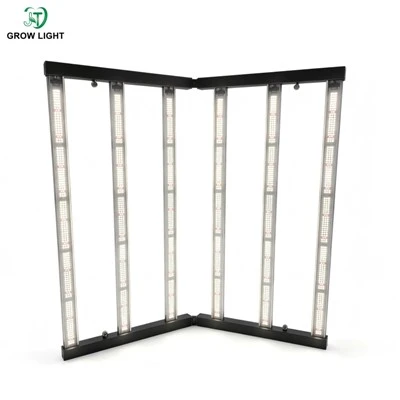
![Trifold Wide Bar LED Grow Light For Flowering Stage]() Trifold Wide Bar LED Grow Light For Flowering StageHighlightsview more
Trifold Wide Bar LED Grow Light For Flowering StageHighlightsview more
1. 9.5cm wide bar, about 50% wider than a standard 6cm bar
2. Custom large chip white light, above the best commercial Samsung diode
3. Independent UV/IR dimming channel
4. 0-10V stepless... -
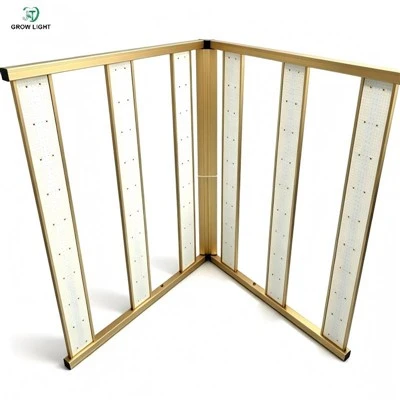
![Elite LED Foldable Grow Light For Commercial Grow Room]() Elite LED Foldable Grow Light For Commercial Grow RoomKey Highlightsview more
Elite LED Foldable Grow Light For Commercial Grow RoomKey Highlightsview more
1. Samsung / Sanan large chip diodes — better heat dissipation, 50,000-hour rated lifespan
2. 180° triple fold frame — collapses flat for shipping, tool-free setup
3. 1 to 4-way dimming with UV/IR... -
![Dual Side Emission Under Canopy Lighting For Commercial Grow Rooms]() Dual Side Emission Under Canopy Lighting For Commercial G...Product Highlightsview more
Dual Side Emission Under Canopy Lighting For Commercial G...Product Highlightsview more
1.Dual side emission — light reaches both faces of the canopy in one pass
2.20–25% yield increase reported by commercial growers
3.Upgrades lower canopy from loose larf/B-grade to dense,... -
![Triple Side Under Canopy LED Light For Full Canopy Penetration]() Triple Side Under Canopy LED Light For Full Canopy Penetr...Product Highlightsview more
Triple Side Under Canopy LED Light For Full Canopy Penetr...Product Highlightsview more
1. Triple side emission — surrounds the plant with light from three directions in a single pass
2. Built for dense, wide canopies and multi-sided planting layouts
3. IP66 waterproof rated for... -
![1100W Wide Bar LED Grow Light For Indoor Plants]() 1100W Wide Bar LED Grow Light For Indoor PlantsWide Bar LED Grow Light Advantageview more
1100W Wide Bar LED Grow Light For Indoor PlantsWide Bar LED Grow Light Advantageview more
1. 12cm wide bars,uniform, stable lighting with broad coverage
2. Large-chip LED beads, high luminous efficacy
3. Full-spectrum output suitable for the seedling stage, vegetative... -
![4x4 indoor Spider LED Grow Light with adjustable full spectrum]() 4x4 indoor Spider LED Grow Light with adjustable full spe...Full spectrum design, suitable for the entire growth stage of plants, UV spectrum makes plants of better quality. The adjustable spectrum function can accurately control light and accelerate better photosynthesis of indoor plants....view more
4x4 indoor Spider LED Grow Light with adjustable full spe...Full spectrum design, suitable for the entire growth stage of plants, UV spectrum makes plants of better quality. The adjustable spectrum function can accurately control light and accelerate better photosynthesis of indoor plants....view more -
![720W LED Grow Light With Single Channel Dimming For Commercial Growing]() 720W LED Grow Light With Single Channel Dimming For Comme...Your First Commercial Grow Room, Without the First-Timer Price Tagview more
720W LED Grow Light With Single Channel Dimming For Comme...Your First Commercial Grow Room, Without the First-Timer Price Tagview more
The 720W LED grow light is where smart growers start — full commercial output, a fraction of the weight, and none of the extra cost you don't need yet.... -
![Quantum Board LED Grow Lights]() Quantum Board LED Grow Lights①Simple structure and good heat dissipation effect.view more
Quantum Board LED Grow Lights①Simple structure and good heat dissipation effect.view more
②Full spectrum+660nm+730nm
③High PPFD Value
④Accept OEM/ODM, suitable for home tent planting -
![240W Quantum Board Grow Lights]() 240W Quantum Board Grow LightsHighlightsview more
240W Quantum Board Grow LightsHighlightsview more
1. 2.9umol/J high efficacy — same efficiency class as our 120W panel, scaled to 700umol/S PPF output
2. Built for 2x4 tents — even canopy coverage without doubling up smaller fixtures
3. Fan-free thermal... -
![4x4ft Trifold LED Grow Light For Flowering Stage]() 4x4ft Trifold LED Grow Light For Flowering StageKey Highlightview more
4x4ft Trifold LED Grow Light For Flowering StageKey Highlightview more
1.Custom large chip diodes — benchmarked against Samsung's 301H EVO
2.Merged UV, IR, and red spectrum channel — one dial for flowering-specific output
3.Reinforced folding hinge — engineering... -
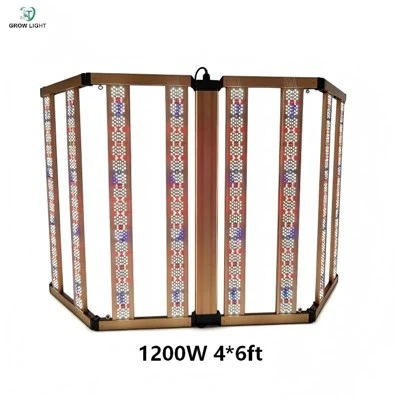
![4x6ft LED Grow Light For Large Flowering Rooms]() 4x6ft LED Grow Light For Large Flowering RoomsKey Highlightview more
4x6ft LED Grow Light For Large Flowering RoomsKey Highlightview more
1. Custom large chip white light — benchmarked against 281BVK, above the best commercial Samsung diode
2. Independent UV/IR dimming channel — separate from main spectrum control
3. 9.5cm wide bar —... -
![1200W Elite LED Grow Light For Large Commercial Grow Rooms]() 1200W Elite LED Grow Light For Large Commercial Grow RoomsKey Highlightsview more
1200W Elite LED Grow Light For Large Commercial Grow RoomsKey Highlightsview more
1. 12-bar extended frame: covers 4x6 ft (1.1m x 1.8m) from a single fixture
2. Custom spectrum tuning: red-to-blue ratio matched to vegetative or flowering stage
3. Daisy chain control: centralized...


LED Grow Lights vs. HPS
Which Is More Cost-Effective for Commercial Cultivation?
HPS isn't dead. There are facilities running it profitably today. But the economics only work when you're not accounting for everything. Here's the full picture — and the number most suppliers hope you don't calculate.
Most growers focus on fixture purchase price. That's the least important number in a 5-year operating model.


Product drawing


| What You're Comparing | LED Grow Lights | HPS 1000W DE | The Real-World Impact |
| Photon efficacy (PPE) | 2.5–3.1 µmol/J | 0.94–1.70 µmol/J | LED delivers up to 2x more plant-usable light per watt |
| Heat load at same PPFD | 20–30% lower | Higher baseline | Smaller HVAC sizing. Lower cooling cost — every month, every year |
| PPFD uniformity | ±10–15% (multi-bar) | ±25–35% typical | Uneven light = uneven yield = lower % sellable product per harvest |
| Spectrum control | Tunable, dimmable, programmable | Fixed yellow-red, no control | LED adapts to growth stage. HPS doesn't. |
| Fixture lifespan | 50,000+ hours | 10,000–20,000 hours | No scheduled relamping. No unplanned downtime during flower. |
| Mounting flexibility | Closer mounting (low radiant heat) | Must maintain distance | LED works in vertical racks, low ceilings, under canopy |
| Day-1 fixture cost | Higher | Lower | HPS wins on purchase price. Nowhere else. |
| 3–5 year total operating cost | Lower in most commercial cases | Higher in most commercial cases | Energy + cooling + relamping closes the gap by month 10–18 |
Still running HPS? Here's what that decision is costing you annually. Representative 5-year cost model — 1,000 m² facility, 18 hours/day, $0.12/kWh:
| Cost Category | HPS System | LED System (2.9 µmol/J avg) | LED Advantage |
| Annual lighting energy | ~$118,000 | ~$72,000 | Save ~$46,000 per year |
| Bulb replacement (18-mo cycle) | ~$16,000/yr | $0 | Full saving — zero relamping |
| HVAC operating cost delta | Baseline | ~20–30% lower demand | Long-term compounding reduction |
| Estimated 5-year operating cost | ~$670,000+ | ~$375,000–410,000 | ~$260,000+ total saving |
| Typical LED payback period | — | 8–18 months | Faster in high-energy-cost markets (CA, Western Europe) |
Calculation basis: 250 fixtures, 18 hr/day, 365 days, $0.12/kWh. Results vary with local energy rate and facility design.
Send us your current setup — fixture count, wattage, energy rate, canopy size. We'll show you exactly what switching to LED costs, what it saves, and when you break even. No obligation. Just the number you need to make the decision.
LED Grow Lights Product Types
Match the Right Fixture to Your Operation
This is where most buyers make their first expensive mistake. Not choosing a bad fixture — choosing the right fixture for the wrong application. A quantum board that outperforms everything in a grow tent will disappoint you in a vertical farm rack. A foldable commercial fixture designed for cannabis LED grow lights flowering rooms is the wrong geometry and wrong intensity for a lettuce tower. Here's how to match correctly.
Choosing the right fixture type matters more than choosing the right brand.
Commercial LED grow lights — for high-intensity indoor cultivation
Commercial LED grow lights in the 240W–1,000W multi-bar foldable format are the current benchmark for high-intensity indoor cultivation across the USA and Europe. Cannabis flowering rooms, high-value crop facilities, multi-room commercial grows. Designed for PPFD targets of 800–1,200 µmol/m²/s with ±10–15% canopy uniformity.
The key advantage over other formats: superior light distribution geometry. More photons on the canopy edges, less wasted on walls. In a 1,000 m² facility, that uniformity difference can mean 5–10% more sellable yield per cycle — without changing anything else. This is what a quality LED grow lights factory engineers into the fixture design — not just raw output, but where the output lands.
→ Full guide: Commercial LED Grow Lights

Greenhouse LED grow lights — supplemental lighting that works with the sun

The right greenhouse LED grow lights don't replace sunlight — they fill the gap when it isn't enough. For commercial greenhouse operations in Northern Europe, Canada, and northern US states, supplemental lighting stabilises DLI during low-light months and enables year-round production scheduling.
Key distinction from indoor fixtures: greenhouse supplemental lights are specified around DLI contribution — typically +100–300 µmol/m²/s — not as full replacement. Oversizing is a common and costly mistake. Working directly with a LED grow lights manufacturer who understands greenhouse system design prevents it.
→ Full guide: Greenhouse LED Grow Lights
Vertical farming LED lighting — engineered for tight spaces and multi-tier systems
Vertical farming LED lighting is a physically different category. When you're running 45–80 cm between shelf tiers, you need bar-format fixtures that sit flat against the shelf underside, deliver uniform light across full shelf width, and generate minimal heat in the tight airspace between tiers.
Leafy greens, herbs, microgreens, and strawberries in vertical systems across the USA and Europe are increasingly the highest-margin CEA operations — because vertical farming LED lighting enables year-round, location-independent production at predictable yield. And because the right wholesale LED grow lights supplier can standardize fixture specs across all rack tiers for consistent system performance.
→ Full guide: Vertical Farming LED Lighting

Under canopy lighting — the yield improvement most growers haven't tried yet

Top lighting, no matter how powerful, cannot penetrate a dense cannabis canopy effectively. The physics of leaf absorption means PPFD at the lower third of the plant may be 60–80% lower than at canopy top — even with a 1,000W LED grow light overhead.
More power at the top won't fix a light distribution problem at the bottom.
Under canopy lighting — 60–150W IP65-rated fixtures installed within the canopy — delivers +150–250 µmol/m²/s directly to the shaded lower zones. Typical result in commercial cannabis facilities: 10–25% more sellable flower per cycle, significant reduction in popcorn bud formation, better batch-to-batch consistency.
→ Full guide: Under Canopy Lighting
Quantum board grow lights — efficient, versatile, accessible
Quantum board grow lights distribute LED chips across a large flat PCB surface, using passive cooling and external drivers. The format is efficient, quiet, and cost-effective for grow tents, smaller commercial operations, and R&D environments.
Honest assessment: quantum board grow lights are excellent up to a certain scale. For large commercial deployments, the mounting geometry and coverage uniformity of multi-bar foldable systems typically outperforms boards. For the right application, a well-built quantum board at 2.6–3.0 µmol/J is hard to beat on value. OEM grow lights programs for quantum boards are available from 1 unit — including custom spectrum and private label.
→ Full guide: Quantum Board Grow Lights

|
Product Type |
Power Range |
PPE |
PPFD Target |
Best For |
|
Commercial foldable |
240W–1,000W |
2.8–3.1 µmol/J |
800–1,200 µmol/m²/s |
Cannabis, high-value indoor, USA/EU commercial |
|
Greenhouse top light |
200W–800W |
2.8–3.1 µmol/J |
+100–300 µmol/m²/s supplemental |
Year-round greenhouse, DLI gap filling |
|
Vertical farming bar |
18W–80W/bar |
2.8–3.0 µmol/J |
200–350 µmol/m²/s |
Leafy greens, herbs, multi-tier CEA |
|
Under canopy (IP65) |
60W–150W |
2.5–2.8 µmol/J |
+150–250 µmol/m²/s |
Cannabis lower canopy activation |
|
Quantum board |
100W–600W |
2.6–3.0 µmol/J |
200–900 µmol/m²/s |
Grow tents, small commercial, R&D |
Applications of LED Grow Lights

Indoor Commercial Cultivation
Fully controlled indoor grows where LED replaces sunlight entirely. High PPFD output, uniform canopy coverage, and 0–10V dimming control support stable yields and consistent crop quality across continuous cycles. Typical PPFD target: 800–1200 µmol/m²/s (crop-dependent)

Greenhouse Supplemental Lighting
Supports crop production when natural sunlight is insufficient — during low-light winter months, early morning and evening extension, and in high-latitude growing regions. Stabilizes production seasonally and extends daily light integral (DLI).

Vertical Farming Systems
Multi-layer growing systems for leafy greens, herbs, and propagation. Low heat output and uniform bar-style distribution allow high-density production in tight inter-shelf spacing, enabling year-round output in limited footprint. Typical PPFD target: 200–350 µmol/m²/s

Under Canopy Lighting
Installed below the main canopy to reach shaded lower zones. Particularly effective in cannabis cultivation for activating lower bud sites, reducing "popcorn bud" formation, and increasing total sellable flower weight without increasing top-light intensity or heat. Supplemental PPFD contribution: +150–250 µmol/m²/s

Tissue Culture & Propagation
Controlled, low-intensity lighting for early-stage plant development. Provides stable, uniform illumination that promotes compact root and shoot development with minimized etiolation risk. Typical PPFD target: 50–120 µmol/m²/s

Home Growing & Grow Tents
Compact, energy-efficient solutions for personal cultivation. Easy installation, full-spectrum output, and adaptable mounting make quantum board options well-suited for limited indoor spaces.
Crop-Specific Light Parameters
Matching LED grow light configuration to crop requirements requires understanding four interdependent parameters: PPFD, DLI, spectrum, and CO₂ enrichment response. The table below consolidates established horticultural science benchmarks for commercial crops.
|
Crop |
PPFD (µmol/m²/s) |
DLI (mol/m²/day) |
Recommended Spectrum |
CO₂ Enrichment Response |
|
Cannabis – Veg |
400–600 |
20–30 |
Blue-dominant (R:B ~2:1) |
Moderate benefit at 800–1000 ppm |
|
Cannabis – Flower |
900–1,200 |
40–65 |
Full spectrum, R:B ~4:1 + far-red |
High benefit at 1,000–1,500 ppm |
|
Lettuce / Baby Greens |
200–350 |
12–17 |
Blue-enhanced broad spectrum |
Moderate at 800–1,200 ppm |
|
Tomato (Greenhouse) |
400–600 (supplemental) |
20–30 |
Broad spectrum, red-dominant |
Strong benefit at 1,000–1,200 ppm |
|
Basil / Herbs |
250–400 |
14–20 |
Full spectrum |
Moderate at 800–1,000 ppm |
|
Strawberry |
300–500 |
15–25 |
Red-dominant with blue |
Moderate at 800–1,000 ppm |
|
Tissue Culture |
50–120 |
4–8 |
Blue-dominant, low intensity |
Not typically enriched |
|
Propagation / Seedling |
100–200 |
6–12 |
Balanced, gentle spectrum |
Not typically enriched |
Sources: Utah State University Crop Physiology Lab (Bugbee et al.); Wageningen University & Research horticultural lighting studies; Cornell University CEA program; USDA AMS CEA Guidance Documents.
PPFD, PPE, DLI, and Spectrum
The Four Numbers That Separate Good Decisions from Expensive Ones
Walk into any grow lighting conversation with these four metrics and you'll immediately know whether a supplier is giving you real data or impressive-looking fiction. Most buyers never ask for all four — which is exactly how they end up with a system that underperforms.
Most growers think they need more power. What they actually need is better distribution and verified efficiency data.
1. PPFD — what your plants are actually receiving
PPFD (Photosynthetic Photon Flux Density), measured in µmol/m²/s, counts the photosynthetically active photons landing on one square meter of canopy per second. This is the performance metric. Everything else — wattage, lumens, even beam angle — is secondary.
Two fixtures at identical wattage can deliver completely different PPFD at canopy level. Don't accept PPFD data taken at the manufacturer's reference distance. Ask for the number at your actual mounting height and spacing. That's where it matters. A fixture that looks impressive at 30 cm may be completely wrong for your 60 cm mounting distance.
This is where most suppliers mislead buyers: PPFD figures are often measured at the fixture's most flattering distance, not your operating distance. Always request PPFD maps at your actual setup height — and verify center vs. edge variation. A ±35% variation across the coverage area means your edge plants are operating at half the intensity of your center plants.
2. PPE — your energy bill in a single number
PPE (Photon Efficacy), measured in µmol/J, tells you how many usable photons you get per joule of electricity. This is the efficiency metric that drives your operating cost per gram of yield. Here's a comparison that surprises most buyers:
|
Fixture |
Wattage |
PPE |
Total µmol/s |
Annual energy cost (18hr, $0.12) |
|
Budget LED |
800W |
2.0 µmol/J |
1,600 µmol/s |
~$630/yr per fixture |
|
Mid-range LED |
600W |
2.6 µmol/J |
1,560 µmol/s |
~$473/yr per fixture |
|
High-performance LED |
640W |
3.0 µmol/J |
1,920 µmol/s |
~$505/yr per fixture |
|
HPS 1000W DE |
1,000W |
1.6 µmol/J |
1,600 µmol/s |
~$788/yr per fixture |
The high-performance LED delivers 20% more usable light than the budget LED — while consuming 20% less electricity. In a 200-fixture facility, that PPE difference compounds to $25,000+ per year in energy costs. Over five years, that's $125,000 — from one spec line on a data sheet most buyers skip.
This is something most suppliers won't highlight: a cheaper fixture with lower PPE often costs more to operate than a premium fixture within 18 months.
3. DLI — the number that governs growth rate across a full day
DLI (Daily Light Integral), measured in mol/m²/day, is total photon delivery over a full photoperiod. Formula: PPFD × hours × 0.0036. For greenhouse LED grow lights in low-light regions, DLI gap calculation is the mandatory starting point for any supplemental lighting specification. For indoor grows, DLI is the number you manage through photoperiod design — not just fixture selection.
4. Spectrum — not all light recipes perform equally
The right spectrum depends on your crop and growth stage. Full spectrum LED grow lights cover most applications, but targeted configurations — higher blue for vegetative stage, red-dominant for flowering, far-red for photoperiod manipulation — measurably improve specific crop outcomes when matched to crop protocols.
The right spectrum doesn't just drive yield — it affects crop quality. In cannabis, far-red and UV protocols influence terpene and cannabinoid expression. In strawberries and herbs, spectrum tuning can measurably improve Brix content and aroma profile. This is why custom spectrum matters beyond PPFD targets.
|
Wavelength |
Range |
Plant Response |
Commercial Application |
|
Blue |
400–500 nm |
Compact internodes, stomatal control, root development |
Veg stage, seedlings, tissue culture, propagation |
|
Green |
500–600 nm |
Deeper canopy penetration, secondary photosystems |
Full-spectrum balance, canopy depth optimization |
|
Red |
600–700 nm |
Peak photosynthesis, flowering trigger, biomass |
Flower/fruit stage, yield maximization |
|
Far-Red |
700–800 nm |
Emerson enhancement effect, photoperiod response |
Accelerated flowering, lower canopy penetration |
Custom spectrum configuration is available on our products — from standard fixed-ratio to multi-channel adjustable designs. Whether you're growing LED grow lights for cannabis across a full veg-to-flower cycle or running a mixed-crop greenhouse, we match spectrum to your protocol.
How to Evaluate Any LED Grow Light Before You Find Out the Hard Way
The lighting market has a problem. It's easy to make numbers look impressive on a spec sheet. A fixture listed at "1,500 µmol/m²/s" might deliver that — at the dead center, at 30 cm, in a lab. Your canopy is not a lab. Here's a practical evaluation framework that separates reliable products from expensive disappointments.
The most costly mistakes in commercial lighting aren't made during installation. They're made during procurement, when the wrong questions get skipped.
1. Verify PPE at system level — not chip level
LED chip manufacturers publish efficacy data for the chip in isolation, at controlled lab temperatures. System-level PPE — what the full fixture delivers at real operating temperatures with real driver losses — is always lower. The gap can be 10–20%.
If a LED grow lights supplier can only show you chip spec sheets: that's your answer. A quality LED grow lights manufacturer has system-level data available without hesitation.
2. Ask for PPFD maps at your actual mounting height
Request PPFD distribution maps at your mounting height — not the manufacturer's reference distance. For commercial LED grow lights in cannabis applications, verify uniformity across the full 4×4 or 5×5 ft footprint. Target: ±15% maximum variation. Anything wider means uneven canopy development and inconsistent yield across the room.
A ±35% PPFD variation doesn't mean some plants get a little less light. It means your edge plants are running at half the intensity of your center plants — every hour of every cycle.
3. Check control system compatibility
At commercial scale, precision control matters. A proper grow light system supports: exact photoperiod switching (a 15-minute dark period error stresses flowering cannabis), 0–10V dimming for stage-by-stage intensity adjustment, zone control for multi-room operations running different crops, and environmental integration — when light intensity changes, HVAC and CO₂ targets should respond automatically.
All our dimmable LED grow lights support 0–10V dimming and third-party controller integration as standard. We also provide full grow room control system design — airflow, HVAC integration, CO₂ scheduling — as part of project support, because the fixture alone doesn't determine your outcome. The system does.
4. Factor total system cost — not fixture price
Fixture purchase price is one line item. The full picture includes: energy cost over system lifetime (PPE drives this entirely), HVAC load reduction vs. your current setup, DLC rebate eligibility that can offset 20–40% of capital cost, and maintenance cost over a 5–7 year cycle. A fixture that costs 15% more but delivers 0.3 µmol/J better PPE typically pays back that premium within 12–18 months at commercial scale.
Send us your layout — we'll show you exactly where your current setup is losing yield. PPFD map at your mounting height, system-level PPE data, certification documentation, and a sample unit if you want to test before you commit. No purchase required to access any of this.
LED Grow Lights Certifications
What You Need for USA and Europe
This section costs growers real money when they skip it. Certification gaps have disqualified facilities from rebate programs worth $30,000–50,000. They've blocked insurance approvals. They've stalled building permits. Know what you need before you order — not after.
A fixture that isn't DLC listed in the USA could be costing you $30–150 per fixture in unclaimed rebates right now.
|
Market |
Certification |
What It Covers |
Why It's Non-Negotiable |
|
USA |
ETL or UL Listed |
Electrical safety |
Required for commercial facility insurance and building permits in most US states |
|
USA |
DLC Horticultural Listed |
Verified energy performance |
Required to qualify for utility rebates — $30–150/fixture in CA, CO, MI, IL and other states |
|
USA |
FCC |
Radio frequency / EMI compliance |
Required for dimmable/wireless control systems — often overlooked, always enforced |
|
EU / UK |
CE + RoHS |
Safety, EMC, hazardous materials |
Legal requirement for import and sale across EU and UK markets. No CE = no legal installation. |
|
All markets |
IP65 minimum |
Dust and water ingress protection |
Mandatory for greenhouse, under-canopy, and any wet environment. IP66 for active irrigation zones. |
What our products carry as standard — not as upgrades
Every LED grow light from our LED grow lights factory is certified to ETL, CE, DLC, RoHS, and IP65 as standard. IP66 variants available across the range. OEM grow lights, and private label programs include full certification documentation under your brand — ETL, CE, and DLC under your company name, with all paperwork prepared in parallel with production.

FCC

RoHS

CE

EMC

IP66

CE
Sourcing Our LED Grow Lights Direct
Wholesale, OEM, and Factory Pricing
At JT Grow Light, we see this happen all the time. Most buyers in the LED grow lights wholesale market are paying for 2–3 layers of distribution margin without knowing it. Understanding where you sit in the supply chain — and what it costs — is the first step to buying smarter.
The difference between factory-direct and end-distributor pricing on LED grow lights typically runs 20–35%. On a $200,000 lighting project, that's $40,000–70,000.
Factory direct vs distributor
As a direct LED grow lights factory, JT Grow Light operates at the base of the cost stack. Every layer between the factory and buyer adds margin — regional distributor, local reseller, online marketplace. For commercial projects and distribution businesses, going direct means not just better pricing, but direct access to engineering support, visible production scheduling, and the ability to change specifications before manufacturing — not after delivery.

Bulk and wholesale orders
For bulk LED grow lights orders — single large facilities or distribution programs — standard product lead time is 10–15 days. At JT Grow Light, we support wholesale LED grow lights programs for distributors in the USA, Europe, and other markets, with stable production capacity (8,000–12,000 units/month, 4 in-house production lines) and 100% in-house testing before shipment.

OEM and custom LED grow lights
One thing many buyers are surprised by when working with JT Grow Light: OEM LED grow lights and custom configurations require large minimum orders. They don't — at least not with us.
Custom LED grow lights are available from 1 unit, including:
Custom spectrum configuration
Private label branding
Custom power range and driver integration
Market-specific certification packages
Custom packaging and accessories

LED grow lights for cannabis
Commercial LED grow lights for cannabis in licensed USA facilities require the same ETL/DLC certifications as any commercial horticultural lighting. In emerging European cannabis markets, CE marking applies. What changes is the specification: PPFD targets of 900–1,200 µmol/m²/s for flowering, thermal management requirements for dense canopy environments, and control system integration for precise photoperiod management.
At JT Grow Light, we supply commercial LED grow lights to licensed cannabis operations in the USA and Europe. If you have specific compliance requirements for your facility license type, share them — we'll confirm compatibility and provide the documentation your compliance team needs.

Building a distribution program or sourcing for a large project? Tell us your target volume, market, and any OEM requirements. We'll respond with pricing, lead time, and certification documentation within 24 hours.
LED Grow Lights Projects

Indoor Cannabis Facility (USA)
This project was a mid- to large-scale indoor cannabis cultivation facility (~2,500–3,000 m² canopy area). The client originally used HPS lighting and faced serious heat and uneven growth issues.
Lighting Configuration
- Lighting: 800W Commercial LED Grow Lights
- PPE: ~2.8–3.0 µmol/J
- Target PPFD: 900–1200 µmol/m²/s
- Layout: 4×4 coverage
- Control: 0–10V dimming
Note: PPFD (Photosynthetic Photon Flux Density) measures actual usable light reaching plants, not just output
Problems We Solved
- Severe heat load from HPS → HVAC overload
- Poor PPFD uniformity → uneven canopy
- High electricity cost per gram
|
Parameter |
Before (HPS) |
After (LED) |
|
Light Efficiency |
~1.5 µmol/J |
2.8–3.0 µmol/J |
|
Canopy Uniformity |
±35% variation |
±10–15% |
|
Energy Consumption |
100% baseline |
↓ 35–45% |
|
Yield Consistency |
unstable batches |
stable multi-cycle output |
Vertical Farm (CA)
Project Background: A Canada vertical farm focused on leafy greens (lettuce, herbs), operating in a fully controlled environment agriculture (CEA) system.
System Design
- Lighting: T8 Vertical Farming LED Lighting
- Mounting: integrated into multi-layer racks
- PPFD: 200–350 µmol/m²/s (leafy greens range)
- Photoperiod: 16–18 hours
Problems We Solved
- Light blocking between layers
- Uneven growth across shelves
- Low space utilization
|
Parameter |
Before |
After |
|
Yield per m² |
baseline |
↑ 30–50% |
|
Shelf Uniformity |
inconsistent |
highly uniform |
|
Labor Efficiency |
manual adjustment |
standardized cycles |
|
Energy Cost per kg |
high |
optimized |


Tissue Culture Lab (Asia)
A plant tissue culture lab producing micropropagated seedlings. The main issue was plant elongation and inconsistent batch quality.
Lighting Setup
- Lighting: 18W / 4ft LED tube grow lights
- Spectrum: full spectrum (blue + red optimized)
- PPFD: 50–120 µmol/m²/s
- Distance to canopy: 20–30 cm
Scientific Insight
- Blue light (400–500nm) → controls compact growth
- Red light (600–700nm) → drives biomass and elongation
Imbalance leads to stretching (etiolation)
|
Issue |
Before |
After |
|
Plant Height |
elongated |
compact |
|
Batch Consistency |
unstable |
standardized |
|
Survival Rate |
lower |
↑ 15–25% |
|
Labor Cost |
high (handling fragile plants) |
reduced |
Under Canopy Lighting(USA)
Supplemental lighting for Under canopy optimization
- Lighting: Under canopy lighting (IP65)
- Power: 120W per unit
- Beam angle: 120°
- Mounting: installed between rows, below main canopy
- Supplemental PPFD: +150–250 µmol/m²/s (under canopy zone)
What We Did
Instead of increasing top light power (which increases heat and cost),
we added under-canopy lighting to target the shaded zone directly
This created a multi-layer lighting structure:
- Top lights → drive overall growth
- Under canopy lights → activate lower bud sites
Result
- Lower canopy PPFD increased by ~40–60%
- More uniform bud development across the plant
- Yield improvement: +10–20% (more sellable flowers)
- Reduced “popcorn buds” → higher-grade output

FAQ
Q: What are the best commercial LED grow lights?
A: There's no single best fixture — the right choice depends on your crop, PPFD target, canopy geometry, and growing system. In practice, a quality commercial LED grow light meets three criteria: system-level PPE ≥2.8 µmol/J, PPFD uniformity ±15% or better, and the right physical format for your setup. For cannabis flowering, a multi-bar foldable in the 640–1,000W range is the current standard. For vertical farms, a bar-format IP65 fixture is a different category entirely.
Q: How much can I save by switching from HPS to LED grow lights?
A: Most commercial facilities see 30–50% lower lighting energy consumption. Factor in reduced HVAC load and zero bulb replacement cost, and the 5-year operating cost saving typically exceeds the LED capital investment significantly. In high-energy-cost markets — California, Western Europe — payback periods of 8–12 months are common.
Q: What PPFD do I need for cannabis growing?
A: For LED grow lights for cannabis: veg stage 400–600 µmol/m²/s; flowering 900–1,200 µmol/m²/s. At higher PPFD levels, CO₂ enrichment to 1,000–1,500 ppm is recommended to prevent light saturation limiting photosynthesis. DLI target for flowering: 40–65 mol/m²/day.
Q: Can I get custom spectrum or OEM LED grow lights?
A: Yes — from 1 unit. Custom spectrum, private label branding, custom power configurations, and market-specific certifications (ETL, CE, DLC under your brand) available on any order size. Lead time: 20–25 days.
Q: How much can I save with LED grow lights?
A: Most commercial growers see:
- 30–50% lower energy use
- Reduced HVAC cost
- No bulb replacement
Payback is often around 8–14 months.
Q: What is the minimum order for LED grow lights wholesale?
A: No minimum for standard products. For wholesale LED grow lights programs with volume pricing tiers, contact us with your target quantity and market — we'll provide tiered pricing and lead time confirmation.
Q: What PPE should I look for in a commercial LED grow light?
A: For new commercial installations in 2025: ≥2.8 µmol/J system-level efficacy is the minimum for commercial viability. High-performance systems reach 2.8–3.1 µmol/J. Always verify at fixture level — not chip level. The gap between chip PPE and system PPE can be 10–20%.
Q: What are typical lead times?
A: Standard products: 10–15 days. Custom LED grow lights and OEM/private label: 20–25 days. For large-volume projects, earlier order confirmation allows production scheduling aligned to your facility timeline.
Q: What certifications should LED grow lights have?
A: For commercial use:
- US: ETL / UL / DLC
- EU: CE / RoHS
- High humidity: IP65
Certifications may also affect rebates and compliance.
Q: What type of LED grow light should I choose?
A: It depends on your system:
- Multi-bar → indoor commercial grows
- Linear → vertical racks
- Under canopy → dense crops
- Quantum board → small setups
Q: Can you help design a lighting system for my project?
A: Yes. If you share your layout and crop details, we can help you:
- Calculate PPFD requirements
- Design lighting layout
- Estimate ROI
- Optimize system performance
This is usually where the biggest gains come from.
Your Next Step Takes Less Than 2 Minutes
You now have the framework. Here's what separates growers who act on it from those who sit on it for another 12 months:
PPE ≥2.8 µmol/J system-level — verified, not claimed
Uniformity ±15% or better — because averages don't grow crops, minimums do
ETL + DLC + CE + RoHS + IP65 — standard on every fixture we make
Custom and OEM from 1 unit — 20–25 day lead time, full certification under your brand
Wholesale programs for USA and Europe — 10–15 day standard lead time, 8,000–12,000 units/month capacity
We invest continuously in LED chip and driver technology — which means our product range updates as the technology improves, and our customers have access to the latest efficacy benchmarks without switching suppliers.
|
Tell us your canopy size, crop type, target PPFD, and location. We'll send you a complete photometric layout — PPFD distribution map, fixture count, energy model, and certification documentation for your market — within 24 hours. Not a quote. A layout. The data you need to make the right decision before you spend a dollar. |
Want to go deeper on a specific product category first? Start here:
→ Commercial LED Grow Lights — high-intensity indoor cannabis and crop facilities
→ Greenhouse LED Grow Lights — year-round supplemental lighting solutions
→ Vertical Farming LED Lighting — multi-tier CEA systems
→ Under Canopy Lighting — yield improvement for dense canopy crops
→ Quantum Board Grow Lights — grow tents, small commercial, R&D
We're well-known as one of the leading LED grow lights manufacturers and suppliers in China. Please rest assured to buy cheap LED grow lights for sale here from our factory. Contact us for customized service and discount information.