Commercial LED Grow Lights
The Buyer's Guide for Cultivators
You're not buying a light for a grow tent. You're specifying a lighting system for a facility - one where a wrong decision doesn't just cost you a fixture, it costs you months of underperforming yield, inflated energy bills, and a canopy that never quite hits the numbers you planned for.
This is written for commercial growers, facility managers, and wholesale LED grow lights buyers who need to get the specification right the first time. We'll cover what separates a genuine commercial LED grow light from a consumer product dressed up in commercial language, how to match foldable LED grow lights and modular LED grow lights to different room layouts, what wattage and coverage specs actually mean at canopy level, and how to source direct from a commercial LED grow lights manufacturer without paying distributor markups.
Already know your room size and crop? Jump to Section 6 - tell us your canopy dimensions, target PPFD, and fixture budget. We'll send you a complete room layout with PPFD distribution maps within 24 hours.
-
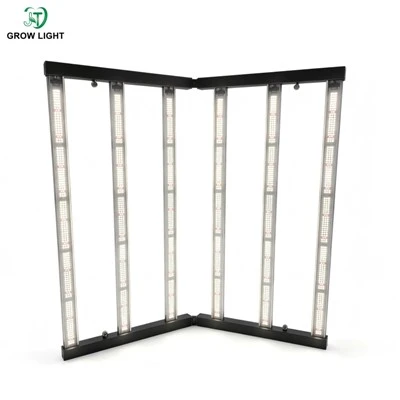
![Trifold Wide Bar LED Grow Light For Flowering Stage]() Trifold Wide Bar LED Grow Light For Flowering StageHighlightsview more
Trifold Wide Bar LED Grow Light For Flowering StageHighlightsview more
1. 9.5cm wide bar, about 50% wider than a standard 6cm bar
2. Custom large chip white light, above the best commercial Samsung diode
3. Independent UV/IR dimming channel
4. 0-10V stepless... -
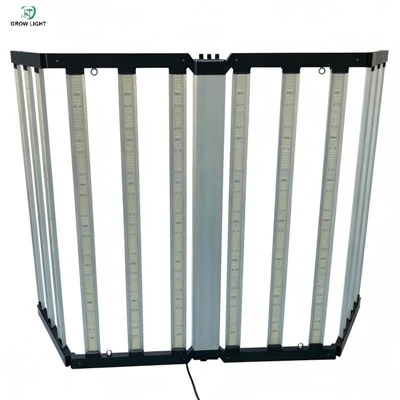
![Elite LED Foldable Grow Light For Commercial Grow Room]() Elite LED Foldable Grow Light For Commercial Grow RoomKey Highlightsview more
Elite LED Foldable Grow Light For Commercial Grow RoomKey Highlightsview more
1. Samsung / Sanan large chip diodes — better heat dissipation, 50,000-hour rated lifespan
2. 180° triple fold frame — collapses flat for shipping, tool-free setup
3. 1 to 4-way dimming with UV/IR... -
![1100W Wide Bar LED Grow Light For Indoor Plants]() 1100W Wide Bar LED Grow Light For Indoor PlantsWide Bar LED Grow Light Advantageview more
1100W Wide Bar LED Grow Light For Indoor PlantsWide Bar LED Grow Light Advantageview more
1. Uniform, stable lighting with broad coverage
2. Full-spectrum output suitable for the seedling stage, vegetative growth, and flowering
3. Dual-channel dimming for precise... -
![4x4 indoor Spider LED Grow Light with adjustable full spectrum]() 4x4 indoor Spider LED Grow Light with adjustable full spe...Full spectrum design, suitable for the entire growth stage of plants, UV spectrum makes plants of better quality. The adjustable spectrum function can accurately control light and accelerate better photosynthesis of indoor plants....view more
4x4 indoor Spider LED Grow Light with adjustable full spe...Full spectrum design, suitable for the entire growth stage of plants, UV spectrum makes plants of better quality. The adjustable spectrum function can accurately control light and accelerate better photosynthesis of indoor plants....view more -
![720W LED Grow Light With Single Channel Dimming For Commercial Growing]() 720W LED Grow Light With Single Channel Dimming For Comme...Your First Commercial Grow Room, Without the First-Timer Price Tagview more
720W LED Grow Light With Single Channel Dimming For Comme...Your First Commercial Grow Room, Without the First-Timer Price Tagview more
The 720W LED grow light is where smart growers start — full commercial output, a fraction of the weight, and none of the extra cost you don't need yet.... -
![4x4ft Trifold LED Grow Light For Flowering Stage]() 4x4ft Trifold LED Grow Light For Flowering StageKey Highlightview more
4x4ft Trifold LED Grow Light For Flowering StageKey Highlightview more
1.Custom large chip diodes — benchmarked against Samsung's 301H EVO
2.Merged UV, IR, and red spectrum channel — one dial for flowering-specific output
3.Reinforced folding hinge — engineering... -
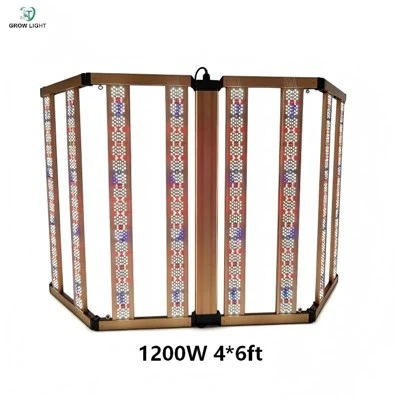
![4x6ft LED Grow Light For Large Flowering Rooms]() 4x6ft LED Grow Light For Large Flowering RoomsKey Highlightview more
4x6ft LED Grow Light For Large Flowering RoomsKey Highlightview more
1. Custom large chip white light — benchmarked against 281BVK, above the best commercial Samsung diode
2. Independent UV/IR dimming channel — separate from main spectrum control
3. 9.5cm wide bar —... -
![1200W Elite LED Grow Light For Large Commercial Grow Rooms]() 1200W Elite LED Grow Light For Large Commercial Grow RoomsKey Highlightsview more
1200W Elite LED Grow Light For Large Commercial Grow RoomsKey Highlightsview more
1. 12-bar extended frame: covers 4x6 ft (1.1m x 1.8m) from a single fixture
2. Custom spectrum tuning: red-to-blue ratio matched to vegetative or flowering stage
3. Daisy chain control: centralized... -
![780W LED Grow Light With 2 Channel Dimming For Flexible Spectrum Control]() 780W LED Grow Light With 2 Channel Dimming For Flexible S...The 780W LED grow light gives you everything the 720W does, plus the one thing serious growers ask for next: independent control over your spectrum without spending more on wattage.view more
780W LED Grow Light With 2 Channel Dimming For Flexible S...The 780W LED grow light gives you everything the 720W does, plus the one thing serious growers ask for next: independent control over your spectrum without spending more on wattage.view more
1) 2 independent dimming channels — run more... -
![Wide-panel LED Grow Lights With High Power For Grow Room]() Wide-panel LED Grow Lights With High Power For Grow RoomDiscover wide-panel LED grow lamps with high power and uniform coverage. Perfect LED grow light for grow rooms, offering full spectrum, UV & IR options.view more
Wide-panel LED Grow Lights With High Power For Grow RoomDiscover wide-panel LED grow lamps with high power and uniform coverage. Perfect LED grow light for grow rooms, offering full spectrum, UV & IR options.view more -
![High-Efficiency Folding LED Grow Lights For Commercial Farming]() High-Efficiency Folding LED Grow Lights For Commercial Fa...High-efficiency 1500W folding LED grow lights provide uniform, high-intensity light for commercial indoor farming. Reliable, energy-saving, and easy to install for consistent plant growth.view more
High-Efficiency Folding LED Grow Lights For Commercial Fa...High-efficiency 1500W folding LED grow lights provide uniform, high-intensity light for commercial indoor farming. Reliable, energy-saving, and easy to install for consistent plant growth.view more -
![6 Wide Bar Foldable LED Grow Lights With Full Spectrum]() 6 Wide Bar Foldable LED Grow Lights With Full SpectrumDiscover high-efficiency 6 wide bar foldable LED grow lights with full spectrum. 1200W & 1300W models deliver up to 3750 μmol/s, ideal for commercial cannabis cultivation, greenhouses, and indoor farms.view more
6 Wide Bar Foldable LED Grow Lights With Full SpectrumDiscover high-efficiency 6 wide bar foldable LED grow lights with full spectrum. 1200W & 1300W models deliver up to 3750 μmol/s, ideal for commercial cannabis cultivation, greenhouses, and indoor farms.view more


What Actually Makes a "Commercial" LED Grow Light - And Why It Matters
Walk through any trade show and you'll see the word "commercial" on everything from a 100W grow tent fixture to a 1,200W multi-bar system. The label means nothing on its own. What actually separates a professional LED grow light built for commercial cultivation from everything else comes down to four things that spec sheets often obscure.
Most 'commercial' fixtures are consumer products with a bigger number on the box. Here's how to tell the difference.
1. Uniformity - the metric that determines what percentage of your canopy performs
A high PPFD LED grow light that delivers 1,400 µmol/m²/s at the centre, but only 700 µmol/m²/s at the edges, isn't a commercial fixture - it's a spotlight. Real commercial performance means ±10–15% variation in PPFD across the entire rated coverage area. That uniformity translates directly into what percentage of your canopy reaches target intensity, and what percentage underperforms.
In a 1,000 m² facility, the difference between ±15% and ±35% uniformity is not an academic distinction. It's 5–10% more sellable yield per cycle - from the same electricity, the same fixtures, just better light distribution geometry.
2. L90 lifespan - not just "50,000 hours"
Every long lifespan LED grow light on the market claims 50,000 hours. The number that actually matters is L90 - the point at which output drops to 90% of initial. A fixture rated at 50,000 hours L70 (70% output remaining) is not the same as one rated 50,000 hours L90. At L70, your PPFD targets have drifted 30% before you've noticed a problem. Specify L90 for commercial installations. Any serious commercial LED grow lights manufacturer will have this data available.
3. System integration - a commercial fixture has to talk to the room
Consumer grow lights turn on and off. Commercial LED grow lights integrate. That means 0–10V dimming for stage-by-stage intensity management, zone control for multi-room facilities running different crops or growth stages, and environmental coordination - when your lighting intensity changes, your HVAC and CO₂ system should respond automatically. If a fixture doesn't support these integrations, it's not built for commercial cultivation regardless of its wattage.
4. Thermal design - because heat is money
High output LED grow lights generate heat. The question is where. Consumer fixtures dump heat into the room. Well-engineered commercial LED grow lights manage heat through the fixture itself - aluminum heat sink design, passive or active thermal management - keeping junction temperatures low enough to maintain L90 lifespan and reducing the radiant heat load on your HVAC system. In a sealed room running 18 hours a day, this is not a minor detail. It's a facility operating cost variable.
Commercial lighting is a system decision, not a fixture decision. How your fixtures interact with your room's airflow, HVAC capacity, CO₂ delivery, and rack layout determines your actual yield outcome. At JT Grow Light, we design commercial lighting systems together with these variables - not in isolation.That's why our customers don't run into uniformity problems six months after installation.
Foldable vs Modular LED Grow Lights
Which One Is Right for Your Grow Room?
This is the question we get most often from commercial buyers - and the answer matters more than most people realise. Foldable LED grow lights and modular LED grow lights are both multi-bar formats, but they behave differently in different room configurations. Picking the wrong one doesn't mean the lights don't work. It means you leave yield on the table.
This is where most commercial buyers make a decision they later regret. Not because one format is better - but because the wrong format for the room costs you uniformity you can never get back.
Foldable LED grow lights
The standard for fixed-layout commercial rooms
Foldable LED grow lights use multiple LED bars arranged on a folding frame that opens to a fixed width - typically covering a 4×4 ft or 5×5 ft footprint per fixture. The integrated frame keeps bar spacing and geometry consistent across every unit, which is exactly what you want in a fixed-layout commercial room where every fixture covers the same canopy area.
The advantages are real: faster installation (unfold, hang, connect), consistent bar-to-bar spacing optimised by the manufacturer for uniformity, and a lower per-fixture cost than fully modular systems. For cannabis LED grow lights rooms with standard 4×4 or 5×5 canopy layouts, foldable LED grow lights are the default choice for a reason.

Modular LED grow lights
When your room doesn't fit a standard template
Modular LED grow lights - called detachable LED grow lights(or Spider LED grow lights) - use independently connected bar units that can be arranged in any configuration. Instead of a fixed frame, each bar is positioned and connected individually, which means you can spec the exact coverage geometry your room requires.
The flexibility comes at a cost: installation takes longer, and uniformity depends on getting the bar spacing right during installation rather than relying on factory geometry. For facilities with non-standard room dimensions, retrofit projects, or R&D environments where layouts change frequently, modular LED grow lights are worth the additional setup complexity.

|
Foldable LED Grow Lights |
Modular LED Grow Lights |
|
|
Coverage footprint |
Fixed (4×4, 5×5 ft standard) |
Fully configurable to any dimension |
|
Installation speed |
Faster - unfold and hang |
Slower - each bar positioned individually |
|
Uniformity consistency |
Factory-optimised bar spacing |
Depends on installer configuration |
|
Best for |
Standard fixed-layout commercial rooms |
Custom dimensions, non-standard layouts, retrofit projects |
|
Per-fixture cost |
Lower |
Higher (more configuration flexibility) |
|
Maintenance |
Full fixture replacement if needed |
Individual bar replacement - lower downtime risk |
|
Typical application |
Cannabis flowering rooms, veg rooms, multi-room commercial facilities |
Large custom facilities, R&D rooms, retrofit to existing structures |
This is exactly the kind of mistake we help commercial growers avoid at JT Grow Light - before it becomes a costly problem after installation.
Not sure which format fits your room? Send us your room dimensions and row layout - we'll specify the right fixture format, hanging height, and spacing to hit your PPFD target with ±15% uniformity or better. No charge for the layout.
Specification of Our commercial LED grow lights
|
Product Style |
Foldable LED grow lights |
Modular LED grow lights |
|
Wattage |
240/320/480/600/640/720/800/1000/1200/1500 |
240/480/680/860/1060/1260 |
|
Full Spectrum |
Full spectrum+660nm+730nm (Customized) |
Full spectrum+360nm+660nm+730nm (Customized) |
|
Light Source |
Samsung 281B/301B/301H/301H EVO |
Samsung 281B/301B/301H/301H EVO |
|
PPE |
2.8~3.2 umol/J |
2.8~3.2 umol/J |
|
PPFD Uniformity |
≥ 0.85 |
≥ 0.85 |
|
PF |
≥0.95 |
≥0.95 |
|
Beam angle |
120° |
120° |
|
ROI |
Energy saving vs HPS: up to 40–50% |
Energy saving vs HPS: up to 40–50% |
|
Coverage |
2x4ft 4x4ft 5x5ft 6x6ft |
2x4ft 4x4ft 5x5ft 6x6ft |
|
Support Dimmer |
0–10V dimming |
0–10V dimming |
|
IP Rating |
IP65 |
IP65 |
|
Lifespan (hours) |
>50000 |
>50000 |
|
Working Time (hours) |
>50000 |
>50000 |
|
Product Weight(kg) |
10~25 |
10~25 |
|
Input Voltage(V) |
AC110-277/50/60Hz |
AC110-277/50/60Hz |
|
Working Temperature(℃) |
-20°C~+45°C |
-20°~+45°C |
|
Lamp Body Material |
Aluminum Alloy |
Aluminum Alloy |
|
Color Rendering Index(Ra) |
90 |
90 |
|
Cooling method |
passive cooling |
passive cooling |
|
Mounting Height |
≥ 6" (15.2cm) Above canopy |
≥ 6" (15.2cm) Above canopy |
|
Customization |
OEM & ODM |
OEM & ODM |
|
Certification |
CE FC HoHS |
CE FC HoHS |
|
Warranty(Year) |
5-Year |
5-Year |
|
Application |
Indoor, vertical farming,Tent, Cannabis cultivation |
Indoor, vertical farming, Grow tent, Cannabis cultivation |
Where Commercial LED Grow Lights Are Actually Used
When people search for commercial LED grow lights, they usually expect a short answer: cannabis, vertical farms, indoor plants. But the more important question is: what happens if you choose the wrong lighting structure for your specific application?
Indoor Cannabis Cultivation - The Canopy Uniformity Problem
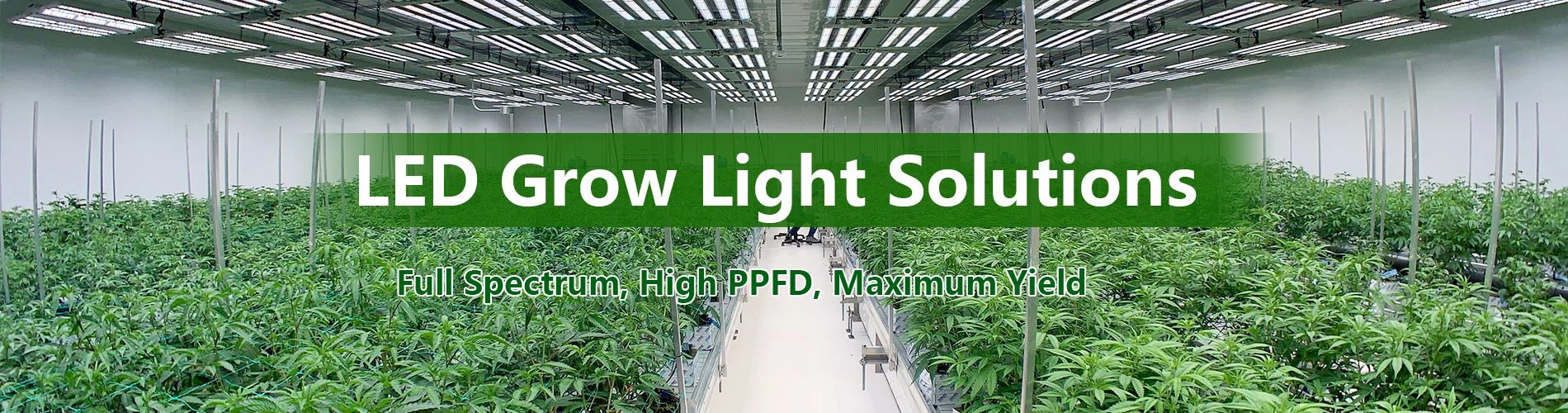
Walk into a commercial cannabis room during mid-flower and you immediately understand the challenge. The canopy is dense. Plants are competing aggressively for light. Cannabis LED grow lights must deliver wide, even coverage - not concentrated intensity in one spot.
Lower buds in poorly lit zones receive significantly fewer photons, leading to uneven flower development, inconsistent quality within the same batch, and lower overall yield per square foot. This is why most professional cannabis operations use multi-bar foldable fixtures rated at 600W-1,000W, designed specifically to spread light across a 4x4 ft to 5x5 ft footprint at PPFD levels of 800-1,200 umol/m2/s during flower.


Vertical Farming and Multi-Layer Rack Systems
Vertical farms operate under completely different constraints. Each growing layer is limited in height - often as little as 30-50 cm of clearance between the canopy and the fixture. Vertical farming LED lights must fit into tight vertical spacing while still delivering consistent output across the full shelf width.
Heat buildup between layers is a serious operational problem. Even a 2-3 degree Celsius increase in inter-canopy temperature can accelerate transpiration rates and raise humidity to unmanageable levels. That is why modular LED grow lights - slim, independently replaceable bar-style units - are the preferred format in rack systems. They integrate cleanly, minimize radiant heat to adjacent layers, and simplify maintenance.
Wattage, Coverage, and PPFD
What the Numbers Actually Mean at Canopy Level
Wattage is the first number buyers look at. It's also the least useful number for predicting canopy performance. Two 1000W LED grow lights from different manufacturers can deliver completely different PPFD at your canopy - and the cheaper one might actually be delivering less usable light while consuming more electricity. Here's how to read the numbers correctly.
Wattage tells you what you're spending on electricity. PPFD tells you what your plants are actually receiving. These are not the same number.
1. How wattage maps to commercial PPFD targets
In commercial cultivation, you're engineering toward a PPFD target - not a wattage number. The wattage you need depends on the PPE of the fixture you choose and the coverage area you're working with. Here's a practical reference for how the main commercial power ranges perform:
|
Power Range |
Typical PPE |
Coverage Footprint |
Canopy PPFD (approx.) |
Best Commercial Application |
|
640W LED grow lights |
2.8–3.1 µmol/J |
4×4 ft (1.2×1.2 m) |
900–1,100 µmol/m²/s |
Cannabis flowering, high-value crops |
|
720W LED grow lights |
2.8–3.0 µmol/J |
4×4 to 5×4 ft |
950–1,150 µmol/m²/s |
High-intensity flowering rooms |
|
800W LED grow lights |
2.8–3.1 µmol/J |
4×4 to 5×5 ft |
1,000–1,200 µmol/m²/s |
Commercial cannabis, large single-canopy rooms |
|
1000W LED grow lights |
2.8–3.0 µmol/J |
5×5 ft (1.5×1.5 m) |
1,000–1,300 µmol/m²/s |
Maximum intensity flowering, high CO₂ facilities |
Note: PPFD figures are at 60 cm mounting distance. Actual canopy PPFD depends on mounting height, room reflectivity, and fixture spacing. Always verify with a PPFD map at your specific setup - not manufacturer reference conditions.
2. Coverage footprint: 4×4, 5×5, and 4×8 - matching fixture to room layout
Coverage footprint matters as much as peak PPFD. A 4×4 LED grow light placed over a 5×5 area will hit your uniformity target at center but drop off at the edges. A 5×5 LED grow light used in a 4×4 space wastes output and overlaps inefficiently with adjacent fixtures. Here's how to think about it by room type:
- 4×4 LED grow lights - standard single-plant or 4-plant canopy unit. Most common configuration in commercial cannabis facilities. 640W–720W range.
- 5×5 LED grow lights - higher intensity per fixture, covers more canopy per unit, reduces fixture count in large rooms. 800W–1,000W range.
- 4×8 LED grow lights - rectangular coverage for table-based or rack systems. Common in propagation rooms and commercial veg stages.
The mistake that wastes more money than any other in commercial lighting: buying fixtures for their peak center PPFD, then discovering the edge coverage is 40–50% lower. Always request a full PPFD distribution map for your coverage area at your hanging height before ordering. A legitimate commercial LED grow lights factory provides this without hesitation.
3. High wattage vs high efficiency: the real trade-off
High wattage grow lights and high efficiency LED grow lights are not the same thing - and confusing them is an expensive mistake. A 1,200W fixture at 2.2 µmol/J delivers less usable light than a 640W fixture at 3.0 µmol/J - and costs nearly twice as much to run. In commercial cultivation, high power grow lights make sense when you need maximum PPFD intensity in a CO₂-enriched environment. But higher wattage alone doesn't mean better results. Higher PPE does.
Full Spectrum, UV/IR, and Adjustable Spectrum
What Commercial Growers Actually Need
Spectrum is the variable most commercial growers underspecify. Everyone knows they need red and blue. Fewer growers think carefully about what the full spectrum configuration does to crop quality - not just yield weight, but potency, terpene expression, color, Brix content, and marketable grade.
Spectrum doesn't just affect how fast your crop grows. It affects what your crop is worth when it's sold.
Full spectrum LED grow lights - the commercial baseline
Full spectrum LED grow lights provide a broad wavelength distribution across the 380–780 nm range, covering all photosynthetically active wavelengths plus far-red. For most commercial applications - cannabis cultivation, fruiting crops, leafy greens at commercial scale - a well-designed full spectrum LED grow light for indoor is the right starting point. The question is whether a fixed spectrum is sufficient or whether your crop protocol benefits from adjustability.

Dimmable and adjustable spectrum - when control matters

Dimmable LED grow lights let you adjust intensity without changing fixtures - critical for managing different growth stages in the same room, ramping up PPFD gradually after transplant, or reducing intensity during the last days before harvest. Adjustable spectrum LED grow lights go further: you can shift the ratio of blue, red, and far-red channels independently across growth stages.
For serious commercial operations, adjustable spectrum is not a luxury. Shifting from blue-dominant (vegetative) to red-dominant (flowering) without changing a single fixture - and doing it on a timer across a 1,000 m² facility - is exactly the kind of operational control that separates profitable commercial cultivation from break-even.
LED grow lights with UV and IR - the quality driver most growers overlook
LED grow lights with UV and IR are increasingly standard in premium commercial cannabis operations. UV (280–400 nm) stimulates secondary metabolite production - terpenes, flavonoids, cannabinoids - that drive product potency and quality grade. IR (far-red, 700–800 nm) activates the Emerson enhancement effect, improving photosynthetic efficiency, and is central to photoperiod manipulation for accelerated flowering.
The commercial case for UV/IR is straightforward: in a licensed cannabis market where product sells at $3–8/gram or more, a 5–10% improvement in quality grade or potency per batch is worth more than the entire cost of the lighting upgrade. This is why full spectrum LED grow lights cannabis specifications increasingly include UV and IR channels as standard rather than optional.

|
Spectrum Feature |
What It Does |
Commercial Impact |
|
Full spectrum (380–780 nm) |
Covers all photosynthetically active wavelengths |
Baseline requirement for all commercial applications |
|
Blue dominant (veg mode) |
Compact internodes, strong root development |
Prevents stretch in veg, improves transplant success rate |
|
Red dominant (flower mode) |
Peak photosynthesis, flowering trigger |
Maximises flower biomass and density in flowering stage |
|
Far-red (700–800 nm) |
Emerson effect, photoperiod response |
Accelerates flowering, improves lower canopy penetration |
|
UV (280–400 nm) |
Secondary metabolite stimulation |
Increases terpenes, cannabinoids, and product quality grade |
|
Dimmable 0–10V |
Stage-by-stage intensity control |
Eliminates fixture changes between growth stages |
|
Adjustable spectrum (multi-channel) |
Independent channel control |
Single fixture covers full crop cycle - veg to harvest |
All our commercial LED grow lights include full spectrum with UV and IR as standard. Dimmable 0–10V is standard across the range. Multi-channel adjustable spectrum is available on request - custom spectrum configurations matched to your specific crop protocol, from 1 unit.
Commercial LED Grow Lights ROI
How to Build the Business Case
If you're still evaluating commercial LED grow lights based on fixture purchase price, you're looking at the wrong number. In commercial cultivation, every dollar of fixture cost needs to be measured against what it costs - and what it returns - over a 5–7 year operating cycle. Here's how to build that case properly.
The growers who delay switching to LED don't save money. They spend it - on energy, bulb replacement, and yield inconsistency - while their competitors don't.
Energy: the number that compounds every month
High efficiency LED grow lights with PPE of 2.8–3.1 µmol/J consume dramatically less electricity than HPS systems delivering equivalent PPFD. In a commercial facility running 18 hours per day at $0.12/kWh, the difference between a 2.0 µmol/J system and a 3.0 µmol/J system - delivering the same canopy PPFD - is approximately $160/year per fixture. In a 200-fixture facility, that's $32,000 per year. Over five years: $160,000.
|
Facility Size |
HPS Annual Energy |
LED Annual Energy (2.9 µmol/J avg) |
Annual Saving |
5-Year Saving |
|
100 fixtures / ~400 m² |
~$47,000 |
~$29,000 |
~$18,000/yr |
~$90,000 |
|
200 fixtures / ~800 m² |
~$94,000 |
~$58,000 |
~$36,000/yr |
~$180,000 |
|
300 fixtures / ~1,200 m² |
~$141,000 |
~$87,000 |
~$54,000/yr |
~$270,000 |
|
500 fixtures / ~2,000 m² |
~$235,000 |
~$145,000 |
~$90,000/yr |
~$450,000 |
Basis: 1000W HPS vs. 640W LED at 2.9 µmol/J. 18 hr/day, 365 days, $0.12/kWh. Actual results vary with local energy rate.
Yield consistency: the ROI driver no one puts in the spreadsheet
Uniformity improvements from ±35% (HPS) to ±12% (commercial LED) affect something harder to quantify but easier to feel at the end of every harvest: batch-to-batch consistency. When edge plants hit the same PPFD as center plants, grading is more predictable, harvest timing is tighter, and the percentage of top-grade product per batch increases. For licensed cannabis operations in the USA and Europe, where premium grade commands a 30–50% price premium over mid-grade, that consistency improvement has direct revenue impact.
DLC rebates: the cost offset most buyers don't claim
In the USA, DLC listed LED grow lights qualify for utility rebate programs that can offset 20–40% of fixture capital cost. On a 300-fixture commercial LED grow lights installation, that's $15,000–$45,000 back - enough to move payback from 14 months to under 10. All fixtures in our range carry DLC Horticultural listing as standard.
Want the actual payback number for your facility? Send us your current fixture count, wattage, energy rate, and canopy size. We'll build a full 5-year cost model - energy saving, HVAC reduction, rebate eligibility, and payback period - specific to your operation. Sent back to you within 24 hours.
Certifications for Commercial LED Grow Lights
USA and Europe
Certifications are the part of the spec that gets checked last - and causes the most expensive problems when it's wrong. A fixture that isn't ETL listed may not be insurable in your facility. A fixture that isn't DLC listed disqualifies you from rebates worth thousands of dollars. Know what you need before you order.
|
Market |
Required Certification |
What Happens Without It |
|
USA - Commercial |
ETL or UL Listed |
Fixture may not meet NEC requirements. Insurance coverage for the facility may be compromised. |
|
USA - Rebate Programs |
DLC Horticultural Listed |
Disqualified from utility rebate programs in CA, CO, MI, IL and other states. $30–150 per fixture left unclaimed. |
|
USA - Wireless Controls |
FCC |
Non-compliant wireless dimming systems can create EMI interference in commercial facilities. |
|
EU / UK - All commercial |
CE + RoHS |
Illegal to import, sell, or install. No exceptions for commercial facilities. |
|
Greenhouse / Wet areas |
IP65 minimum |
Fixtures in humid environments without IP65 rating face premature failure and safety risk. |
Every fixture from our commercial LED grow lights factory is certified to ETL, CE, DLC, RoHS, and IP65 as standard. Not as an upgrade tier. Not as an optional package. Standard. IP66 variants are available for active irrigation environments. OEM and private label programs include full certification documentation under your brand name.
Sourcing Commercial LED Grow Lights
Wholesale, OEM, and Factory Direct
At JT Grow Light, we work directly with commercial growers and distributors on projects of this scale. Commercial lighting procurement at scale is a different process from buying a few fixtures for a small room. The decisions you make on sourcing - direct factory vs. distributor, standard product vs. custom, off-the-shelf vs. OEM - have meaningful impact on project cost, lead time, and what happens when you need support six months after delivery.
Most commercial buyers are paying 20–35% more than they need to - not because LED grow lights are expensive, but because they're buying through the wrong channel.
Factory direct: what it actually means
As a commercial LED grow lights manufacturer, JT Grow Light sits at the base of the cost structure.
Every layer between factory and buyer adds margin - distributor, reseller, marketplace. On a $150,000 lighting project, that 20–35% margin difference is $30,000–$52,500 - real budget that could instead be invested into better system design, higher PPE fixtures, or faster ROI.
Beyond price, working directly with JT Grow Light means:
• Direct access to our engineering team for layout and specification
• Clear production scheduling - no middle layer delays
• Ability to adjust specifications before production - not after delivery


Wholesale and bulk commercial LED grow lights orders
For bulk commercial LED grow lights orders, JT Grow Light supports both project buyers and distributors globally.
• 8,000–12,000 units/month production capacity
• 4 in-house production lines
• 100% aging and quality testing before shipment
Our standard lead time:
• 10–15 days for standard products
• Stable supply for multi-phase or multi-room projects
Wholesale pricing is available based on volume - and structured to support long-term distribution, not one-off transactions.
OEM commercial LED grow lights: from 1 unit, 20–25 day lead time
One thing many buyers don't expect when working with JT Grow Light: OEM and custom configurations don't require large minimum orders
From 1 unit, we support:
• Custom spectrum configuration - fixed or multi-channel adjustable
• Private label branding - logo, packaging, documentation
• Driver and control system integration - 0–10V, PWM, DALI
• Certification under your brand - ETL/DLC (USA), CE/RoHS (EU)
• Custom packaging and accessories for distribution programs
Lead time:
• 20–25 days for custom/OEM
• Certification documentation prepared in parallel with production

Building a distribution program or specifying a large commercial project? Tell us your fixture count, target market, spectrum requirements, and any OEM needs. We respond with full pricing, lead time, and certification documentation within 24 hours. No distributor in the middle.
Our Certifications

CE

IP66

CE

RoHS

FCC

CE
Q: What is the difference between foldable and modular LED grow lights?
A: Foldable LED grow lights use an integrated folding frame with fixed bar spacing - faster to install, factory-optimised for uniformity, better for standard fixed-layout rooms. Modular LED grow lights use independently positioned bars that can be configured to any layout - better for custom dimensions and retrofit projects. Both formats deliver commercial-grade performance when correctly specified. The right choice depends on your room geometry.
Q: How many watts do I need for commercial cannabis cultivation?
A: PPFD target is the right starting point, not wattage. For cannabis flowering, target 900–1,200 µmol/m²/s. With a quality 640W LED grow light at 3.0 µmol/J, you'll hit 900–1,100 µmol/m²/s across a 4×4 ft footprint at 60 cm mounting height. An 800W LED grow light at the same PPE covers a 5×5 ft area at similar intensity. What changes is coverage footprint, not just raw power.
Q: What is the best coverage area for a 1000W LED grow light?
A: A 1000W LED grow light at 2.8–3.0 µmol/J optimally covers a 5×5 ft (1.5×1.5 m) footprint at 1,000–1,300 µmol/m²/s PPFD, mounted at 60–75 cm above canopy. Pushing it to a 6×6 ft area reduces average PPFD and uniformity significantly. For maximum intensity in a CO₂-enriched environment, keep coverage at 5×5 or tighter.
Q: Do commercial LED grow lights need UV and IR?
A: For commercial cannabis cultivation focused on premium quality grade and maximum terpene/cannabinoid expression: yes. LED grow lights with UV and IR measurably improve secondary metabolite production - which directly affects product grade and sale price in licensed markets. For commodity leafy greens and herbs where yield weight is the primary metric, UV/IR provides marginal additional benefit. We include UV and IR as standard on our commercial range because our customers are predominantly in premium cultivation.
Q: What certifications do commercial LED grow lights need in the USA?
A: ETL or UL listing for electrical safety and insurance compliance; DLC Horticultural listing for utility rebate eligibility; FCC for wireless control systems; IP65 for humid environments. All our commercial LED grow lights carry all four as standard. DLC listing is particularly important - a 200-fixture installation without DLC could mean $6,000–$30,000 in unclaimed rebates.
Q: What is the minimum order for commercial LED grow lights wholesale?
A: No minimum order for standard products. For commercial LED grow lights wholesale volume pricing, contact us with your fixture count and target market. OEM and custom configurations are available from 1 unit with 20–25 day lead time.
Q: How do I verify a commercial LED grow lights manufacturer is reliable?
A: Ask for: (1) system-level PPE data from third-party lab testing - not chip spec sheets; (2) PPFD distribution maps at your specific mounting height; (3) L90 lifespan data, not just L70; (4) certification documentation for ETL, DLC, CE as applicable; (5) references from comparable commercial projects. A manufacturer who hesitates on any of these is telling you something important.
Q: How long do commercial LED grow lights last?
A: Quality long lifespan LED grow lights are rated 50,000+ hours at L90 - meaning ≥90% of initial output maintained over that period. At 18 hours/day in a commercial operation, that's approximately 7–8 years before output meaningfully degrades. Driving fixtures at 70–80% of rated current extends this further by reducing thermal stress.
Ready to Specify Your Commercial Room? Here's Your Next Step
If you've already experienced inconsistent yield, poor uniformity, or higher-than-expected energy costs, you're not alone - we see this regularly when systems are specified incorrectly from the start.
Every week you run an under performing lighting system, it costs you in energy, in yield consistency, and in the gap between what your facility produces and what it's capable of. Here's what we bring to a commercial lighting project:
- PPE 2.8–3.1 µmol/J system-level - verified by third-party lab data, not marketing claims
- ±10–15% PPFD uniformity - across the full coverage footprint, not just at center
- Full spectrum with UV and IR, 0–10V dimmable - standard on every commercial fixture
- ETL + DLC + CE + RoHS + IP65 - every fixture, every order, no upgrade required
- Foldable and modular formats - 240W to 1,000W, 4×4 to 4×8 coverage
- OEM and private label from 1 unit - 20–25 day lead time, full certification under your brand
- Wholesale programs for USA and Europe - 10–15 day lead time, 8,000–12,000 units/month capacity
Tell us your room dimensions, crop, target PPFD, and current lighting setup. We'll send you a complete photometric layout - PPFD distribution map, fixture count, hanging height, energy model, and DLC rebate estimate for your state or country - within 24 hours. Not a sales pitch. A layout. The exact data you need to make the right decision for your facility.
← Back to: LED Grow Lights - Complete Buyer's Guide
→ Related: Greenhouse LED Grow Lights | Vertical Farming LED Lighting | Under Canopy Lighting | Quantum Board Grow Lights
We're well-known as one of the leading commercial led grow lights1 manufacturers and suppliers in China. Please rest assured to buy cheap commercial led grow lights1 for sale here from our factory. Contact us for customized service and discount information.
Detachable LED Grow Light, Full Spectrum Plant Light, vertical farming light timers for plants