


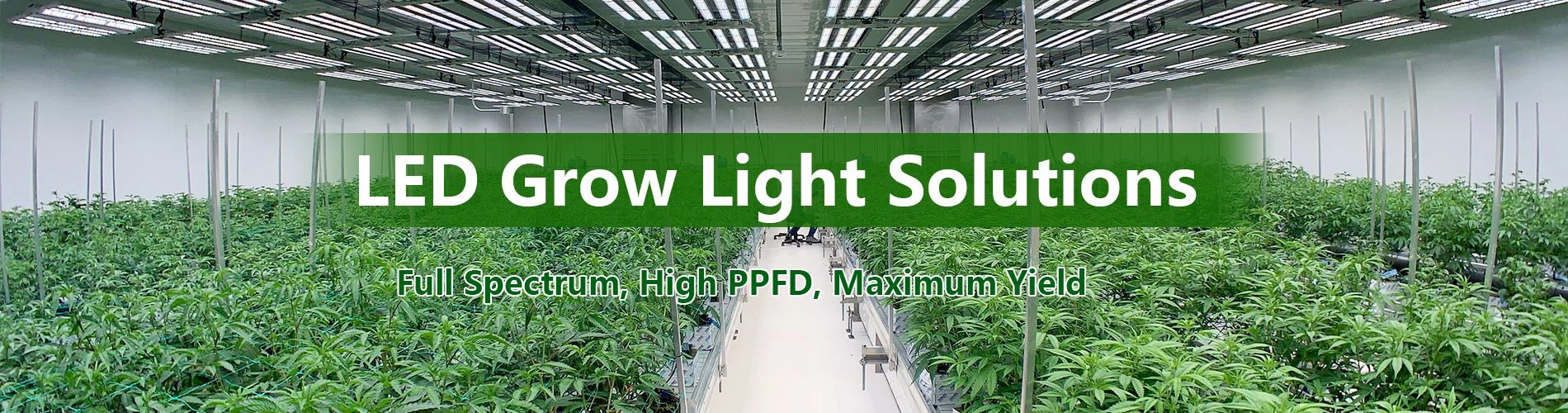

Foldable LED grow lights have become one of the most talked-about lighting formats in commercial cultivation. In brochures, sales presentations, and online discussions, they are often positioned as a near-universal solution: better coverage, higher yields, easier installation, and fewer lighting problems overall.
On the surface, these expectations don't sound unreasonable. Foldable designs do change how light is delivered, and they can solve certain structural problems that rigid fixtures struggle with.
But in real grow rooms, the gap between what growers expect from Foldable LED Grow Lights and what actually determines results is where most purchasing mistakes happen. Understanding that gap is far more important than memorizing another spec sheet.
Expectation

#1:Foldable LED grow lights automatically increase yield
One of the most common assumptions growers make is that switching to a foldable LED grow light will immediately boost yield. The logic feels intuitive: better coverage should equal more usable light, and more usable light should equal more biomass.
In reality, foldable designs do not directly "create" yield. What they do is reduce variability.
In commercial cultivation, yield losses often don't come from a lack of total light, but from uneven light distribution. Certain areas overperform, others underperform, and management effort increases to compensate. Foldable LED Grow Lights help narrow that performance gap by improving uniformity across the canopy.
For many growers, the real benefit appears as fewer weak zones, more consistent plant development, and tighter harvest windows-not as dramatic one-cycle yield spikes.
Growers who expect instant yield jumps are often disappointed. Growers who understand that consistency drives long-term output tend to extract much more value from foldable systems.
#2: Foldable structure means universal fit
Another widespread expectation is that a folding LED grow light will fit perfectly in any room, regardless of layout or constraints. Since the fixture is adjustable, the assumption is that planning becomes unnecessary.
This is where misunderstandings begin. Foldability offers adjustment potential, not automatic compatibility. Bar spacing, mounting height, aisle width, and room geometry still matter. Foldable systems give growers more tools to adapt, but they do not replace thoughtful layout decisions.
Many underperforming installations fail not because the Foldable Grow Light itself is flawed, but because "adjustable" was mistaken for "plug-and-play."
When used intentionally, foldable designs allow lighting to adapt to real-world rooms. When used casually, they simply replicate old problems in a new format.


#3: More flexibility means more complexity
Some growers hesitate to adopt foldable LED grow lights because they associate flexibility with operational complexity. More moving parts, more decisions, more things to go wrong.
In practice, the opposite is often true. Once configured correctly, a Foldable Grow Light system typically simplifies long-term operations. Uniform coverage reduces the need for constant canopy correction. Predictable light behavior reduces trial-and-error across cycles.
The complexity exists at the design and planning stage-not in daily operation.
Growers who invest time upfront usually experience fewer lighting-related interventions later, which directly translates into labor stability and smoother workflows.
Reality
#1: Structure matters more than specs
One of the biggest mismatches between expectation and reality is spec obsession. Growers often compare wattage, PPE, diode brands, and efficiency curves in detail, while overlooking a more fundamental question: how does light actually move through the canopy? Foldable LED Grow Lights matter because they change geometry, not because they change numbers.
By splitting light into multiple bars and allowing spatial adjustment, folding LED grow light systems influence angles, penetration depth, and shadow formation in ways that spec sheets cannot fully describe.
Experienced growers eventually shift their evaluation criteria. Instead of asking how powerful a fixture is, they ask how predictable its behavior is across different rooms and growth stages. That shift marks the difference between equipment buying and system thinking.
#2: Foldable lights stabilize operations, not just plants
The impact of foldable LED grow lights extends beyond plant physiology. Inconsistent lighting increases labor. Staff spend more time correcting uneven growth, adjusting plant positions, and managing unpredictable development. These costs are often invisible until they compound.
By reducing structural inefficiencies, foldable systems stabilize operations. Canopies become easier to manage. Harvest timing becomes more consistent. Planning becomes more reliable. This operational calm is one of the least advertised-and most valuable-benefits of Folding LED Grow Light systems.
#3: Foldable LED grow lights are not shortcuts
It is important to be clear about what foldable LED grow lights do not do. They do not replace good airflow design. They do not compensate for poor genetics. They do not fix inconsistent feeding or weak SOPs.
Foldable systems remove structural inefficiencies that should not exist in the first place. They create conditions where good cultivation practices can perform more consistently-but they do not replace those practices.
Growers looking for shortcuts often feel disappointed. Growers focused on control and repeatability often find foldable systems indispensable.
JTGL's perspective: expectations meet real grow rooms
At JTGL, many customer conversations start with expectations and end with operational clarity. Our approach to Folding LED Grow Light design prioritizes real-room performance over marketing promises. Systems are developed to behave consistently in different facilities, not just to win isolated spec comparisons.
Bar spacing logic, driver placement, and structural proportions are refined to minimize self-shadowing and unpredictable light paths. The goal is not maximum theoretical output, but stable, repeatable results.
Growers working with JTGL often notice a shift after a few cycles. Discussions move away from raw intensity and toward predictability, labor efficiency, and long-term scalability. That transition reflects a deeper understanding of how lighting supports commercial cultivation.

The real value: reducing unnecessary variables
Commercial cultivation is fundamentally about managing variables. Some variables-like genetics and environment-require constant attention. Others, like structural lighting inefficiencies, should be engineered out of the system entirely.
Foldable LED Grow Lights help eliminate variables that stem from rigid design assumptions. They allow lighting to adapt to real spaces, real crops, and real workflows. Over time, this reduction in unnecessary variability translates into more stable output, more predictable labor demands, and better long-term ROI.
The most successful growers eventually stop asking whether a light is foldable or not. They ask whether it makes their operation easier to run.
When evaluated through that lens, foldable LED grow lights are neither miracle solutions nor marketing gimmicks. They are tools-powerful when understood, disappointing when misunderstood.
For growers willing to think beyond specs and toward systems, foldable designs often become a foundational part of scalable cultivation strategies.


