


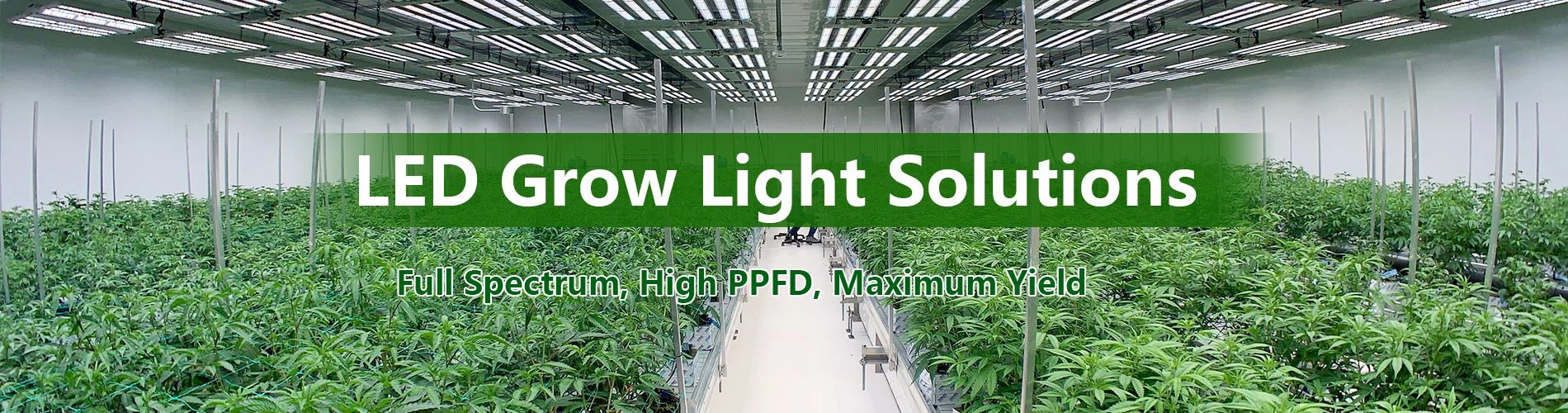
In my years managing the optical testing lab at JTGL, I've observed that the most successful commercial growers don't ask "How bright is this light?" Instead, they ask, "How identical will my plants be from the center of the tray to the far edge of the rack?" In an industrial-scale facility, inconsistency is a cost driver. If 15% of your crop is undersized due to poor light distribution, your automated packaging line slows down, your waste metrics spike, and your profit margins evaporate.
As an engineer, I view a grow rack as a closed optical system. When you install a high-wattage LED grow light bar, you are creating a massive spike of energy in the center of the shelf. While the peak PAR numbers look great on a marketing brochure, the physics of a centralized fixture dictates a rapid "Edge Drop-off." For a professional grower, this gradient is a disaster. This is where the strategic engineering of a full spectrum LED grow light tube array becomes the only logical solution for facilities focused on absolute uniformity.
The Physics of the Edge Effect: Why Bars Struggle in Racks
When we design a heavy full spectrum led grow light bar, the light originates from a relatively concentrated area. According to the Inverse Square Law and basic trigonometry, the photons traveling to the corners of a grow tray have to cover a longer distance and hit the canopy at a shallower angle than those directly underneath the fixture.
In a narrow vertical shelf, this results in a "hot center and dark perimeter." If you are growing high-value herbs, this means the center plants might be over-saturated (causing tip burn), while the perimeter plants are stretching (causing weak stems).
By contrast, using multiple LED tube grow lights allows us to implement a "distributed footprint" strategy. Instead of one or two powerful bars, we engineer a layout with four or five LED grow lights tube units spaced precisely across the shelf. This creates "Overlapping Light Cones." The light from Tube 1 fills in the natural drop-off of Tube 2, and so on. In our testing, this distributed approach reduces the PPFD variance across a standard 4x2 foot tray from a staggering 40% (common with single bars) to less than 8%. For an automated facility, that 8% variance is the difference between a standardized product and a graded mess.
Thermal Uniformity: The Silent Partner of Light Uniformity
One thing I always remind our clients is that plant growth isn't just about photons; it's about the relationship between light and leaf temperature. A bulky full spectrum led grow light bar is a heat-dense object. Even with a good heat sink, it creates a localized "Heat Column" directly under the fixture.
In a dense rack, this means the plants in the center of the shelf are experiencing a different VPD (Vapor Pressure Deficit) than the plants at the edges. Even if the light was perfectly even, the temperature difference would cause the center plants to transpire faster, leading to uneven nutrient uptake.
The slim, linear profile of a full spectrum LED grow light tube solves this through "Thermal Dilution." By spreading the 100 Watts of power across five separate LED tube grow lights, we spread the thermal load. This ensures that the air temperature across the entire canopy remains within a narrow 1°C range. As an engineer, I aim for systemic stability. When the light and the temperature are both uniform, the biology of the plant becomes predictable. Predictability is the foundation of a profitable business.
Optical Transmission and the "Z-Axis" Consistency
In vertical farming, we also have to consider the "Z-Axis"-the consistency of light as the plant grows taller. Because a LED grow light bar often has higher-wattage diodes, it creates a "high-intensity zone" that is very unforgiving. If the plant grows 2 inches closer to the bar than expected, it enters a zone of potential photo-inhibition.
The engineering behind a full spectrum LED grow light tube allows for a much more "gentle" intensity gradient. Because each diode is lower wattage but part of a larger, coordinated array, the "sweet spot" for growth is vertically deeper. This gives the grower a wider "margin of error." Whether the plant is 4 inches or 8 inches from the light, the change in received PPFD is less drastic. For a facility manager handling thousands of plants, this reduced sensitivity to plant height is a massive operational advantage.
Managing the "End-of-Row" Light Loss
In large-scale facilities, the ends of the racks are notorious for light loss into the aisles. As an engineer at JTGL, I've worked on custom optical lenses for our tubes that help combat this.
Standard LED tube grow lights often have a 120-degree beam angle, which is great for overlap but bad for aisle loss at the ends of the run. We can engineer the end-of-row LED grow lights tube units with a tighter 90-degree beam or a specialized reflective coating to "kick" the light back toward the plants. This level of granular, row-by-row optimization is nearly impossible-or prohibitively expensive-to achieve with a standardized full spectrum led grow light bar infrastructure.
Reliability: Uniformity Over Time
Uniformity is not just a spatial requirement; it's a temporal one. If you have 500 lights in a room and 50 of them degrade in brightness faster than the others, your uniformity is gone.
This is why we focus so heavily on the "Thermal Path" in our engineering. We use high-purity aluminum extrusions for our full spectrum LED grow light tube housings to ensure the LED junction temperature never exceeds a certain threshold. In our aging tests, this prevents the "spectral drift" and "lumen depreciation" that plagues cheaper, non-engineered products. If the light you buy today isn't the same intensity in 12 months, your standardized growing protocols will fail.
Conclusion: Engineering the Perfect Crop
In the high-stakes world of commercial indoor cultivation, uniformity is the ultimate metric of engineering success. While a high-wattage LED grow light bar has its place in open-room, high-ceiling environments, the multi-tier vertical farm demands the precision of a linear, distributed system.
By utilizing an array of LED tube grow lights, we are able to eliminate the edge effect, stabilize the thermal environment, and provide a deep, consistent light field that ensures every single plant is a carbon copy of the next. At the end of the day, my goal as an engineer is to make the lighting "invisible" to the production process-it should be so consistent and so reliable that the grower never has to think about it. When the light is uniform, the harvest is guaranteed.


