


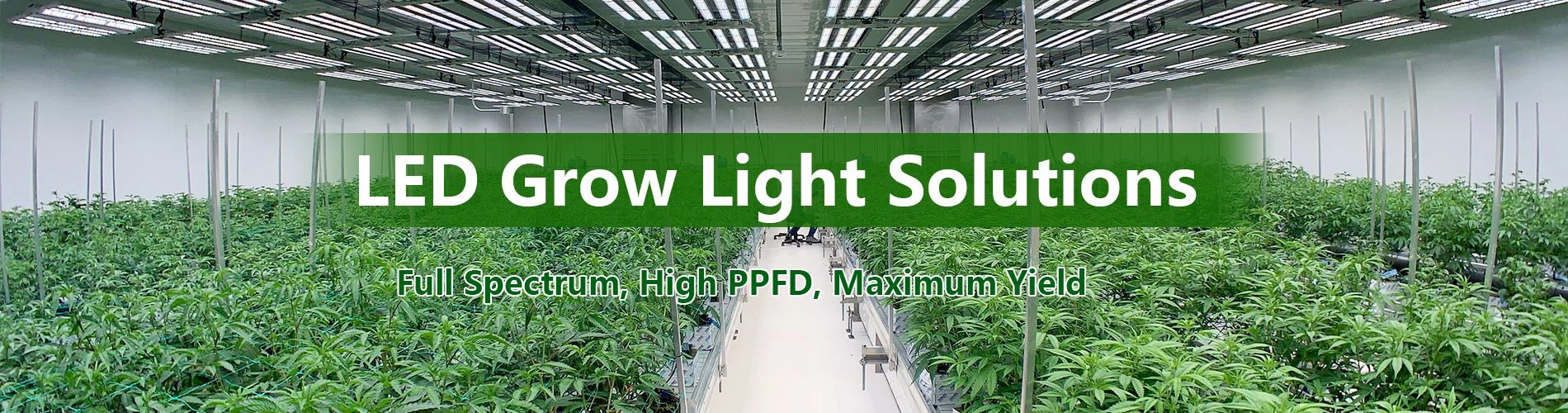
In many grow rooms, lighting conversations still follow the same familiar pattern.
Something underperforms/Lower buds look weak
Uniformity slips/Yield stalls.
The instinctive response is almost always the same: increase intensity.
More wattage/More lights/Higher PPFD targets.
For a long time, that logic worked. When canopies were thinner, spacing was wider, and expectations were lower, adding more top light often solved the problem. But modern commercial grow rooms are no longer simple environments. Canopies are denser. Space is tighter. Margins are thinner. And the limits of intensity-based thinking are showing up everywhere.
This is the context in which under canopy lighting starts to matter - not as a brighter light, but as a signal that the entire lighting strategy needs to change.

The Industry's Long-Standing Habit: Treating Light as a Power Problem
Most lighting strategies today are still built around a single assumption: if plants underperform, they need more light. This assumption turns lighting into a one-dimensional control knob. Turn it up, and results should improve.
That mindset explains why many facilities keep pushing top lighting harder even when the results stop improving proportionally. It also explains why Under Canopy Grow Light systems are often misunderstood or misused.
When under canopy lighting enters the conversation, it usually means intensity is no longer the limiting factor. The problem has shifted from how much light is applied to how light moves through the plant structure. At that point, lighting stops being a power problem and becomes a strategy problem.
From One Direction to Multiple Entry Points
Traditional top lighting relies on a single directional assumption: light enters from above and travels downward.
This works well until canopy density increases. As leaves expand horizontally and overlap, the plant itself becomes a barrier. Light is intercepted early, absorbed by upper leaves, and converted into heat long before it reaches productive lower sites.
Adding more top light does not change this geometry. It only intensifies what is already happening. Under canopy lighting breaks this one-directional model. By introducing light from below or from the side, LED under canopy lights create new entry points into the canopy. Areas that were previously excluded from the light environment become active again.
This is not supplementation. It is re-routing. Once lighting has multiple entry paths, the system behaves differently. Light distribution becomes something that can be designed rather than hoped for. That is the first strategic shift.
Why Lighting Strategy Is Really About Distribution, Not Peaks
For years, the industry has used peak PPFD as a proxy for lighting quality. Higher numbers suggested better performance. In reality, peak PPFD only tells part of the story. In mature grow rooms, the most expensive inefficiencies are not caused by insufficient peaks. They are caused by uneven distribution. Large differences between top and lower canopy zones lead to:
- Structural imbalance in plants
- Inconsistent flower development
- Unpredictable harvest quality
Under Canopy LED Grow Light systems do not aim to push peak values higher. Their purpose is to lift underperforming zones into a usable range.
This is a strategic decision. Instead of maximizing the best-performing areas, under canopy lighting stabilizes the weakest ones. The overall system becomes more balanced, even if headline numbers do not change dramatically. For commercial facilities, that balance is often more valuable than incremental gains at the top.
Shifting the Focus From Yield Points to Whole-Plant Management
Top-light-only strategies naturally bias outcomes toward the upper canopy. That is where the most energy is delivered, and that is where performance is optimized. Lower sections often become an afterthought.
Introducing under canopy lighting changes this relationship. It forces the grower to think about the plant as a three-dimensional production unit rather than a flat surface. When lower canopy zones receive consistent light:
- Node development becomes more uniform
- Bud structure improves across levels
- Maturity timing aligns more closely
Under canopy lighting does not necessarily make plants grow faster. It makes them grow more evenly. This distinction matters. Even growth simplifies downstream decisions, reduces corrective interventions, and improves predictability. At this stage, lighting strategy starts to overlap with plant architecture management.
When Lighting Starts Affecting Operational Decisions
One of the clearest signs that lighting has moved beyond intensity is when it begins to influence operational planning. Facilities that integrate under canopy lighting often notice changes in areas that have nothing to do with fixtures themselves:
- Harvest timing becomes more consistent
- Labor planning becomes easier
- Trimming decisions become less subjective
- Quality grading stabilizes
These effects are not accidental. They result from reduced variability within the canopy. Once lighting affects workflow, it is no longer just an environmental input. It becomes part of the operational system. This is why discussions around under canopy lighting in mature facilities often involve facility managers and owners, not just growers. The impact extends beyond plant physiology into business execution.
Why This Shift Only Happens in More Mature Facilities
It is important to say this clearly: under canopy lighting is not an early-stage solution.
Facilities that are still struggling with basic airflow, spacing, nutrition, or environmental control rarely benefit from adding complexity. Lighting strategy evolves in stages.
- Early stages focus on adding enough light.
- Intermediate stages focus on optimizing intensity.
- Advanced stages focus on designing distribution.
Under Canopy Grow Light systems belong to the third stage. They become relevant only when a facility has already stabilized its fundamentals and begins optimizing for consistency, predictability, and operational efficiency. This is also why under canopy lighting often feels unnecessary in younger operations and indispensable in mature ones.
Designing Light Instead of Stacking Fixtures
Once lighting becomes a strategic system, the design priorities change. Power density becomes secondary. Beam distribution becomes critical. Light integration matters more than raw output.
From a manufacturer's perspective, this is where many projects succeed or fail. At JT Grow Light, under-canopy projects are rarely approached as standalone product sales. They are treated as layout and distribution challenges. The emphasis is placed on:
- Matching beam spread to canopy geometry
- Using appropriate power levels for close-range lighting
- Ensuring long-term thermal stability
- Integrating fixtures cleanly into existing structures
When under canopy LED grow light systems are designed around plant structure rather than specifications, they tend to deliver consistent, repeatable results. This is also why experienced buyers increasingly ask where and how lights will be installed instead of how powerful they are.
Under Canopy Lighting as a Strategic Signal
Perhaps the most overlooked aspect of under-canopy lighting is what it represents conceptually. When a facility starts asking about under-canopy lighting, it is usually a sign that intensity is no longer the primary bottleneck. The questions change:
- Where is light being wasted?
- Which zones are underutilized?
- How do we reduce variability?
These are strategy questions, not equipment questions. At this stage, lighting decisions are no longer reactive. They are deliberate. Under canopy lighting does not replace top lighting. It reframes how lighting is evaluated altogether.
The Moment Lighting Stops Being a Setting
In early facilities, lighting is something you adjust. In mature facilities, lighting is something you design. LED under canopy lights accelerate this transition by forcing growers to confront the limits of single-direction thinking.
- They expose structural blind spots.
- They highlight inefficiencies.
- They reward thoughtful integration.
When lighting strategy shifts from chasing intensity to managing distribution, the grow room becomes more predictable, more controllable, and ultimately more profitable. That is why under canopy lighting matters - not because it is brighter, but because it changes how light is used.
Final Thought: Strategy Is What Comes After Power
Under canopy lighting is often discussed as a product category. In reality, it is a strategic milestone. It marks the point where a facility moves beyond simply applying power and starts designing outcomes.
Once lighting is treated as a system - with direction, distribution, and purpose - intensity becomes just one variable among many. And that is when lighting finally starts working with the grow room, instead of fighting against it. Under-canopy grow light only works when it is treated as one layer within a broader layered lighting strategy.


