


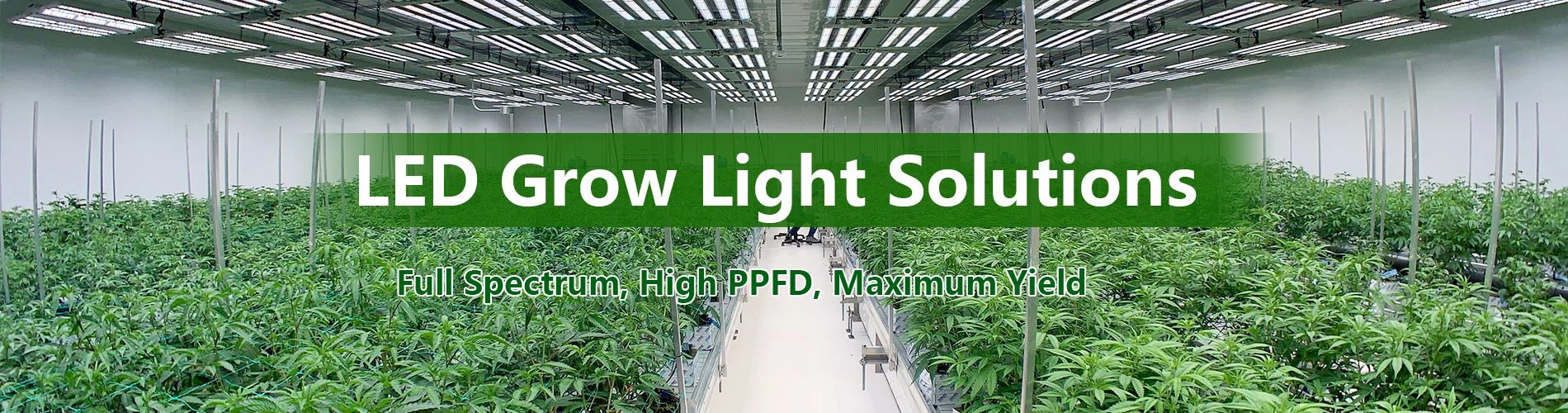
If you're running an indoor cannabis operation - whether it's a 500 m²-licensed facility or a multi-tier vertical setup - lighting is the single biggest lever you have over yield, quality, and operating costs.
Not genetics. Not nutrients. Lighting.
Because in a fully controlled indoor environment, your plants get exactly what you give them. And if the light is wrong - wrong intensity, wrong spectrum, wrong schedule - everything downstream suffers. Yield drops. Quality becomes inconsistent. Costs climb. Not sure which indoor growing setup is right for your operation? Start with our Indoor Growing overview guide.
Here, we will provide a clear and practical explanation of how cannabis LED grow lights actually work in real operations - from clone room to harvest, from fixture selection to ROI calculation.


Why Lighting Is the #1 Factor in Cannabis Yield and Quality
Cannabis is one of the most light-responsive crops in commercial cultivation. Unlike leafy greens or herbs, which perform reasonably well across a wide range of light intensities, cannabis has a steep response curve - more quality light, more yield, up to a point.
Three factors drive everything:

PPFD (Photosynthetic Photon Flux Density)
Measured in µmol/m²/s - tells you how many usable photons are landing on the canopy per second. This is the number your plants actually respond to. Wattage tells you how much electricity you're using. PPFD tells you what your plants are getting. These are not the same thing.

Spectrum
Cannabis responds differently to different wavelengths at different stages. Blue light drives compact vegetative growth. Red light triggers and sustains flowering. Far-red light can accelerate the transition to flowering and improve canopy penetration. Getting this wrong at the wrong stage costs you weeks of suboptimal growth.

Photoperiod
cannabis is a short-day plant. Flowering is triggered by shifting to a 12/12 light cycle. Vegetative growth is maintained on 18/6 or longer. Any light leaks or timer errors during the dark period can stress plants, cause hermaphroditism, and destroy a flowering cycle.
Modern LED grow lights for cannabis give you precise control over all three. That's why indoor cannabis growing lights have shifted almost entirely to LED in new commercial buildings over the past five years.
Cannabis Growth Stages and Light Requirements
This is where most generic lighting guides fall short. They give you one number - "cannabis needs 600–1000W" - and leave you to figure out the rest. In practice, cannabis has four distinct stages with meaningfully different lighting requirements.
Clone and Seedling Stage
Clones and seedlings are the most light-sensitive phase of the plant's life. Too much intensity causes bleaching, curling, and stress. Too little causes stretching and weak root development.
|
Parameter |
Recommended Range |
|
PPFD |
100–200 µmol/m²/s |
|
Photoperiod |
18–24 hours light |
|
Spectrum |
Blue-dominant (400–500 nm) |
|
Mounting height |
40–60 cm above canopy |
Blue light at this stage promotes compact internode spacing and strong root development. Many facilities use dedicated propagation fixtures - lower wattage, even distribution - rather than running their full commercial fixtures at low dimming, which can reduce uniformity.
A common mistake: running full-power fixtures at 20% dimming for clones. The PPFD average might be right, but hotspots near the centre can still cause stress, while the edges remain underlighted. A purpose-built propagation setup almost always performs better.
Vegetative Stage
Once rooted and established, cannabis in veg can handle significantly more light. The goal here is canopy structure - building strong lateral branching, healthy internodes, and the framework that will carry your flowering sites.
|
Parameter |
Recommended Range |
|
PPFD |
400–600 µmol/m²/s |
|
Photoperiod |
18/6 (light/dark) |
|
Spectrum |
Blue-dominant, full spectrum |
|
DLI target |
20–30 µmol/m²/day |
At this stage, cannabis grow light setup decisions around spacing and canopy training (topping, LST, SCROG) interact directly with your lighting layout. If your fixtures have poor edge uniformity, plants near the walls will stretch toward the center. Targeting ±15% PPFD variation across the canopy during veg pays off significantly at harvest.
CO₂ enrichment at 800–1,000 ppm during veg can improve growth rate and canopy fill, particularly at higher PPFD levels.
Flowering Stage
This is where lighting investment matters most - and where the difference between a well-designed system and a poorly specified one shows up in your yield data.
|
Parameter |
Recommended Range |
|
PPFD |
900–1,200 µmol/m²/s |
|
Photoperiod |
12/12 (light/dark) |
|
Spectrum |
Full spectrum, red-dominant (R:B ~4:1), with far-red |
|
DLI target |
40–65 µmol/m²/day |
|
CO₂ enrichment |
1,000–1,500 ppm for maximum response |
What PPFD do cannabis plants need during flowering? The short answer is 900–1,200 µmol/m²/s at the canopy for most commercial strains. High-yielding strains in CO₂-enriched environments can utilize up to 1,500 µmol/m²/s, but beyond that, photoinhibition typically sets in and returns diminish.
Far-red wavelengths (700–800 nm) play an important role during flowering. They enhance the Emerson effect - essentially boosting photosynthetic efficiency - and help trigger the photoperiod response. Many high-performance LED grow lights for cannabis flowering now include tunable far-red channels specifically for this reason.
What's the best light spectrum for cannabis flowering? A red-dominant full-spectrum with a R:B ratio around 4:1 and a far-red inclusion is the current commercial standard. Avoid blue-heavy spectra during flowering - they can suppress the flowering response and extend cycle time.
Harvest and Late Flower
In the final 1–2 weeks before harvest, some growers reduce intensity slightly (to 700–900 µmol/m²/s) and shift spectrum toward red/far-red to support final trichome development. This is strain-dependent and facility-dependent - worth testing in your specific setup rather than applying universally.
Common Cannabis Lighting Mistakes That Cost You Yield
Buying by Wattage, Not PPFD
Most growers think wattage matters. It doesn't - not directly. What actually limits your yield is how much usable light reaches your canopy. Two fixtures at the same wattage can deliver completely different results depending on efficiency and distribution. Always ask for PPFD maps, not watt counts.
Mistake 1
Ignoring Uniformity
A fixture advertising a centre PPFD of 1,400 µmol/m²/s may deliver only 700 µmol/m²/s at the edges. This is where many facilities lose 15–25% of potential yield without realizing it - and blame genetics instead of light distribution.
Mistake 2
Running One Light Through the Entire Cycle
Using a high-intensity flowering fixture at 20% dimming rarely works well for clones and seedlings. The PPFD average might look right, but hotspots near the centre can still stress young plants, while the edges remain underlighted. Different stages benefit from different setups.
Mistake 3
Underestimating the System Interaction
A poorly designed lighting system doesn't just reduce yield. It locks your facility into underperformance for the next 3–5 years - because every other system (HVAC, humidity, CO₂) was sized and calibrated around the wrong light load.
Mistake 4
LED vs HPS for Cannabis - Which One Actually Wins?
HPS has been the industry standard for indoor cannabis for decades. It works. But it was designed for a different era - before LED efficiency reached current levels, before energy costs became a primary operating concern, and before multi-tier and vertical cannabis cultivation became viable.
Here's an honest comparison at the facility level:
| Factor | HPS (1000W DE) | Commercial LED (650W) | What It Means |
| PPE (efficiency) | ~1.7 | ~2.8–3.2 | LED delivers ~70–85% more usable light per watt |
| Heat load at same PPFD | Higher | 20–30% lower | LED reduces HVAC demand significantly |
| Spectrum control | Fixed, yellow-red dominant | Tunable, full spectrum | LED allows stage-specific optimization |
| PPFD uniformity | ±25–35% typical | ±10–15% with multi-bar design | LED uniformity directly improves yield consistency |
| Mounting flexibility | Needs distance due to heat | Can mount closer | LED enables under-canopy and vertical applications |
| Bulb replacement | Every 12–18 months | Not required | HPS maintenance adds Labour and downtime cost |
| Upfront fixture cost | Lower | Higher | LED costs more initially |
| 5-year operating cost | Higher | Lower | LED typically wins on total cost of ownership |
The bottom line for commercial cannabis: LED performs better where it counts - energy cost, consistency, and long-term ROI. HPS may still make sense in existing facilities with sunk infrastructure costs and short remaining operational timelines. For new builds or major retrofits, the math almost alwunder-canopy lighting is often the most cost-effective path to yield improvement - delivering
l for a 1,000 m² cannabis facility (18 hours/day, $0.12/kWh):
| Cost Item | HPS System | LED System | Difference |
| Annual lighting energy | ~$118,000 | ~$70,000 | ~$48,000/year saved |
| Bulb replacement (18-mo cycle) | ~$16,000/year | $0 | Full saving |
| HVAC premium (heat load) | Baseline | ~20–30% lower | Significant reduction |
| Estimated 5-year operating cost | ~$670,000+ | ~$350,000–400,000 | ~$270,000+ saved |
| Typical LED payback period | - | 8–18 months | Varies by energy rate |
Calculation basis: 250 fixtures × 1,000W HPS vs. 650W LED, 18hr/day, 365 days, $0.12/kWh. Actual results vary by facility design and local energy rates.
How to Set Up a Complete Cannabis Lighting System
How to set up lighting for an indoor cannabis grow is one of the most common questions we hear from new facility operators - and the answer is almost never "just buy X watts per square meter." A proper system design involves three layers working together.
Top Lighting Layout
Top lighting is your primary light source - the fixtures mounted above the canopy delivering the majority of your PPFD target.
Key decisions:
Coverage calculation
Start with your target PPFD and canopy area. Divide the total required µmol/s by your fixture's output to get the fixture count. Most commercial facilities target 900–1,100 µmol/m²/s average across the canopy in flowering rooms.
In most projects we've worked on, the biggest performance gap isn't fixture quality - it's layout. A great fixture in a poor layout consistently underperforms a mid-range fixture in a well-designed one.
Mounting height
Higher mounting increases coverage area but reduces intensity and can reduce uniformity. Most commercial LED grow lights for cannabis perform optimally at 45–75 cm above the canopy in flowering.

Uniformity first
A lighting advertising 1,400 µmol/m²/s center PPFD may deliver only 700 µmol/m²/s at the edges of its rated coverage area. That's a 2×2 light sold as a 4×4 light. For commercial cannabis, target ±15% uniformity or better across your canopy.
How many LED grow lights do I need for my cannabis grow room?
A rough calculation: multiply your target PPFD (µmol/m²/s) by your canopy area (m²) to get total µmol/s required. Divide by your fixture's total output (µmol/s, from spec sheet or third-party test). Add 10–15% buffer for edge losses. For accurate layout planning, a photometric simulation is strongly recommended before purchasing.
Under Canopy Lighting for Cannabis
Under canopy lighting is one of the most underutilized tools in commercial cannabis cultivation - and one of the highest-ROI additions you can make to an existing facility.

Cannabis plants develop a dense upper canopy that blocks significant light from reaching lower bud sites. Without intervention, lower branches produce small, loose "popcorn buds" with low market value. Under canopy fixtures - typically 60–150W IP65-rated units - are installed between rows and below the main canopy to deliver an additional 150–250 µmol/m²/s directly to shaded zones.
Results from commercial operations:
- Lower canopy PPFD increased by 40–60%
- Reduction in popcorn bud formation
- Total sellable flower weight increase: +10–20%
- Minimal additional heat load (low-wattage fixtures)
- No increase in top-light intensity or HVAC demand
For facilities already running at maximum top-light capacity, under canopy lighting is often the most cost-effective path to yield improvement - more impact per dollar than upgrading primary fixtures.
Grow Light Controller Integration
Manual light scheduling works at small scale. At commercial scale, a grow light controller is not optional - it's infrastructure.
What a proper control system handles:
Photoperiod automation
Precise 12/12 switching for flowering rooms, 18/6 for veg. Even a 15-minute error in the dark period can stress flowering plants. Automated control eliminates this risk entirely.
01
Dimming control (0–10V)
Allows you to run fixtures at reduced intensity during clone and seedling stages, ramp up gradually when introducing plants to new light levels, and fine-tune intensity across the crop cycle without changing fixtures.
02
Zone control
In large facilities with multiple rooms at different growth stages, zone-level control lets you run different schedules and intensities simultaneously from a single system.
03
Environmental integration
Advanced controllers integrate with your HVAC, CO₂, and humidity systems. When lighting intensity changes, temperature and humidity requirements shift - synchronized control prevents the environmental swings that cause stress and reduce yield.
04
Cannabis grow light schedule veg vs flower
Management becomes entirely hands-off with a properly configured controller - and the consistency improvement across multi-cycle operations is measurable.
05
Cannabis Grow Light Cost and ROI Analysis
How much does it cost to light a cannabis grow room? The honest answer is: it depends heavily on scale, energy rates, and what you're comparing against. Here's a framework for thinking through it.
1. Upfront Equipment Cost
For a 500 m² commercial flowering room targeting 1,000 µmol/m²/s average PPFD:
|
Item |
Specification |
Estimated Range |
|
Primary LED lighting |
650W commercial, ~125 units |
Major cost driver |
|
Under canopy lighting |
120W IP65, supplemental |
Additional investment |
|
Grow light controller |
Zone control system |
System cost |
|
Installation and wiring |
Labor + materials |
Site-dependent |
Exact pricing varies by manufacturer, specification, and project scale. Wholesale cannabis grow lights pricing from a direct cannabis LED grow lights manufacturer typically represents 20–35% savings vs. distributor pricing for large-scale projects.
2. Operating Cost Comparison
The metric that matters for ROI is cost per gram of sellable flower - not cost per fixture or cost per watt. Switching from a legacy HPS system (~1.5 µmol/J) to a modern LED system (~3.0 µmol/J) at the same PPFD target:fixing
- Lighting energy consumption: reduced by approximately 40–50%
- HVAC load: reduced by approximately 20–30% due to lower heat output
- Bulb replacement: eliminated entirely
- Yield consistency: improved due to better uniformity, typically resulting in higher percentage of sellable product per cycle
For most commercial cannabis operations in North America, the payback period on LED investment runs 8–18 months - faster at higher energy rates, slower in markets with very low electricity costs.
3. The Hidden Cost of Under performance
One cost that rarely appears in ROI calculations: the cost of a poorly desienergy-efficiency incentives - in some states, rebates can offset 20–40% of the system with 35% PPFD variation doesn't just reduce yield – it means you're running an expensive facility at the performance level of a budget setup every single cycle. Some zones hit 1,200 µmol/m²/s. Others hit 700 µmol/m²/s. Your yield is limited by the weakest zones - not the average. Your product grading suffers. Your batch-to-batch consistency suffers.
Getting the design right before installation is almost always cheaper than trying to fix it after.
Cannabis Grow Light Compliance and Certifications
This section is one that most lighting guides skip entirely - and one that commercial cannabis operators need to take seriously. Certification requirements affect everything from facility permitting to utility rebate eligibility.
US Market Requirements
ETL / UL listing: Required for electrical safety compliance in most US commercial installations. Many state cannabis regulators and building inspectors require UL or ETL-listed fixtures as a condition of facility approval.
DLC (DesignLights Consortium) Horticultural Listing: Not a legal requirement, but increasingly important for two reasons. First, many US utility rebate programs require DLC-listed fixtures to qualify for energy efficiency incentives - in some states, rebates can offset 20–40% of fixture purchase cost. Second, DLC listing requires third-party testing of photometric performance, providing independent verification of manufacturer claims.
IP65 rating: Essential for cannabis grow rooms, where high humidity, irrigation runoff, and cleaning protocols create wet conditions. Fixtures without adequate IP rating in these environments create both safety and reliability risks.
Canadian Market
Health Canada's cannabis facility licensing requirements specify strict environmental controls. While there is no specific federal LED fixture standard, provincial electrical codes (following CSA standards) apply. Many Canadian cannabis facilities specify ETL/CSA dual-listed fixtures to satisfy both electrical safety and licensing requirements.
European Market
CE marking is required for any electrical equipment sold in the EU. RoHS compliance (restriction of hazardous substances) is also required and particularly relevant for LED fixtures, which contain regulated materials.
For export-oriented commercial cannabis LED grow lights manufacturers, maintaining CE, RoHS, ETL, and UL certifications simultaneously is increasingly a baseline expectation from serious buyers - not a differentiator.
A Note on Rebates
In US states with legal cannabis and active utility energy efficiency programs - California, Colorado, Michigan, Illinois, and others - LED lighting rebates for cannabis facilities are available and meaningful. In some cases, a 1,000-fixture installation can qualify for significant rebates available in utility incentives. These programs change frequently. Always verify current availability with your utility before finalizing purchasing decisions.
Cannabis Farm Lighting Projects
Indoor Cannabis Facility - United States
When we design lighting systems for commercial cannabis facilities, the first thing we look at is never the lighting - it's the room. Here are two projects that illustrate why.
A mid-to-large licensed indoor cannabis operation originally running 1,000W DE HPS across all flowering rooms. Primary issues: excessive heat load overwhelming HVAC capacity, ±35% PPFD variation producing inconsistent canopy, and energy costs running significantly above projections.
Lighting solution: 800W foldable LED grow lights, PPE 2.8–3.0 µmol/J, targeting 900–1,200 µmol/m²/s at canopy, 4×4 coverage per lighting, full 0–10V dimming integration with existing environmental controls.

Vertical Cannabis Operation - Canada

A licensed producer is exploring vertical cultivation to maximize canopy area within a fixed facility footprint. The challenge: standard top-lighting fixtures cannot effectively serve multi-tier vertical racks due to their depth and heat concentration.
Lighting solution: Use folding LED grow lights to hang directly on the vertical grow rack. PPFD 800–1000 µmol/m²/s per tier (adjusted by growth stage), uniform bar-style distribution across 1.2m shelf width.
|
Metric |
Single-tier HPS |
LED Lighting |
|
Canopy area per m² floor space |
1× |
2× (2tiers) |
|
Energy per gram |
Higher |
Significantly reduced |
|
Environmental stability |
Challenging |
Improved (lower heat per tier) |
|
Yield per m² floor |
Baseline |
↑ 200–300% |
This project illustrates why cannabis vertical-farming lighting is fundamentally different from standard flowering-room lighting - and why fixture selection matters beyond PPFD numbers. For operations combining cannabis cultivation with multi-tier rack systems, see our Vertical Farming LED Lighting guide for rack integration and linear LED specifications.
FAQ
Q: What PPFD do cannabis plants need at each stage?
A: Clone/seedling: 100–200 µmol/m²/s. Vegetative: 400–600 µmol/m²/s. Flowering: 900–1,200 µmol/m²/s. These are canopy-level targets - verify with a PAR meter at canopy height, not from spec sheet numbers at a fixed distance.
Q: How many LED grow lights do I need for my cannabis grow room?
A: Calculate your total PPFD requirement (target µmol/m²/s × canopy area in m² = total µmol/s needed), then divide by your fixture's verified output. Add 10–15% buffer. For any serious commercial installation, run a photometric layout simulation before purchasing.
Q: What's the best light schedule for cannabis veg and flower?
A: Vegetative: 18 hours light / 6 hours dark is standard. Some operators run 20/4 for faster growth.
Flowering: 12/12 is the industry standard trigger and maintenance schedule. Consistency matters more than the exact hours - use a reliable controller.
Q: Can I use the same LED grow lights for both veg and flower?
A: Yes, if the fixture has sufficient dimming range and the right spectrum. Full-spectrum fixtures with 0–10V dimming can run at 30–40% for veg and 100% for flower. Spectrum-tunable fixtures allow additional optimization. The main limitation is that a fixture optimized for 1,000 µmol/m²/s flowering output running at 30% dimming may not produce ideal spectral balance for veg - dedicated veg fixtures often perform better in large facilities with separate rooms.
Q: How do I reduce electricity costs in my cannabis grow room?
A: Switch to high-efficiency LED (≥2.8 µmol/J) if you haven't already. Optimize mounting height and layout to achieve target PPFD with fewer fixtures. Integrate dimming control to avoid over-lighting. Explore utility rebate programs in your area - DLC-listed fixtures often qualify. Run a lighting audit on your current setup before investing in new equipment.
Q: What certifications should I require from a cannabis grow light supplier?
A: For US commercial installations: ETL or UL listing, IP65 rating for wet environments, and DLC listing if utility rebates are relevant to your project. For Canadian operations: ETL/CSA dual listing. For EU markets: CE and RoHS. Any serious cannabis grow light factory or wholesale cannabis grow lights supplier operating at commercial scale should be able to provide third-party test reports, not just self-reported spec sheets.
Q: What's the difference between a commercial LED and a quantum board for cannabis?
A: Commercial multi-bar LED fixtures are designed for large-scale cultivation - high total output, superior uniformity across wide coverage areas, robust thermal management for continuous operation, and control integration. Quantum boards are cost-efficient and well-suited for small rooms, grow tents, and R&D setups. For operations with canopy areas above roughly 50 m², commercial fixtures almost always outperform quantum boards in terms of uniformity and long-term reliability.
Q: Does switching to LED require changing my HVAC system?
A: Usually yes - but typically as a reduction in capacity, not an increase. LED systems produce significantly less heat at the same PPFD. However, the change in heat distribution (LED produces less radiant heat, more convective) also changes airflow and humidity behaviour. A full environmental system review is recommended when making the switch, particularly for large facilities.
Before you invest in lighting, get your layout right. Because once it's installed, fixing mistakes is expensive - and most suppliers won't tell you that until after the order is placed. Send us your grow plan and room dimensions - we'll show you what most suppliers miss, and give you a free layout recommendation before you commit to anything.