


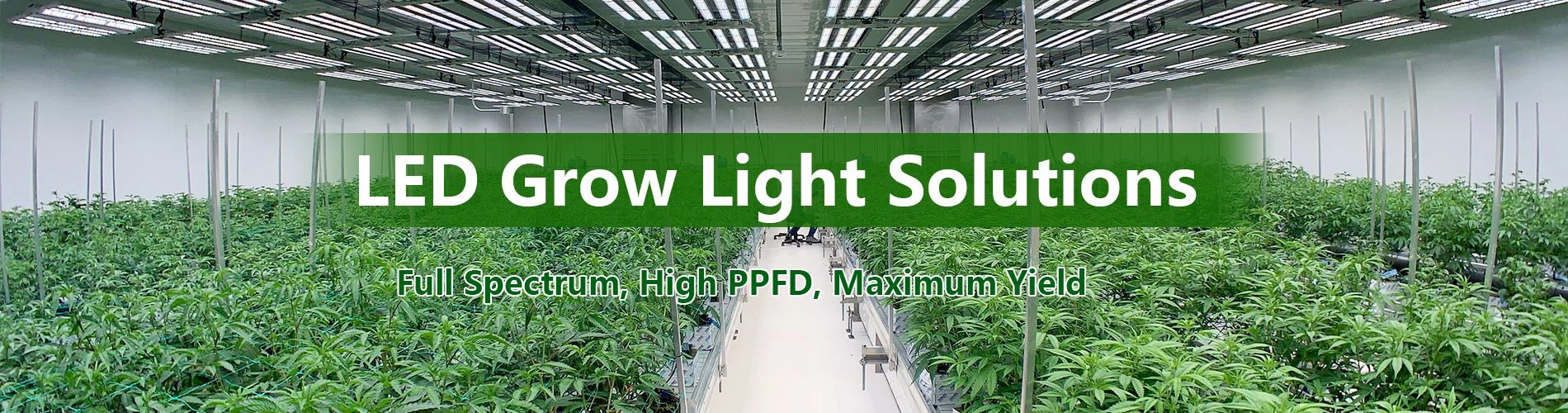
Greenhouse LED Grow Lights
How to Use Supplemental Lighting to Maximize Year-Round Crop Yield
Walk into a commercial greenhouse in December in the Netherlands, Canada, or the Pacific Northwest, and you'll see something that didn't exist twenty years ago: rows of LED fixtures mounted above the crop canopy, running quietly through the short winter days, keeping tomatoes fruiting and lettuce growing at the same pace they would in July.
That's supplemental lighting at work - and it's quietly becoming one of the most important infrastructure decisions in modern commercial greenhouse production.
This is written for greenhouse operators, facility planners, and growers who want a clear, practical breakdown of how greenhouse LED grow lights actually work in real operations - from calculating your DLI gap, to choosing between top lighting and inter-lighting, to understanding what the numbers actually mean for your bottom line.
And here is something worth saying upfront: greenhouse lighting is fundamentally different from vertical farming or indoor growing. Most problems we see in greenhouse lighting projects come from growers applying indoor grow room logic to a greenhouse environment. Get this wrong at the specification stage, and you don't just lose efficiency - you lock yourself into years of unnecessary energy cost and unstable yields. The two are not the same, and the difference matters more than most suppliers will tell you.


Why Greenhouse Growers Are Turning to LED Supplemental Lighting
The core challenge of commercial greenhouse production is not technology - it's the sun. Natural light is inconsistent, seasonal, and geography-dependent. A greenhouse in Minnesota or Scotland receives dramatically less usable light in December than in June. A cloudy week in an otherwise productive month can push an entire crop batch below its DLI target, slowing growth, reducing yield, and disrupting the production schedule your buyers depend on.
Commercial greenhouse lighting solves this problem - not by replacing sunlight, but by filling the gap between what the sun provides and what your crop actually needs.
The global greenhouse horticulture lighting market was valued at approximately $2.8 billion in 2023 and is projected to exceed $6.5 billion by 2028. The growth is driven by three converging trends: rising food security concerns pushing local year-round production, energy-efficiency improvements making LED supplemental lighting economically viable at scale, and consumer demand for consistent-quality produce regardless of season.
For commercial greenhouse operators, the business case is increasingly straightforward:
Yield consistency
Supplemental lighting stabilizes crop production across seasons. Instead of 40% lower output in winter months, a well-designed system delivers predictable batch sizes year-round - which is what supermarket and food service buyers actually need.
Cycle time control
With supplemental lighting, growers can maintain target DLI regardless of weather, shortening crop cycles by 10–20% in low-light periods and enabling more production cycles per year.
Quality improvement
Light-stressed crops - those not meeting DLI targets - show measurable quality decline: lower sugar content in tomatoes, looser head structure in lettuce, reduced flower density in ornamentals. Supplemental lighting prevents this.
Three metrics drive every greenhouse supplemental lighting decision:
DLI (Daily Light Integral)
Total photon delivery over a full day, combining both natural sunlight and artificial light. This is the number your crop responds to. Everything else is a means to an end.
PPFD
Instantaneous photon density at the canopy. Your supplemental fixture's PPFD output, combined with ambient light levels, determines whether you're hitting your DLI target.
Photoperiod
Total hours of light per day. In crops sensitive to day length, photoperiod control is as important as light intensity - and supplemental lighting gives you precise control over both.
How Greenhouse LED Grow Lights Work
Supplemental vs Full Replacement Lighting
Understanding the difference between supplemental lighting and full replacement lighting is the foundation of any greenhouse lighting decision. Getting this wrong leads to either underinvestment - systems that don't actually close the DLI gap - or overinvestment - systems sized for indoor growing that cost far more than a greenhouse application requires.
Supplemental lighting enhances natural light. The fixture runs when natural light is insufficient - during morning and evening hours, on overcast days, or throughout the low-light winter months. It is not designed to replace sunlight entirely. This means lower fixture density, lower total wattage, and meaningfully lower capital and operating costs than a full indoor grow room.
Full replacement lighting (used in vertical farms and indoor grow rooms) replaces sunlight entirely. Every photon comes from the fixture. This requires significantly higher PPFD targets, more fixtures, and much higher energy consumption.
In greenhouse applications, most crops need supplemental PPFD of 50–200 µmol/m²/s from the lighting system - far less than the 200–1,200 µmol/m²/s required in full indoor cultivation. This is an important distinction when evaluating fixture specifications and system cost.

Top Lighting vs Inter-Lighting (Intra-Canopy)

Top lighting - fixtures mounted above the crop canopy, directing light downward - is the standard configuration for most greenhouse supplemental lighting applications. It is straightforward to install, easy to maintain, and effective for crops with open canopy structure where light penetrates to the lower zones.
Intra-canopy LED lighting (also called inter-lighting) - fixtures installed within the crop canopy, between rows or between plant stems - is used for tall, dense crops like tomatoes, cucumbers, and peppers where the upper canopy blocks significant light from reaching the fruiting zone. By placing light sources within the canopy, inter-lighting delivers usable PPFD directly to the zone where fruit development occurs, without requiring higher top-light intensity.
|
Factor |
Top Lighting |
Intra-Canopy Lighting |
|
Installation |
Simple, overhead mounting |
Complex, within-row installation |
|
Best crops |
Lettuce, herbs, flowers, propagation |
Tomatoes, cucumbers, peppers |
|
Light penetration |
Limited in dense canopy |
Direct to fruiting zone |
|
Maintenance |
Easy access |
Requires careful crop management |
|
Typical PPFD contribution |
50–200 µmol/m²/s |
50–150 µmol/m²/s additional |
|
IP rating required |
IP65 minimum |
IP66 recommended |
In many large-scale commercial tomato greenhouse operations, top lighting and Intra-canopy LED lighting are used together - top lights provide overall canopy coverage, inter-lights activate the lower fruiting zones. This is where many greenhouse lighting projects we work on see the most meaningful yield improvement.
How to Calculate Your DLI Gap
This is the step most greenhouse growers skip - and that's exactly why their lighting system never delivers the yield they expected. It is the single most important number in your lighting specification, and most suppliers gloss over it because it requires real data, not just a fixture catalog.
Step 1: Find your location's average outdoor DLI by month. USDA and NASA provide solar radiation databases for most regions. Example: a greenhouse in the Netherlands receives approximately 2–4 mol/m²/day of usable DLI in December, versus 18–22 mol/m²/day in June.
Step 2: Apply your greenhouse transmission factor. Most glass greenhouses transmit 60–75% of outdoor radiation. A 3.0 mol/m²/day outdoor DLI becomes approximately 1.8–2.25 mol/m²/day inside the greenhouse.
Step 3: Identify your crop's target DLI. Tomatoes need 20–30 mol/m²/day. Lettuce needs 12–17 mol/m²/day. The gap between what you're getting and what your crop needs is your supplemental lighting target.
Step 4: Calculate the required supplemental PPFD. Formula: Supplemental PPFD = DLI gap ÷ (photoperiod hours × 0.0036)
Example for tomatoes in a Dutch greenhouse in December:
- Target DLI: 22 mol/m²/day
- Natural DLI inside greenhouse: ~2.0 mol/m²/day
- DLI gap: 20 mol/m²/day
- Planned photoperiod extension: 18 hours total
- Required supplemental PPFD: 20 ÷ (18 × 0.0036) = 309 µmol/m²/s
This is the number your fixtures need to deliver at canopy height. Not the fixture's rated output at 1 meter. At canopy height. Always verify with photometric data at your actual installation geometry.
This is something many commercial greenhouse LED grow lights suppliers gloss over - they quote fixture output, not canopy-level PPFD at your specific mounting height and spacing. Those are very different numbers, and the gap between them is where projects go wrong.
Greenhouse LED Grow Lights Requirements by Crop
Matching your led grow lights for greenhouse application to your specific crop is not optional in commercial production. Each crop has distinct DLI requirements, supplemental PPFD targets, and spectrum sensitivities that directly determine how much your lighting investment actually improves yield.

Tomatoes and Peppers
Tomatoes and peppers are the dominant fruiting crops in commercial greenhouse production globally, and they represent the most demanding supplemental lighting application - high DLI requirements, tall canopy structure requiring inter-lighting consideration, and strong CO₂ response at higher light levels.
|
Parameter |
Tomatoes |
Peppers |
|
Target DLI |
20–30 mol/m²/day |
18–25 mol/m²/day |
|
Supplemental PPFD |
150–300 µmol/m²/s |
150–250 µmol/m²/s |
|
Photoperiod |
Up to 18 hours |
Up to 16 hours |
|
Spectrum |
Broad spectrum, red-dominant |
Broad spectrum |
|
CO₂ response |
Strong at 800–1,200 ppm |
Moderate at 800–1,000 ppm |
|
Inter-lighting benefit |
High (dense canopy) |
Moderate |
LED grow lights for tomatoes in commercial greenhouse operations typically combine top lighting at 150–200 µmol/m²/s with inter-lighting at 50–100 µmol/m²/s in the fruiting zone - delivering total supplemental PPFD of 200–300 µmol/m²/s where it counts most. Studies from Wageningen University research programs have demonstrated consistent yield improvements of 1% per mol/m²/day of additional DLI in tomato production, making the ROI calculation for supplemental lighting straightforward in low-light regions.
LED grow lights for peppers follow similar logic, though peppers are somewhat more tolerant of lower light levels than tomatoes. In regions with mild winters, peppers may not require supplemental lighting year-round - targeted use during the lowest DLI months (typically November through February in the Northern Hemisphere) often delivers the most cost-effective return.
Lettuce and Leafy Greens
Greenhouse lettuce production benefits significantly from supplemental lighting in winter months, with relatively modest PPFD requirements that make the investment economics attractive even for mid-scale operations.
|
Parameter |
Recommended Range |
|
Target DLI |
12–17 mol/m²/day |
|
Supplemental PPFD |
50–150 µmol/m²/s |
|
Photoperiod |
16–18 hours |
|
Spectrum |
Blue-enhanced full spectrum |
Lettuce LED grow lights in greenhouse applications are typically simpler specifications than tomato systems - lower PPFD targets, no inter-lighting requirement, and straightforward top-lighting layout. The primary value is cycle time consistency: without supplemental lighting, winter greenhouse lettuce cycles in high-latitude locations can extend by 30–50% compared to summer production. With adequate supplemental DLI, cycle times stabilize year-round.
This is where many greenhouse operators discover an unexpected ROI source: more production cycles per year, not just higher yield per cycle.


Strawberries and Flowers
Greenhouse strawberry lighting and ornamental flower production involve an additional dimension that fruiting vegetables and leafy greens do not: photoperiod sensitivity. Many strawberry varieties and ornamental crops (chrysanthemums, poinsettias, carnations) flower in response to day length, not just light intensity.
For day-neutral strawberry varieties in vertical or bench greenhouse systems, supplemental lighting targets are similar to other fruiting crops - 200–400 µmol/m²/s total PPFD, with far-red spectrum addition improving fruit set and development. For photoperiod-sensitive varieties, carefully controlled day length extension or interruption is as important as total DLI.
Greenhouse flower lighting for ornamentals often prioritizes photoperiod control over raw intensity - low-level night interruption lighting (as little as 2–5 µmol/m²/s for 4 hours in the middle of the dark period) can be sufficient to control flowering timing in photoperiod-sensitive species, at very low operating cost.
Full spectrum greenhouse grow lights with adjustable far-red channels are increasingly specified for mixed greenhouse operations growing both fruiting crops and ornamentals - the ability to tune spectrum by zone delivers better results than a single fixed spectrum across the entire facility.
Seedlings and Propagation
Propagation and seedling production in greenhouse environments benefit from supplemental lighting primarily for uniformity and cycle time consistency - the same principles as vertical farm propagation, but at lower intensity levels given the presence of ambient natural light.
|
Parameter |
Recommended Range |
|
Target DLI |
6–12 mol/m²/day |
|
Supplemental PPFD |
50–120 µmol/m²/s |
|
Spectrum |
Blue-dominant |
|
Photoperiod |
16–20 hours |
Supplemental LED grow lights for greenhouse propagation should prioritize uniformity above intensity. In propagation benches with multiple trays, ±10–15% PPFD variation is the target - uneven germination and rooting in the propagation stage creates quality variation that carries through the entire production cycle.

Common Greenhouse Lighting Mistakes That Cost You Yield
Most greenhouse lighting problems don't announce themselves. They show up quietly - as slightly lower winter yields, inconsistent product grades, or energy bills that never quite match projections. In greenhouse lighting projects we've been called in to review, these are the mistakes we find most often.
Mistake 1: Only running lights in winter, ignoring cloudy-day supplementation
Many greenhouse operators install supplemental lighting and set it to run only during defined winter months. This misses a significant portion of the potential value. A single cloudy week in March or October can push DLI below crop targets just as effectively as a December day. Sensor-based control systems that trigger supplemental lighting based on real-time DLI measurement - not calendar date - consistently outperform time-based systems. This is something many greenhouse lighting controller suppliers don't emphasize because sensor-based systems require more sophisticated installation.
This is where most greenhouse lighting projects quietly fail - not because the fixtures are wrong, but because the control logic was never set up correctly.
Mistake 2: Setting supplemental PPFD too high
More light is not always better - especially when natural light is already contributing. If your system is over-lighting the canopy on a bright day, you're literally paying electricity to reduce your profit margin - pushing PPFD above the crop's light saturation point delivers no additional yield while running up your energy bill. Most growers don't realize this is happening until they see the electricity invoice. In well-designed systems, dimmable greenhouse grow lights with 0–10V control integrated with outdoor light sensors automatically adjust output based on real-time conditions - delivering target DLI efficiently without over-lighting. Most growers who don't have this lose 15–25% of potential energy savings.
Mistake 3: Ignoring IP rating requirements
Greenhouse environments combine high humidity, condensation, irrigation spray, and regular cleaning protocols that create genuinely wet conditions. Fixtures without adequate IP rating fail prematurely in these environments - and fixture failure mid-cycle, in the middle of winter, is expensive in ways that go well beyond replacement cost. IP65 is the minimum for greenhouse top lighting. For inter-lighting applications closer to irrigation, IP66 is the appropriate specification. Any serious commercial greenhouse lighting supplier should offer IP65/IP66 rated fixtures as standard - not as a premium option.
This is something most suppliers won't tell you until after a fixture fails mid-cycle in the middle of winter - which is the most expensive time to find out.
Mistake 4: No integration between lighting and environmental controls
Supplemental lighting increases canopy temperature and transpiration rate. Running lights at full intensity without adjusting HVAC, ventilation, and irrigation in response creates humidity imbalances and temperature stress that partially offset the yield benefits of increased DLI. Lighting and environmental control must be designed as an integrated system. This is where we see the biggest gap between what growers expect from a lighting upgrade and what they actually get - because the lighting supplier and the climate control supplier are often different companies, working independently.
Mistake 5: Choosing top lighting for dense-canopy crops without inter-lighting
Top lighting for tomatoes and cucumbers in a dense, mature canopy delivers most of its PPFD to the upper 30–40 cm of the plant. The fruiting zone - where the economic value actually is - receives a fraction of that. Intra-canopy LED lighting solves this directly, but many operators only discover its value after a full season of suboptimal results with top lighting alone. This is the hidden reason your ROI never shows up on paper - you invested in top lighting, ran the numbers, and still couldn't explain why winter yields stayed flat. The answer was in the fruiting zone the whole time.
How to Design a Greenhouse LED Lighting System
Step 1 - Calculate Your DLI Gap
As outlined above, the DLI gap calculation is the starting point for any greenhouse lighting specification. Do this before looking at any fixture specifications. Key reference data for DLI gap calculation:
|
Region |
Winter DLI (outdoor, Dec–Feb) |
Typical Greenhouse DLI (60% transmission) |
|
Netherlands / Northern Europe |
1.5–4 mol/m²/day |
0.9–2.4 mol/m²/day |
|
Northern USA / Canada |
3–8 mol/m²/day |
1.8–4.8 mol/m²/day |
|
Southern USA / Mediterranean |
8–15 mol/m²/day |
4.8–9 mol/m²/day |
|
Year-round tropics |
15–25 mol/m²/day |
9–15 mol/m²/day |
For most commercial greenhouse operations in Northern Europe and northern North America, winter supplemental lighting is not optional for fruiting crops - the DLI gap is simply too large to close without it.
Step 2 - Choose Top Lighting vs Inter-Lighting
The crop type and canopy structure determine which approach is appropriate:
Use top lighting when:
- Crop canopy height is under 60–80 cm
- Crop is lettuce, herbs, flowers, or propagation
- Greenhouse structure limits within-canopy installation
Use inter-lighting when:
- Crop canopy exceeds 1.5m (tomatoes, cucumbers, peppers)
- Upper canopy is dense and blocks light penetration
- Maximum fruiting zone yield is the priority
Use both when:
- High-value fruiting crop in a low-light region
- Maximum DLI delivery is required year-round
- Facility ROI justifies higher capital investment
Step 3 - Fixture Selection and Layout
IP rating: IP65 minimum for top lighting, IP66 for inter-lighting. Non-negotiable in greenhouse environments.
Fixture type: Linear LED grow lights and full spectrum LED grow light bars are the standard specification for modern commercial greenhouse top lighting - slim profile for minimal shading, uniform distribution across the bench or row width, and passive cooling for reliability in humid environments.
Spacing and layout: Fixture spacing determines PPFD uniformity. For most top-lighting applications, target ±15% PPFD variation or better across the crop area. Request full photometric distribution data (IES files) from any supplier - not just peak output numbers.
Controller integration: A greenhouse lighting controller integrated with outdoor light sensors, crop-stage scheduling, and 0–10V dimming is essential for commercial operations. Manual on/off control wastes energy and produces inconsistent DLI delivery. When evaluating any greenhouse LED grow lights factory or supplier, ask specifically about control system integration - it is as important as the fixture specification itself.
Dimming capability: Dimmable greenhouse grow lights with sensor-based automatic adjustment consistently reduce energy consumption by 20–35% compared to fixed-output systems running on timers - by avoiding over-lighting during partially sunny days.
Greenhouse LED Lighting Efficiency and ROI
The Energy Math
In a commercial greenhouse, supplemental lighting typically represents 30–50% of total electricity consumption during winter months. The efficiency of your fixtures - measured in PPE (µmol/J) - directly determines your operating cost per unit of DLI delivered.
If you're not sure whether your current lighting setup is already costing you yield, this is the section to read carefully. The numbers below are based on real operating scenarios - and the gap between an underperforming system and a well-designed one is larger than most growers expect.
Representative 5-year cost model for a 5,000 m² commercial tomato greenhouse (Netherlands, 18-hour operation during 5 low-light months, $0.15/kWh):
|
System |
PPE |
Annual Lighting Energy Cost |
5-Year Cost |
|
HPS toplighting (1.7 µmol/J) |
1.7 µmol/J |
~$148,000 |
~$740,000 |
|
Standard LED (2.5 µmol/J) |
2.5 µmol/J |
~$101,000 |
~$505,000 |
|
High-efficiency LED (3.2 µmol/J) |
3.2 µmol/J |
~$79,000 |
~$395,000 |
|
Saving (HPS → high-efficiency LED) |
- |
~$69,000/year |
~$345,000 over 5 years |
Calculation basis: 5,000 m² canopy, 200 µmol/m²/s supplemental PPFD target, fixture count derived from PPE and output. 5 months × 18hr/day operation. Actual results vary by facility and energy rate.
For operations currently running HPS supplemental lighting - still common in older greenhouse installations - the case for upgrading to commercial greenhouse LED grow lights is compelling at current energy prices. Payback periods of 18–36 months are typical for HPS-to-LED conversions, faster in high-energy-cost markets.
Yield ROI Beyond Energy Savings
Energy savings are the most visible ROI component, but not always the largest. In many commercial greenhouse projects we've worked on, the yield improvement from better DLI consistency and uniformity exceeds the energy saving in absolute dollar terms.
For tomato producers, the Wageningen research benchmark of 1% yield improvement per additional mol/m²/day of DLI translates directly into revenue. A 5,000 m² facility producing 60 kg/m²/year at $1.50/kg generates $450,000 in annual revenue. A 10% DLI improvement from better supplemental lighting = $45,000 in additional annual revenue - often larger than the energy saving alone.
Rebates and Incentive Programs
In the United States and Canada, DLC-listed horticultural LED fixtures qualify for utility energy efficiency rebates in many territories. For large greenhouse installations, these rebates can offset 15–30% of fixture purchase cost, meaningfully improving project payback. Programs vary significantly by utility and region - always verify current availability before finalizing purchasing decisions. Any credible wholesale greenhouse grow lights supplier should be able to provide documentation supporting rebate applications for DLC-listed products.
Greenhouse LED Grow Lights vs Vertical Farming Lighting
Understanding the fundamental differences between greenhouse supplemental lighting and vertical farming LED systems helps facility planners avoid mismatched specifications - and make the right production model decision for their specific crops and markets.
|
Factor |
Greenhouse LED Lighting |
Vertical Farming LED Lighting |
|
Light source role |
Supplemental (adds to sunlight) |
Full replacement (replaces sunlight) |
|
Required PPFD from fixtures |
50–300 µmol/m²/s |
150–1,200 µmol/m²/s |
|
Energy cost per m² |
Lower |
Higher |
|
Seasonal variation |
Exists (natural light varies) |
None (fully controlled) |
|
Location dependency |
Yes (latitude affects natural DLI) |
None (any location) |
|
Crop density |
Single canopy, lower density |
Multi-tier, very high density |
|
Best crops |
Tomatoes, peppers, cucumbers, flowers |
Leafy greens, herbs, microgreens |
|
Capital cost per m² canopy |
Lower |
Higher |
|
Yield consistency |
Moderate-high (weather dependent) |
Very high (fully controlled) |
|
Fixture type |
Top light + inter-light |
Linear bar, rack-integrated |
The practical decision framework is this: if your crop is a fruiting vegetable or ornamental that benefits from natural light contribution and single-canopy production, greenhouse supplemental lighting almost always offers better economics than vertical farming. If your crop is leafy greens or herbs, requires maximum space efficiency, or needs complete independence from geography and weather, vertical farming makes more sense.
Most large-scale commercial operations don't choose between the two - they use greenhouse production for tomatoes, cucumbers, and peppers, and vertical farming for leafy greens and herbs, matching the production model to the crop economics.
For a complete breakdown of vertical farming lighting system design and crop specifications, see our Vertical Farming LED Lighting guide.
FAQ
Q: What is the best LED grow light for a commercial greenhouse?
A: There is no single best fixture - the right specification depends on your crop, location, DLI gap, and canopy structure. For tomatoes and peppers: high-output top lighting combined with inter-lighting for dense canopy zones. For lettuce and herbs: lower-intensity full spectrum top lighting. For ornamentals: full spectrum with photoperiod control capability. In all cases, IP65 minimum rating, PPE ≥ 2.5 µmol/J, and verified photometric data are baseline requirements.
Q: How much supplemental light does a greenhouse need?
A: Calculate your DLI gap: target DLI minus actual greenhouse DLI from natural light. Divide the gap by (photoperiod hours × 0.0036) to get required supplemental PPFD. For most commercial greenhouse crops in Northern Europe and northern North America, winter supplemental PPFD requirements range from 100–300 µmol/m²/s depending on crop and target DLI.
Q: When should I use supplemental lighting in my greenhouse?
A: For operations in latitudes above 45°N or 45°S: year-round for fruiting crops, winter months for leafy greens. For operations between 35–45° latitude: winter months for fruiting crops, optional for leafy greens. Below 35° latitude: supplemental lighting is often unnecessary for most crops except during extended cloudy periods. Sensor-based control that triggers lighting based on real-time DLI measurement is always more efficient than calendar-based scheduling.
Q: What is DLI and why does it matter for greenhouse lighting?
A: DLI (Daily Light Integral) is the total amount of photosynthetically active light a plant receives over a full day, measured in mol/m²/day. It combines both natural sunlight and artificial light contributions. DLI is the primary metric that drives crop growth rate, yield, and quality - not PPFD alone. A fixture delivering 200 µmol/m²/s for 16 hours produces a DLI contribution of 11.5 mol/m²/day. Understanding DLI is the foundation of any rational greenhouse lighting decision.
Q: Do greenhouse LED lights need to be waterproof?
A: Yes - IP65 is the minimum for top lighting in greenhouse environments and IP66 for inter-lighting applications near irrigation. Greenhouse conditions - humidity, condensation, irrigation spray, cleaning - create genuinely wet environments. Fixtures without adequate IP rating fail prematurely and create safety risks. Any greenhouse LED grow lights manufacturer supplying commercial operations should offer IP65/IP66 as standard specification.
Q: How do I calculate my greenhouse lighting requirements?
A: Follow the four-step DLI gap calculation outlined in this guide: find your location's outdoor DLI by month, apply your greenhouse transmission factor, identify your crop's target DLI, then calculate required supplemental PPFD. For accurate fixture count and layout, run a photometric simulation using IES files from your fixture supplier - not just peak output numbers from a spec sheet.
Q: What's the difference between top lighting and inter-lighting in greenhouses?
A: Top lighting mounts above the canopy and is suitable for low-canopy crops and general supplemental lighting. Inter-lighting installs within the crop canopy and is used for tall, dense crops like tomatoes and cucumbers where top light cannot penetrate to the fruiting zone. For high-value fruiting crops in low-light regions, combining both approaches delivers the best yield results - and the strongest ROI.
Q: How long is the payback period on greenhouse LED lighting?
A: For HPS-to-LED conversions: typically 18–36 months, depending on energy costs, operating hours, and yield improvement. For new installations replacing no prior system: 24–48 months is typical. In high-energy-cost markets (Europe, Japan) or operations running long supplemental hours, payback can be as short as 12–18 months. DLC rebates, where available, can reduce payback by 6–12 months.
If you're planning a greenhouse lighting project - new installation or retrofit - here is the reality most suppliers won't say directly: the lighting decisions you make at the specification stage will determine your energy cost and yield consistency for the next 5–10 years. A wrong call on fixture type, DLI target, or control system doesn't just affect this season. It compounds.
Most clients come to us after one or two seasons of unexplained underperformance. You don't have to wait that long.
Send us your greenhouse location, crop type, canopy area, and current yield data. We'll calculate your DLI gap, identify where your current system is losing yield or wasting energy, and give you a realistic ROI projection - before you commit to anything. As a greenhouse LED lighting manufacturer working directly with commercial operations, we usually spot the issue within 24 hours. Before you make that decision, send us your layout.