


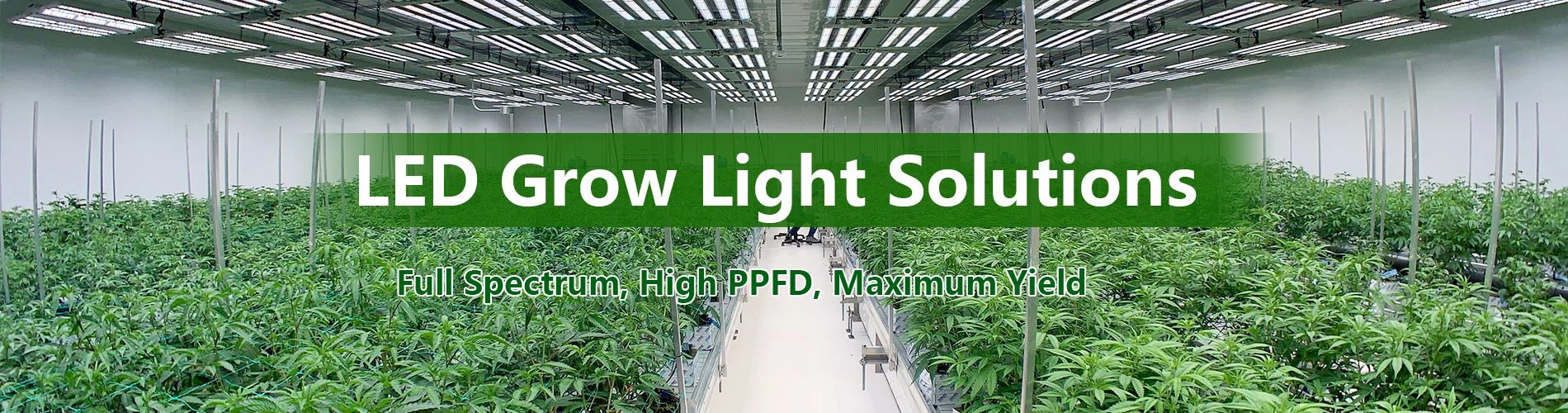
How to Avoid Costly Setup Mistakes
There has never been more interest in indoor growing - and never more confusion about how to do it well.
Walk into any commercial indoor cultivation facility today, whether it's a licensed cannabis operation in Colorado, a vertical leafy greens farm supplying a supermarket chain in Ontario, or a hydroponic herb operation running out of a repurposed warehouse in Tokyo - and the single most consequential infrastructure decision in that facility is the lighting system.
Not the nutrients. Not the genetics. Not the HVAC. It's the lighting.
Because in a fully controlled indoor environment, your plants get exactly what you give them. And if what you give them is wrong - wrong intensity, wrong spectrum, wrong uniformity - no amount of nutrients, genetics, or HVAC can fix it. This is where most indoor growing operations lose money without ever identifying the source.
There is no sunlight to compensate for a weak fixture, no warm summer day to push a struggling crop across the finish line. Every photon your plants receive comes from your indoor growing lights - and everything downstream from yield to quality to operating cost traces directly back to how well that system was designed.
This is the starting point for any indoor grower or facility planner trying to understand the full landscape of indoor cultivation lighting - what the options are, how to match them to your specific setup, and how to avoid the mistakes that silently cost yield and money across years of operation.
And here is something worth saying before we go further: indoor growing is not one thing. Cannabis cultivation, vertical farming, hydroponics, and grow tent setups all fall under the indoor growing umbrella - but they have meaningfully different lighting requirements, different economics, and different failure modes. The grower who applies vertical farm logic to a cannabis flowering room, or indoor grow room logic to a greenhouse, will consistently underperform. Getting clarity on which type of operation you're running is the first decision, not the last.


What Is Indoor Growing and Why Lighting Defines Everything
Indoor growing - also called controlled environment agriculture (CEA) - refers to any spectrum, or control system, you need to be clear aboutmarily under artificial light, in a controlled environment independent of outdoor weather, seasons, or geography.
The global CEA market was valued at approximately $67 billion in 2023 and is projected to exceed $172 billion by 2030. The growth is driven by food security concerns, the economics of local supply chains, and the consistent quality advantages that fully controlled production environments offer over field and traditional greenhouse growing.
In an indoor growing system, lighting is not one input among many. It is the primary driver of three things that determine whether your operation is profitable:
- Yield. Cannabis flowering rooms, vertical lettuce farms, and hydroponic tomato operations all share one characteristic: yield is directly proportional to the quality and quantity of light delivered to the canopy - up to the crop's light saturation point. Underlight your crop and you leave yield on the table every single cycle.
- Quality. Light-stressed crops show measurable quality decline - lower cannabinoid density in cannabis, looser head structure in lettuce, reduced flavor compounds in herbs. Inconsistent lighting produces inconsistent product, and inconsistent product loses buyers.
- Operating cost. In most commercial indoor growing operations, lighting accounts for 40–60% of total electricity consumption. The efficiency of your lighting system - measured in PPE (photon efficacy, µmol/J) - directly determines your cost per gram, cost per head, or cost per kilogram of yield. A poorly specified system doesn't just underperform once. It costs you money every operating hour for the life of the facility.
Three metrics drive every indoor growing lights decision:
PPFD (Photosynthetic Photon Flux Density, µmol/m²/s)
The density of photosynthetically active photons reaching the canopy per second. This is the primary performance metric. Not watts, not lumens. PPFD.
DLI (Daily Light Integral)
Total photon delivery over a full photoperiod. DLI = PPFD × hours × 0.0036. This is the number your crop's growth rate responds to.
PPE (µmol/J)
Photon efficacy. How much usable light you get per watt of electricity consumed. This is the efficiency number that drives your operating cost.
Most growers who come to us after a disappointing first cycle were tracking wattage. The ones who succeed are tracking PPFD, DLI, and PPE from day one. This is something most indoor grow light suppliers won't explain - because wattage is easier to sell. Sounds like a small distinction - but this is where most indoor growing operations quietly lose money before they even realize it.
Types of Indoor Growing - Which Setup Are You Running?
Before choosing a lighting, a spectrum, or a control system, you need to be clear on which type of indoor growing operation you're running. The lighting requirements, economics, and system design differ significantly across these categories - and applying the wrong framework is the most common source of costly specification errors.
Indoor Cannabis Cultivation
Indoor cannabis cultivation is the most lighting-intensive application in commercial horticulture. Cannabis has one of the steepest light response curves of any commercial crop - yield and cannabinoid density increase significantly with PPFD up to 1,200+ µmol/m²/s in CO₂-enriched environments. Getting the lighting right is not optional. It is the primary lever on both yield and product quality.
Core lighting requirements:
- Veg stage: 400–600 µmol/m²/s, 18/6 photoperiod
- Flower stage: 900–1,200 µmol/m²/s, 12/12 photoperiod
- Full spectrum with red-dominant flowering configuration
- Precise photoperiod control via grow light controller
- Under canopy lighting for lower bud site activation
What most suppliers won't tell you: the difference between a well-designed cannabis lighting system and a poorly specified one is not measured in one cycle. It compounds across every cycle for the life of the facility - in yield consistency, product grade, and energy cost per gram. We've seen operations run two full years before realizing their lighting layout was the problem the whole time. It compounds across every cycle for the life of the facility - in yield consistency, product grade, and energy cost per gram.
→ For a complete breakdown of cannabis lighting requirements, growth stage specifications, and system design, see our Cannabis Growing guide.

Vertical Farming

Vertical farming stacks multiple growing tiers within a single facility footprint - maximizing canopy area per square meter of floor space and enabling year-round production independent of geography. It is the fastest-growing segment of commercial indoor cultivation, driven by the economics of local food supply and the premium that consistent, locally grown produce commands in retail markets.
Core lighting requirements:
- Leafy greens and herbs: 200–350 µmol/m²/s
- Linear LED bar light integrated into the rack structure
- Low heat output for tight tier spacing (45–65 cm)
- IP65 rating for wet growing environments
- Zone-level control for multi-crop operations
The system integration point most operations miss: in vertical farming, indoor vertical farm lighting does not work in isolation. Rack structure, airflow between tiers, and thermal management interact directly with lighting performance. A great fixture in a poor rack integration consistently underperforms a well-integrated mid-range system. This is why we design lighting as part of a complete vertical farming system - not as a standalone product.
→ For a complete breakdown of vertical farming lighting requirements, crop-specific specifications, and rack integration, see our Vertical Farming LED Lighting guide.
Greenhouse Supplemental Lighting
Greenhouse growing occupies a distinct position in the indoor cultivation landscape - it supplements natural sunlight rather than replacing it entirely. The lighting economics are meaningfully different: lower fixture density, lower total wattage, and lower capital cost than full indoor cultivation, with the trade-off of some dependence on natural light variability.
For greenhouse operators in high-latitude locations or those targeting year-round production consistency, supplemental LED lighting closes the DLI gap that natural light cannot fill during low-light months - stabilizing crop cycles, improving winter yield, and enabling consistent product quality for buyers who need predictable supply regardless of season.
→ For a complete breakdown of greenhouse supplemental lighting, DLI gap calculation, and top lighting vs inter-lighting design, see our Greenhouse LED Grow Lights guide.

Indoor Hydroponic Growing

Hydroponic growing - soil-free cultivation in nutrient solution - is increasingly common across commercial indoor operations, from large-scale lettuce NFT systems to small-format DWC setups for herbs and speciality crops. Lighting requirements for hydroponic systems follow the same PPFD and DLI principles as for soil-based growing, but with one important difference: nutrient availability is not a limiting factor in a well-managed hydroponic system, so light is often the primary growth-limiting factor.
Core lighting requirements:
- Match PPFD to crop type (same targets as soil-based equivalents)
- Higher emphasis on uniformity - hydroponic systems often run continuous flow, meaning every plant position needs consistent light exposure
- IP65 minimum - hydroponic environments produce significant humidity and water exposure
- Full spectrum LED for broad crop flexibility
Indoor hydroponic lighting design should account for the nutrient-light interaction: at higher PPFD levels, plants in well-managed hydroponic systems can utilize more light than soil-grown equivalents at the same DLI - which means the ceiling on productivity is higher, but so is the cost of underlighting.
Indoor Grow Tent Setup
Grow tents represent the entry point for indoor growing - compact, self-contained environments designed for personal cultivation or small commercial operations. The lighting requirements are, in principle, the same as in larger commercial setups, but the scale and economics differ significantly.
Core lighting requirements:
- Quantum board LED grow lights for most tent sizes (2×2 to 4×4 ft)
- Lower total wattage but same PPFD targets at canopy
- Heat management is critical in enclosed tent environments
- Simple timer-based control is usually sufficient at this scale
The selection of indoor grow tent lights is primarily a function of tent size and crop type. For a 4×4 ft cannabis-flowering tent, a 400–600W quantum board or a small commercial LED delivering 900–1,000 µmol/m²/s at 18–24 inches is the standard specification. For vegetables and herbs in the same footprint, 200–400W at lower PPFD is typically sufficient.

LED Grow Lights for Indoor Growing - What Actually Matters
LED has become the industry standard for indoor grow room LED lights across every commercial segment - and for reasons that go well beyond energy efficiency. Understanding what actually differentiates a high-performance LED system from an underperforming one is the foundation of any good purchasing decision.

Why LED Dominates Indoor Growing
|
Factor |
LED |
HPS |
|
PPE (efficiency) |
2.5–3.4 µmol/J |
1.0–1.7 µmol/J |
|
Heat load at same PPFD |
20–30% lower |
Higher baseline |
|
Spectrum control |
Full spectrum, tunable |
Fixed, yellow-red dominant |
|
PPFD uniformity |
±10–15% (multi-bar) |
±25–35% typical |
|
Mounting flexibility |
Closer mounting, versatile |
Heat requires distance |
|
Lamp replacement |
Not required |
Every 12–18 months |
|
Lifespan |
50,000+ hours |
10,000–20,000 hours |
|
Upfront cost |
Higher |
Lower |
|
5-year operating cost |
Lower |
Higher |
If you're still comparing LED and HPS on upfront cost alone, you're looking at the wrong number. The fixture price is a one-time decision. The energy cost runs every hour, every day, for the next decade. In most commercial indoor growing operations at current energy prices, the switch from HPS to high-efficiency LED pays back in 8–18 months. After that, the energy saving is pure operating cost reduction - every month, every cycle, for the remaining life of the facility.
The Four Parameters That Actually Matter


PPFD at canopy
Not fixture output at 1 meter. Always verify at your actual mounting distance and coverage area. This is the number your plants respond to.
01
PPE
The efficiency metric. For new commercial installations in 2025, ≥2.5 µmol/J is the minimum acceptable standard. High-performance systems reach 3.0–3.4 µmol/J. The difference between 2.0 and 3.0 µmol/J at the same PPFD target is a 33% reduction in lighting electricity consumption - compounding across every operating hour.
02
Uniformity
PPFD variation across the coverage area. Target ±15% or better for commercial operations. In one project we reviewed, the center PPFD was over 1,100 µmol/m²/s - but edge zones were below 800. The grower had been blaming genetics for two cycles. It wasn't genetics. It was uniformity. This is where projects start to fail - quietly, invisibly, one harvest at a time.
03
Spectrum
The wavelength distribution of your light output. Blue light (400–500 nm) drives vegetative growth and compact structure. Red light (600–700 nm) drives flowering and fruiting. Far-red (700–800 nm) enhances photosynthetic efficiency and flowering response. Full spectrum LED with adjustable ratios gives you control that fixed-spectrum HPS cannot provide.
04
Most growers focus on wattage. The growers who consistently hit yield targets focus on these four parameters instead. Wattage tells you what you're spending. PPFD, PPE, uniformity, and spectrum tell you what you're getting.
How to Choose the Right Indoor Grow Light for Your Setup
Match Light Type to Your Growing System
|
Growing System |
Recommended Fixture Type |
Key Reason |
|
Commercial indoor room (cannabis, high-value crops) |
Foldable / modular commercial LED |
High output, superior uniformity, close mounting |
|
Vertical rack system |
Linear LED grow light bar |
Slim profile, low heat, rack-integrated |
|
Indoor grow tent |
Quantum board grow lights |
Cost-efficient, easy deployment |
|
Hydroponic bench |
Full spectrum LED bar |
Even coverage, IP65 for wet environment |
|
Propagation / tissue culture |
Low-intensity full spectrum bar |
Uniform low PPFD, blue-dominant |
Calculate Your PPFD Requirements
Start with your crop and work backward to your fixture specification. Never start with wattage.
|
Crop |
Stage |
Target PPFD |
DLI Target |
|
Cannabis |
Veg |
400–600 µmol/m²/s |
20–30 mol/m²/day |
|
Cannabis |
Flower |
900–1,200 µmol/m²/s |
40–65 mol/m²/day |
|
Lettuce / leafy greens |
Full cycle |
200–350 µmol/m²/s |
12–17 mol/m²/day |
|
Tomatoes / peppers |
Full cycle |
400–600 µmol/m²/s |
20–30 mol/m²/day |
|
Herbs / basil |
Full cycle |
250–400 µmol/m²/s |
14–20 mol/m²/day |
|
Microgreens |
Full cycle |
150–250 µmol/m²/s |
8–14 mol/m²/day |
|
Seedlings |
Propagation |
100–200 µmol/m²/s |
6–12 mol/m²/day |
|
Tissue culture |
Propagation |
50–120 µmol/m²/s |
4–8 mol/m²/day |
How far should grow lights be from plants indoors? Mounting distance determines real-world PPFD delivery. Most commercial LED grow lights are designed for 45–75 cm above canopy in high-intensity applications (cannabis flowering), and 15–35 cm for bar-format fixtures in vertical rack configurations. Always verify against the manufacturer's PPFD distribution map at your actual mounting height - not at a reference distance that doesn't match your setup.
Efficiency First - Why PPE Matters More Than Wattage
A 600W fixture at 3.0 µmol/J delivers 1,800 µmol/s of usable light. A 800W fixture at 2.0 µmol/J delivers 1,600 µmol/s - less usable light, more electricity consumed. The higher-wattage fixture underperforms the lower-wattage fixture on every metric that matters.
In a commercial indoor grow room operating 18 hours per day, 365 days per year, the difference between a 2.0 µmol/J system and a 3.0 µmol/J system delivering the same total PPFD is approximately 33% lower energy consumption. At $0.12/kWh across a 1,000 m² facility, that difference exceeds $40,000 per year.
This is the hidden reason so many indoor growing ROI calculations never show up on paper - the fixture wattage looked reasonable, but the PPE was too low, and the energy cost eroded the margin quietly, every month, for years.
Common Indoor Growing Lighting Mistakes
Most indoor growing lighting problems don't announce themselves at installation. They show up in your electricity bill and your yield data, month after month, while you're busy looking everywhere except the lighting layout. By the time most growers call us, they've already lost two or three cycles worth of potential yield. You don't have to wait that long.
Mistake 1: Buying by wattage instead of PPFD
Wattage is a consumption metric, not a performance metric. It tells you how much electricity the fixture uses - nothing about how much usable light reaches your canopy. Two fixtures at the same wattage with different PPE ratings can deliver 30–40% different PPFD at the same mounting distance. Always specify by target PPFD and verify with third-party photometric data. Most growers don't realize this until after the first cycle underperforms - and by then the system is installed. Sounds like a small detail. This is where ROI disappears.
Mistake 2: Ignoring uniformity
A high peak PPFD number in a manufacturer's spec sheet means nothing if uniformity is poor. ±35% PPFD variation across a 4×4 coverage area means your edge zones are chronically underlighted while your center zones may be approaching light saturation. Yield is limited by your weakest zones - not your average. This is where most indoor grow room operations lose 15–20% of potential yield without ever identifying the source.
Mistake 3: No grow light controller
Manual timer-based photoperiod management introduces human error, inconsistent light cycles, and wasted energy at commercial scale. A grow light controller with automated scheduling, 0–10V dimming, and environmental integration is not optional for any operation targeting consistent batch-to-batch performance. The growers who skip this step always regret it by cycle three.
Mistake 4: Treating lighting and environment as separate decisions
Indoor grow room lighting directly affects canopy temperature, transpiration rate, and humidity levels. Running lights at full intensity without HVAC and irrigation adjustments creates environmental instability that partially offsets the yield benefits of increased PPFD. Lighting and environmental control must be designed as an integrated system. This is the mistake we fix most often in indoor growing projects - and it is almost always the result of the lighting supplier and climate control supplier working independently without coordinating the system design. In one facility we redesigned, the lighting system was performing exactly as specified - but nobody had accounted for how the heat distribution from the new LED layout would affect airflow patterns in the rack system. Three tiers were running 4°C warmer than the others. The grower thought it was a climate control failure. It was a system integration failure.
Mistake 5: Using the same fixture and spectrum for every growth stage
A 1,000W commercial LED grow light delivering 1,200 µmol/m²/s run at 20% dimming for seedlings and doesn't produce the same quality of light as a purpose-built propagation fixture at 150 µmol/m²/s. The average PPFD might look similar on paper, but the uniformity, spectral balance, and heat distribution are different. Different stages benefit from different setups - and the decisions made in the propagation stage set the structural foundation for everything that follows.
How to Set Up an Indoor Grow Room Lighting System
Step 1 - Define Your Target PPFD by Crop and Stage
Use the PPFD reference table above as your starting point. Define your target for each growth stage before looking at any fixture specifications. This number - not wattage - drives every subsequent decision.
Step 2 - Design Your Layout for Uniformity
01
Coverage calculation
Multiply your target PPFD (µmol/m²/s) by your canopy area (m²) to get total µmol/s required. Divide by your fixture's verified output per unit. Add 10–15% buffer for edge losses.
02
Spacing
Fixture spacing determines uniformity. For most commercial LED grow lights, maintaining consistent spacing and avoiding irregular layouts is more important than optimizing individual fixture position.
03
Verify with photometric data
Always request IES files or third-party PPFD distribution maps from your supplier - not just peak output numbers. A fixture's real-world uniformity across your actual coverage area is the number that matters, not the center-point PPFD at a reference distance.
04
How to set up indoor grow lights
Properly means running a photometric simulation of your actual room geometry before purchasing - not after. This is a service any serious indoor grow lights manufacturer should provide as part of the specification process.
Step 3 - Integrate Your Controller
At commercial scale, a grow light controller indoor system handles:
Photoperiod automation
Precise on/off scheduling eliminates the human error and timer drift that causes light cycle inconsistency. For cannabis, even a 15-minute deviation in the dark period can cause stress responses in sensitive strains.
0–10V dimming
Allows intensity adjustment by growth stage without changing fixtures - running at 30–40% for propagation, ramping to 100% for peak flowering. This also enables gradual intensity transitions that reduce plant stress when moving between rooms.
Zone control
In multi-room or multi-crop facilities, independent zone scheduling and dimming allows simultaneous management of different growth stages without manual intervention.
Environmental integration
Advanced systems link lighting schedules with HVAC, CO₂, and irrigation - automatically adjusting environmental parameters when light intensity changes. This is the difference between a grow room that runs smoothly and one that requires constant manual management.
Indoor Growing Lighting Cost and ROI
The Numbers That Drive the Decision
In most commercial indoor grow lights applications, lighting represents 40–60% of total electricity consumption. The efficiency of your system compounds across every operating hour - making PPE the single most important specification for long-term profitability.
Representative 5-year cost comparison for a 500 m² commercial indoor grow room (18 hours/day, $0.12/kWh, targeting 900 µmol/m²/s for cannabis flowering):
|
System |
PPE |
Annual Energy Cost |
5-Year Energy Cost |
|
Legacy HPS (1.5 µmol/J) |
1.5 µmol/J |
~$131,400 |
~$657,000 |
|
Standard LED (2.5 µmol/J) |
2.5 µmol/J |
~$78,840 |
~$394,200 |
|
High-efficiency LED (3.2 µmol/J) |
3.2 µmol/J |
~$61,600 |
~$308,000 |
|
Saving (HPS → high-efficiency LED) |
- |
~$69,800/year |
~$349,000 over 5 years |
Calculation basis: 500 m² canopy, 900 µmol/m²/s target, fixture count derived from PPE and output, 18hr/day, 365 days. Actual results vary by facility design and local energy rates.
This is the hidden reason so many indoor growing ROI projections never materialize - the fixture looked affordable, the wattage seemed reasonable, but the PPE was too low, and the energy cost eroded the margin quietly, every single month.
If you're running a legacy HPS system and these numbers don't immediately trigger an upgrade evaluation, run the same calculation with your actual energy rate. In markets above $0.15/kWh - which includes most of Europe and many US states - the annual saving from upgrading to high-efficiency LED exceeds $80,000 on a 500 m² operation. Payback periods of 8–14 months are common.
Indoor Growing vs Greenhouse Growing - How to Choose
For operators evaluating whether to build an indoor grow room or invest in greenhouse production, the decision framework comes down to crop type, location, and production model.
|
Factor |
Indoor Growing |
Greenhouse Growing |
|
Light source |
100% artificial |
Natural + supplemental LED |
|
Energy cost per m² |
Higher |
Lower |
|
Location flexibility |
Any location, any climate |
Climate/geography dependent |
|
Seasonal variation |
None |
Exists |
|
Crop density |
High (multi-tier possible) |
Single canopy |
|
Best crops |
Cannabis, leafy greens, herbs, microgreens |
Tomatoes, cucumbers, peppers, flowers |
|
Yield consistency |
Very high |
Moderate-high |
|
Capital cost per m² |
Higher |
Lower |
|
Year-round production |
Yes |
Yes (with supplemental lighting) |
The practical decision: if your crop is cannabis, leafy greens, herbs, or microgreens - and you need complete environmental control and location independence - indoor growing almost always makes more sense. If your crop is a fruiting vegetable or ornamental that benefits from natural light contribution and doesn't require multi-tier density, greenhouse production typically offers better economics.
Most large-scale commercial operations don't choose between the two - they use indoor growing for high-value, high-density crops, and greenhouse production for fruiting vegetables and ornamentals.
→ For a complete breakdown of greenhouse supplemental lighting and how it compares to full indoor cultivation, see our Greenhouse LED Grow Lights guide.
Indoor Growing Projects
In indoor growing projects we've worked on - from 200 m² single-room operations to multi-facility commercial networks - the pattern is consistent: the operations that perform well didn't just buy good fixtures. They designed good systems. The ones that struggle almost always made the same mistake: they specified lighting in isolation, without thinking about how it interacts with everything else in the room. Here is what that looks like in practice - and what a different approach delivers.

Commercial Indoor Cannabis Facility
A mid-to-large licensed indoor cannabis operation originally running 1,000W DE HPS across all flowering rooms. Primary issues: excessive heat load overwhelming HVAC capacity, ±35% PPFD variation producing inconsistent canopy, and energy costs running significantly above projections.
Lighting solution: 800W commercial LED grow lights, PPE 2.8–3.0 µmol/J, targeting 900–1,200 µmol/m²/s at canopy, full 0–10V dimming integration with existing environmental controls.
→ For the complete breakdown of this project and cannabis lighting system design, see our Cannabis Growing guide.
Commercial Vertical Farm - Canada (Leafy Greens)
A licensed vertical farm producer focused on lettuce, mixed greens, and herbs for local supermarket supply. Originally running T5 fluorescent lighting - adequate at construction, but increasingly uncompetitive as energy costs rose and yield consistency requirements tightened.
Lighting solution: Linear LED grow light bars, full spectrum with blue-enhanced ratio, PPE 2.6 µmol/J, 250–300 µmol/m²/s at canopy, 16-hour photoperiod, zone-level control.
|
Metric |
Before |
After (LED Bar) |
|
PPE |
~0.9 µmol/J |
2.6 µmol/J |
|
PPFD uniformity |
±25–30% |
±10–12% |
|
Lighting energy |
100% baseline |
↓ ~65% |
|
Yield per m² |
Baseline |
↑ 20–28% |
|
Payback period |
- |
~16 months |
→ For the complete breakdown of this project and vertical farming lighting system design, see our Vertical Farming LED Lighting guide.

FAQ
Q: How much light do indoor plants need?
A: It depends entirely on the crop. Cannabis flowering: 900–1,200 µmol/m²/s. Leafy greens: 200–350 µmol/m²/s. Tomatoes and peppers: 400–600 µmol/m²/s. Herbs: 250–400 µmol/m²/s. Microgreens: 150–250 µmol/m²/s. Seedlings: 100–200 µmol/m²/s. Always verify at canopy height with a PAR meter - not from fixture spec sheets measured at a fixed reference distance.
Q: What is the best grow light for indoor growing?
A: There is no single best fixture - the right specification depends on your crop, growing system, and scale. Commercial foldable LED for cannabis and high-value crops. Linear LED bar for vertical racks. Quantum board for grow tents. Full spectrum IP65 bar for hydroponics. In all cases, PPE ≥ 2.5 µmol/J, ±15% uniformity or better, and verified third-party photometric data are baseline requirements.
Q: How far should grow lights be from plants indoors?
A: For high-intensity commercial LED (cannabis flowering): 45–75 cm above canopy. For bar-format LED in vertical racks: 15–35 cm. For quantum boards in grow tents: 30–60 cm depending on intensity. Always verify against the PPFD distribution map at your actual mounting height - the right distance is the one that delivers your target PPFD at your canopy, not a generic recommendation.
Q: How many hours should grow lights be on indoors?
A: Cannabis vegetative stage: 18 hours on / 6 hours off. Cannabis flowering: 12 hours on / 12 hours off. Leafy greens and herbs: 16–18 hours. Seedlings and propagation: 18–20 hours. Tissue culture: 16–24 hours depending on species. Consistency matters more than exact hours - use a reliable controller, not a manual timer.
Q: What's the difference between indoor grow lights and regular lights?
A: Regular lights are designed for human vision - they produce lumens, which measure brightness as humans perceive it. Indoor grow lights are designed for plant photosynthesis - they produce PPFD, which measures photons in the wavelength range plants can use (400–700 nm). A bright regular light can appear intense to human eyes but deliver almost no usable photons for plant growth. This is why wattage and lumens are irrelevant metrics for indoor growing - PPFD is the only number that matters.
Q: How do I choose between different types of LED grow lights for indoor growing?
A: Match fixture type to growing system first. Then specify by target PPFD for your crop. Then evaluate PPE for efficiency. Then verify uniformity with photometric data. Price should be the last consideration - a low-cost fixture that delivers 20% less PPFD than specified, or with 35% uniformity variation, costs far more in lost yield than the price difference would suggest.
Q: Is indoor growing more expensive than greenhouse growing?
A: Per square meter of canopy, yes - primarily due to lighting energy cost. Indoor growing requires 100% artificial light; greenhouse growing supplements natural light. However, indoor growing enables multi-tier cultivation, complete environmental control, and location independence that greenhouse growing cannot match. For high-density, high-value crops in controlled environments, the higher energy cost is offset by a higher yield per square metre and superior consistency.
Q: What certifications should indoor grow lights have?
A: For US commercial installations: ETL or UL listing, IP65 for wet environments, DLC horticultural listing for utility rebate eligibility. For Canadian operations: ETL/CSA dual listing. For EU markets: CE and RoHS. Any credible indoor grow lights factory or commercial indoor grow lights supplier operating at commercial scale should provide third-party test reports on request - not just self-reported specifications.
Most lighting mistakes don't show up during installation - they show up in your electricity bill and your yield data, month after month, while the system runs exactly as it was incorrectly specified.
If you already have a layout in mind, send it over. We'll tell you - very directly - whether it will work, or where it will fail. We review layouts regularly and we know what the common failure points look like before they become expensive problems.
That conversation usually saves people a lot more than the cost of the lights. Send us your grow room dimensions, crop type, and target PPFD - and we'll show you what most suppliers miss.