


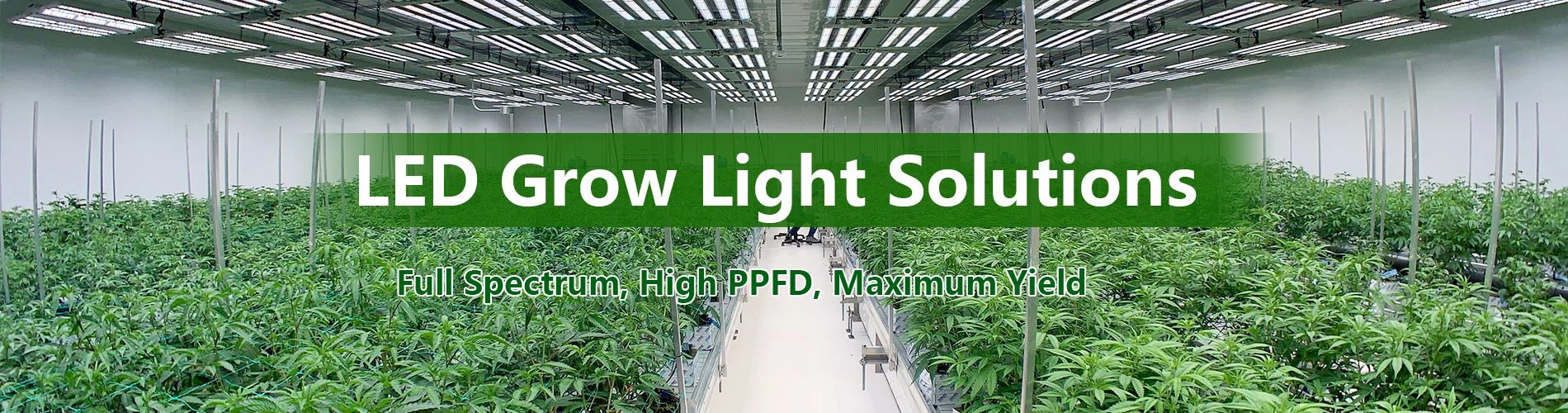
Walk into any modern vertical farm - whether it's a 500 m² urban leafy greens operation or a 5,000 m² commercial facility supplying supermarket chains - and the first thing you notice is the light. Row after row of glowing LED bars, stacked four, six, eight tiers high, running 16–18 hours a day, every day of the year.
That light is not decoration. It is the farm. And here is something most lighting suppliers will never tell you: in vertical farming, the light fixture alone does not determine your yield. Rack structure, airflow between tiers, and thermal behavior across shelf levels matter just as much. This is why we don't design lights as standalone products - we design them as part of a complete vertical farming system. Most problems we get called in to fix were caused by suppliers who ignored this.
In a vertical farming system, there is no sunlight, no seasons, no weather. Every photon your crop receives comes from your lighting system. Which means every yield outcome - how fast plants grow, how uniform the harvest is, how much energy you burn per kilogram of product - traces directly back to how well your vertical farming LED lighting is designed.

What Is Vertical Farming and Why Lighting Is Everything
Vertical farming is controlled environment agriculture (CEA) taken to its logical conclusion. Instead of spreading crops across a single horizontal plane, plants are grown on multiple stacked tiers - maximizing canopy area per square meter of floor space, minimizing land use, and enabling year-round production independent of geography or climate.
The global vertical farming market was valued at approximately $5.5 billion in 2023 and is projected to exceed $35 billion by 2030, driven by food security concerns, urbanization, and the economics of local food supply chains. Commercial operators across North America, Europe, and Asia are scaling rapidly - and lighting infrastructure is the central investment decision in every new build.
Here is why lighting dominates everything else in a vertical farm:
1. No natural light input. Unlike greenhouses, which supplement sunlight, vertical farms replace it entirely. There is no backup. If the lighting system underperforms, there is nothing to compensate.
2. Energy cost is the primary operating expense. In a typical commercial vertical farm, lighting accounts for 40–60% of total electricity consumption. A poorly specified system does not just underperform - it bleeds money every operating hour for the life of the facility.
3. Uniformity determines consistency. In vertical farming, crop consistency is everything. Buyers - supermarkets, food service operators, meal kit companies - require predictable sizing, color, and quality batch after batch. That consistency starts with uniform light distribution across every shelf, every tier, every cycle.
Three metrics drive every lighting decision in commercial vertical farming lighting:
1. PPFD (µmol/m²/s) - the density of photosynthetically active photons reaching the canopy per second. This is the primary performance metric. Not watts. Not lumens.
2. DLI (mol/m²/day) - total photon delivery over a full day. DLI = PPFD × photoperiod hours × 0.0036. This is the number that determines whether your crop consistently meets its growth targets.
3. PPE (µmol/J)- photon efficacy, the efficiency of your fixture. Higher PPE means more usable light per watt of electricity. In an indoor vertical farm setup running 18 hours a day, PPE differences compound into enormous cost differences over time.
How Vertical Farming LED Lighting Is Different from Standard Grow Lights
Not all grow lights are suitable for vertical farming. The physical and thermal constraints of multi-tier rack systems make fixture selection fundamentally different from a single-canopy indoor grow room.
1. Why HPS and CMH Do Not Work in Vertical Farms
High-pressure sodium and ceramic metal halide fixtures generate significant radiant heat concentrated directly below the fixture. In a single-tier room with 3–4 meters of ceiling height, this heat dissipates before reaching the canopy. In a vertical rack with 60–80 cm of tier spacing, it does not.
The consequences are direct: heat stress on plants in the tier immediately below, elevated ambient temperature across all tiers, and HVAC systems fighting a losing battle against concentrated heat sources in a confined space. Beyond heat, the physical form factor of HPS and CMH fixtures - designed for open single-canopy rooms - makes integration into rack structures impractical.
Vertical farming requires low-profile, low-heat, high-efficiency fixtures designed specifically for close-range, multi-tier application. This is where linear LED grow lights for vertical farming became the industry standard.
2. Linear LED vs Foldable Commercial LED - Key Differences
|
Factor |
Linear / Bar LED |
Foldable Commercial LED |
|
Form factor |
Slim bar, 30–150 cm length |
Multi-bar folding panel |
|
Mounting |
Underside of shelf, rack-integrated |
Overhead suspension |
|
Heat output |
Very low (passive cooling) |
Low-moderate |
|
PPFD uniformity |
Excellent across shelf width |
Good for open canopy |
|
Tier spacing required |
50–80 cm |
80–120 cm minimum |
|
Best application |
Vertical racks, multi-tier |
Single canopy, high PPFD rooms |
|
Typical wattage |
18W–80W per bar |
240W–800W per fixture |
For vertical farming, LED grow light bars or T8 LED grow lights in rack-integrated configurations deliver the combination of slim profile, low heat, and excellent shelf-width uniformity that multi-tier systems require. Full spectrum LED grow light bars with optimized blue-red ratios are now the default specification for new commercial vertical farm builds globally.
In most vertical farm projects we've redesigned, the fixture spec was fine. The problem was how it was integrated into the rack. Sounds like a small detail - but this is where yield consistency disappears.
3. Tier Spacing and Fixture Selection
Tier spacing - the distance from one shelf surface to the underside of the shelf above - is one of the most consequential design decisions in a vertical farm. It determines plant canopy height, airflow volume per tier, and the effective mounting distance of your lighting. Typical tier spacing ranges:
|
Crop Type |
Recommended Tier Spacing |
Notes |
|
Leafy greens/lettuce |
45–60 cm |
Compact canopy, short cycle |
|
Herbs/basil |
50–65 cm |
Slightly taller canopy |
|
Microgreens |
35–50 cm |
Very compact, fast cycle |
|
Strawberries |
65–80 cm |
Taller canopy, fruiting structure |
|
Seedlings/propagation |
35–50 cm |
Low intensity, compact |
Fixture mounting distance (shelf underside to canopy top) directly affects PPFD delivery. Most multi layer grow light systems using bar-format LEDs are designed for 15–35 cm mounting distance, delivering target PPFD without the intensity falloff that affects larger panel fixtures at the same distance.
Vertical Farming LED Lighting Requirements by Crop
Matching your vertical farming grow lights to your specific crop is not optional - it is the difference between a profitable operation and one that perpetually misses yield targets. Each crop has distinct PPFD, DLI, spectrum, and photoperiod requirements.
Leafy Greens and Lettuce
Lettuce and leafy greens are the dominant crop in commercial vertical farming globally - fast cycle times (21–35 days), predictable demand, and relatively forgiving light requirements make them the economic foundation of most operations.
|
Parameter |
Recommended Range |
|
PPFD |
200–350 µmol/m²/s |
|
DLI |
12–17 mol/m²/day |
|
Photoperiod |
16–18 hours |
|
Spectrum |
Blue-enhanced full spectrum |
|
CO₂ enrichment |
800–1,200 ppm for maximum response |
LED grow lights for lettuce(LED tube grow light) in vertical farm configurations typically use full spectrum bars with a blue-enhanced ratio (R:B ~2:1 to 3:1). Blue light at 400–500 nm promotes compact leaf structure, prevents tip burn, and supports stomatal regulation - critical for the dense, humid microclimate inside vertical racks.
This is something many vertical farming LED lighting suppliers won't tell you upfront: targeting the upper end of the PPFD range (350 µmol/m²/s) without extending photoperiod to match. The DLI target matters more than instantaneous PPFD. Running at 250 µmol/m²/s for 18 hours delivers a DLI of 16.2 mol/m²/day - well within the optimal range - while running at 350 µmol/m²/s for 12 hours delivers only 15.1 mol/m²/dayincreases the risk of bolting risk in some varieties.
For cannabis vertical farming specifically, lighting requirements differ significantly from leafy greens. See our Cannabis Growing guide for a complete breakdown.

Herbs and Microgreens

Herbs (basil, cilantro, mint, chives) and microgreens are high-value, fast-cycle crops increasingly popular in vertical farm product mixes. Their compact canopy height makes them ideal for tight-spaced rack configurations.
|
Parameter |
Herbs |
Microgreens |
|
PPFD |
250–400 µmol/m²/s |
150–250 µmol/m²/s |
|
DLI |
14–20 mol/m²/day |
8–14 mol/m²/day |
|
Photoperiod |
14–18 hours |
12–16 hours |
|
Cycle time |
21–40 days |
7–14 days |
LED grow lights for microgreens(LED tube grow light) in vertical configurations prioritize uniformity above intensity - microgreen trays cover the entire shelf surface, so any PPFD variation directly produces uneven germination and growth across the tray. Target ±10% uniformity or better for commercial microgreen production.
Basil, in particular, benefits from higher blue-to-red light ratios during early growth to control internode length. Without adequate blue, basil stretches rapidly in vertical rack environments, reducing yield quality and creating canopy management problems.
Strawberries
Vertical strawberry cultivation is a growing segment in commercial CEA, driven by premium pricing and year-round supply potential. Strawberry vertical farm lighting is more demanding than leafy greens - both in PPFD requirements and in the importance of spectrum management across the fruiting cycle.
|
Parameter |
Vegetative |
Flowering / Fruiting |
|
PPFD |
200–350 µmol/m²/s |
300–500 µmol/m²/s |
|
DLI |
12–18 mol/m²/day |
17–25 mol/m²/day |
|
Spectrum |
Blue-dominant |
Red-dominant, far-red addition |
|
Photoperiod |
16–18 hours |
12–16 hours (variety-dependent) |
Far-red light (700–800 nm) plays a significant role in strawberry flowering and fruit development, triggering the photoperiod response and improving fruit set in day-neutral varieties. Full spectrum LED grow lights for vegetables with adjustable far-red channels are increasingly specified for commercial strawberry vertical farm operations.
Tier spacing for strawberries requires more headroom than leafy greens - 65–80 cm minimum - which reduces tier count per meter of rack height but is necessary to accommodate the fruiting canopy structure.

Seedlings and Tissue Culture

Propagation and tissue culture lighting represent a specialized segment within vertical farming - lower intensity, highly controlled spectrum, and extreme uniformity requirements.
|
Parameter |
Seedlings |
Tissue Culture |
|
PPFD |
100–200 µmol/m²/s |
50–120 µmol/m²/s |
|
DLI |
6–12 mol/m²/day |
4–8 mol/m²/day |
|
Spectrum |
Blue-dominant (400–500 nm) |
Blue-dominant, low intensity |
|
Photoperiod |
16–20 hours |
16–24 hours |
Blue-dominant spectrum at this stage is critical. Blue light drives compact shoot development, strong root initiation, and controlled internode spacing. LED grow lights for vegetative growth at the seedling stage lay the structural foundation that determines performance throughout the production cycle - getting this wrong is expensive, because the consequences show up weeks later.
In tissue culture applications, consistency of light intensity across the culture vessel is more important than raw PPFD level. Even minor variation (±15%) across culture vessels causes batch inconsistency that propagates through the entire downstream production chain.
Common Vertical Farming Lighting Mistakes That Kill Your Yield
Most vertical farm lighting problems are not obvious at installation. They show up two or three cycles in - and by then, the racks are full, the system is locked in, and fixing it is expensive. We've redesigned systems where growers had already lost 15–25% yield for six months without knowing why. Most clients come to us after two or three failed cycles. You don't have to wait that long.
Mistake 1: Specifying by wattage instead of PPFD
Wattage tells you how much electricity a fixture consumes. It tells you nothing about how much usable light reaches your canopy. Two fixtures with identical wattage but different PPE ratings can deliver 30–40% different PPFD at the same mounting distance. In a vertical farm running 18 hours a day, that gap compounds into a significant yield difference over a production year. Always specify by target PPFD, verify with third-party photometric data - not manufacturer spec sheets.
01
Mistake 2: Ignoring uniformity in favor of peak output
A fixture with 350 µmol/m²/s center PPFD and ±30% variation delivers 245 µmol/m²/s at the edges. For leafy greens, that edge zone is chronically underlighted - plants grow slower, heads are smaller, and harvest grades are mixed. This is where many vertical farms lose 15–20% of potential yield without ever identifying the cause. They assume it is a variety issue or a nutrition issue. It is a lighting uniformity issue. This is where most vertical farms quietly lose money - and most lighting suppliers never flag it.
02
Mistake 3: Using the same spectrum for every crop and every stage
A full spectrum bar that works well for lettuce vegetative growth may not be optimal for basil, strawberry flowering, or microgreen germination. In operations growing multiple crops on the same rack system, spectrum flexibility - either through tunable fixtures or dedicated bars per crop zone - delivers measurably better results than a one-size-fits-all approach.
03
Mistake 4: Underestimating tier heat accumulation
Even low-heat LED lighting accumulate thermal load in a closed vertical rack environment. Without adequate airflow design between tiers, the upper tiers run 3–5°C warmer than the lower tiers. For temperature-sensitive crops like lettuce and basil, this differential translates directly into inconsistent growth rates, increased tip burn incidence, and batch quality variation across shelf positions. Lighting selection and HVAC design must be treated as a single integrated problem - not two separate purchasing decisions.
04
Mistake 5: No controller integration
Manual photoperiod management at commercial scale introduces human error, inconsistent light cycles, and wasted energy. A properly integrated vertical rack LED lighting system with zone-level control, automated scheduling, and 0–10V dimming is not a luxury - it is baseline infrastructure for any operation targeting consistent batch-to-batch performance.
When choosing a vertical farming LED lighting manufacturer, ask: Do they design for the system or just for the grow lights? Most suppliers only answer for the grow lights. That's where the problems start.
05
How to Design a Vertical Farming LED Lighting System
Step 1 - Calculate Your PPFD and DLI Requirements
Start with your target crop and work backwards to your lighting specification. The formula is straightforward:
DLI = PPFD × Photoperiod (hours) × 0.0036
Example for commercial lettuce:
- Target DLI: 14 mol/m²/day
- Planned photoperiod: 16 hours
- Required PPFD: 14 ÷ (16 × 0.0036) = 243 µmol/m²/s
This means a fixture delivering 250 µmol/m²/s on average across the shelf at your mounting distance meets your target - and you do not need to overspec to 350 µmol/m²/s, which would waste energy and unnecessarily increase heat load.
How many lights per shelf in a vertical farm? Calculate total µmol/s required (PPFD target × shelf area in m²), then divide by your fixture's verified output per unit. For a 1.2m × 2.4m shelf targeting 250 µmol/m²/s, total requirement is approximately 720 µmol/s - typically met by 2–3 bar fixtures depending on individual fixture output.
Step 2 - Choose the Right LED Grow Lights Type
|
Fixture Type |
Best Application |
Key Advantage |
Avoid When |
|
T8 LED grow light (4ft) |
Standard rack systems |
Easy replacement, wide availability |
Custom shelf widths |
|
Custom LED grow light bar |
Purpose-built facilities |
Optimized for exact shelf dimensions |
Budget-constrained projects |
|
Grow light strip |
Supplemental / low-intensity tiers |
Very compact, flexible |
Primary light source for high-PPFD crops |
|
Full spectrum T8 LED |
Multi-crop operations |
Balanced spectrum, consistent output |
Single-crop optimized facilities |
IP65 waterproof LED grow lights are the standard specification for commercial vertical farm fixtures - not optional. Irrigation, humidity management, and cleaning protocols in vertical farm environments create wet conditions that non-rated fixtures cannot reliably withstand. Any serious vertical farming lighting supplier should offer IP65-rated fixtures as a baseline.
Step 3 - Plan Your Rack and Light Integration
Fixture placement relative to shelf structure determines real-world performance more than fixture spec alone. In most commercial vertical farm configurations, LED bars are mounted on the underside of each shelf, directing light downward to the canopy below.
Key integration decisions:
- Mounting distance: Most bar fixtures perform optimally at 15–30 cm above the canopy. Verify PPFD at your actual mounting distance - not at the manufacturer's reference distance.
- Cable management: In multi-tier racks with 6–8 shelves per bay, cable routing and connection points need to be planned before installation. Retrofitting cable management after rack assembly is expensive and disruptive.
- Zone control: Large facilities with multiple crop types and growth stages benefit from zone-level dimming and scheduling. Properly setting up lighting for a vertical farm means treating each crop zone as an independent light environment - not running the entire facility on a single schedule.
- Airflow integration: LED bar position affects airflow patterns between tiers. Fixtures mounted flush to the shelf underside reduce airflow restriction compared to fixtures with significant depth profile. In tight tier-spacing configurations (45–55 cm), this matters.
Vertical Farming LED Lighting Efficiency and ROI
Energy Cost Is the Number That Compounds
n a commercial vertical farm operating 365 days a year, lighting efficiency is not a specification detail - it is the primary driver of long-term profitability. The difference between a 2.0 µmol/J system and a 3.0 µmol/J system at the same PPFD target is a 33% reduction in lighting energy consumption. At commercial scale, that is a significant annual saving.
Representative 5-year energy cost model for a 1,000 m² vertical farm (18 hours/day, $0.12/kWh, targeting 250 µmol/m²/s for leafy greens):
|
System |
PPE |
Annual Energy Cost |
5-Year Energy Cost |
|
Legacy fluorescent T5 |
~0.9 µmol/J |
~$87,600 |
~$438,000 |
|
Standard LED (2.0 µmol/J) |
2.0 µmol/J |
~$39,420 |
~$197,100 |
|
High-efficiency LED (3.0 µmol/J) |
3.0 µmol/J |
~$26,280 |
~$131,400 |
|
Saving (standard → high-efficiency) |
- |
~$13,140/year |
~$65,700 over 5 years |
Calculation basis: 1,000 m² canopy, 250 µmol/m²/s target, fixture count and wattage derived from PPE and output. Actual results vary by facility design and local energy rates.
For operations currently running T5 fluorescent lighting - still common in older vertical farm installations - the case for upgrading to high-efficiency LED grow lights for vertical farming is straightforward. Payback periods of 12–24 months are typical, depending on energy rates and fixture pricing.
If you're not sure whether your current lighting layout is already costing you yield, send us your shelf size and crop type - we'll show you exactly where the loss is coming from, before you commit to any new equipment.
Vertical Farming LED Lighting Projects
When we design lighting systems for vertical farm facilities - and we've worked on projects from 200 m² urban farms to 8,000 m² commercial operations - the first question is never "which fixture?" It is always: what crop, what tier spacing, what DLI target, and what does your energy budget look like per kilogram of yield. Here are two projects that show what that process looks like in practice.
A licensed vertical farm producer focused on lettuce, mixed greens, and herbs for local supermarket supply. The facility was originally built with T5 fluorescent lighting - adequate at the time of construction, but increasingly uncompetitive as energy costs rose and yield consistency requirements tightened.
System upgrade: Linear LED grow light bars, full spectrum with blue-enhanced ratio, PPE 2.6 µmol/J, targeting 250–300 µmol/m²/s at canopy, 16-hour photoperiod, zone-level 0–10V dimming control integrated with environmental management system.
|
Metric |
Before |
After (LED Bar System) |
|
PPE |
~0.9 µmol/J |
2.6 µmol/J |
|
PPFD uniformity |
±25–30% |
±10–12% |
|
Lighting energy |
100% baseline |
↓ ~65% |
|
Crop cycle time |
Baseline |
↓ 2–3 days (improved DLI consistency) |
|
Yield per m² |
Baseline |
↑ 20–28% |
|
Tip burn incidence |
Moderate |
Significantly reduced |
|
Payback period |
- |
~16 months |
The yield improvement came primarily from uniformity, not intensity. The T5 system had sufficient average PPFD but ±30% variation - meaning edge zones were chronically underpowered. Switching to bar-format LEDs with ±11% uniformity brought the entire shelf into the optimal growth range simultaneously.

Vertical Farming vs Greenhouse Lighting - Key Differences
Understanding how vertical farming LED lighting differs from greenhouse supplemental lighting helps facility planners make the right infrastructure investment for their specific production model.
|
Factor |
Vertical Farming |
Greenhouse Growing |
|
Light source |
100% artificial (LED) |
Natural light + LED supplemental |
|
PPFD dependency |
Entirely from fixtures |
Partially from sunlight |
|
Energy cost |
Higher (full replacement lighting) |
Lower (supplemental only) |
|
Seasonal variation |
None (fully controlled) |
Exists (natural light varies) |
|
Location flexibility |
Any location, any climate |
Requires a suitable climate or significant heating |
|
Crop density |
Very high (multi-tier) |
Single canopy, lower density |
|
Capital cost |
Higher per m² canopy |
Lower per m² canopy |
|
Yield consistency |
Very high (controlled) |
Moderate (weather-dependent) |
|
Best for |
Leafy greens, herbs, microgreens |
Tomatoes, cucumbers, peppers, flowers |
The core distinction is this: vertical farming trades higher energy cost for total environmental control and maximum space efficiency. Greenhouse growing trades lower energy cost for dependence on natural light variability. For a complete breakdown of greenhouse growing, see our Greenhouse LED Grow Lights guide.
For crops like leafy greens and herbs - with short cycles, consistent demand, and high value per square meter - vertical farming economics work well. For fruiting crops like tomatoes and peppers, which require higher PPFD, longer cycles, and benefit from natural light, greenhouse production typically offers better economics at scale.
This is why most commercial operations choose their production model based on crop first - not facility preference.
FAQ
Q: What PPFD do I need for vertical farming?
A: It depends on your crop. Leafy greens and lettuce: 200–350 µmol/m²/s. Herbs and basil: 250–400 µmol/m²/s. Microgreens: 150–250 µmol/m²/s. Strawberries: 300–500 µmol/m²/s. Seedlings: 100–200 µmol/m²/s. Always verify at canopy height with a PAR meter - not from fixture spec sheets measured at a fixed reference distance.
Q: How many LED lights do I need per shelf in a vertical farm?
A: Calculate your target PPFD × shelf area (m²) to get total µmol/s required. Divide by your fixture's verified output per unit. For a standard 1.2m × 2.4m shelf targeting 250 µmol/m²/s, you need approximately 720 µmol/s total - typically 2–3 bar fixtures depending on individual output. Always run a photometric simulation for the actual shelf geometry before ordering.
Q: What is the best LED light for vertical farming leafy greens?
A: A linear LED grow light bar with full spectrum output, blue-enhanced ratio (R:B ~2:1 to 3:1), PPE ≥ 2.5 µmol/J, ±10–15% PPFD uniformity across shelf width, and IP65 rating. Verify performance with third-party photometric data, not manufacturer-reported numbers only.
Q: What's the difference between T8 LED grow lights and bar-style LED for vertical farms?
A: T8 LED grow lights use standard tube form factor (typically 4ft/1.2m) and can be used in standard fluorescent fixture housings - making them a cost-effective retrofit option. Custom bar-style LEDs are purpose-designed for specific shelf widths, often with integrated mounting and optimized optics for closer mounting distances. For new builds, custom bar-format typically outperforms T8 on uniformity and installation efficiency. For retrofits, T8 LED grow lights offer a lower-cost upgrade path with minimal structural changes.
Q: Do vertical farming LED lights need to be waterproof?
A: Yes - IP65 rating is the baseline for commercial vertical farm environments. Irrigation, humidity management, condensation, and regular cleaning all create wet conditions that non-rated fixtures cannot reliably handle. IP65 waterproof LED grow lights are standard specification for any serious commercial installation.
Q: How much does vertical farming lighting cost to operate?
A: At $0.12/kWh with a high-efficiency LED system (3.0 µmol/J) targeting 250 µmol/m²/s for 18 hours/day, a 1,000 m² operation spends approximately $26,000–$30,000 per year on lighting electricity. Legacy fluorescent systems at the same PPFD target spend roughly 3× that amount. The efficiency gap is the primary financial argument for LED in any new build or retrofit.
Q: What certifications should vertical farming LED fixtures have?
A: For US commercial installations: ETL or UL listing for electrical safety, IP65 for wet environment protection, and DLC horticultural listing for utility rebate eligibility. For Canadian operations: ETL/CSA dual listing. For EU markets: CE and RoHS. Any credible vertical farming lighting factory operating at commercial scale should provide third-party test reports on request.
Q: How does vertical farming lighting compare to greenhouse lighting?
A: Vertical farming uses 100% artificial light – a higher energy cost but complete environmental control and location flexibility. Greenhouse lighting supplements natural sunlight – lower energy cost but subject to seasonal variation and geographic constraints. The right choice depends on your crop mix, target market, location, and capital budget - not a universal preference.
Planning a vertical farm lighting system? Share your crop mix, shelf dimensions, tier count, and target DLI - Planning a vertical farm lighting system? Most of the yield losses we see - typically 15–30% below potential - trace back to lighting decisions made at the specification stage, not the growing stage. If you're not sure your current spec is right, send us your shelf dimensions, crop mix, and tier count. We'll review it and show you what most suppliers miss. As a vertical farming LED lighting manufacturer working directly with commercial operations, we can usually spot the issue within 24 hours - before it costs you a full cycle.