


For buyers sourcing LED grow lights from China, the real question isn't price. It's whether the factory behind the product is actually controlling the things that determine long-term performance - or just assembling components and hoping for the best.
Here's what we do differently, and why it matters.
How We Build Our Lights
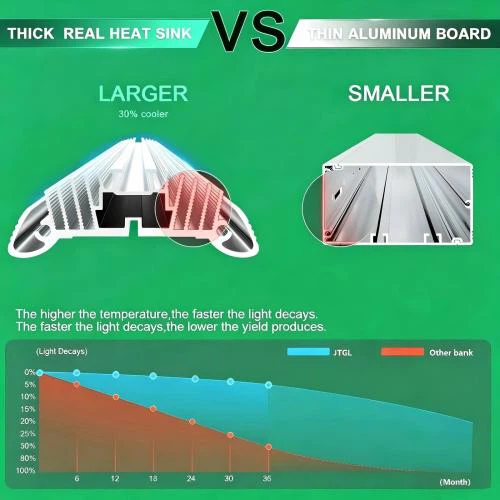
Heat is the primary reason LED grow lights fail or degrade before their rated lifespan. When chips run hot, lumen output drops, spectrum shifts, and driver components wear faster.
We use thickened aluminum alloy housings with extended heat dissipation fins across our light range. The design pulls heat away from the chip junction more efficiently than standard-thickness housings, which means chips run cooler, hold their output longer, and don't drift spectrally over time.
This isn't a premium feature on select models. It's how we build all of our commercial LED grow lights.
Running Chips at 70% Rated Power
Most LED manufacturers push chips as hard as possible to hit output numbers. We deliberately don't.
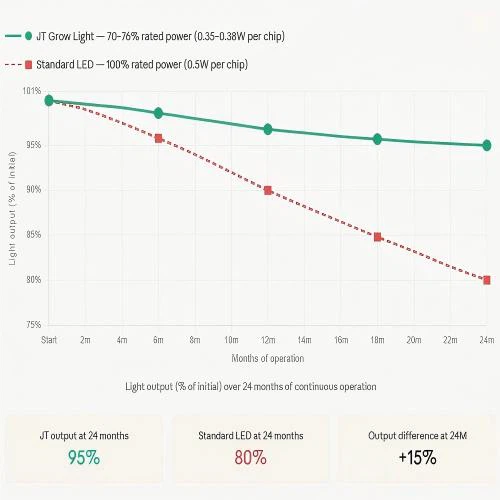
Each chip in our lights is rated at 0.5W. We run them at 0.35W - 70% of rated power. A chip operating below its thermal and electrical limits maintains its lumen output and spectral consistency far longer than one running at full load. This is why our fixtures maintain stable light output over time, without the gradual drop-off that growers notice in cheaper fixtures after 12–18 months.
It's a deliberate trade-off: slightly lower peak output in exchange for significantly better long-term stability. For commercial cannabis growers running multiple harvest cycles per year, consistency matters more than peak numbers.
Production Process
Every commercial LED grow light we produce follows a documented sequence. No steps skipped for rush orders.
Available Processes

Lamp Bead Patch
LED chips are placed using automated SMT equipment. We control chip binning - the grade and wavelength tolerance of chips in each batch - to maintain consistent output and spectrum across all boards in a production run. This is where many suppliers introduce batch variation without realizing it.
Power Supply Test
Each driver is tested before installation. We use consistent driver brands and specifications across production runs. Switching components mid-run is one of the most common ways suppliers quietly reduce costs - and one of the most common causes of batch inconsistency. We don't do it.
Assembly
PCB boards, verified drivers, heatsink structures, and housings are assembled on structured workflow lines with checkpoints at each stage.
Performance & Function Testing
Every assembled fixture is checked for output levels, electrical function, and physical integrity before moving to the testing phase.

Testing Equipment
Integrating Sphere - Spectrum Verification
We use an integrating sphere to measure PPF output and full spectrum distribution on every production batch. This is the only accurate way to confirm that what's coming off the line matches your spec.
Optical Testing
Beam angle and light distribution are verified using dedicated optical equipment.

PPFD Distribution Testing
Fixtures are mapped for PPFD across a defined canopy area. This verifies uniformity across the footprint - not just peak output at the center. For cannabis cultivation and vertical farming, where canopy coverage consistency directly affects yield, this matters.
Digital Power Meter
Actual wattage and power factor are measured against. The label says ches what the meter reads.
Aging Testing
Every batch runs through extended burn-in testing before shipment. We run fixtures under operating conditions for 48–72 hours - long enough to identify early-failure units before they reach your facility.
What this catches: driver instability under sustained load, solder joint failures from thermal cycling, and LED chip defects that only show up under extended operation. For commercial cannabis operations and vertical farms where a mid-cycle fixture failure causes significant operational and financial disruption, this step is non-negotiable.

Quality Control Summary
|
Stage |
Method |
What It Catches |
|
Chip sourcing |
Binning verification |
Flux & wavelength consistency |
|
PCB assembly |
SMT automated placement |
Chip positioning accuracy |
|
Driver installation |
Electrical pre-test |
Driver defects before assembly |
|
Full assembly |
Visual + functional check |
Assembly and wiring issues |
|
Spectrum output |
Integrating sphere |
Spectrum deviation from spec |
|
PPFD distribution |
PPFD mapping |
Uniformity across canopy |
|
Electrical performance |
Digital power meter |
Wattage accuracy, power factor |
|
Optical performance |
Optical test equipment |
Beam angle, distribution |
|
Burn-in stability |
48–72hr aging test |
Early failure identification |
|
Final inspection |
Pre-shipment checklist |
Packaging, labeling, documentation |
Our ETL, CE, RoHS, and FCC certifications are maintained through ongoing compliance testing - not one-time approvals.
Lead Times & Documentation
Standard commercial LED grow light orders: 15–25 business days. OEM and custom spectrum orders are quoted based on scope.
Every shipment includes full product documentation: spec sheets, test reports, and certification copies - ready for your facility compliance records or import clearance.
JT Grow Light - LED Grow Light Manufacturer | Thickened Aluminum Housing | 70% Chip Power Design | Integrating Sphere Spectrum Verification | Aging Testing | ETL / CE / RoHS / FCC | Commercial LED Grow Light Factory serving global growers & distributors