


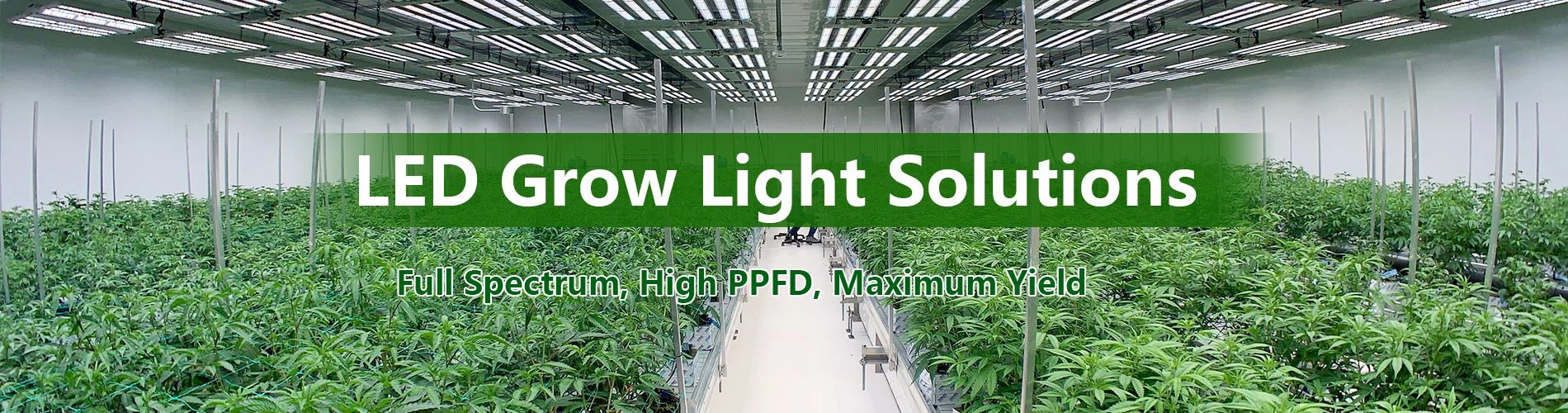
These Photos Came From a Customer


A grower sent us these photos last week. No prompting, no "can you send us a testimonial" request - just a straightforward message showing us how the canopy looked heading into late flower under our fixtures. Dense colas, tight bud structure, even coverage from wall to wall, and if you look closely at the fixtures overhead, you can actually see the red and far-red diodes glowing warmer than the white channels around them.
We're sharing these because this is the kind of proof that actually matters to a buyer. Spec sheets are easy to write. A canopy that looks like this after a full flowering cycle is not.
The fixture behind this result is our 1200W full spectrum LED grow light for cannabis, built on a 1.1m x 1.8m frame, using Samsung diodes for the white spectrum and Osram diodes for the deep red and far-red channels. That combination is the whole story behind this article, so let's walk through why it matters, in plain language, not lab-report language.
The Hardware Behind the Result - Samsung and Osram, Not Generic Diodes
Why Chip Brand Actually Matters for Light Output Consistency
Here's something a lot of first-time buyers don't realize: not all LED diodes are built the same, even when two grow lights list the same wattage on the box. Generic, unbranded diodes tend to drift in color output and lose efficiency faster over time. Branded diodes from established manufacturers go through tighter quality control, so the light you get in month one is much closer to the light you get in month eighteen.
That consistency is what a commercial cannabis LED grow light manufacturer should be able to guarantee, and it's a big part of why we don't switch to cheaper diode suppliers just to shave a few dollars off a unit price.
Samsung for Full-Spectrum White Light, Osram for Deep Red and Far-Red
Our 1200W fixture uses two diode brands doing two different jobs:
Samsung LM301 series diodes handle the broad white spectrum - the blue, green, and yellow wavelengths plants use for vegetative structure and overall photosynthesis.
Osram diodes handle the deep red and far-red channels, which play a bigger role during flowering, particularly in bud density and the plant's response to shorter day-length signals.
This is what's called a Samsung Osram LED grow light setup, and it's become a pretty common combination among serious commercial builds because each brand is simply stronger in a different part of the spectrum.
Reading the Spectrum Chart - What the Curve Actually Tells You
If you've ever looked at a spectrum graph and had no idea what you were looking at, you're not alone. Here's the plain-English version of ours.
| Wavelength Range | Color | What It's For |
|---|---|---|
| Around 380–400nm | Near-UV | Small dose linked to trichome and terpene development |
| Around 450–460nm | Blue | Drives compact, sturdy plant structure |
| 500–600nm | Green/Yellow | Penetrates deeper into a dense canopy than blue or red alone |
| Around 660nm | Deep Red | The strongest driver of photosynthesis and flower development |
| Around 730nm | Far-Red | Signals the plant to stretch and finish flowering faster |
Two things stand out on our curve: a tall, clean peak at 660nm - meaning strong deep-red output exactly where flowering plants use it most - and a distinct secondary peak near 730nm, the far-red band. A lot of budget fixtures skip far-red almost entirely because it's expensive to produce well. Ours doesn't skip it, and that's a deliberate spectrum decision, not an accident.
1200W in a 1.1m x 1.8m Footprint - What That Means for Coverage
Wattage alone doesn't tell you much without knowing the footprint it's spread across. Here's the practical breakdown for this fixture.
| Spec | Detail |
|---|---|
| Fixture size | 1.1m x 1.8m |
| Power draw | 1200W |
| Diode brands | Samsung (white spectrum) + Osram (red/far-red) |
| Recommended coverage | Approximately 1.2–1.5 sq meters (13–16 sq ft) at commercial flowering intensity |
| Mounting height | Typically 30–45cm above canopy, adjusted as plants stretch |
For growers running a 1.1m x 1.8m grow tray or rolling bench, this is close to a one-to-one match between fixture footprint and canopy footprint, which is exactly why the coverage in the photos looks so even - there aren't gaps at the edges where light intensity drops off.
Why Spectrum Ratio Matters More Than Total Wattage
Two Lights, Same Wattage, Very Different Results
This is probably the single most misunderstood thing in LED grow light shopping. Two 1200W fixtures can look identical on a spec sheet and produce noticeably different results in the same grow room, simply because the ratio of red, far-red, blue, and white light is different.
A fixture with a spiky, single-peak white output (common with older or cheaper diode designs) pushes a lot of energy into wavelengths plants use less efficiently. A properly balanced full spectrum output, like the curve above, puts more of that same wattage into the bands that actually drive flowering - mainly deep red - while still keeping enough blue and green for healthy structure and canopy penetration.
| Comparison Point | Single-Peak White LED | Full Spectrum (Samsung + Osram) |
|---|---|---|
| Deep red output (660nm) | Often weak or absent | Strong, dedicated peak |
| Far-red output (730nm) | Usually missing | Present, supports flowering finish |
| Canopy penetration | Weaker in dense grows | Stronger due to green/yellow content |
| Visual result | Leggier, less dense buds | Tighter bud structure, denser colas |
The Role of Red and Far-Red in Bud Density
Deep red light is the primary driver of the photosynthesis process that fuels flower development, which is why growers running full-spectrum fixtures with a strong 660nm peak, like the customer photos above, tend to see denser, heavier colas. Far-red light, meanwhile, plays a supporting role by influencing how a plant times its flowering response - a factor that many lower-cost fixtures simply don't invest in producing well.
None of this means wattage doesn't matter. It just means wattage is only half the story. A optimized spectrum LED grow light yield result comes from getting both the quantity and the ratio of light right at the same time.
How Does Light Spectrum Affect Cannabis Yield in Practice
This is one of the most searched questions among commercial growers shopping for lighting, so it's worth answering directly instead of dancing around it.
In practice, spectrum affects three things growers can actually see and measure:
Bud density - stronger deep-red output tends to correlate with tighter, heavier flower structure rather than airy, stretched buds.
Canopy uniformity - better green and yellow content means light reaches lower bud sites in a dense canopy, not just the top layer.
Flowering timeline consistency - far-red presence supports a more predictable finish time across a large canopy, which matters a lot when you're running a commercial harvest schedule.
We're not going to throw out a made-up yield percentage increase here, because that number changes with strain, room design, CO2 levels, and a dozen other variables. What we can say is that the photos in this article are a real, unedited result from a real commercial room running this exact spectrum, and that's a more honest data point than a marketing claim with no source.
Industry Trend: Buyers Are Asking About Chip Brand, Not Just Wattage
A few years ago, most inquiries we got were simple: "How many watts do I need for my room?" That's still a common question, but it's no longer the only one. More and more commercial buyers - especially the ones scaling past a single room - are now asking about diode brand, spectrum charts, and even asking for third-party test reports before they place a bulk order.
This shift matters because it changes what a commercial cannabis LED grow light manufacturer actually needs to offer to stay competitive. A nice-looking website and a low price per watt used to be enough. Today, growers comparing multiple suppliers side by side are much more likely to ask a wholesale LED grow light supplier for real spectrum data, real diode sourcing information, and photos or video from existing customers, not just studio renders.
What to Ask Before You Buy - A Grower's Checklist
If you're comparing fixtures right now, here's a short, practical list worth going through with any wholesale LED grow light supplier before you commit to a bulk order:
- Ask which diode brands are used, and for which wavelengths specifically.
- Ask for the actual spectrum chart, not just a marketing description like "full spectrum."
- Ask if they can share real customer photos or footage from an active grow room, not just render images.
- Ask about far-red output specifically - it's one of the easiest things for a budget fixture to leave out.
- Confirm ETL, CE, DLC, and RoHS status directly, with documentation.
A supplier that answers all five of these clearly and quickly is usually a supplier worth working with.
FAQ
Q: What's the difference between Samsung and generic LED diodes in a grow light?
A: Branded diodes like Samsung's are manufactured under tighter quality control, which generally means more consistent color output and slower efficiency loss over the life of the fixture compared to unbranded alternatives.
Q: Does more far-red light really increase yield?
A: Far-red light doesn't work alone, but paired with strong deep-red output, it supports more consistent flowering timing and canopy development, which is why many full-spectrum fixtures include a dedicated far-red channel rather than relying on white light alone.
Q: What size grow light do I need for a 1.1m x 1.8m canopy area?
A: A 1200W fixture sized to roughly match that footprint, like the one in this article, is generally suited to commercial flowering intensity across a comparable canopy area, though exact placement and mounting height should be adjusted based on strain and room layout.
Q: How do I verify a manufacturer's spectrum claims?
A: Ask for the actual spectrum graph rather than a general description, and where possible, ask for third-party test data or DLC listing, which independently verifies a fixture's efficacy and output claims.
We could have written this article around specs alone. Instead, we wanted to start with what a real customer's canopy actually looked like, because that's the kind of evidence that means something to another grower comparing suppliers. The spectrum behind those photos isn't a mystery - it's a Samsung and Osram diode combination, tuned toward strong deep-red and far-red output, running at 1200W across a 1.1m x 1.8m footprint.
If you want to see the full spectrum chart, ask about coverage for your specific room size, or just want to compare notes with other growers running this setup, we're happy to walk through it with you directly.


