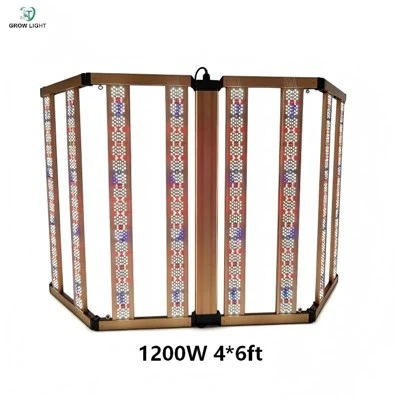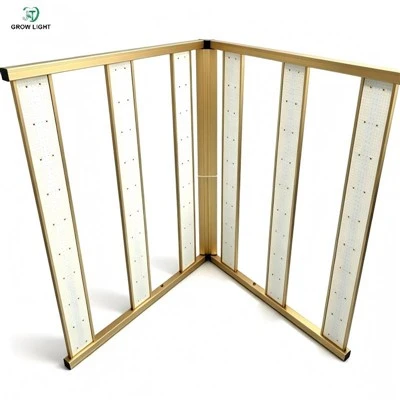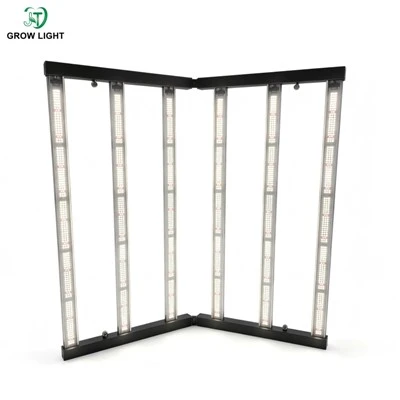

A lot of commercial grow operations start small. A single room, a handful of rows, maybe a 4ft under canopy light tucked under each bench to catch the lower bud sites that the top fixture can't reach. It works fine - until the operation grows. Rows get longer, canopy density increases, and the original 4ft under canopy lighting layout that made sense at a smaller scale starts leaving gaps, dark corners, and uneven coverage.
This is one of the most common transitions commercial growers go through: moving from 4ft to 6ft or 8ft under canopy grow lights as the room scales up. It sounds like a simple swap - bigger light, same idea - but the reality involves several physical, electrical, and layout changes that are worth understanding before ordering new fixtures.
Signs It's Time to Upgrade Your Under Canopy Lighting
Most growers don't plan an upgrade in advance - they notice the signs after a harvest or two. A few patterns show up consistently across commercial rooms running 4ft under canopy light setups that have outgrown their original design.
Persistent dark zones between fixtures. A 4ft fixture covers roughly four feet of canopy. On longer benches, growers often space 4ft units with small gaps between them to save on fixture count, which works until canopy density increases and those gaps turn into visibly underdeveloped bud sites.
Canopy density has increased since the original install. A room that started with moderate spacing and has since been trained tighter, trellised more densely, or switched to a higher-yield cultivar puts more demand on under canopy LED light coverage than the original layout was designed for.
Row length has changed. Expansion projects that extend benches or add new rows often inherit the old 4ft spacing plan by default, which compounds the coverage problem across a larger footprint.
Energy and labor costs per square foot are climbing. More fixtures mean more daisy chain connections, more bracket installs, and more potential failure points - all of which add up in maintenance time as a room scales.
None of these signs mean the original 4ft fixtures were a bad choice. They were likely the right call for the original room size. The question is whether the current room still matches that original design.


Fewer Fixtures, Lower Installation Cost
The most immediate, most quantifiable benefit of upgrading from 4ft to 6ft or 8ft under canopy lighting is a straightforward reduction in fixture count across the same row length. Because wattage and coverage scale with fixture length, a longer fixture covers more canopy per unit - which means fewer total units, fewer daisy chain connections, and fewer power entry points across a room.
Here's what that looks like across a few common row lengths, based on standard fixture spacing:
Row length Fixtures needed (4ft) Fixtures needed (6ft) Fixtures needed (8ft)
| Row length | 4ft fixtures | 6ft fixtures | 8ft fixtures |
|---|---|---|---|
| 24ft | 6 | 4 | 3 |
| 48ft | 12 | 8 | 6 |
| 96ft | 24 | 16 | 12 |
These numbers assume end-to-end fixture placement along a standard commercial bench. Actual spacing varies based on canopy density and beam angle, but the ratio holds consistently: moving from 4ft to 8ft typically cuts total fixture count by 40 to 50 percent across the same row length.
That reduction compounds in a few directions that matter for a commercial budget:
- Daisy chain connections drop proportionally. Fewer fixtures means fewer physical connection points, and fewer connection points means fewer potential failure points to troubleshoot later. A 96ft row that needed 24 daisy chain links with 4ft fixtures only needs 12 with 8ft fixtures - half the wiring complexity for the same coverage.
- Installation labor drops. Each fixture install involves mounting a bracket, connecting a daisy chain link, and verifying beam alignment. Cutting the fixture count nearly in half on a large room translates directly into fewer labor hours during install, which matters most on large-scale commercial builds where electricians are billing by the hour.
- Fewer power entry points. Daisy chaining supports up to 5 units per power cord on most under canopy LED light fixtures regardless of length, so longer fixtures covering more row length per chain reduce how many separate power drops a room needs.
For a grower comparing the sticker price of a 4ft fixture against a 6ft or 8ft unit, it's easy to look only at the per-unit cost. The more complete comparison includes the total number of units needed to cover the same row, plus the labor and wiring that scales with that count - and on that basis, upgrading to a longer fixture is often the lower total cost option for large rooms, even though each individual unit costs more.
What Changes Physically When You Move Up in Size
Bracket Height and Mounting
Under canopy fixtures typically mount on height adjustable brackets rather than being fixed directly to a grow rack, and bracket specifications differ slightly based on fixture design. A standard dual side fixture, for example, commonly ships with a black bracket adjustable from 22cm to 38cm in 5cm increments, with 3 brackets per fixture. A 3 side or triple side version typically uses a different bracket, often adjustable from 22cm to 32cm, color coded differently (commonly white) to distinguish it from the dual side version at a glance on a busy installation.
When upgrading from 4ft to 6ft or 8ft, the bracket height range itself usually stays the same within a given emission type - a 6ft dual side unit and an 8ft dual side unit typically use the same bracket spec. What changes is the number of brackets needed overall, which drops along with the fixture count. A grower replacing twelve 4ft fixtures (36 brackets at 3 per unit) with eight 6ft fixtures only needs 24 brackets for the same row - a meaningful reduction in mounting hardware.
One detail worth checking before ordering: not all under canopy lines use fully interchangeable brackets across lengths from the same manufacturer. It's worth confirming bracket compatibility directly with the supplier rather than assuming a longer fixture automatically uses the same hardware as a shorter one from a different product generation.
Daisy Chain Capacity Per Power Cord
Daisy chaining is one of the more practical considerations in a size upgrade, because the chain limit doesn't automatically scale with fixture length. Most under canopy LED light fixtures - 4ft, 6ft, or 8ft - support up to 5 units per power cord, regardless of individual fixture wattage, since the limit is typically set by the cumulative amperage the connector and cord are rated for rather than physical fixture count alone.
This means the real benefit isn't a higher daisy chain limit - it's that each chain now covers more total row length. Five 4ft fixtures on one chain cover 20ft of row. Five 8ft fixtures on the same chain limit cover 40ft - double the coverage per power drop, without exceeding the rated connection limit.
Growers planning a large room upgrade should still confirm the exact daisy chain rating for their specific fixture wattage, since higher wattage 8ft units (commonly 250W) draw more current per fixture than a 120W 4ft unit, and five 250W units on one chain represents a meaningfully higher total load than five 120W units - worth verifying against the power cord's rated capacity before finalizing a layout.
Connector Compatibility
Under canopy fixtures typically use a sealed, waterproof connector for both the main power input and the daisy chain link between units, which matters given how close these fixtures sit to irrigation lines and canopy runoff compared to a standard top light. When upgrading fixture sizes, the connector type usually stays consistent within the same manufacturer's product line, which allows a transitional period where older 4ft units and newer 6ft or 8ft units can run on the same wiring infrastructure during a phased upgrade - more on mixing sizes in a later section.
What Changes Electrically
Moving from a 4ft to a 6ft or 8ft fixture usually means a jump in wattage per unit, and that jump needs to be accounted for before ordering replacement fixtures, not after.
A typical wattage progression across the product line looks like this:
| Fixture length | Common wattage |
|---|---|
| 4ft | 120W |
| 6ft | 150W / 180W / 200W |
| 8ft | 250W |
The practical electrical consideration is total circuit load, not per-fixture wattage in isolation. A room running twelve 4ft fixtures at 120W draws 1,440W total. Replacing those with eight 6ft fixtures at 200W draws 1,600W - a modest increase despite fewer total fixtures, because each unit now draws more current individually. Growers upgrading a room should recalculate total circuit load against existing breaker capacity rather than assuming a lower fixture count automatically means lower total power draw. In most cases it's close, but it's worth verifying rather than assuming.
Controller compatibility is the second electrical check. Most under canopy lines run on 0-10V dimming through a shared controller across daisy chained units. If the existing controller was sized for a specific total wattage across the 4ft layout, adding higher wattage 6ft or 8ft fixtures on the same controller circuit needs to stay within that controller's rated output - this is a quick confirmation with the manufacturer or electrician before wiring the new fixtures into an existing control system, rather than something to discover after installation.
Can You Mix 4ft with 6ft or 8ft in the Same Room
Upgrading doesn't have to mean replacing every fixture in a room at once, and in practice, most commercial growers phase the transition rather than doing a full rip-and-replace.
Mixing fixture lengths works well in a few specific scenarios:
- Irregular row spacing. Rooms with non-uniform bench lengths - common in retrofitted or expanded facilities - often fit better with a mix of 6ft and 8ft fixtures across different rows than forcing a single length throughout, since matching fixture length to actual row length minimizes wasted coverage or gaps at row ends.
- Phased capital expenditure. Replacing an entire room's fixtures in one purchase is a significant upfront cost. Many growers upgrade one section or one row at a time, running older 4ft fixtures alongside newer 6ft or 8ft units in the same room while budget allows for a full transition over multiple growing cycles.
- Expansion into new space. When a room physically expands, the original 4ft fixtures in the existing section often stay in place, while the new section is built out with 6ft or 8ft fixtures sized for the new layout from the start.
The main technical requirement for mixing fixture lengths is keeping daisy chain groups separate by wattage where possible, since combining very different wattages on a single chain and controller can complicate dimming calibration - some growers run 4ft units on one controller zone and 6ft or 8ft units on a separate zone specifically to keep dimming behavior predictable across both. This isn't a hard technical limitation so much as a practical layout choice that makes long-term maintenance simpler.
Industry Trends Behind the Shift to Longer Fixtures
The move toward longer under canopy LED light fixtures isn't happening in isolation - it reflects a broader shift in how commercial cultivation facilities are being designed and scaled. A few trends are driving this directly.
Facility consolidation
Commercial cultivation, particularly in cannabis and controlled environment agriculture, has trended toward fewer, larger facilities rather than many small rooms, as operators look for efficiency gains at scale. Longer benches and wider rows are a natural byproduct of that consolidation, and lighting infrastructure has followed - fixture manufacturers have expanded 6ft and 8ft under canopy lighting options specifically in response to this demand, where a few years ago 4ft was closer to the standard default length across the category.
Labor cost pressure
Installation and maintenance labor has become a larger share of total operating cost in commercial grow facilities as wages have risen across North America. Any layout change that reduces the number of physical connection points - exactly what longer fixtures with fewer total units accomplish - has become a more explicit purchasing consideration than it was when labor costs were a smaller line item.
Energy efficiency standards
Commercial cultivation facilities, particularly in states and provinces with specific cannabis cultivation licensing requirements, are increasingly subject to energy efficiency benchmarks tied to canopy square footage. A fixture layout that achieves more even PPFD distribution with fewer total connection points and lower cumulative driver loss (since fewer drivers in the daisy chain generally means less conversion loss across the circuit) can support compliance with these benchmarks more easily than a fragmented, high fixture count layout.
A Practical Scenario: Scaling a 48ft Row
To put the numbers in context, consider a mid-size commercial grow room expanding an existing 48ft row that originally ran twelve 4ft under canopy light fixtures.
At the original density, the room was drawing roughly 1,440W across the row (12 fixtures at 120W), spread across three daisy chain groups of four fixtures each, with 36 brackets total.
After evaluating canopy density and deciding to upgrade to 8ft fixtures, the same 48ft row requires 6 fixtures at 250W, totaling 1,500W - a comparable total wattage draw, but with half the fixture count. Daisy chaining drops to a single group of 6 fixtures still under the 5-unit-per-cord limit when split across two power drops, cutting the number of physical power entry points from three to two. Bracket count drops from 36 to 18.
The net result: comparable energy draw and improved canopy coverage uniformity, achieved with roughly half the hardware and connection points - directly translating into less installation labor and a simpler long-term maintenance footprint for that row.


FAQ
Q: Do I need to replace all my 4ft fixtures at once?
A: No. Many commercial growers phase their upgrade by row or by section, running older 4ft fixtures alongside newer 6ft or 8ft units during a transition period, particularly when budget or scheduling makes a full replacement impractical in a single cycle.
Q: How many fewer fixtures will I need after upgrading?
A: It depends on row length, but as a general reference, moving from 4ft to 6ft typically reduces fixture count by around 30 to 35 percent across the same row, while moving to 8ft typically reduces it by 40 to 50 percent, based on standard end-to-end fixture spacing.
Q: Will my existing controller work with 6ft or 8ft units?
A: It depends on the controller's rated output capacity relative to the new total wattage. Since 6ft and 8ft fixtures draw more power per unit than 4ft fixtures, it's worth confirming the controller's maximum rated load against the new total circuit wattage before wiring larger fixtures into an existing control system.
Q: Does upgrading require new electrical wiring?
A: Not always, but it's worth verifying. Total circuit wattage often shifts modestly when upgrading fixture sizes, even when fixture count decreases, so confirming existing circuit capacity against the new total load - ideally with a licensed electrician, particularly if local cultivation licensing involves electrical inspection - is a reasonable step before finalizing an upgrade.
Upgrading from 4ft to 6ft or 8ft under canopy lighting is rarely just a matter of buying a longer fixture. The real decision involves recalculating fixture count across the row, checking total circuit load against existing electrical capacity, confirming bracket and connector compatibility, and - in many commercial facilities - accounting for local electrical code and cultivation licensing requirements before finalizing the upgrade.
With those checks in place, the upgrade typically delivers what most growers want: more even canopy coverage, fewer physical connection points to maintain, and a simpler installation footprint across a room that has outgrown its original lighting layout.