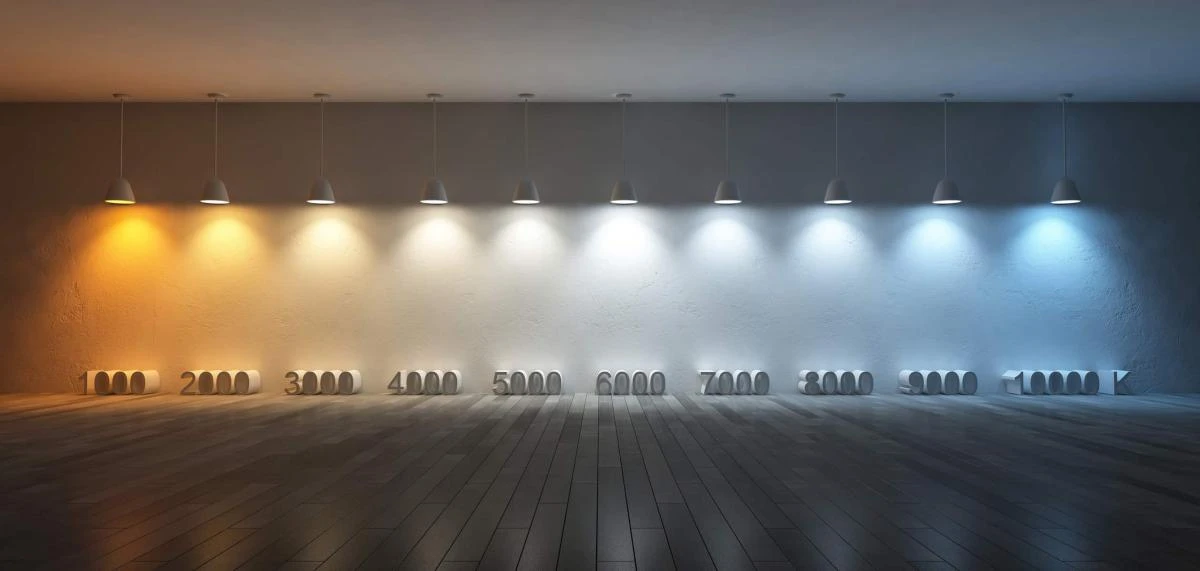
Have you ever encountered this scenario: LED grow lights appear to be full spectrum, brightness hasn't dimmed, PPFD readings seem consistent, yet plant behavior changes-internodes lengthen, leaf angles widen, tops thin out, and flowering appears slightly accelerated. Growers might attribute this to nutrient or water issues, but what's truly shifting is the "seasonal light cycle." When white light gradually shifts from 5000K to 4200K, it may seem like merely a "warmer color tone." But for plants, this conveys entirely different information. Plants don't perceive color temperature; they interpret the "meaning of light." That 800K shift fundamentally alters that meaning.
1. From 5000K to 4200K: Plants perceive seasonal change
To plants, 5000K white light resembles sunlight, dawn, and direct rays-signaling an environment that encourages compact, vigorous growth. Plants should grow steadily, upward, and maintain structure. When light decay and phosphor degradation gradually reduce white light to 4200K, the light becomes warmer, more "horizontal," and "softer." Plants interpret this as "the sun's angle has lowered," "The season is advancing," and "it's time to transition into generative growth." This isn't to say 4200K light is inferior, but plants interpret this spectral shift as a "signal change," naturally adjusting their behavior accordingly.
2. Why does white light color temperature decrease?
Full-spectrum white light is produced by combining blue LED chips with phosphor coatings. A slight drop in blue light makes the entire light appear warmer; slight aging of phosphors amplifies this effect. In LED grow lights, blue light is the fastest-degrading wavelength. Thus, as lights age, a decrease in white light color temperature is inevitable. This explains why inexpensive LED grow lights are more prone to light spectrum shifts-refer to our earlier article Why Cheap LED Grow Lights Drift Fast.
3. Effects of White Light Shifting from 5000K → 4200K on Plants
1) Internodes Begin to Loosen
Reduced blue light diminishes "directional light." Blue light is one of the primary signals keeping plants compact. When it decreases, plants become more inclined to extend internodes and spread leaves wider. You'll observe the canopy becoming looser rather than stronger. This doesn't indicate poorer health, but rather a behavioral shift-the plant receives a signal that "you don't need to be so compact."
2) Thinning Tops and Wider Leaf Angles
The blue light dominance at high color temperatures stabilizes salt transport and internode control. A drop in color temperature means less blue light and a relative increase in red light. Plants respond to this change consistently: the top no longer shoots upward but spreads outward. You'll observe upper leaves spreading out in layers instead of pointing directly at the lights, as if preparing for the reproductive phase.
3) Earlier flowering onset
Lower color temperature = warmer spectrum = plants interpret this as "lower sun angle."
In nature, a lower sun angle typically signals seasonal maturity, prompting plants to shift toward generative development.
In grow rooms, this manifests as: faster flowering initiation, denser flower bud formation, and earlier transition to generative growth at the top.
This effect is more pronounced in photoperiod-sensitive and light-signal-sensitive strains. You'll observe them "preparing early," even without altering the photoperiod.
4) Reduced canopy synchronization
The most problematic aspect isn't the color temperature drop itself, but the uneven distribution. LED grow lights have varying thermal paths, with different temperatures across light bar sections. Consequently, the white light color temperature decreases at different rates within the same fixture. The left side may drop faster, the right slower, while the center experiences more pronounced warming due to higher driver heat.
5) Plant growth shifts from "structural development" to "reproductive mode."
5000K favors vegetative energy, while 4200K favors generative signals.
When plants continuously perceive a warming trend, they interpret it as the season progressing from early to mid-to-late stages. Consequently, their resource allocation shifts from "structural development" to "preparing for reproduction."
This explains why many growers prefer slightly warmer light during the later flowering stage-it genuinely promotes generative development.
4. Why do high-quality LED grow lights maintain more stable color temperatures?
Premium LED grow lights employ long-term decay control in their blue LED chip and phosphor combinations, ensuring a "uniform decline" rather than "uneven warming" in their light output curve. Take JT Photoelectric's full-spectrum LED grow lights, for instance-they maintain light decay at a fixed rate, allowing plants to perceive a consistent "seasonal cycle." It's not about being whiter or more perfect, but about being more consistent.