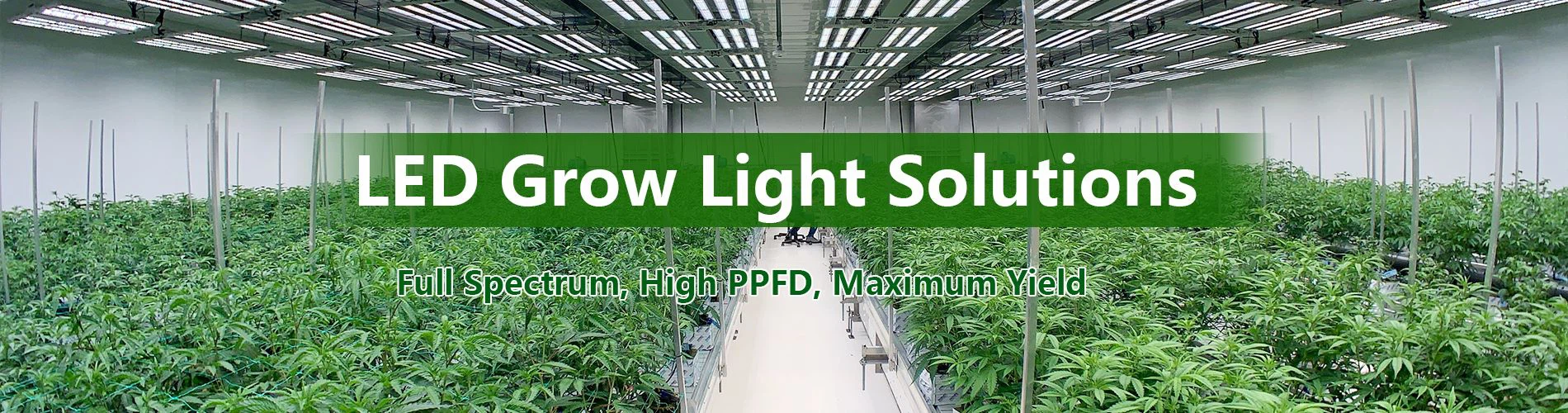
1. The Scientific Basis of Photosynthesis: Quantum Dialogue between Plants and Light The spectral needs for photosynthesis
Chlorophyll and carotenoids are the main parts of plant photosynthesis. They absorb certain wavelengths of light. In the red light range of 620–680nm and the blue light range of 430–460nm, chlorophyll a/b absorbs the most light. In the blue violet light range of 400–500nm, carotenoids help with absorption. This natural selection comes from how the solar spectrum is spread out as the Earth evolved. Red light makes up approximately 42% of visible light on the surface, while blue light makes up about 10%. This is exactly what plants need to capture light.
Regulation of Photoperiod and Light Morphology
Cryptochrome and phytochrome make up the plant's system for seeing light. Red light (660nm) changes the shape of the photosensitive pigment Pr into Pfr, which causes physiological reactions such seed germination and stem elongation inhibition. Far red light (730nm) does the opposite. Cryptochrome controls the opening and shutting of stomata, circadian rhythms, and the production of anthocyanins by detecting blue light (450nm). This molecular-level light regulating mechanism lets plants change how they develop dependent on how much light they get.
Numbers that show how well photosynthesis works
PPFD (photosynthetic photon flux density) and YPFD (yield photon flux density) are two important numbers that tell you how well light is working. A PPFD of 1 μ mol/m ²/s means getting 1 micromolar photon per second per square meter. YPFD, on the other hand, gives a better picture of how well light energy is being used by taking into account how much photosynthesis different wavelengths contribute. When lettuce is exposed to a 40% blue light spectrum, it has 20% more vitamin C and 15% thicker leaves. When red light makes up 60% of the light, the amount of dry matter increases by 25%.
2. The agricultural revolution of LED technology: going from the lab to the factory (1) The "Light Formula" Revolution in Plant Factories
The Yangling Plant Factory uses a three-dimensional cultivating system with layers, and each layer has its own spectral control module. A "soft light meal" with 60% blue light is used to help the roots grow and the stems thicken during the seedling stage. During the nutritional growth period, a 1:1 red blue light "satiety light meal" speeds up the accumulation of photosynthetic products. During the reproductive growth period, the amount of far red light is increased to control the timing of flowering and the quality of the fruit. This dynamic spectral management lets lettuce produce 2500 seeds per day per 1469 square meters, which is 50 times more than typical farms.
Engine operated by light to speed up breeding
Through photoperiod management, the Yangling Technology Center of Sinochem Syngenta Group in China is able to grow five generations of maize every year. The LED technology in the smart greenhouse mimics tropical sunlight, shortening the reproductive cycle from 120 days to 48 days. The method for regulating light quality made male corn ears' pollen more active by 30%, female corn ears' pollination rate by 25%, and the weight of 1000 grains by 5 grams per acre. The IoT environmental control system makes breeding 2.5 times more efficient than the old field mode.
The "Light Efficiency Revolution" in Facility Agriculture
The Baoshihong Agricultural Cooperative in Yanggao County, Shanxi Province, shows that using LED lights has boosted the number of layers of fruit on tomato plants from three to five and the annual income from each greenhouse by 20,000 yuan. The 700 yuan per season for electricity and the 2000 yuan per season for fertilizer savings have led to big economic gains. According to market data, facility-grown vegetables that use LED fill light have 18% more vitamin C, 22% less nitrate, and 15% more product rate.
3. Technological advances and improvements in the industry: the growth of LED agricultural lighting
Precision in the spectrum
By combining many chips, full spectrum LED technology can produce a continuous spectral output of 400–780nm. It is also 40% more efficient than typical fluorescent lights, with a light efficiency of 2.8 μ mol/J. The Qingdao Vertical Farm uses a proprietary spectral design that cuts the time it takes for lettuce to grow by 15 days and the amount of energy it uses by 35%.
A revolution in energy efficiency
The third generation LED chip increases the light efficiency to 3.2 μ mol/J. It works with an intelligent dimming mechanism to provide you light when you need it. The information from Yangling Demonstration Park demonstrates that dynamic lighting control has cut the energy use per unit of output from 0.35 kWh/kg to 0.22 kWh/kg, which is now at the international advanced level.
Smart integration
A "light temperature water fertilizer" connection system has come about because of the combination of AI and the Internet of Things. The intelligent management system at Lanjian Intelligent Technology Plant Factory collects environmental data every 30 seconds and uses it to optimize light intensity, spectral ratio, and CO₂ concentration. The investigation found that the technique made lettuce grow 18% faster and cut down on pests and infections by 40%.