
Low ceilings don't announce themselves as a problem on day one. Most growers notice the issue only after plants are already in the room. Stretch feels harder to control. Light burn appears earlier than expected. Hanging height becomes a constant compromise. At that point, frustration sets in-not because the lighting is bad, but because the room simply doesn't give you enough vertical space to work with.
Low-ceiling grow rooms exist everywhere. Converted warehouses. Basements. Older industrial buildings. Shipping-container farms. And in many of these spaces, growers don't get to choose the ceiling height-they inherit it.
This is where foldable LED grow lights often enter the conversation. Not as a magic fix, but as a structural adaptation to an unchangeable constraint.
Low ceilings change how lighting decisions behave
In standard-height rooms, lighting mistakes have room to hide. Hanging height can be adjusted. Canopy distance can be managed. Light spread has space to soften before hitting the plant. Low ceilings remove that buffer. Low-ceiling rooms are a good example of where foldable lights make sense.
Every inch matters. Small structural differences in fixtures translate directly into plant response. High-output lights become harder to tame. Overlap zones become more aggressive. Uniformity becomes fragile.
Growers working in low-clearance rooms quickly learn that wattage alone is not the deciding factor. Fixture geometry and deployment discipline matter more than raw output.
Why foldable structure matters more when vertical space is limited
Foldable LED grow lights don't create more ceiling height-but they use it more predictably.
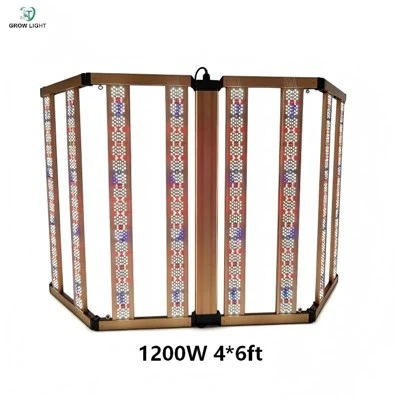
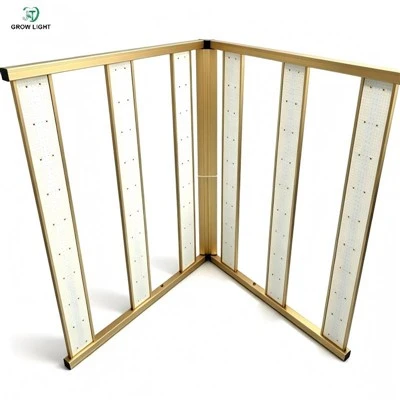
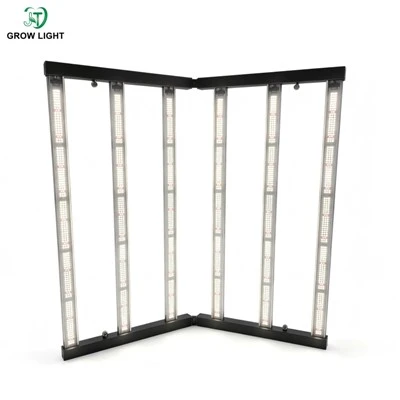
Most foldable grow lights are designed around flat, horizontal bar layouts. When unfolded, the fixture occupies vertical space efficiently. No bulky housings are hanging below the bars. No unnecessary depth added by structural frames.
In low-ceiling rooms, this matters. A few inches saved at the fixture level translates directly into safer canopy distance. That extra clearance often determines whether a room can operate comfortably or constantly feels on edge.
This is one of the quiet reasons foldable LED grow lights are favored in low-clearance commercial cultivation-even when total power remains moderate.
Low ceilings punish uneven distribution faster
In tall rooms, uneven distribution can soften over distance. In low rooms, it can't.
Hot spots become stress points quickly. Edge zones lag behind. Canopy uniformity becomes harder to maintain because light doesn't have space to blend.
Foldable grow lights tend to perform better here because their bar spacing is predefined. The distribution pattern is engineered rather than improvised. When deployed correctly, this structure produces more even coverage at shorter distances.
This doesn't mean foldable design eliminates risk-but it narrows the margin of error. And in low-ceiling rooms, margin is everything.
Hanging height discipline becomes non-negotiable
Low ceilings remove flexibility. Hanging height decisions must be precise.
Foldable LED grow lights support this precision by behaving consistently across rooms. When each fixture unfolds into the same geometry, hanging height decisions scale cleanly. Growers don't need to re-learn spacing rules for each room.
In contrast, mixed or modular fixtures often introduce variability that low-ceiling environments cannot tolerate. What "kind of works" in one spot fails quickly in another. Low ceilings reward systems that behave the same way every time.
Why high power is especially dangerous in low-clearance rooms
Low ceilings amplify intensity risk. High-power foldable grow lights can technically fit into low rooms-but fitting is not the same as functioning. Without sufficient distance for heat dissipation and light blending, excessive intensity stresses plants quickly.
This is why many successful low-ceiling operations favor moderate power with excellent uniformity, rather than aggressive wattage. Foldable LED grow lights support this strategy by offering wide, even coverage at controlled output levels.
The mistake is assuming foldable design automatically makes high power safe. It doesn't. It simply gives growers more control over how that power is delivered.
Low ceilings expose poor planning early
In tall rooms, mistakes take time to surface. In low rooms, they appear immediately.
Light stress. Uneven growth. Environmental instability. These signals show up within days, not weeks.
Foldable grow lights don't prevent mistakes-but they make planning outcomes more predictable. Their geometry allows growers to model coverage and hanging height accurately before installation.
This predictability is often the difference between a low-ceiling room that runs smoothly and one that constantly feels compromised.
Manufacturer insight: low ceilings demand structural honesty
From a manufacturer perspective, low-ceiling projects are some of the most revealing.
At JT Grow Light (JTGL), feedback from growers operating in low-clearance rooms consistently highlights the same theme: success depends less on chasing maximum output and more on matching fixture structure to physical reality.
Foldable LED grow lights designed with slim profiles, balanced bar spacing, and controlled output tend to outperform bulkier or more complex systems in these environments-not because they are stronger, but because they are more compatible.
Low ceilings don't forgive structural excess.
It's important to be honest. Foldable LED grow lights are not a solution for every low-ceiling problem.
If ceiling height is extremely limited, or if canopy height cannot be controlled, no lighting design will fully compensate. Structural limitations eventually win.
Foldable design reduces friction-but it cannot create space where none exists. Growers who succeed in low-clearance environments combine foldable fixtures with disciplined canopy management and realistic yield expectations.
Grower takeaway: low ceilings reward structural discipline
Low-ceiling grow rooms don't reward power. They reward control. Foldable LED grow lights offer an advantage in these spaces not because they fold, but because they unfold into predictable, efficient structures that respect vertical limits.
For growers working under low ceilings, lighting decisions should be evaluated not by headline specs, but by how calmly the system runs once plants fill the room.