Why the Same Spectrum Isn't Ideal for Every Growth Stage
A single fixed spectrum is convenient. It is rarely optimal. Early stages benefit from more blue to keep plants compact and sturdy. Later stages respond better to higher red and, in many cases, a measured dose of far-red. Sticking with one unchanging recipe means accepting a compromise at every phase of the cycle.
The Basics - What Different Wavelengths Actually Do for Plants
Blue Light (~400-500 nm) and Compact Vegetative Growth
Blue light is the main morphological control tool in the early stages. It shortens internodes, thickens leaves, and builds stronger stems. Higher blue ratios early on reduce stretch and produce the compact structure that is easier to manage in dense commercial canopies.
Red Light (~600-700 nm) and Flowering/Fruiting Response
Red light drives high photosynthetic efficiency and plays a central role in the shift to reproductive growth. Raising the red proportion as plants move into flowering or fruiting supports biomass accumulation in flowers and fruit while still contributing strongly to overall photosynthesis.
Far-Red Light and the Shade Avoidance Effect
Far-red (roughly 700–750 nm) interacts with phytochrome and can trigger shade-avoidance responses-stem elongation and changes in flowering timing. Used carefully, modest far-red improves canopy light penetration and supports the Emerson enhancement effect when combined with red. Most commercial recipes keep far-red in the 5–15 % range of total output during flowering rather than running it high for the entire cycle.
Adjusting Spectrum Through the Seedling and Early Vegetative Stage
Why Higher Blue Ratios Help Prevent Leggy Growth
Young plants under low blue stretch toward any available light. Increasing the blue component early produces stockier seedlings and cuttings with shorter internodes and better structural strength. This is one of the easiest spectrum changes to make and one of the highest-impact ones.
Typical Spectrum Ratios Growers Use at This Stage
Many commercial growers target a higher blue-to-red balance early-often roughly 1:1 to 2:1 blue:red, or a full-spectrum white that is relatively blue-rich. Intensity stays moderate while the spectrum does the morphological work.
Adjusting Spectrum Through the Vegetative Growth Stage
Balancing Red and Blue for Steady Canopy Development
Once plants enter active vegetative growth, the spectrum usually moves toward a more balanced or moderately red-leaning mix. The goal is steady leaf and stem development without excessive stretch or the overly tight growth that limits light penetration deeper into the canopy.
Where Under-Canopy Supplemental Lighting Becomes Useful
In dense canopies, top lighting alone leaves lower leaves and potential flower sites in heavy shade. PPFD can easily drop 50–80 % from the top of the canopy to the bottom. Adding under-canopy supplemental bars-full-spectrum units placed below or within the canopy-raises lower-level light, improves uniformity, and supports better development of lower sites. Studies on dense crops have shown meaningful gains in lower-canopy productivity and overall yield consistency when this approach is used.
Adjusting Spectrum Through the Flowering/Fruiting Stage
Increasing Red Ratio to Support Flowering Response
Most growers increase the red proportion as plants enter flowering or fruiting. Ratios in the range of 3:1 to 4:1 red:blue, or a full-spectrum recipe that is clearly red-rich, are common starting points. The higher red content supports reproductive growth while still providing enough blue to keep structure reasonable.
Adding Far-Red for Stem Elongation and Flowering Timing
Modest far-red during the flowering transition can influence stretch and flowering speed through phytochrome responses. It is usually introduced carefully rather than left at high levels for the entire cycle-excess far-red quickly produces elongated, weaker growth.
How Fixture Type Affects How Easily You Can Adjust Spectrum
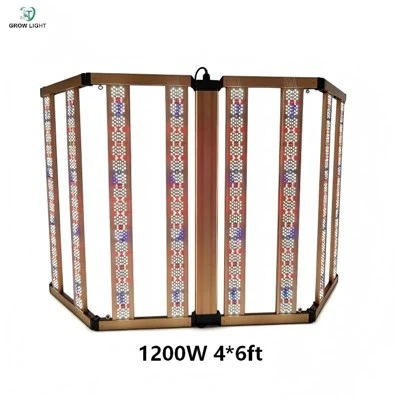
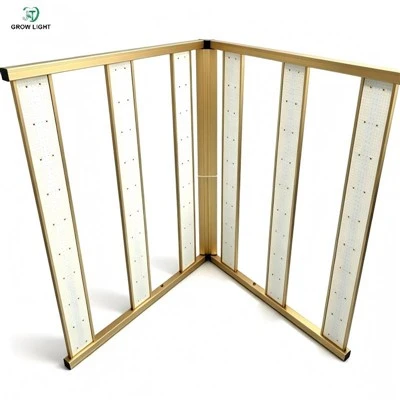
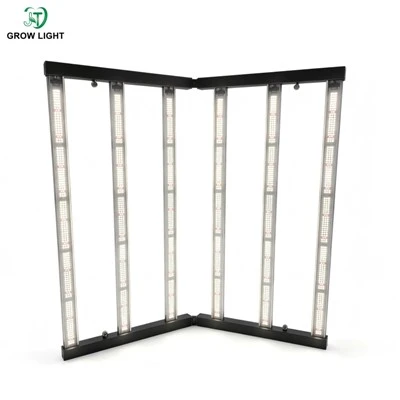
Bar-style full-spectrum fixtures are easy to reposition and combine. They work well in multi-stage rooms or when under-canopy bars are added later. Larger fixed full-spectrum fixtures in the 1100 W class deliver consistent coverage across wide canopies and suit operations that prefer one reliable recipe rather than frequent channel adjustments.
|
Growth Stage |
Spectral Emphasis |
Fixture Approach That Fits Well |
|
Seedling / early veg |
Higher blue, moderate intensity |
Full-spectrum bars or blue-rich channels |
|
Vegetative |
Balanced to moderately red |
Full-spectrum or multi-channel |
|
Flowering / fruiting |
Higher red + optional far-red |
Red-rich full spectrum or tunable |
Fixed full-spectrum fixtures are simpler and usually less expensive. Multi-channel adjustable fixtures give more precise control at higher cost and complexity.
Real-World Scenario - Adjusting Spectrum Across a Multi-Stage Commercial Grow Room
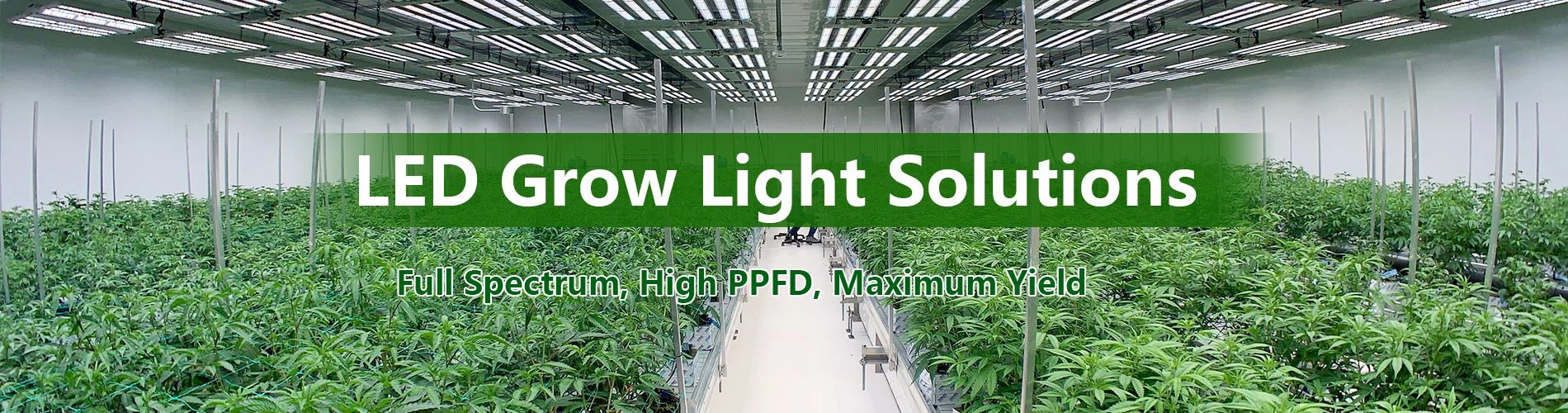
A single commercial room often contains plants at different stages. One practical setup uses overhead full-spectrum fixtures as the base layer and adds under-canopy or inter-canopy bars in the denser flowering zones. The overhead lights provide the main intensity and a solid full-spectrum foundation. The supplemental bars raise lower-canopy light and can run a slightly different spectral emphasis if the fixtures allow independent control. This combination improves uniformity without forcing a complete change of the main lighting system.
Fixed Full Spectrum vs Stage-Adjustable Spectrum - Which Should You Choose
|
Factor |
Fixed Full Spectrum |
Multi-Channel Adjustable |
|
Upfront cost |
Lower |
Higher |
|
Flexibility |
One solid recipe |
Stage- and crop-specific control |
|
Operational complexity |
Low |
Higher |
|
Best fit |
Single-crop or simplified ops |
Multi-stage or specialized production |
Many commercial growers still get strong results with well-designed fixed full-spectrum fixtures. Adjustable systems make the most sense when the facility regularly runs different crops or wants precise morphological control.
Does Spectrum Adjustment Actually Improve Yield - What the Data Shows
Reported Yield and Quality Differences Between Fixed and Stage-Tuned Spectrum
Research and commercial trials show that spectrum changes influence morphology, secondary metabolites, and lower-canopy development. Yield gains from spectrum tuning alone are often modest-commonly reported in the 5–15 % range when intensity and environment are already well managed. Larger improvements frequently come from better light distribution (including under-canopy supplementation) rather than spectrum changes by themselves. Results vary by crop, cultivar, and overall growing conditions. Treat spectrum as a refinement tool, not a magic switch.
Industry Trend - Rise of Multi-Channel Adjustable Spectrum Fixtures
Multi-channel and tunable fixtures have become more common in commercial catalogs. Growers who value morphological control or run diverse crops increasingly specify independent blue, red, far-red, and sometimes UV channels. At the same time, high-quality fixed full-spectrum fixtures remain widely used because of their simplicity and strong overall performance.
How to Choose a Reliable LED Grow Light Manufacturer for Spectrum-Specific Needs
When you evaluate an LED grow light manufacturer or LED grow light factory for wholesale LED grow light or custom spectrum grow light work, spectral accuracy and documentation matter as much as total output.
What Spectral Data (SPD Charts) to Ask For Before Ordering
Request detailed spectral power distribution charts measured on the actual production fixtures, not marketing graphics. Confirm the percentages of blue, red, far-red and any other bands at the power levels you intend to use. Ask whether channels can be controlled independently and how the spectrum shifts under dimming. Factories that supply clear SPD data and allow sample testing reduce the risk of receiving a spectrum that looks good on paper but behaves differently in the room. Missing or vague SPD data should be treated as a red flag.
F AQ
Q: Does light spectrum really affect plant growth stages?
A: Yes. Blue strongly influences compactness early on; red and far-red play larger roles in flowering and morphology later.
Q: What spectrum is best for flowering?
A: Most commercial recipes increase the red proportion and often add modest far-red. Exact ratios depend on crop and desired morphology.
Q: Do you need different lights for different growth stages?
A: Not always. Many operations run a good full-spectrum fixture throughout. Adjustable or supplemental fixtures become useful when precise control or dense canopies are involved.
Q: What is the point of under-canopy supplemental lighting?
A: It raises light levels in the lower canopy where top lighting is heavily shaded, improving uniformity and lower-site development.
Q: How do I choose between fixed full spectrum and adjustable spectrum?
A: Fixed is simpler and usually cheaper. Adjustable offers more control for multi-stage or specialized production.
Q: Is an 1100 W class full-spectrum commercial fixture suitable for most rooms?
A: It works well for larger canopies that need consistent full-coverage light. Match total output and uniformity to the actual area.
Q: What about MOQ and customization?
A: Most factories support custom spectral recipes and form factors above minimum order quantities. Confirm the final SPD on production samples
Request independent SPD measurements and, if possible, measure a sample fixture with a spectrometer under the conditions you will use.
Matching the LED grow light spectrum by growth stage is less about chasing a perfect recipe and more about making deliberate, crop-specific choices. When you request quotes, ask for SPD charts at the relevant power levels along with PPFD maps. Samples remain the most reliable way to confirm that the spectrum and distribution will perform as expected once the lights are installed.