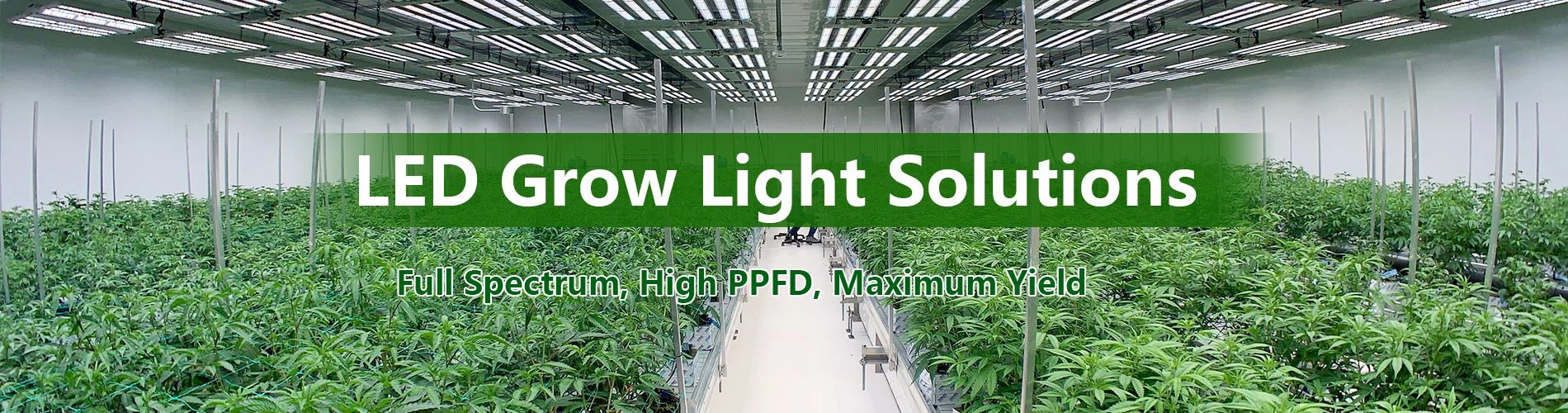
If you've spent any amount of time talking to commercial growers lately, especially the ones running large indoor operations or greenhouse facilities, you've probably noticed that their priorities around lighting have shifted. It didn't happen overnight, and nobody made a big announcement about it, but the change is very real. Over the last two or three years, we've heard fewer growers obsess over who has the highest PPF, and far more asking questions about stability, heat behavior, and what happens after a few months of real-world use.
I don't want to say "everyone stopped caring about PPF"-that's not true. Efficiency still matters. But more growers are telling us the same thing in slightly different words: "The number on the spec sheet isn't what kills my yield. It's how the grow lights age." That mindset wasn't common five years ago. Back then, most procurement decisions were driven by efficiency marketing and big watt-to-PPF comparisons. Today, the conversations feel noticeably more mature.
A lot of this shift comes from simple experience. When LED adoption accelerated, many growers were buying lights without a clear understanding of long-term degradation or thermal management. Some LED grow lights performed beautifully in the first month and then started drifting-sometimes subtly, sometimes dramatically-after the first long cycle. You can ignore a 3% drop. A 12% or 15% drop across hundreds of fixtures? That's a different story. We've heard growers describe uneven canopy development, unexpected stretching, inconsistent flower density-things that didn't show up in the marketing brochures but made themselves known by cycle three. We explained how spectrum actually drifts during decay in Why Spectrum Shapes Plant Behavior More Than Specs Ever Will.
One grower in Michigan recently told us he now checks his PPFD maps every cycle because early LED batches taught him a painful lesson: not all LED grow lights degrade at the same pace. Some of his older LED grow lights lost intensity faster than others, and even though he couldn't see it with his eyes at first, the plants definitely noticed. His phrase was, "It's not the brightness I lose-it's the uniformity." That sentiment sums up a lot of what we see across the industry. Cheap lights accelerate this decay, which I covered in Think Cheap LED Grow Lights Are Stealing Your Profits.
This is why thermal behaviour is getting so much attention. And honestly, it should've been the priority from the start. High-efficacy chips only tell half the story; how those chips are cooled tells the other half. When junction temperatures run too high, degradation speeds up. Spectrum shifts. Drivers get stressed. And because most growers run lights for extremely long photoperiods, these effects compound over time. A lamp that runs a few degrees cooler tends to age much more gracefully, something growers notice without needing to be engineers.
What's interesting is that many growers don't use technical terminology, but they explain the problems in very real terms. One said, "I don't know the right word for it, but some lights just look tired after a few months." Another pointed at a row and said, "Those used to match. Now they don't." These aren't academic observations-they're operational ones. And they're exactly what's driving the shift from "maximum efficiency mindset" to "long-term stability mindset."
It's also worth mentioning that growers have more data tools than before. Affordable PPFD meters, environmental logs, and mapping apps make inconsistencies visible. What used to be a vague impression-"this side feels weaker"-can now be quantified. And once a grower sees the numbers, it becomes harder to ignore small decay patterns.
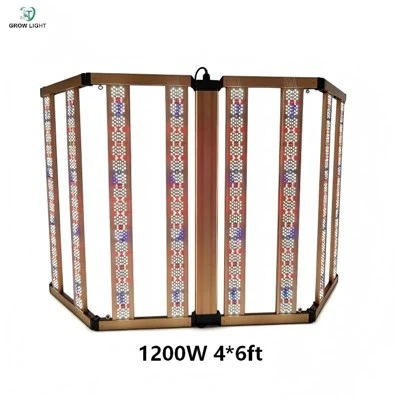
As a professional manufacturer of LED growth lights, JT Grow Light prioritized long-term performance long before it became a trend, focusing on heat dissipation design, driver reliability, and batch consistency. While our LED grow lights don't always boast the "highest PPF value in the industry," growers who have used these lights frequently mention slower performance degradation and more stable spectral characteristics.
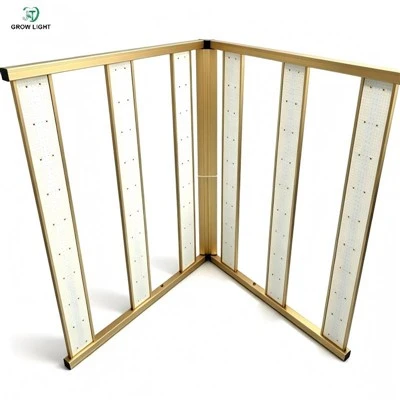
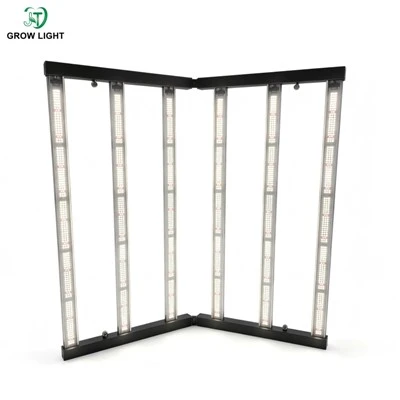
Regarding heat dissipation design, JT maximizes the surface area of the aluminum alloy for faster airflow and quicker heat removal from the lamp body. We use thicker aluminum alloys, unlike the thinner materials used in other products on the market. JT uses domestically recognized drivers with the best functionality. Regarding the wattage of the LED chips, we only use 70% of their rated wattage; for example, a 0.5W chip is actually used at 0.35W, significantly reducing light decay. Only when the hardware of a lamp is up to par can it achieve better results.
I have reviewed data from growers using JT Grow Light, covering multiple growing cycles. While not perfect at the lab level, the overall trend is consistent: lower operating temperatures, more stable output curves, and fewer unexpected issues.
This doesn't mean growers are abandoning efficiency as a metric. It just means efficiency no longer stands alone as the primary indicator of value. More growers now ask:
– What does the degradation curve look like in month four?
– Are batch outputs matched, or will I fight canopy inconsistency later?
– How much heat does the fixture really generate in my environment?
– How often will I have to adjust, maintain, or replace these units?
These are pragmatic questions. They're also the questions that define modern commercial cultivation.
So while "2025 is the year growers care less about PPF" isn't a phrase you'll find in a formal report, it does reflect a very real pattern we see across conversations, procurement decisions, and long-term facility planning. The market is maturing. The excitement over big shiny numbers is fading. What's replacing it is a quieter-but much more important-focus on predictability and stability.
And if there's one insight that seems to hold across nearly every discussion, it's this: The best light isn't the one that peaks the highest. It's the one that surprises you the least over time.