Where Under Canopy Lighting Started
When under canopy lighting first became a standard part of commercial grow room design, the fixtures behind it were simple by necessity. A single-side design, emitting from one direction at roughly 120°, was the default across most of the industry. It solved the basic problem well enough: the top light couldn't reach the lower canopy, and a single strip of LEDs tucked under the bench gave those bud sites some direct light instead of none.
For smaller rooms with modest canopy density, that was enough. A single-side under canopy light aimed upward or along one face of the row closed the most obvious gap in a grow room's lighting plan, and it did so with a simple, inexpensive design that was easy to manufacture and install.
That simplicity is also what eventually limited it.
What Growers Started Running Into
As commercial cultivation scaled up, canopy density increased, and training methods got more sophisticated, a pattern started showing up in grower feedback that was hard to ignore: single-side fixtures lit one face of the plant well, and left the opposite face almost entirely dependent on whatever light happened to scatter around the stem.
In rows where plants were trained or trellised on both sides - which became increasingly common as growers adopted SCROG and similar training methods to maximize yield per square foot - a single-side under canopy grow light simply couldn't do the job it was being asked to do. One face of the canopy would develop into dense, sellable flower. The other face, relying on indirect spillover, would consistently finish looser and less developed. Growers noticed this pattern across different rooms and different cultivars, which ruled out plant genetics or environmental variables as the explanation. The lighting layout itself had a structural blind spot.
The feedback wasn't about the fixture failing at its job. It was doing exactly what a single-side design is built to do - light one direction well. The issue was that grow rooms had evolved past what a single direction of light could adequately cover.
Why Multi-Side Emission Became the Answer
The fix wasn't a stronger single-side fixture. Increasing the output of a 120° design doesn't change where the light goes - it just makes the lit side brighter while the shaded side stays shaded. What growers actually needed was a change in how the light was distributed around the fixture, not how much of it there was.
Double-side emission, at roughly 180°, was the first step in that direction. By emitting from two opposing faces of the fixture simultaneously, a double-side LED under canopy light could cover both sides of a row trained on two faces, closing the exact gap that single-side designs had left open. For standard commercial rows - the most common layout across mid-size facilities - this was enough to bring the lower canopy up to the same level of development as the upper canopy.
Triple-side emission, at roughly 270°, extended that logic further for denser or more complex canopy structures. In rows where plants were effectively surrounded by canopy on more than two sides - wider benches, tighter multi-directional spacing, or particularly dense training structures - even double-side coverage could leave a third face of the plant underlit. Adding a third emission plane closed that remaining gap, giving growers a fixture that matched the physical reality of a canopy that didn't have just two sides to light.
The shift from single-side to multi-side wasn't a matter of making the fixture more powerful. It was a matter of recognizing that a plant's canopy is not a flat surface facing one direction - it's a three-dimensional structure, and the lighting covering it needed to reflect that.
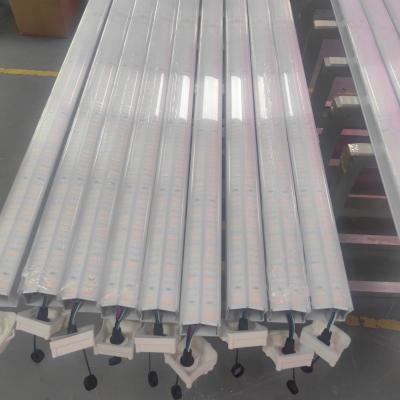


Why We Phased Out the Single-Side Design
As double-side and triple-side options became available, the shift in what growers were ordering was consistent and fairly fast. Single-side fixtures, which had made up the bulk of early under canopy lighting orders, steadily became a smaller share of the product mix as more growers moved to multi-side coverage for the reasons above.
This wasn't a case of pulling a product before the market was ready to move on. It reflected what growers were already telling us directly: once a facility experienced the difference in lower canopy development between single-side and double-side coverage, very few went back. New installations defaulted to double-side or triple-side from the start, and existing single-side installations were gradually replaced during routine upgrades rather than being maintained as-is.
By the time single-side orders had dropped to a small fraction of overall demand, keeping it as a standard catalog item no longer matched how the product was actually being used in the field. It's still available as a custom order for specific use cases - certain retrofit situations or very particular row configurations where a single direction of light genuinely is the right fit - but it's no longer part of the standard under canopy grow light lineup the way double-side and triple-side are.
What This Shift Reflects in the Industry
This progression from single-direction to multi-direction coverage isn't unique to under canopy fixtures. A similar pattern has played out in top lighting over the past several years, where early LED fixtures focused heavily on raw output and intensity, and later generations shifted focus toward distribution - spreading that output more evenly across a canopy rather than concentrating it in a single hotspot.
Under canopy lighting arrived at the same conclusion from a different angle. Because these fixtures sit inside or along the canopy rather than above it, the distribution problem is even more pronounced - a fixture mounted above a room can rely on distance and reflection to even out its coverage to some degree, but a fixture tucked into the lower canopy is working at close range, where the direction of emission matters immediately and directly.
The broader trend across horticultural lighting has been a move away from treating light output as a single number - total wattage, total PPF - and toward treating it as a distribution problem that needs to match the actual geometry of the plant being lit. Multi-side under canopy lighting is a fairly direct expression of that shift: the industry moved from asking how much light a fixture could produce, to asking how completely that light could cover a canopy from every angle it needed to reach.
Where the Line Stands Today
Double-side and triple-side emission are now the standard options across both the 6ft under canopy light and 8ft under canopy light sizes, giving growers a way to match coverage type to row structure independent of fixture length. A standard two-sided row can run double-side coverage at either length; a denser or multi-directional canopy can step up to triple-side, also available at either 6ft or 8ft depending on the room's scale.
That combination - choosing emission type based on canopy structure, and choosing fixture length based on row size - reflects how far the category has moved from its single-side origins. What started as a single strip of LEDs solving one obvious gap has become a more deliberate system for matching light distribution to the actual shape of the canopy it's covering.
FAQ
Q: Can I still order a single-side under canopy light?
A: It's available as a custom order for specific retrofit or row configurations where a single direction of light fits the layout, but it's no longer part of the standard product lineup.
Q: Is triple-side emission always better than double-side?
A: Not necessarily - it depends on row structure. Standard two-sided rows are usually well covered by double-side emission; triple-side is built for denser or multi-directional canopy where a third face of the plant would otherwise stay shaded.
Q: Why didn't a stronger single-side fixture solve the coverage problem?
A: Increasing output on a single-side design makes the lit side brighter, but it doesn't change where the light goes - the shaded side stays shaded regardless of intensity.
Q: Do double-side and triple-side fixtures cost significantly more than single-side units did?
A: Multi-side designs involve more LEDs and a different housing structure, so there is a cost difference, but most growers found the more even canopy development worth the difference once they compared results directly.