


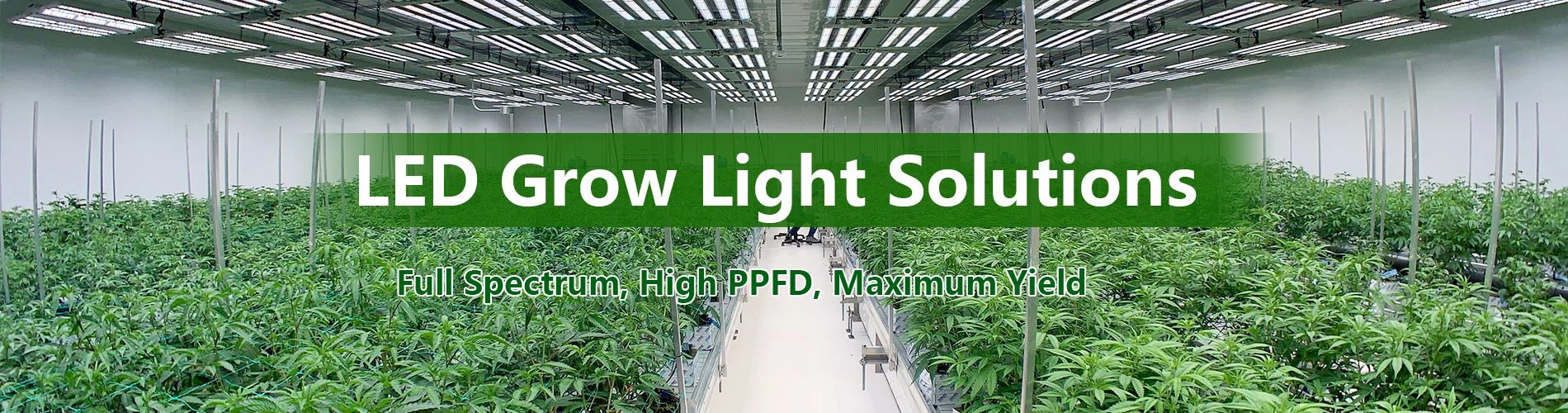

If you've ever unboxed a high-power LED grow light with UV and looked closely at the spec sheet or the controller settings, you've probably noticed something: the white light spectrum runs on one dimming channel, and UV sits on its own, completely separate channel. Some buyers assume this is just manufacturers overcomplicating a simple product, or worse, padding the spec sheet to make the fixture look more advanced than it needs to be.
It's neither. There's a real engineering reason behind it, and once you understand it, it actually becomes one of the easier ways to tell a well-designed fixture from a corner-cut one.
We get this question often enough from distributors and growers comparing quotes that it's worth breaking down properly - not just what a separate LED grow light UV dimming channel is, but why it exists, what happens if a manufacturer skips it, and how to check for it yourself before placing an order.
What Does It Actually Mean When UV Has Its Own Dimming Channel?
On a dual channel LED grow light with UV, the fixture is built with two independently controllable circuits: one driving the main white/full-spectrum diodes, and a second, separate circuit driving just the UV (and often IR) diodes. Each channel can be dimmed, turned on, or turned off without affecting the other.
Compare that to a single-channel full-spectrum fixture, where every diode on the board - white, UV, IR, whatever's included - runs off the same driver output and dims together as one block. There's no way to run UV at a different intensity or schedule than the rest of the spectrum, because they're electrically tied together.
The single-channel approach is simpler and cheaper to build. The dual channel approach costs more, but it gives the grower actual control over how UV is used - which matters more than it sounds like once you understand what UV diodes are actually like to work with.

Why UV Diodes Can't Share a Dimming Circuit with White Light Diodes
This is the core engineering reason, and it comes down to basic electrical characteristics.
Different forward voltage and drive current requirements
UV diodes and white/full-spectrum diodes don't share the same forward voltage curve or optimal drive current. White LED chips are generally driven at a fairly standardized current range that's been refined over more than a decade of horticultural lighting development. UV chips, particularly UVA and UVB emitters, often need a narrower, more specific current range to run efficiently and avoid premature degradation.
When you force both diode types onto a single shared dimming circuit, the driver has to compromise - running at a current level that's a reasonable average for both, rather than the ideal setting for either. That compromise might not cause an obvious problem on day one, but it shows up over months of continuous operation.
Uneven current distribution over time
Here's where it gets practical. On a shared circuit, small mismatches in how current is distributed between diode types tend to get worse, not better, as the fixture ages. A UV diode running slightly outside its ideal current window will typically show accelerated lumen depreciation compared to a UV diode running on its own properly tuned channel. Over an extended operating period, this kind of mismatch is a common contributor to one section of a fixture failing well ahead of the rest.
The heat curve problem
UV diodes also tend to have different thermal behavior than white diodes at comparable power levels. On a shared circuit, the driver and heat sink design have to account for the least forgiving thermal profile across both diode types, which either means over-engineering the cooling for the white diodes or under-cooling the UV diodes. Neither is efficient. A separate channel lets the fixture's designer optimize current and thermal management independently for each diode type.
What this means for driver failure rates
Put simply: a shared-channel design asks one driver output to do two jobs it wasn't optimized for. Over time, this tends to correlate with a higher rate of driver current mismatch issues and, in some cases, earlier driver failure overall. A dedicated UV channel isolates that risk - if the UV circuit is ever going to show stress, it does so on its own line, without dragging the main spectrum output down with it.
| Design Factor | Shared Single Channel | Separate UV Channel |
|---|---|---|
| Current optimization per diode type | Compromised, shared setting | Independently tuned |
| Thermal management | One-size-fits-all across diode types | Optimized separately |
| Long-term lumen depreciation risk | Higher for UV diodes | Lower, isolated to UV circuit |
| Driver stress under continuous use | Higher | Lower, isolated |
| Ability to control UV dose independently | Not possible | Fully adjustable |
Why UV Needs to Be Used in Small, Controlled Doses Anyway
Even setting the electrical side aside, there's a second reason independent UV control matters: how UV actually gets used in a real grow cycle.
Most commercial growers only introduce UV during the later stages of flowering, often to encourage trichome production or influence certain secondary metabolite responses. It's typically used for short daily windows, not run continuously alongside the main spectrum for the entire photoperiod.
Without a separate dimming channel, you can't actually replicate this kind of controlled dosing. UV would either run at a fixed ratio tied to the main spectrum the whole time, or not be adjustable in any meaningful way. That's a problem, because overexposing plants to UV isn't a minor issue - excess UV can trigger light stress responses, cause visible leaf damage, and in more severe cases, actually suppress growth instead of enhancing the qualities growers are targeting.
A LED grow light with separate UV channel lets a grower dial in exactly how much UV exposure the crop gets, and exactly when, rather than guessing or accepting whatever ratio the manufacturer hardwired into a single-channel design.
The Human Safety Angle Most Buyers Don't Think About
Here's a consideration that often gets left out of the conversation entirely: UV exposure isn't just a plant issue. It's a people issue too.
Anyone spending time in a grow room - checking plants, doing maintenance, taking measurements - is also exposed to whatever UV is running at the time. Prolonged UV exposure carries the same basic risks in a grow room that it does anywhere else: skin and eye irritation with repeated exposure, and more serious concerns with extended, unprotected exposure over time.
With a separate UV channel, staff working in the room can simply switch off the UV circuit while they're present, without needing to shut down or reconfigure the main lighting at all. On a shared-channel fixture, this kind of selective control isn't an option - it's all or nothing.
For any commercial facility thinking through operational safety protocols, this is a genuinely practical reason to prioritize fixtures with independent UV control, separate from any of the plant-side arguments.
How to Tell If a Grow Light's UV Channel Is Truly Independent
Since this detail doesn't always jump out from a product photo, here's how to actually verify it before ordering.
Check the spec sheet for channel labeling.
A fixture with genuinely independent UV control will usually list something like "2-channel dimming: main spectrum + UV/IR" explicitly, rather than a single dimming percentage applied to the whole fixture.
01
Look at the controller or app interface.
If the fixture ships with a smart controller or an app, there should be a visibly separate slider or setting specifically for UV, distinct from the overall dimming control. If there's only one master dimming control for the entire fixture, UV is very likely running on the shared channel.
02
Ask the supplier directly.
A straightforward question - "does the UV channel dim independently from the main spectrum, and can you confirm the driver setup supports that" - is a fair thing to ask any wholesale UV LED grow light supplier, and a supplier that can't answer clearly is worth a second look before you commit to a bulk order.
03
Request the wiring or driver diagram for OEM orders.
For larger OEM/ODM purchase agreements, it's reasonable to request documentation confirming the UV circuit is wired to its own driver output rather than sharing one with the main spectrum.
04

Why More Manufacturers Are Moving Toward Independent UV Control
A few years ago, UV was often included on fixtures mostly as a marketing checkbox - "has UV" was enough to differentiate a product on a listing page. That's shifted. Commercial growers, particularly larger operations running precise light recipes across flowering stages, are increasingly specifying independent UV dimming as a requirement rather than a nice-to-have.
Part of this comes from growers wanting finer control over light recipes as cultivation practices become more data-driven. Part of it comes from buyers in North America and Europe becoming more aware of the operational safety considerations around UV exposure, and building that into their facility protocols and purchasing criteria.
For an OEM LED grow light buyer sourcing fixtures for resale, being able to confirm and explain independent UV control is increasingly a point worth highlighting to end customers, not just a technical footnote.
Comparing UV Exposure Approaches Across Growth Stages
Since UV usage isn't constant throughout a crop's life cycle, it's worth laying out how independent UV control typically maps to different growth stages, compared to a fixed-ratio single channel approach.
| Growth Stage | Typical UV Usage Goal | Single Channel Limitation | Independent Channel Advantage |
|---|---|---|---|
| Vegetative stage | Usually minimal to none | UV runs at a fixed ratio regardless of need | Can be turned off entirely without affecting main spectrum |
| Early flowering | Low, gradual introduction | Difficult to ramp up UV alone | UV can be increased gradually and monitored independently |
| Late flowering | Higher, targeted exposure for a short daily window | Increasing UV means increasing overall intensity | UV can be pushed higher for a set daily window without changing main spectrum output |
| Harvest/pre-harvest | Often reduced or stopped to avoid stress on mature tissue | All-or-nothing adjustment | Can be dialed down or off independently |
This kind of stage-by-stage flexibility is exactly why more serious commercial operations are treating independent UV control as a baseline requirement rather than an extra feature, especially as light recipe optimization becomes a bigger part of how growers try to improve yield consistency and product quality.
What This Means When You're Comparing Quotes
If you're sourcing fixtures and see two options with similar wattage and similar PPFD claims, but one lists "2-channel dimming with independent UV control" and the other just lists "full spectrum including UV," treat that as a meaningful difference, not just wording. It usually reflects a real difference in driver design, wiring complexity, and ultimately how much control you'll actually have once the fixture is installed and running in your facility.
For growers building out light recipes for different stages of a crop cycle, or for OEM/ODM buyers who need to explain product differentiation to their own end customers, this is one of those details worth confirming in writing before an order is finalized - not assumed based on a spec sheet bullet point alone.
FAQ
Q: Can UV and white light run safely on the same dimming channel?
A: It's possible, but not ideal. Running both on a shared channel means neither diode type gets its optimal drive current, which tends to accelerate wear on the UV diodes specifically and can contribute to earlier driver stress over time.
Q: How much UV exposure is too much for flowering plants?
A: This varies by crop and UV type, but the general principle holds across most cultivation guidance: UV should be introduced gradually, monitored for visible leaf stress, and limited to short daily windows rather than run continuously - which is exactly why independent dimming control matters.
Q: Does every high-power LED grow light have a separate UV channel?
A: No. Many budget or single-channel fixtures include UV diodes wired into the same circuit as the main spectrum. Independent UV control is more common on mid-to-high-tier fixtures designed with more flexible light recipes in mind.
Q: Is UV dimming a standard feature or a premium upgrade?
A: It varies by manufacturer, but a separate UV dimming channel generally does add to production cost, since it requires an additional driver output and more complex wiring. It's reasonable to expect it to correlate with a higher price point compared to single-channel fixtures.
A separate UV dimming channel isn't a gimmick or an unnecessary complication - it's a deliberate engineering choice that protects the fixture's lifespan, gives growers real control over how UV gets used in a light recipe, and accounts for the safety of anyone working in the room. Next time you're comparing two fixtures that both claim to include UV, don't stop at "does it have UV." Ask whether that UV channel actually dims independently. It's a small line item on a spec sheet, but it tells you a lot about how seriously the fixture was engineered.


