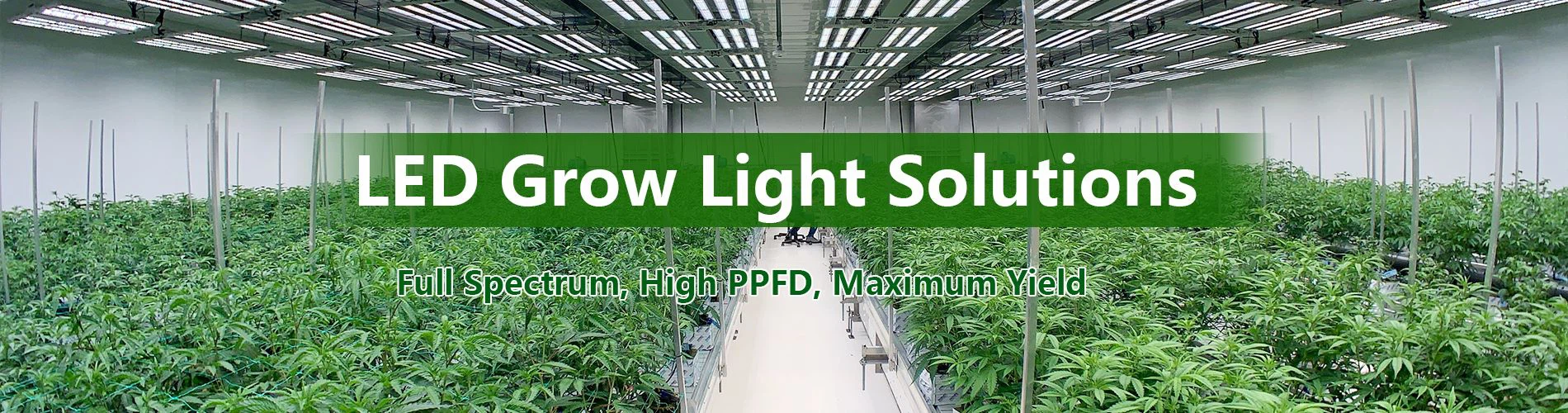
1. Spectral adaptability: precisely aligning with the requirements of crop growth.
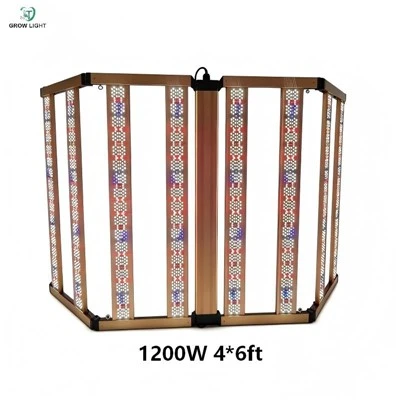
Plants depend on photosynthetically active radiation (PAR) in the range of 400 to 700 nm for most of their photosynthesis. Blue light (400–500 nm) speeds up the growth of stems and the production of chlorophyll. Red light (600–700 nm) speeds up the production of flowers, fruits, and sugar. There are several kinds of plants that can grow in greenhouses, and the spectral needs of these plants change a lot as they grow. So, LED plant lights need to be able to change their spectrum.
Spectrum tailored to the type of crop
Leafy vegetables, like lettuce and spinach, need a lot of blue light (with a red blue ratio of 2:1 to 3:1) to help their leaves develop thicker and make vitamins. A greenhouse in Shouguang, Shandong Province, for instance, utilises LED lights with a red-blue ratio of 3:1. This makes the leaves of lettuce 20% thicker and the vitamin C content 15% higher.
Fruits and vegetables, like tomatoes and peppers, need a lot of red light (4:1 to 6:1 red to blue ratio) to help flower buds grow and fruit get bigger. Researchers at Nanjing Agricultural University have found that LED lights with 60% red light can boost tomato yield by 30% and sugar content by 2 ° Brix.
Succulent plants need a balance of red and blue light (1:1 to 2:1) to keep them from growing too fast and make them more compact.
Ability to span the full spectrum
LED lights for multi-variety hybrid greenhouses need to be able to change the complete spectrum and mimic the cycles of natural light. For instance, the Osram SYNIOS P2720 full spectrum lamp bead spans the range of wavelengths from 380 to 780 nm and has a CRI of at least 90. Can meet all of the needs of crops throughout their lives.
Specific spectral needs
Some plants need far red light (700–800nm) to control their height or ultraviolet light (UV-A) to help them make secondary metabolites. Adding far red light to strawberry plants, for instance, can speed up the ripening process by five days.
2. Energy efficiency and stability are the keys to lowering operating costs.
Greenhouses need extra light for a long time, and the cost of electricity is more than 30% of their running costs. LED plant lights need to save energy and work better by having high photon flux efficiency (PPE) and low light decay.
Classification of Photon Flux Efficiency (PPE)
LED light source PPE must be at least 0.7 μ mol/J, and high-efficiency products must be at least 2.2 μ mol/J. The Cree XTE-FS quantum dot lamp bead PPE, for instance, saves 60% of the energy that high-pressure sodium lamps use.
Control of light loss and a guarantee of a long life
Because the greenhouse is so hot and humid, LED lights break down faster. To make them last longer, they need ceramic heat dissipation technology and a high-quality driving power supply. Weizhaoye Optoelectronic LED lights, for example, can still work reliably for 50000 hours in an atmosphere of 50 °C. The industry standard needs a light flux maintenance rate of ≥ 90% for 30000 hours.
Uniformity of power density and coverage
To get even light distribution, LED lights need to be set up in a matrix and the light intensity needs to be between 200 and 400 μ mol/m²/s per square meter. For instance, a 50-acre greenhouse with 20-40W/㎡ LED lights with two-dimensional translation stage scanning can get a PPFD coefficient of variation of 15% or less.
3. Ability to adapt to the environment: Dealing with very harsh greenhouse conditions
The greenhouse is a complicated place, thus LED plant lights need to be able to resist water, dust, corrosion, and interference.
Requirements for protection levels
To keep dust and moisture out, the lighting fixtures must have a protection rating of IP65 or higher. For instance, in Japan, greenhouse lights have to pass a test that shows they can handle 95% humidity without shorting out.
Range of temperature and humidity tolerance
The power supply must work well at temperatures between 0 and 40 degrees Celsius and humidity levels between 20 and 90 percent RH. For instance, the DLP-AG-3528 power supply from Di Lian Pu is made to work with global grid standards by having a wide voltage range (AC 100–240V).
Protection against interference and compatibility with electromagnetic fields
To keep electromagnetic interference from affecting things like greenhouse temperature control and CO2 sensors, it must meet the IEC 60598-1 standard.
4. Standards for safety: Making sure that people and crops are safe
LED plant lights give off significant electrical and optical radiation and need a lot of safety certifications.
Safety with electricity
To protect against electric shock, the lamp head must pass a 10N force test and the insulation resistance must be at least 4M Ω.
Fault protection: Dimmable bulbs must be able to work steadily at 150% power for 15 minutes, and non-dimmable lighting must pass high-voltage breakdown tests.
For example, lights sent to Japan must meet the JIS C 8156 standard, and CE, UL, PSE, and other certifications are needed.
Safety in Photobiology
To avoid too much exposure to blue and UV radiation, it must meet the IEC 62471 standard. For instance, the European Union says that greenhouse lamps can't let out more than 0.1W/m² of UV radiation.
Safety of Materials
To keep the risk of fire low, the insulation material must pass the 650 °C hot wire test. For instance, the exterior shell of the light fixture must be composed of flame-retardant material with a V-0 grade.