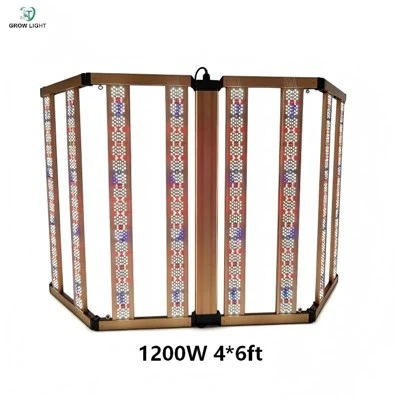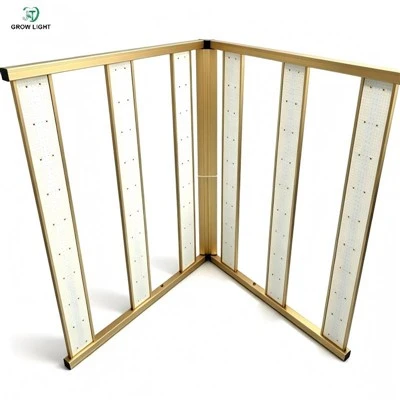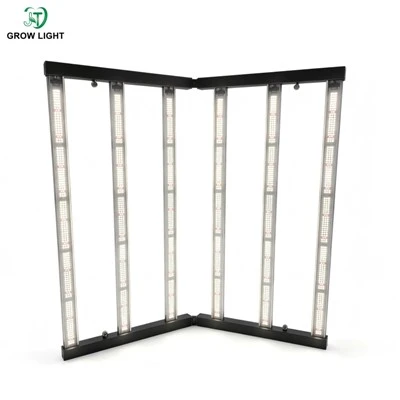

Most growers think they understand foldable LED grow lights the moment they see one opened. Bars spread out, coverage looks wide, installation seems straightforward. The assumption is simple: once the light is unfolded, the job is done.
That assumption is where many problems quietly begin.
In real commercial cultivation projects, especially at scale, the frame of a foldable grow light does far more than hold LED bars in place. It determines how consistently the light can be installed, how airflow moves above the canopy, how the fixture behaves after months of heat cycles, and how forgiving the system is when humans inevitably make small mistakes. These factors rarely show up in spec sheets, yet they are often the difference between a room that runs calmly and one that constantly needs attention.
Frames are not neutral-they shape system behavior
Growers often talk about foldable LED grow lights as if the frame were just packaging for the light engine. In practice, the frame is a structural component that interacts with the entire cultivation system.
Once installed, the frame becomes part of the room's physical architecture. It occupies vertical space, interrupts airflow paths, defines bar spacing, and sets the geometry that installers and plants must live with for years. A poorly considered frame doesn't fail immediately; it introduces friction that compounds slowly, cycle after cycle.
This is why two foldable grow lights with similar wattage and spectrum can behave very differently in the same room. The difference often isn't electrical. It's structural.
Installation accuracy depends more on frame geometry than power
One of the most overlooked aspects of foldable LED frames is how strongly they influence installation accuracy.
In theory, installers follow drawings and measurements. In reality, they follow visual cues. A well-designed foldable frame provides those cues naturally. Symmetry, consistent bar spacing, and predictable hinge behavior make it obvious when something is aligned-and just as obvious when it's not.
Frames with inconsistent hinge angles, flexible joints, or ambiguous bar spacing force installers to "eyeball" alignment. That works until it doesn't. Small misalignments may seem harmless during installation, but they show up later as uneven coverage, awkward overlap zones, and canopies that never quite look uniform.
This is one reason experienced growers care less about whether a foldable grow light can technically open, and more about how precisely it opens every time.
Frame stiffness affects long-term stability more than people expect
Another blind spot is mechanical stiffness.
Foldable LED grow lights go through repeated thermal cycles. They heat up, cool down, and repeat this process daily for years. Frames that lack sufficient stiffness slowly drift. Hinges loosen. Bars sag slightly. None of this looks dramatic on day one, but over time, it changes light distribution in subtle ways that are difficult to trace back to the source.
Growers often respond by adjusting hanging height, adding shims, or compensating elsewhere, without realizing the root cause is mechanical rather than biological or electrical.
A stable foldable frame doesn't need constant correction. It stays where it was installed. That stability is invisible when it's present, and painfully obvious when it's missing.

Airflow interacts with frames, not just light output
Air doesn't care about wattage. It cares about obstacles.
Foldable LED frames, especially in large commercial cultivation rooms, form continuous surfaces and edges above the canopy. The shape and spacing of these surfaces influence how air moves, where it accelerates, and where it stalls.
Frames with bulky cross members or uneven bar spacing can create airflow shadows that trap heat and humidity in specific zones. Growers then add more fans, increasing energy use without addressing the structural cause.
Well-designed foldable frames, by contrast, allow air to pass through predictable corridors. They don't eliminate airflow challenges, but they make them easier to manage because behavior becomes repeatable from row to row.
This is one reason growers sometimes report improved environmental stability after switching fixtures, even when HVAC equipment remains unchanged.
Frames determine how forgiving a system is to human error
No installation is perfect. Cables are routed slightly differently. Hanging points vary by a few millimeters. Bars are not always perfectly level.
A forgiving frame design absorbs these small inconsistencies without turning them into performance problems. A fragile or overly flexible frame magnifies them.
This matters most at scale. When one fixture is slightly off, it's manageable. When fifty fixtures are slightly off in slightly different ways, the room becomes unpredictable.
Foldable LED grow lights that are designed with forgiveness in mind-rigid frames, consistent hinges, clear geometry-help prevent small human errors from becoming systemic issues.
Why growers rarely think about frames until something goes wrong
Frames are invisible when they work. Growers don't walk into a room and think, "This frame is doing a great job today." They notice frames only when adjustments never seem to end.
This psychological bias leads many purchasing decisions to focus almost entirely on electrical specifications, while mechanical design is treated as secondary. Unfortunately, mechanical design often determines how those electrical specs translate into real-world results.
The irony is that frame quality often has a longer operational impact than diode brand or driver model.

Manufacturer perspective: frame design is where experience shows
From a manufacturer standpoint, frame design is one of the clearest markers of experience.
At JT Grow Light (JTGL), feedback from commercial growers consistently reinforces the same lesson: frame issues surface later, not sooner. Projects that feel "fine" in the first cycle begin to show drift in the second or third, and by then, replacing or correcting frames is far more disruptive than choosing correctly upfront.
This is why JTGL treats foldable LED frames as structural components, not accessories. Material selection, hinge tolerances, and load distribution are tested not only for shipping and installation, but for long-term behavior under real cultivation conditions.
Growers rarely ask about this during the first conversation. They always ask about it after they've lived through a problem elsewhere. This is why many growers evaluate foldable LED grow lights not just by output, but by how their frames behave over years of real cultivation.
Frames shape uniformity long before plants fill the room
Before plants reach full canopy, frame geometry already sets the stage for uniformity.
Bar spacing defines overlap zones. Frame width defines edge behavior. Hinge consistency defines symmetry. All of these influence how evenly light is delivered once the canopy closes.
When uniformity issues appear late in a cycle, growers often suspect feeding, genetics, or microclimate differences. Frame geometry is rarely questioned, even though it may be the underlying constraint.
This doesn't mean every uniformity issue is a frame issue. It means frame issues are easy to overlook because they operate quietly.
The cost of overlooking frames is paid over time, not upfront
Choosing a foldable LED grow light with a weak or poorly considered frame rarely causes immediate failure. The cost is paid in small increments: extra adjustments, inconsistent results, added labor, reduced predictability.
These costs don't show up on invoices. They show up as operational fatigue.
Growers who have experienced this tend to change how they evaluate fixtures. They stop asking only "how much light" and start asking "how stable is this structure over time."
Grower takeaway: frames are part of the system, not an afterthought
Foldable LED grow lights are not just electrical devices. They are structural elements suspended above living plants.
The frame determines how the fixture behaves in the real world-how it installs, how it stays aligned, how it interacts with airflow, and how forgiving it is to human imperfection.
Growers who overlook frames often end up managing problems they never expected. Growers who understand frame behavior build rooms that feel calmer, more predictable, and easier to scale.
In commercial cultivation, those qualities matter more than most people realize.