1. Electricity has become the highest cost in indoor growing
If you ask a commercial grower to create a realistic cost pie chart, you'll find a very real situation: electricity is the highest cost in indoor growing.
Whether you're growing cannabis, vegetables, strawberries, leafy greens, or medicinal plants, you'll ultimately find that all the money in your grow room is going towards feeding LED grow lights. Lamps are not just lighting equipment; they are the "energy engine" of the entire system. The lower the luminous efficacy, the higher your electricity bill; the higher the luminous efficacy, the more photons you produce per kilowatt-hour of electricity, meaning lower photon costs.
That's why growers are no longer looking at "wattage" but are starting to look at PPE (Power, Parts, and Equipment). PPE (photon efficiency) directly determines the number of photons generated per kilowatt-hour of electricity. What's the difference between 2.0 μmol/J and 2.8 μmol/J?
It's a 40% difference in photons and also a 40% difference in electricity costs.
For the same electricity cost, you'll either get 2000 μmol/s or 2800 μmol/s.
This is why, although it actually started in 2023, by 2025, it had become a trend: LED grow lights without 2.8 μmol/J or higher weren't qualified for commercial project bidding. Growers prefer to buy "photons at cost." The cheaper the photons, the higher their ROI.
2. Higher luminous efficacy = lower heat = higher yield
High PPE not only saves electricity, but it also changes the energy balance of the entire growing room.
What bothers growers the most? When the lamps are turned on, the entire grow room feels like it's been thrown into an oven. The HVAC system works like crazy, the environment becomes uncontrollable, VPD spikes, and plant stress increases, leading to scorched edges and dry tips in the latter half of the flowering period.
Why were the older grow lights so terrible? Because:
Low luminous efficacy = more energy converted into heat, not photons.
Look:
– 2.0 μmol/J
– 2.8 μmol/J
How many watts does it take to produce 2000 μmol/s?
A rough calculation will show you:
2.0 μmol/J → around 1000 W
2.8 μmol/J → around 714W
That's a difference of nearly 300 W of heat energy, and this 300 W directly translates into "increased room temperature + doubled HVAC pressure + increased plant stomatal pressure".
In other words:
High luminous efficacy = Low heat load
Low heat load = More stable temperature and humidity
More stable temperature and humidity = More stable yield
This is why everyone involved in commercial cannabis will tell you: "High luminous efficacy isn't about saving electricity; it's about stabilising the environment."
3. High luminous efficacy makes it easier to achieve DLI (especially during cannabis flowering)
Plants consume daily light integral (DLI), not just "how bright they look".
If you want to increase yield, density, oil content, or flower weight, DLI is a key performance indicator.
The higher the luminous efficacy, the easier it is to achieve the target DLI without needing to add extra power, more lights, or more electricity.
For a simple real-world example: Many cannabis flower rooms target a DLI of 40–50 mol/day, but using 2.2 μmol/J lights, the grower can't push it to that level; pushing it too high turns the room into a sauna.
Using 2.8–3.0 μmol/J makes it much easier.
High luminous efficacy isn't just about "brighter"; it's about "easier to push plants into their yield range." Growers become increasingly knowledgeable and will eventually gravitate towards high luminous efficacy.
4. ROI doubles directly; project investors value the payback period most
Growers care about yield, investors care about payback period, and high-efficiency LED grow lights are a core component of the entire system's ROI.
Let's do the maths:
For the same room:
Low-efficiency lights: Electricity cost → $3000 USD per month
High-efficiency lights: Electricity cost → $2000 USD per month
How much do you save in a year?
$12000 USD.
A three-year project saves $36000 USD.
And the price difference for the lights might only be $300-$500.
What do you think growers will choose?
What do you think investors will choose?
What do you think integrators who do the engineering design will choose?
Of course, the choice would be full-spectrum grow lights with high luminous efficacy of 2.8–3.0 μmol/J. High luminous efficacy saves more than just money; it's the lifeblood of a project.
5. The commercial trend is set: below 2.8 μmol/J is no longer the standard
Have you noticed that major commercial lighting brands are now:
Fluence is moving towards 2.9 μmol/J.
Gavita is moving towards 3.0 μmol/J.
Luxx and Spider Farmer's commercial lines are also moving towards 2.8+ μmol/J. Greenhouse supplemental lighting requirements in Japan and Canada directly state: minimum 2.7 μmol/J. New cannabis projects in the US directly specify 2.8 μmol/J. Required.
What does this mean? It means this is the standard, the trend, and the industry bottom line.
If you're still using 2.3 μmol/J LED grow lights, your competitiveness is directly eliminated.
This part will be based entirely on your actual situation, without fabricating data.
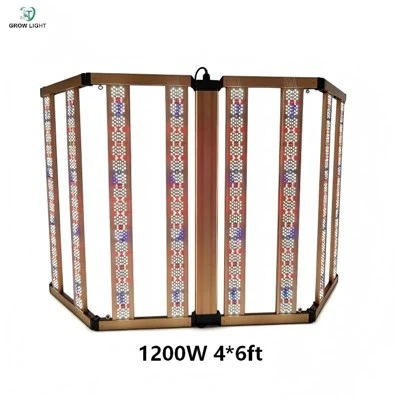
JT grow lights achieve a full-spectrum LED grow light efficiency of 2.8–3.2 μmol/J, primarily due to two factors:
1. The chip operates at full load (total LED power exceeds the actual driving power).
For example, JT's 1000W model:
– Uses a 1500W LED system
– Only runs at 1000W. This allows the LEDs to operate within their optimal efficiency range, resulting in low thermal stress, slow ageing, and naturally higher luminous efficacy.
2. Optimised heat dissipation + large aluminium area → lower chip junction temperature.
Luminous efficacy and temperature are inversely proportional.
JT's excellent heat dissipation results in low temperatures, naturally maintaining high chip efficiency.
3. Reasonable spectral weighting in the full spectrum.
JT doesn't blindly pile on blue and red light; instead, it uses penetrating green light and mid-band wavelengths, making the canopy's overall light absorption more efficient.
In other words, JT grow lights' high PPE (Power Efficiency) isn't artificially achieved but rather "naturally and logically derived through engineering." This is what professional LED grow lights should look like.

7. The ultimate reason for commercial projects shifting to 2.8 μmol/J: More stable, cooler, more energy-efficient, and more productive
High luminous efficacy is the future.
High luminous efficacy is the trend.
High luminous efficacy is the core of ROI.
And 2.8 μmol/J is the industry watershed.
You'll find that all large farms, greenhouses, cannabis facilities, and vertical farms are no longer discussing "brightness", but rather:
Whether it can save electricity
Whether it can be stable
Whether it can run for two years without declining performance
Whether it can support DLI
Whether it can prevent HVAC from exploding
Whether it can improve ROI
And all of this ultimately points to the same answer:
2.8 μmol/J is the minimum threshold for modern indoor growing.
3.0 μmol/J is a stable future.