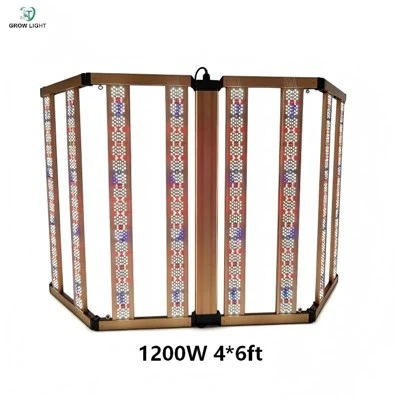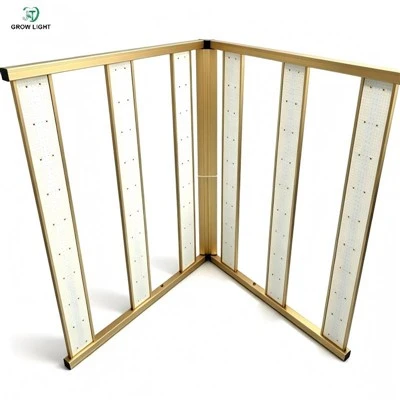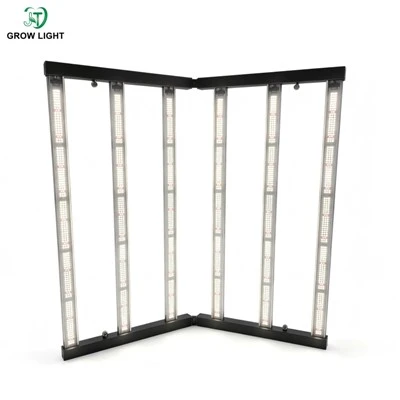
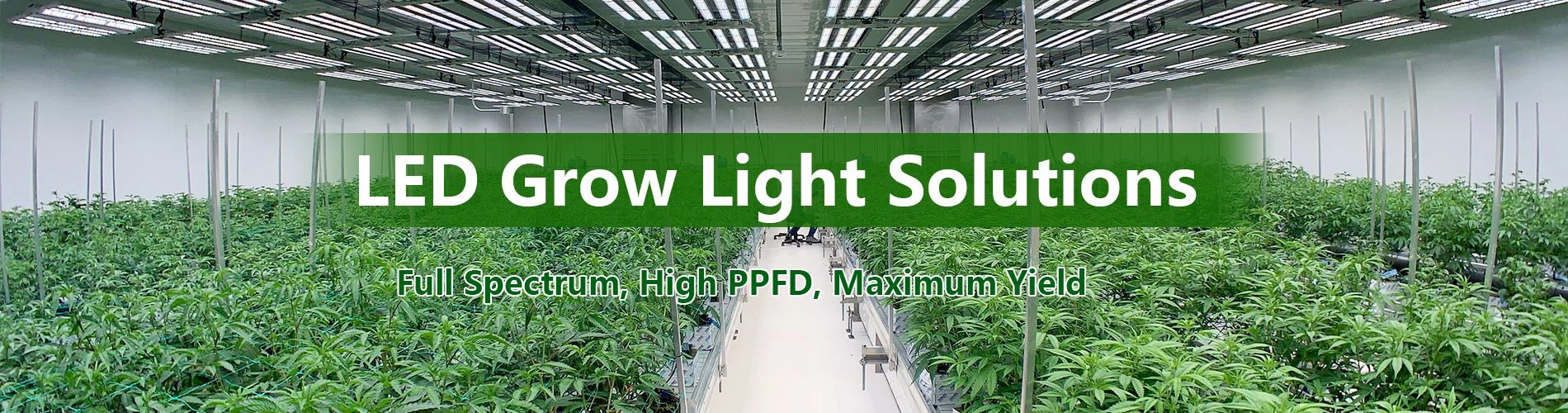

If you spend enough time around commercial farms - real ones, not showroom projects or concept renders - you start to notice something interesting. No matter how fast LED technology evolves, no matter how many new fixtures hit the market every year, LED tube grow lights and LED grow light bars never actually disappear. They stay. Quietly. Almost stubbornly.
You see them in propagation rooms where nobody cares about fancy housing. You see them above dense nursery trays where uniformity matters more than peak PPFD. You see them installed on multi-layer rack systems that have been running non-stop for years, sometimes longer than the brand name printed on the fixture is still relevant.
This raises a question that doesn't get asked often enough:
If LED tube grow lights are "old," why are they still everywhere in commercial farms?
It has everything to do with how commercial growing actually works once the Instagram photos stop and the electricity bills start arriving.
One of the biggest misunderstandings in the grow lighting industry is the belief that commercial farms select lights the same way hobby growers do. They don't.
A hobby grower might ask: Which LED grow light gives me the highest output per square foot?
A commercial farm asks something very different: Which lighting system allows me to run this facility predictably, day after day, year after year, without surprises?
That distinction explains why LED tube grow lights and LED grow light bars remain relevant. They are not chosen because they are exciting. They are chosen because they are understood.
In propagation rooms, nurseries, and vertical rack systems, lighting is rarely treated as a standalone component. It is part of a tightly constrained environment where airflow, humidity, labor access, irrigation, and cleaning routines all collide. A lighting solution that disrupts any of these systems quickly becomes a liability, no matter how impressive it looks on paper.
This is where LED tube grow lights quietly outperform more complex fixtures. Their linear form factor integrates easily into standardized rack dimensions. Their thermal behavior is predictable. Their failure modes are usually local rather than catastrophic. In a commercial setting, these characteristics matter far more than theoretical maximum performance.


Why Linear Light Distribution Still Wins in Multi-Layer Growing
Uniformity Is Not a Buzzword - It's an Operational Requirement
In vertical farming and rack-based cultivation, uniformity isn't something growers chase for aesthetics. It's something they chase because non-uniform growth breaks scheduling, labor planning, and harvest consistency.
This is where the geometry of LED grow lights tube designs and LED grow light bars becomes important. Linear light sources distribute photons along the length of the shelf, not from a single concentrated center point. That alone reduces edge shading, hot spots, and the uneven stretching that often shows up under compact panel-style fixtures in tight spaces.
In multi-layer racks, plants are often positioned just inches below the light source. At that distance, beam shape matters more than raw output. A full spectrum LED grow light tube placed evenly across the rack creates a smooth photon field that plants respond to consistently. The result is not dramatic individual growth - it's predictable trays that behave the same way, cycle after cycle.
Many growers learn this lesson the hard way after experimenting with higher-powered fixtures that simply don't fit the spatial reality of racks. The issue isn't that those lights are "bad." It's that they were never designed for close-canopy, high-density layouts.
Maintenance and Downtime: The Hidden Cost Nobody Puts on Spec Sheets
Commercial farms rarely fail because a light didn't hit its advertised efficiency number. They fail because maintenance becomes unmanageable.
When lighting is installed across hundreds or thousands of square meters, replacement strategy matters just as much as initial installation. LED tube grow lights excel here because they fail gracefully. One tube goes down, not an entire zone. One shelf needs service, not the whole room.
This modularity is a major reason LED grow lights tube systems continue to dominate in propagation and nursery environments. Technicians can replace a single unit without disturbing airflow patterns, irrigation lines, or neighboring crops. That kind of operational flexibility is hard to quantify, but every facility manager understands its value.
Environmental conditions also play a role. High humidity, frequent wash-downs, and nutrient mist are normal in commercial farms. In these environments, water resistance is not a premium feature - it's basic survival.
This is where IP65-rated LED tube grow lights, like those produced by JTGL, quietly earn their keep. The goal isn't to survive rain. It's to survive years of condensation, cleaning cycles, and unpredictable microclimates inside dense grow rooms. Combined with thicker aluminum housings designed for consistent heat dissipation, these fixtures are built for continuous operation, not showroom longevity.
Full Spectrum Doesn't Mean Universal - It Means Purpose-Built
There's a persistent myth that commercial farms want one "perfect" spectrum that does everything. In reality, experienced growers think in stages, not slogans.
Propagation rooms prioritize root development and compact morphology. Nurseries care about stem strength and uniform leaf expansion. Vertical leafy green systems focus on efficiency and consistency, not flowering intensity. In these contexts, full spectrum LED grow light tubes are used because they provide balanced, plant-friendly output without pushing crops into stress responses.
The advantage of LED tube grow lights and LED grow light bars is not that they deliver exotic spectra. It's that they offer controlled, repeatable spectral profiles that growers already understand. When multiple spectrum options are available within the same physical platform - as with JTGL's tube systems - farms gain flexibility without redesigning infrastructure.
That matters more than it sounds. Changing crops, adjusting growth strategies, or responding to market demand becomes possible without ripping out entire lighting systems. In commercial agriculture, that adaptability often determines whether a project remains profitable over time.

Why LED Tube Grow Lights Haven't Been Replaced - They've Been Repositioned
The reason LED tube grow lights remain widely used is not because the industry lacks alternatives. It's because these fixtures occupy a specific and irreplaceable role within commercial systems.
They are not competing with high-power top-lighting solutions. They are not trying to dominate flowering rooms. Instead, they support the backbone of commercial operations - propagation, early-stage growth, dense rack systems, and facilities that value uptime over spectacle.
Over time, LED grow light bars and LED grow light tube designs have matured into infrastructure components rather than gadgets. They are selected for how well they integrate with racks, how easily they scale, and how reliably they perform under less-than-ideal conditions.
Manufacturers like JTGL, who focus on structural durability, thermal stability, waterproof construction, and practical spectrum options, understand this reality. Their role isn't to chase trends. It's to supply lighting tools that behave predictably inside real commercial farms.