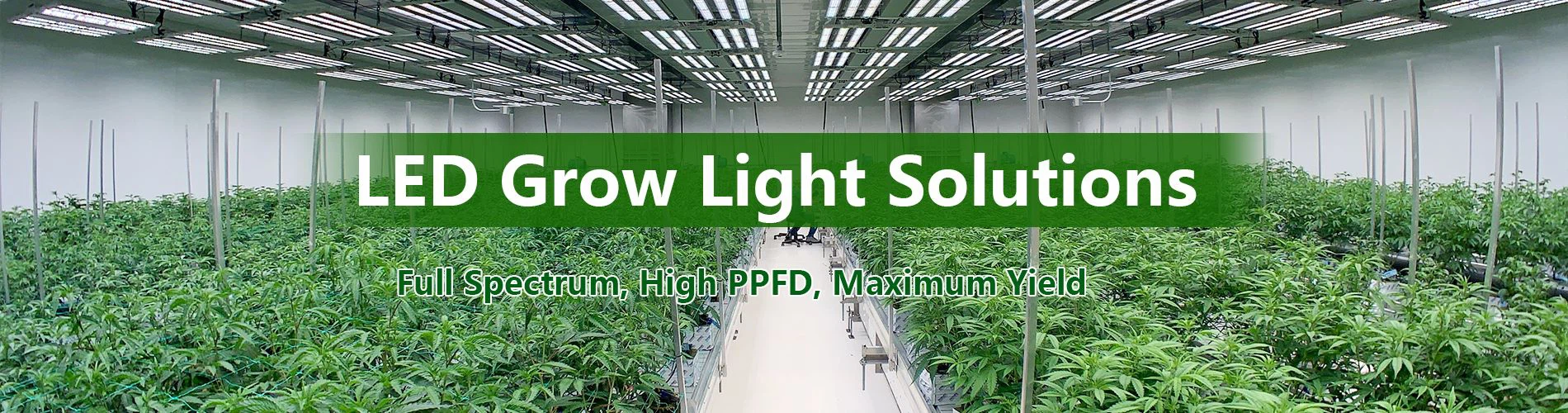

Picture a grower walking into a flower room at week five. The top of the canopy looks great. But push the leaves aside and the bottom third tells a different story: pale leaves, thin stems, small airy buds that will end up as "popcorn."
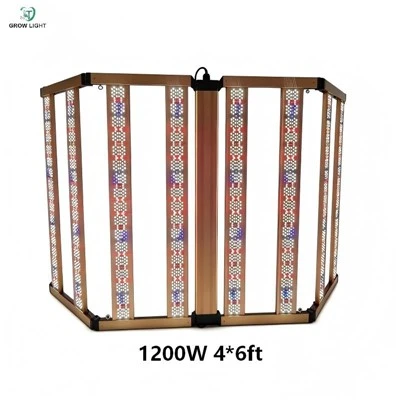
The overhead lights are doing their job. The problem is that the lower plant never gets enough useful light. This is exactly why an under canopy grow light exists. And it is why we did not simply copy an ordinary white-light spectrum when we designed ours.
If you look at the spectrum chart of our under canopy fixture, one thing jumps out right away: a tall red peak, a small blue bump, and a gentle slope of green and yellow in between. Many buyers ask us, "Why is it so red? Where is all the blue?" This article answers that in simple terms.
What Is an Under Canopy Grow Light?
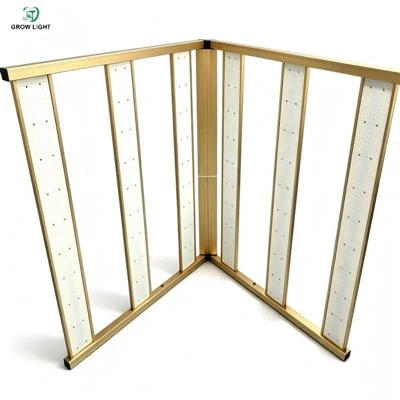
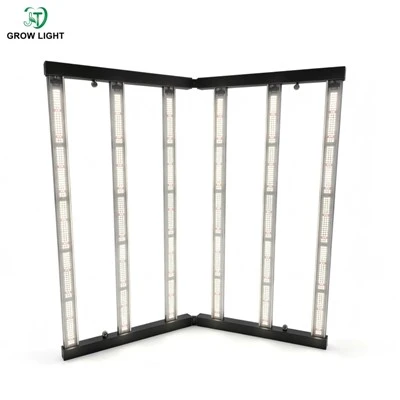
An under canopy grow light, also called inter-canopy lighting or lower canopy lighting, is mounted below or inside the plant canopy. It lights the leaves and flowers that the top lights cannot reach well.
You will see it in three common settings:
Cannabis rooms, where bottom branches tend to stay small and airy
Greenhouse tomatoes and cucumbers, where tall vines shade their own lower leaves
Tiered vertical farms and dense racks, where light from above gets blocked
The lower canopy gets a different kind of light
Here is the key idea that shapes the whole spectrum. Light that has already passed through the top leaves is no longer the same light.
A healthy leaf absorbs roughly 85% to 95% of the red and blue light that hits it. It lets much more green and far-red light pass through or bounce off. So the lower canopy sits in a "filtered" light environment: low in red and blue, relatively rich in green and far-red.
| Light color | What the top leaf does | What reaches the lower leaf |
|---|---|---|
| Blue (about 450 nm) | Absorbs most of it | Very little |
| Green (about 500 to 570 nm) | Absorbs less, transmits and reflects more | Moderate |
| Red (about 660 nm) | Absorbs most of it | Very little |
| Far-red (about 730 nm) | Absorbs little | Relatively more |
So the lower canopy is short on exactly the photons that drive photosynthesis best. A good under canopy light has to put those photons back. That is the starting point for our spectrum.


Why Red Is the Star of This Spectrum
Red matches what chlorophyll wants
Chlorophyll, the green pigment that captures light in leaves, has two big absorption zones: one in the blue range and one in the red range. Deep red around 660 nm sits right on the red peak. That is why you will hear growers call it the "engine" wavelength for photosynthesis.
This is also why a 660nm red LED grow light is such a standard building block in horticulture. Research on plant response, including the well-known McCree curve, shows that red photons deliver strong photosynthetic return per photon.
Red LEDs are efficient
There is a business reason as well. Red LED chips are among the most efficient chips in the grow light world. Chip-level efficacy for deep red can be well above 3 µmol/J, and finished fixtures usually land lower after driver and thermal losses. White LEDs, which use a blue chip plus phosphor coating, lose some energy in the conversion step.
For an under canopy light, this matters. The fixture sits close to the plants, in a space that is often hot and humid. More efficient chips mean less waste heat near the leaves and a lower power bill. That is one reason a well-built red spectrum grow light makes sense for this job.
The lower canopy needs red the most
Remember the table above: the lower canopy is starving for red. Adding a strong red peak fills the biggest gap. In simple terms, we are putting back what the upper leaves took away.
Why Blue Is Only a Small Peak
Many buyers assume more blue is always better, since blue looks "plant friendly." In reality, blue has a smaller role in an under canopy design.
What blue actually does
Blue light helps open the stomata (the tiny pores plants breathe through) and influences plant shape. Plants grown with some blue tend to be more compact and sturdy. So we do not remove blue. We keep a modest peak around 450 nm so the lower plant still gets a basic dose.
Why we do not push it higher
The top lights already supply most of the blue. The plant's overall blue needs are usually covered from above.
Blue photons are less efficient to produce than red ones, so a big blue share raises cost and power without a matching gain.
Too much blue can slow leaf expansion in some crops.
High blue content makes the light look harsh and glaring for workers, who often stand right next to these fixtures during pruning and harvest.
This is also a safety and comfort point. Fixtures at eye level or below eye level with strong blue output can be unpleasant to look at, and photobiological safety testing pays closer attention to blue-heavy light. A smaller blue peak makes the fixture easier to work around.
The Green-Yellow Bridge: Small Part, Real Job
Between the blue bump and the red peak you can see a gentle shoulder of green, yellow and orange. At first glance it looks like filler. It is not.
It reaches deeper into the plant
Green light passes through and reflects inside leaves and canopy layers more than red or blue do. Studies on leaf optics have shown that green photons can drive photosynthesis in the deeper layers of a leaf and in shaded leaves. For a light that has to work inside a thick canopy, that is useful.
It makes the room workable
This one is practical. A pure red and blue light looks purple and makes it hard to see anything. Leaf color, pests, mold and early nutrient problems all become hard to judge. The green-yellow shoulder brings the visual quality back to something close to normal, so your team can scout plants properly. Many growers tell us this is the reason they stop disliking "pink lights."
It smooths the transition
The shoulder rises from the valley around 480 nm up toward the red peak. This broad band typically comes from phosphor-converted white LEDs mixed with red LEDs. The result is a continuous spectrum with no big holes. It also adds orange-red light around 600 to 630 nm, which plants use well.
The Small Far-Red Bump at 730 nm
At the right edge, you can see a small bump around 730 nm. Far-red light sits just outside the traditional PAR range (400 to 700 nm), but it affects plants in two ways:
It works together with red light to improve photosynthetic efficiency, known as the Emerson effect.
It sends signals through the plant's phytochrome system, which influences stem stretch, leaf size and flowering response.
Because far-red can make plants stretch, we keep it small. In the lower canopy, where stems are already reaching, we want a light touch.
Red-Led vs. White-Led: A Practical Comparison
| Factor | Red-led under canopy spectrum | Bright white under canopy spectrum |
|---|---|---|
| Photosynthetic return per watt | Higher in most cases | Lower in most cases |
| Heat near the plant | Lower for the same light output | Higher |
| Visual comfort for workers | Needs the green-yellow bridge to look natural | Looks natural |
| Cost per µmol | Usually lower | Usually higher |
| Fit for supplementing top lights | Excellent, fills the red gap | Good, but repeats what the top lights already give |
| Blue exposure near eyes | Lower | Higher |
The honest takeaway: bright white is not wrong. It is easier on the eyes and fine for general use. But if the goal is to feed the lower canopy efficiently, a red-led spectrum with a supporting green-yellow band usually gives better return on every watt.
Real-World Scenarios
Cannabis flower rooms
Growers use under canopy lights to improve bud density on lower branches and cut down on popcorn buds. Lower sites are often at much lower light levels than the top, so even a modest, well-placed fixture can help. Many growers also report better uniformity across the plant when lower lighting is added.
Greenhouse tomatoes and cucumbers
In tall vine crops, inter-canopy LED trials have reported yield improvements that often fall in the range of several percent to low double digits, depending on crop, season and setup. Keeping the lights close to the leaves also lets growers use less power than raising overhead light levels.
Vertical farms and tiered racks
Where plants are stacked, light from above is blocked quickly. A low-profile, cool-running red-led fixture fits tight gaps between tiers better than a hot, bulky one.
What to Ask an Under Canopy Light Supplier
Whether you are buying one fixture or placing a wholesale under canopy grow light order, ask these questions:
Can you send the full spectrum chart and the PPF breakdown by color band?
What is the efficacy in µmol/J, measured at the fixture level?
What is the lifetime rating, and at what temperature was it tested?
How hot does the fixture run, and what is the IP rating?
What certifications do you hold for my market?
Do you offer OEM under canopy grow light options for spectrum and size?
Working with a direct LED grow light factory or under canopy LED grow light manufacturer also makes custom work easier. If your crop needs a bit more blue, a different far-red level, or a different bar length, the spectrum can be tuned at the production stage rather than patched afterward.
FAQ
Q: What is the best spectrum for an under canopy grow light?
A: There is no single answer for every crop, but a red-led spectrum with a small blue peak, a green-yellow bridge and a light far-red touch is a strong, efficient choice for most lower canopy work.
Q: Do plants really need green light?
A: Yes, in a supporting role. Green light travels deeper into leaves and canopies, and it also lets workers see the plants properly. It is not a waste.
Q: Why do some grow lights look pink or purple?
A: Because they use mostly red and blue chips. Adding a green-yellow band, as we do, brings the color closer to normal white while keeping the red-led efficiency.
Q: Does under canopy lighting replace top lighting?
A: No. It supplements it. The top lights feed the main canopy, and the under canopy fixture feeds the shaded lower plant.
Q: Can the spectrum be customized?
A: With a manufacturer that controls its own production, yes. Blue ratio, red peak position and far-red level can all be adjusted for specific crops and projects.
Our under canopy grow light spectrum is red-led because that is what the lower canopy is missing. The small blue peak keeps plant structure healthy without wasting power or hurting visual comfort. The green-yellow bridge helps light travel deeper and lets your team see what they are doing. The small far-red bump adds a gentle signal without making plants stretch.
Put together, it is not just "red for the sake of red." Every part of the curve has a job.
If you are planning a lower canopy lighting project and want the full spectrum data, test reports, or a custom spectrum quote, send us a message. We are happy to share the details and help you choose the right setup.