If you use full-spectrum LED grow lights with UV, you've probably noticed a detail: the UV output is always the first to "change". Initially, you might see UV making leaves harder, leaf edges darker, and tissues tighter, but after a while, the effect gradually weakens. You might suspect a nutrient problem or the plant changing seasons. But the truth is the light hasn't dimmed, the plant isn't sick, and it's the UV spectrum that's drifting. It's not the brightness that's drifting, but the wavelength.
Of all the IR & UV wavelengths, UV is the most unstable, most prone to decay, most difficult to control, and most prone to drift. Because from materials, packaging, heat, driving, and current to phosphors, UV light is at the "shortest end of the lifespan curve".
1. Why is UV the most fragile?
UV chips operate in the 280–400 nm band, with energy levels far exceeding visible light. Shorter wavelengths have higher energy, and higher energy makes it easier to damage the surrounding structure. Blue light is already difficult to control; UV is an "enhanced" version. Imagine an LED constantly operating at high energy; the pressure on the packaging, adhesive, phosphor, and substrate is several times that of a regular LED.
UV is the most prone to "burning itself out" of all LED wavelengths. It hasn't done anything wrong; its energy is simply too high. The rapid spectral shift in UV is due to the heaviest stress on its materials.
2. UV packaging materials are more prone to ageing.
Visible LEDs can use ordinary silicone or high-temperature silicon for packaging, but UV requires much stricter conditions. UV chips require UV-resistant, ageing-resistant encapsulants, and these encapsulation materials themselves are also exposed to UV radiation.
3. UV light requires the highest heat dissipation.
The UV spectrum demands more heat dissipation than any other spectral band, creating a double pressure of "high energy + high temperature". However, current UV chip technology lacks a better solution, contributing to its short lifespan.
4. UV light decay is not linear but abrupt.
While the light decay of ordinary LEDs is a smooth decline, UV light decay is more like a "cliff-like" drop. Material fatigue leads to a sudden and significant decrease in energy, rather than a gradual decline.
Especially with low-quality UV lamps, energy can even drop to half its original level in the first cycle.
5. UV light has high driving requirements.
Unlike visible light, UV chips require a very stable and clean driving current; otherwise, the wavelength will drift. The greater the current fluctuation, the more easily the centre wavelength of the UV light drifts, even splitting into two peaks, causing the UV light to "distort". What you see is still UV, but what the plant sees is "not the same UV". Cheap lights have unstable drive current, so the UV light naturally collapses first.
6. Most full-spectrum LED grow lights don't truly provide heat dissipation for the UV light.
UV lighting isn't as simple as "adding it on the side", yet 80% of manufacturers do it this way. They don't change the heat dissipation or the driver or upgrade the packaging; they just add a few UV chips and call it "UV spectrum".
Really good manufacturers design the UV light as an independent module, including dedicated heatsinks, independent thermal paths, and independent packaging strategies. JT Grow Light follows this approach in its IR & UV design.
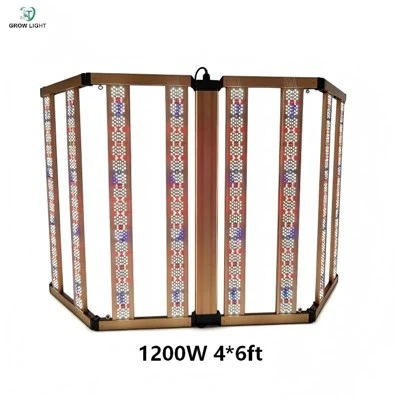
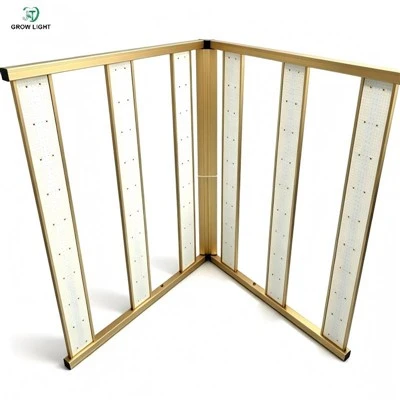
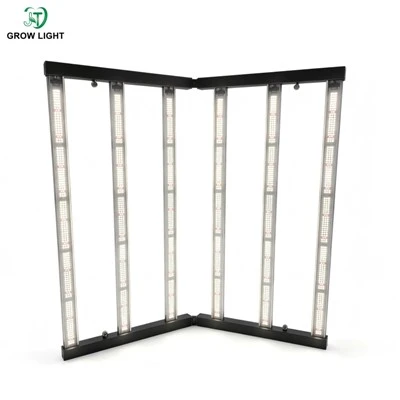
We have a spider LED grow light where UV and IR are separated onto a single LED strip with a dedicated heatsink and independent heat dissipation path. This means that even if the UV or IR spectrum weakens, only the UV strip needs to be replaced, not the entire LED grow light.
7. The Effects of UV Drift on Plants
UV light is a signal that plants interpret as "external stress". It triggers defence, secondary metabolism, flower density, leaf toughness, fragrance, and colour-all behavioural responses, not light intensity responses.
Therefore, UV drift can easily cause:
1) Decreased leaf firmness in the early stages
2) Decreased secondary metabolism
3) Weaker fragrance concentration for the same variety
4) Poorer flowering performance during the flowering period
5) Decreased colour performance
6) Lower plant vigour
8. Why is UV more stable in high-quality LED grow lights?
Because a true UV system isn't just about "brightness", but rather wavelength accuracy/wavelength stability/UV resistance of the encapsulation/heat dissipation/driver quality/stable light decay curve/predictable output, etc.
This is why JT Grow Light uses high-quality packaging and heat dissipation for IR & UV, rather than ordinary display-grade LED technology. We don't judge the quality of LED grow lights by price but by the structural components such as the chip, driver, and heat sink.