



The "Death Zone" Inside the Canopy: Why Standard LEDs Fail
In the engineering department at JTGL, we often refer to the space between high-wire tomato rows or dense cannabis canopies as the "Death Zone." To the untrained eye, it appears to be a lush, green environment. To an electrical engineer, it is a nightmare of 95% relative humidity, volatile organic compounds (VOCs), and "plant sweat" that can dissolve inferior circuitry in a single season.
Many growers are excited by the 30% yield increases promised by Inter-canopy Supplemental Lighting, but they hesitate for a very valid reason: The Humidity Trap. They fear that adding hardware into the dense foliage will either lead to catastrophic electrical shorts or, worse, create a stagnant air pocket that invites Powdery Mildew to destroy their harvest.
If you are going to put lights inside your crop, being "waterproof" is only the beginning. You need a system designed for the specialized Greenhouse micro-climate.
Understanding the Micro-Climate: The Science of "Plant Sweat"
When we talk about the greenhouse environment, we usually refer to the sensor data from the hallways or above the gutters. But inside the canopy, the physics are completely different. This is a micro-environment governed by high transpiration rates.
As plants engage in photosynthesis, they release water vapor through their stomata. In a dense high-wire setup, this moisture gets "trapped." The Vapor Pressure Deficit (VPD) inside the canopy is often much lower than the rest of the greenhouse, meaning the air is nearly saturated. Protecting the crop from powdery mildew while delivering light is essential for achieving the ultimate yield multiplier for vine crops.
For a standard LED fixture, this creates two massive engineering hurdles:
- Condensation Cycles: As temperatures shift between day and night, moisture literally "rains" onto the fixtures from the leaves above.
- Chemical Corrosion: Greenhouse air isn't just water; it contains traces of fertilizers, sulfur burners, and pesticides. This "chemical soup" eats through standard glue and plastic seals.
At JTGL (JT grow light), we realized early on that an IP65 rating-which protects against light splashes-is insufficient for the long-term survival of Intracanopy lighting.

Does Lighting Block Airflow?
The biggest fear among veteran growers is that installing inter-canopy bars will obstruct horizontal airflow. Stagnant air is the primary trigger for Oidium neolycopersici (Powdery Mildew). If your lighting fixture is too bulky, it acts as a dam, stopping the fans from pushing air through the leaf zone.
This is where poor engineering kills a crop. If you save $10,000 on cheap, bulky lighting but lose $50,000 of fruit to fungal rot, the ROI is negative.
JTGL's Design Philosophy: The Aerodynamic Bar. We engineered our Inter-canopy Supplemental Lighting with an ultra-slim, triangular profile. By minimizing the "surface footprint" of the light bar, we ensure that the micro-climate remains dynamic. Air can still flow freely around the fixture, preventing the localized humidity spikes that allow fungal spores to take root. We don't just provide light; we protect your Airflow optimization strategy.
Beyond IP65: The JTGL IP66/IP67 Nano-Coating Shield
When you shop for inter-canopy lighting, you will see many manufacturers claiming "waterproof" status. But as an engineer, I urge you to look closer. A standard "waterproof" light usually relies on rubber gaskets and silicone glue. Over 50,000 hours of heat expansion and contraction, those seals will fail.
At JTGL, we have moved beyond simple gaskets. Our fixtures utilize a Dual-Layer Protection System:
- Structural Hermetic Sealing (IP66): Our bars are vacuum-sealed with aircraft-grade aluminum housings, designed to withstand high-pressure washdowns during greenhouse sanitation.
- Nano-Coating Technology (IP67): The internal PCBA (circuit board) is coated with a specialized hydrophobic nano-film. Even if a seal were to be physically damaged by a pruning tool, the sensitive electronics themselves repel moisture.
This is why we can confidently guarantee a 50,000-hour lifespan even in the most "sweaty" tomato canopies. We have tested our lights in environments with a constant 98% humidity, and the failure rate remains near zero.

Thermal Management: Keeping the Canopy Cool
Heat is the silent killer of LEDs, but in Intracanopy lighting, it's also a threat to the plant. Standard LEDs dissipate heat through bulky fins. If these fins get too hot, they will "cook" the nearby fruit or cause the leaves to curl and close their stomata, stopping photosynthesis.
The JTGL engineering team developed a Passive Thermal Displacement system. We use the aluminum body of the light bar itself as a high-efficiency heat sink. Because the bar is slim and the heat is distributed across the entire length of the fixture, the surface temperature remains safe for direct plant contact. This ensures that the light doesn't disrupt the delicate leaf-temperature balance required for optimal VPD management.
Why Plug-and-Play Construction Matters
In a 10-hectare greenhouse, you don't have time to troubleshoot individual wires. The Greenhouse micro-climate is notorious for corroding electrical connectors.
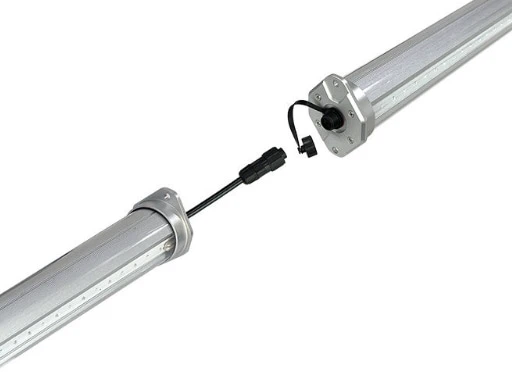
We've seen competitors use standard "outdoor" plugs that fail after 12 months because of the "wicking effect," where moisture travels inside the wire itself. JTGL uses heavy-duty, over-molded waterproof connectors specifically designed for the high-UV and high-humidity conditions of industrial horticulture. Our "Daisy Chain" system allows for quick installation and ensures that the electrical integrity of the entire row is never compromised by a single damp leaf.
ROI and the "Peace of Mind" Factor
As a manufacturer, I know that JTGL isn't the cheapest option on the market. But I always ask my clients: What is the cost of a blackout in Section A during the peak of winter? Or What is the cost of a 20% Powdery Mildew outbreak?
Investing in high-grade Inter-canopy Supplemental Lighting is an insurance policy. By choosing a system designed for Airflow optimization and extreme humidity resistance, you eliminate the two biggest risks in indoor and greenhouse farming. Reliable hardware ensures that your smart power allocation and LED retrofitting strategy pays off for years to come.
Zero Short-Circuits: Our dual IP66/IP67 rating means no downtime.
Healthier Plants: Our slim-profile bars prevent the stagnant air pockets that fungi love.
Labor Savings: You don't have to replace failing units every two years. Our lights are built to last a decade of harvest cycles.
Engineering for the Reality of the Row
The "Humidity Trap" is a real threat, but it is one that can be solved with superior engineering. At JTGL, we don't just build lights for the "best-case scenario." We build them for the worst-case scenario: the dark, damp, crowded center of a record-breaking harvest.
If you are ready to implement Intracanopy lighting but have been worried about the technical risks, let's talk. We can provide the testing data, the IP certifications, and the references from other growers who have successfully integrated our "Death Zone" survivors into their facilities.
Don't let your supplemental lighting become a liability. Choose the manufacturer that understands the micro-climate as well as you understand your crops.


