
The Winter Flavor Crisis: Why "Watery" Tomatoes are Losing You Money
If you walk into a high-end supermarket in January, the tomatoes look perfect-deep red, uniform, and shiny. But once the consumer gets them home, the disappointment sets in. They are often crunchy, acidic, and lack that quintessential "vine-ripened" sweetness. In the industry, we call this the "Winter Flavor Crisis."
For the commercial grower, this is a financial disaster. When your produce lacks flavor, it becomes a commodity, sold at the lowest possible price. But if you can produce a tomato with a BRIX level of 8.0+ in the dead of winter, you move into the "Premium" category, commanding prices that are 50% to 100% higher than standard bulk produce.
The secret to this "Alchemical" transformation isn't just in the fertilizer; it's in the vertical distribution of photons. While top-lighting drives the biomass (the weight), Inter-canopy Supplemental Lighting drives the secondary metabolites (the flavor and nutrition).
The Science of Sweetness: How Photons Become Sugar
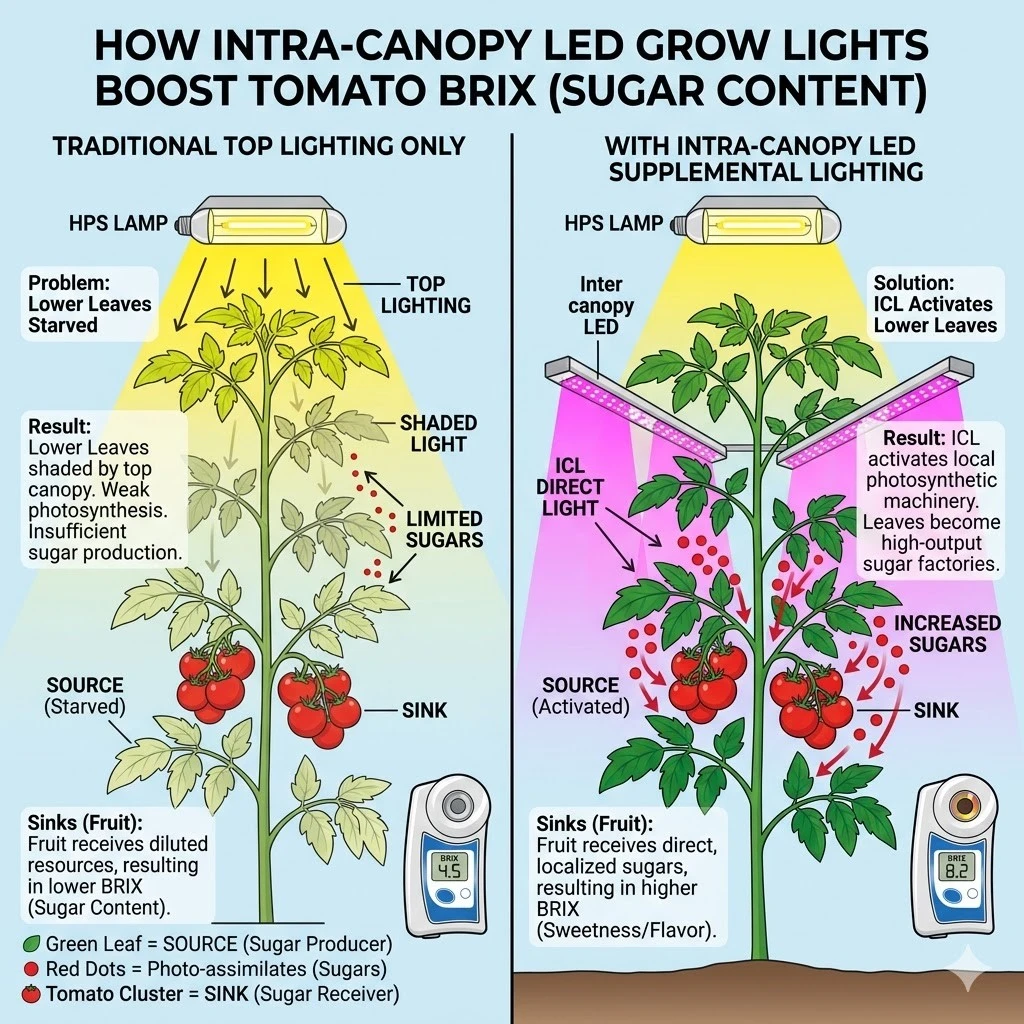
To understand how Intra-canopy LED Grow Lights increase BRIX, we have to look at the source-sink relationship of the plant. Sugars (photo-assimilates) are created in the leaves and transported to the "sinks"-which, in a fruiting plant, are the tomato clusters. When you deliver photons directly to the middle-layer leaves, you bypass the 60% light loss common in high-wire canopies.
In a traditional greenhouse with only top lighting, the lower leaves are often "starved." Because they don't receive enough light, they cannot produce enough sugar to support the fruit ripening right next to them. The plant is forced to "dilute" its resources.
By installing Inter canopy LED grow lights directly adjacent to the fruit clusters, we activate the "local" photosynthetic machinery. These middle-layer leaves become high-output sugar factories, pumping glucose and fructose directly into the nearby tomatoes. The result? A measurable, significant increase in Tomato BRIX levels.

Lycopene Enhancement: The Deep Red Secret
The deep red color of a tomato isn't just for show; it's caused by Lycopene, a powerful antioxidant linked to heart health. Consumers are increasingly shopping for "Nutritional Density," and Lycopene is their primary metric for tomato quality.
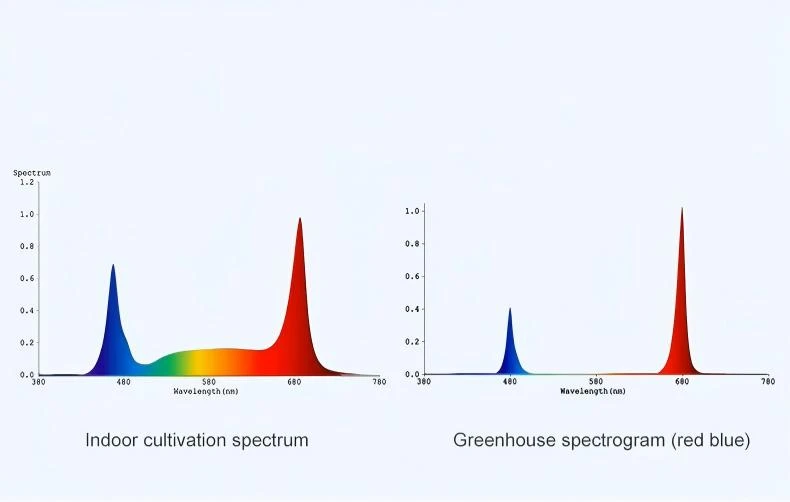
At JTGL (JT grow light), our engineering team has discovered that Lycopene synthesis is highly sensitive to the Red/Blue spectrum ratio. Specifically, the inclusion of Deep Red (660nm) in the inter-canopy zone triggers a phytochrome response that accelerates the conversion of chloroplasts to chromoplasts.
By using our Intra-canopy lighting, we deliver these specific "coloring photons" directly to the fruit skin. Data shows that tomatoes grown with inter-canopy supplemental lighting can have up to a 3-fold increase in carotenoid concentrations compared to those grown under HPS alone. You aren't just growing a red tomato; you are growing a nutritionally superior fruit.
JTGL's "Recipe on Demand": Engineering Flavor
Most LED manufacturers sell a "Fixed Spectrum"-usually a generic pink or white light. But at JTGL, we know that a cucumber in the vegetative stage needs a different "light diet" than a tomato in the ripening stage.
This is why we introduced our Custom Spectrums (Recipe on Demand) for our Inter lighting LED grow light series. We allow professional growers to fine-tune their light recipe:
- The BRIX Booster: A heavy concentration of 660nm Deep Red to maximize carbohydrate transport to the fruit.
- The Vitamin C Catalyst: A specific ratio of Blue (450nm) and Full-Spectrum White to stimulate the synthesis of Ascorbic Acid. In recent trials, inter-canopy lighting increased Vitamin C content in peppers by nearly 10%.
- The Shelf-Life Shield: By optimizing the light quality within the canopy, we encourage the development of a thicker cuticle (skin), which reduces water loss after harvest and extends shelf-life by 2–4 days.
We don't just provide "more light"; we provide the right light at the right depth.
Beyond the Scale: The ROI of Quality
As a manufacturer, I often have to convince growers to look beyond "Grams per Square Meter." If you increase your yield by 10% but your price per kilo drops because of poor quality, you've gained nothing.
However, if you use Intra-canopy LED Grow Lights to achieve:
- +17% Total Yield (Weight)
- +1.5 BRIX points (Sweetness)
- +20% Lycopene (Color/Nutrition)
You are no longer a "farmer"; you are a premium food producer. You can approach high-end retailers like Whole Foods or Marks & Spencer with a product that is objectively superior to your competitors. The Inter-canopy Supplemental Lighting pays for itself not just through more fruit, but through a higher "Average Selling Price" (ASP). Focusing on quality through precise light placement is a core part of the engineering case for inter-canopy lighting.
The Leaf Anatomy Advantage: Abaxial Activation
One technical detail we often discuss at JTGL is the activation of the abaxial (underside) of the leaf. In a top-lit greenhouse, the bottom of the leaf never sees the sun. However, the underside of the leaf is packed with stomata-the "mouths" of the plant that take in CO2.
Our Inter-canopy lighting bars are designed with a wide-angle distribution that allows photons to hit the leaves from the side and below. This stimulates the stomata to stay open longer, increasing the plant's overall gas exchange and metabolic rate. This "whole-plant activation" is what allows the tomato to accumulate more minerals like Potassium, Magnesium, and Calcium, contributing to a more complex, savory flavor profile.
From Commodity to Premium
The days of the "watery winter tomato" are numbered. With the rise of Intra-canopy LED Grow Lights, growers now have the tools to control the "Alchemy" of their crops. You can dial in the sweetness, the color, and the nutritional density of your harvest with the same precision you use for your nutrient solution.
At JTGL, we are dedicated to helping you master this technology. We provide the high-IP rated hardware and the spectral expertise to turn your greenhouse into a high-value production facility.
Flavor is the ultimate competitive advantage. If your tomatoes taste better, your customers will come back. If your tomatoes are more nutritious, your brand will grow. Don't just grow for weight-grow for excellence.