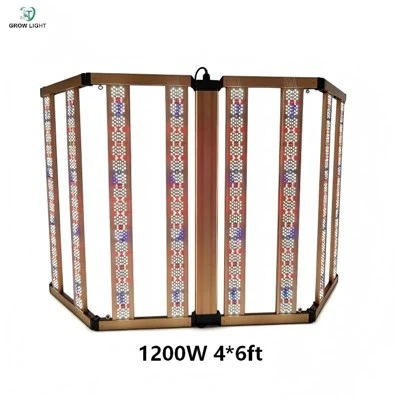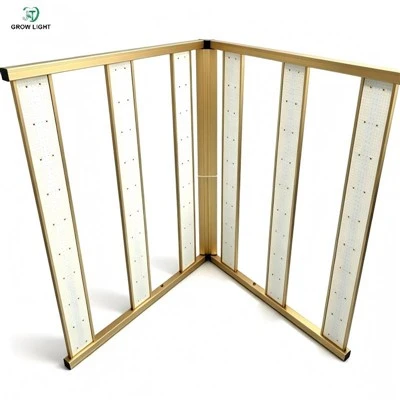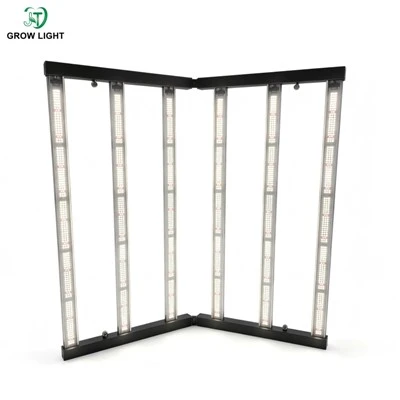
JT Grow Light has completed a 100-unit order of gold-wide-bar foldable LED grow lights for a commercial cultivation operation in the United States. We have consistently exported this type of wide-bar foldable plant light, reflecting the growing preference among commercial growers for wide-bar lighting to achieve large-scale, uniform canopy coverage.
The customer, a mid-to-large commercial grower expanding indoor cultivation capacity, selected this LED grow light after evaluating several wide-bar LED grow light options on the market. Below is a look at what went into the order - from the bar design itself to the testing process every unit passed through before shipping.
What This Grower Chose and Why
1. 12cm Wide Bars for Even Canopy Coverage
The core of this LED grow light's design is its bar width. Each of the six bars measures roughly 12cm across - noticeably wider than the 5-6cm bars found on many standard fixtures. Spreading the same diode count across a broader surface reduces the bright-and-dark striping effect that shows up under narrow-bar lights, where plants directly beneath the diodes receive strong light while plants between bars fall into shadow.
For a commercial operation running dozens of LED grow lights across a facility, that consistency compounds. Uneven light at the individual unit level becomes uneven yield at the room level, and growers scaling up tend to notice that gap faster than smaller operations do.
2. Custom Large-Chip LEDs with Upgraded Red and UV Output
Rather than using standard off-the-shelf diodes, this order was built around custom large-chip LEDs, with both the red and UV channels upgraded to higher-efficacy chip variants. The logic behind large-chip diodes is straightforward: fewer, larger chips can push more usable light output per watt than a higher count of smaller, standard chips - provided the driver and heat management are built to support them, which is where the LED grow light's cooling design comes in.
3. 2.9 μmol/J Photosynthetic Efficacy
The LED grow light is rated at a photosynthetic efficacy (PPE) of 2.9 μmol/J. In practical terms, this measures how efficiently it converts electrical power into usable photosynthetic light - a higher number means more usable light per watt consumed. For a 100-unit commercial deployment, even a modest efficacy advantage adds up meaningfully in the facility's total energy draw over a full growing cycle.
4. Thickened Aluminum Heat Sink for Long-Term Light Stability
Heat management runs through a thickened aluminum alloy heat sink rather than active cooling. Passive cooling removes fans from the equation entirely - fewer moving parts, less maintenance, and quieter operation in a commercial room already running exhaust and dehumidification equipment. Beyond noise and maintenance, better heat dissipation also protects the LED chips themselves: sustained heat exposure is one of the main drivers of light decay over an LED grow light's lifespan, so keeping chip temperatures in check helps the unit's output stay consistent further into its service life.
5. Gold Fixture Finish
This LED grow light ships in a gold-toned housing, a design choice that sets it apart visually from the gray and black aluminum finishes common across the category. For growers who want their facility to look as dialed-in as it performs, the finish has become something of a signature for this product line.


Images Showing Processing Details


Why Commercial Growers Are Moving Toward Wide Bar LED Grow Lights
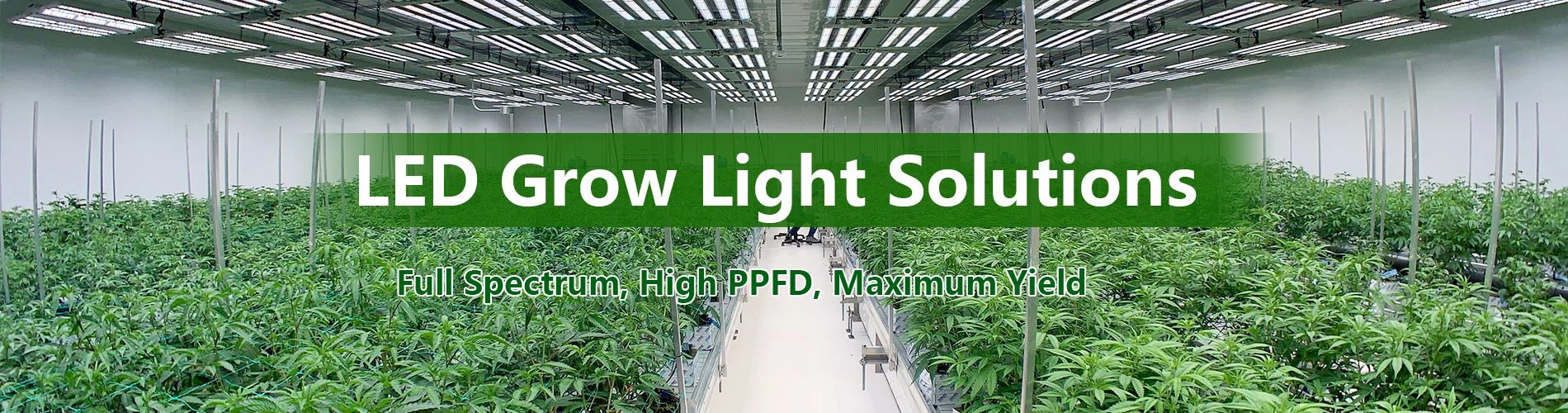
This order isn't an isolated case. Across commercial cultivation, there's a visible shift away from narrow-bar fixtures toward wide-bar LED grow light formats, driven largely by the same coverage problem this customer was solving: narrow bars create light variance across the canopy that growers are increasingly unwilling to accept as a trade-off for lower unit cost. As grow rooms scale from single tents to multi-room commercial facilities, small inconsistencies at the unit level become harder to ignore, pushing more buyers toward wide-format designs even at a higher per-unit price point.


Quality Control: 100% Burn-In Testing Before Packing
Every one of the 100 units in this order went through burn-in (aging) testing before packaging. Burn-in testing runs each LED grow light under power for an extended period prior to shipment, which surfaces early-failure components - a bad solder joint, a driver defect, a diode that fails under sustained load - before the unit ever reaches the customer rather than after installation.
For a bulk order shipping internationally, this step matters more than it might for a single-unit purchase. A defective unit found in testing costs the factory a component and a few hours; the same defect found after installation costs the customer downtime, a support ticket, and a shipment delay on the replacement.
Order Snapshot
| Detail | Information |
|---|---|
| Product | Wide bar foldable LED grow light (gold finish) |
| Power | 1000W |
| Quantity | 100 units |
| Destination | United States |
| Bar structure | 6 bars, ~12cm width per bar |
| LED source | Custom large-chip LEDs, upgraded red/UV |
| Photosynthetic efficacy | 2.9 μmol/J |
| Cooling | Passive, thickened aluminum heat sink |
| Quality control | 100% burn-in tested before packing |
FAQ
Q: What does burn-in testing mean for LED grow lights?
A: Burn-in testing runs an LED grow light under continuous power for a set period before shipment, which surfaces early-failure components - such as a weak solder joint or a defective diode - before the unit reaches the customer. It's a quality control step that catches failures at the factory rather than after installation.
Q: How does bar width affect light distribution in commercial grow rooms?
A: Wider bars spread the same number of LED chips across a larger surface area, which reduces the bright-and-dark striping that narrow bars can create. This results in more even light reaching every part of the canopy, not just the area directly beneath the diodes.
Q: Can JT Grow Light support bulk or OEM orders like this one?
A: Yes. As a LED grow light manufacturer, JT Grow Light supports bulk commercial orders as well as OEM and ODM configurations, including custom chip selection, spectrum tuning, and fixture finish.
JT Grow Light is a China-based LED grow light manufacturer and LED grow light supplier serving commercial growers, distributors, and OEM partners across North America, Europe, Australia, and other export markets. The company supports bulk orders and custom project specifications, with every unit passing through burn-in testing before shipment.