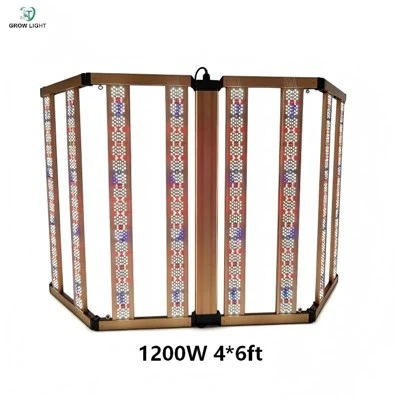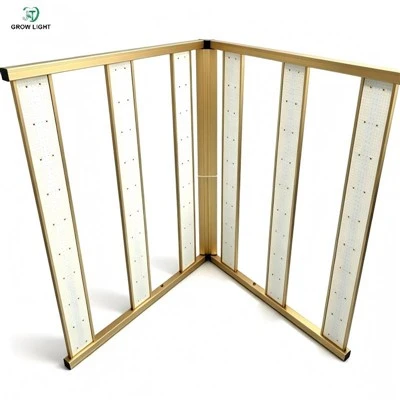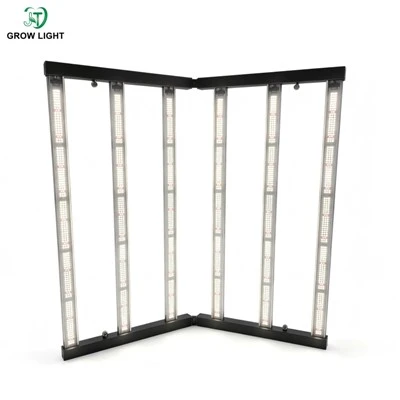
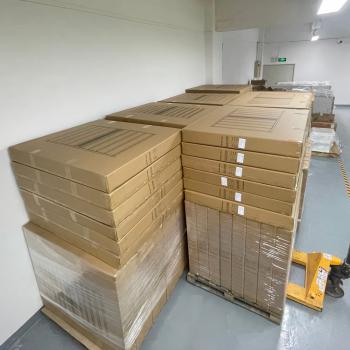
Today we packed and shipped another 200 units of our wide bar LED grow light to a customer in Fitchburg, MA, United States. Nothing unusual about that, except this is the same customer who placed his first order with us almost exactly a year ago - and this was already his 20th-plus reorder.
That's not a typo. Twenty-plus times. Same fixture, same gold-finish design, same 4x6ft coverage footprint. He just keeps ordering more.
We get asked a lot, especially by newer buyers who are still comparing suppliers, what actually separates a grow light that gets reordered from one that gets used once and forgotten. This customer's story is a pretty good answer, so we wanted to write it down honestly, numbers and all, instead of just telling you "our lights are great."
When this grower first messaged us, he wasn't sold on anything. He'd been burned before by suppliers whose specs looked good on paper and fell apart under real canopy conditions, so he was cautious, and honestly, we don't blame him.
Instead of pushing for a bulk order right away, we suggested something simpler: buy two samples, run them in your own space, under your own conditions, and see what happens. If he liked what he saw and moved to a bulk order later, we'd deduct the sample cost from that order. Low risk on his end, and it meant he wasn't taking our word for anything - he was checking it himself.
About a month later, he came back and ordered 50 units. Then 100. Then 200. Over the past twelve months, he's placed more than 20 separate orders for the same wide bar LED grow light, each one building on the last. That kind of buying pattern doesn't happen because of a good sales pitch. It happens because the light performed the same way, batch after batch, in his actual grow room.
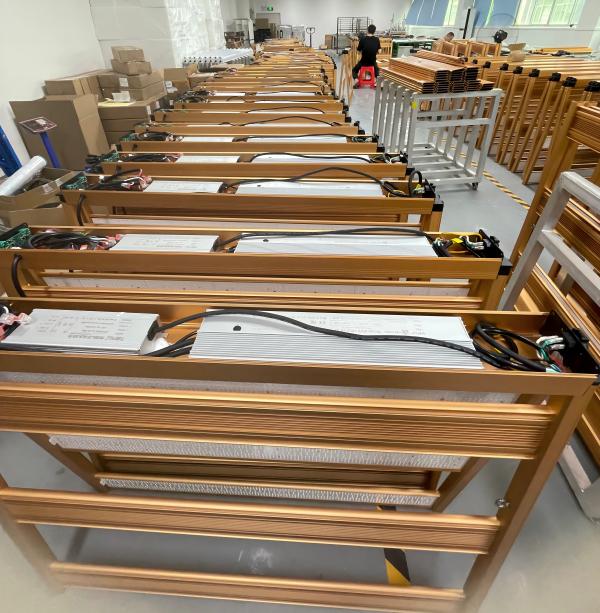
What's actually different about this wide bar LED grow light
A lot of growers assume "wide bar" is just a marketing term, so let's get specific about what it means on this fixture.
A bar that's twice as wide as standard
The light bars on this fixture run about 12cm wide, which is roughly double the width of a standard narrow-bar grow light bar. That extra width matters more than it sounds like it should. A wider bar spreads more diodes across more surface area, which improves how evenly light lands across the canopy and reduces the hot-spot-and-shadow pattern you get with skinny, tightly packed bars. For commercial rooms where uniformity across every square foot directly affects yield consistency, this is one of the first things growers notice once they hang it.
PPE 2.9 - what that number actually means for a grower
The fixture tests at a PPE (Photosynthetic Photon Efficacy) of 2.9 µmol/J. In plain terms, that's how many micromoles of usable light the fixture produces for every joule of electricity it consumes. Higher PPE means more usable light output per watt of power drawn, which translates directly into your electricity bill and your cost per gram at harvest. A fixture sitting in the 2.9 range is competitive with the better commercial horticultural lighting on the market today, and it's a number we can back up with third-party lab testing, not just a spec sheet claim.
Dual foldable design with independent UV dimming
This is a dual foldable LED grow light - the panel folds down the middle for shipping and storage, then opens flat for installation, which cuts freight volume significantly compared to rigid fixed-frame lights. The wattage breakdown is 1000W main spectrum plus a separate 100W UV channel, and it runs as a two channel dimming grow light, meaning the main spectrum and the UV channel adjust independently. Growers running late-flower UV supplementation protocols can dial UV intensity up or down without touching the main light output, which gives a lot more control than a single fixed-ratio spectrum.

Wide bars
Dual foldable design

Independent UV dimming
For a commercial LED grow light running at this scale, that kind of independent control isn't a nice-to-have - it's what lets growers fine-tune spectrum by growth stage instead of running one static setting for the whole cycle.
How we shipped 200 units two days early
This order came with a tighter deadline than usual, so we ran it across two production workshops at the same time instead of one. Once all the components and materials were fully in stock, our team moved through assembly and packing in two days flat.
We don't build everything at once and then test it all at the end. We work in batches - assemble a batch, move it straight into burn-in testing, and once that batch clears, it goes straight to packing while the next batch is already being assembled behind it. That overlapping batch flow is what let us use every hour efficiently instead of losing time waiting for one stage to finish before the next one starts.
Even with that pace, quality control didn't get compressed to save time. Every stage-assembly, burn-in, final packing-has a dedicated QC checkpoint, and every unit must pass inspection before it moves to the next stage. That's how we get a one-pass success rate with no rework loops eating into the schedule. Speed and quality control aren't really in competition here; the batch-overlap process is what makes both possible at the same time. In the end, the full 200-unit order shipped two days ahead of the deadline he gave us.


Why he keeps coming back
We're not going to pretend every customer reorders 20 times in a year - most don't need to, because their grow rooms aren't scaling the way this one is. But the pattern itself is telling. A grower running a commercial operation doesn't have room for a fixture that looks good in a spec sheet and underperforms in the tent. If the light wasn't holding up - if PPFD dropped off, if bars started failing, if yield stalled - he wouldn't be back for a 21st order.
His own feedback has been consistent: the canopy fills in evenly, flower density has held up across grow cycles, and he hasn't had a fixture failure in a batch he's ordered from us yet. That's not a dramatic testimonial. It's just steady, repeatable performance, which is honestly the best kind.
We could tell you our wide bar LED grow light is the best on the market, but that's what every supplier says. What we can tell you is that one commercial grower tested two samples, decided they were worth trusting, and has placed more than 20 orders since. If you're evaluating a high-power grow light for your own operation, and you're in the same position he was a year ago - cautious, and tired of specs that don't hold up - start the same way he did. Two samples, your own space, your own conditions. Let the results decide for you.
FAQ
Q: What makes a wide bar LED grow light different from a standard narrow bar grow light?
A: A wide bar LED grow light uses light bars that are roughly twice the width of standard bars - around 12cm versus 6cm. The extra surface area holds more diodes per bar, which spreads light more evenly across the canopy and reduces the hot-spot-and-shadow pattern common with narrow, tightly spaced bars.
Q: What does a PPE of 2.9 µmol/J actually mean for a commercial grow room?
A: PPE (Photosynthetic Photon Efficacy) measures how many micromoles of usable light a fixture produces per joule of electricity consumed. A PPE around 2.9 µmol/J means more usable light output per watt drawn, which lowers your electricity cost per gram at harvest compared to older or lower-efficacy fixtures.
Q: How does two channel dimming work on a dual foldable LED grow light?
A: Two channel dimming lets you control the main spectrum and a secondary channel - typically UV - independently. On a 1000W+100W UV setup, growers can increase or decrease UV intensity for late-flower supplementation without changing the main light output, giving more precise control across different growth stages.
Q: Why would a commercial grower buy just 2 sample units before placing a bulk order?
A: Testing 2 samples in your own grow room, under your own conditions, lets you verify real-world PPFD, yield response, and build quality before committing to volume. Many manufacturers, including us, will deduct the sample cost from a later bulk order, which makes the sample stage essentially risk-free for the buyer.