Do you know what the most absurd yet daily occurrence in the growing industry is? It's that even though they all have the same wattage rating-1000W-and are all full-spectrum LED grow lights, and they all look quite bright, once placed in a growing room, the yield difference can be as high as 20-50%, sometimes even doubling. You might say this is a brand difference, but growers aren't concerned about brands; they only care about "whether it will grow", "whether it will be stable", and "whether it can support the entire canopy". This is why we always say: wattage is never the key factor determining yield. Wattage is just electrical input; yield is photon output, and photon output is not a simple matter. It involves luminous efficacy, optics, heat dissipation, driving, photon distribution, uniformity, chip load, long-term degradation… a whole host of things that beginners simply cannot see or judge.
If you really explain the underlying logic, it boils down to this: with the same 1000 W, those with more photons, more stable photons, and better photon distribution will produce a higher yield. The same wattage does not mean the same performance. This is like feeding two people the same amount of food. One absorbs nutrients well, sleeps well, and is strong; naturally, it grows quickly and steadily. The other absorbs poorly, is in poor condition, and loses nutrients; the results are drastically different. Wattage is just the input; yield is the output. The same input doesn't mean the same output. That's the difference.

The Impact of Differences in Luminous Efficacy
Let's look at luminous efficacy first. Many people completely misunderstand what the difference in PPE (Photonic Photon Efficacy) really means. 2.0 μmol/J and 3.0 μmol/J seem like just a difference in numbers, but essentially, with the same 1000 W input, one light emits 2000 μmol/s of photons, while the other emits 3000 μmol/s-a full 50% more. This isn't just a small difference. Plants consume the number of photons, not the wattage. You think you're feeding it three meals, but it's only getting one and a half meals; how can the yield be the same?
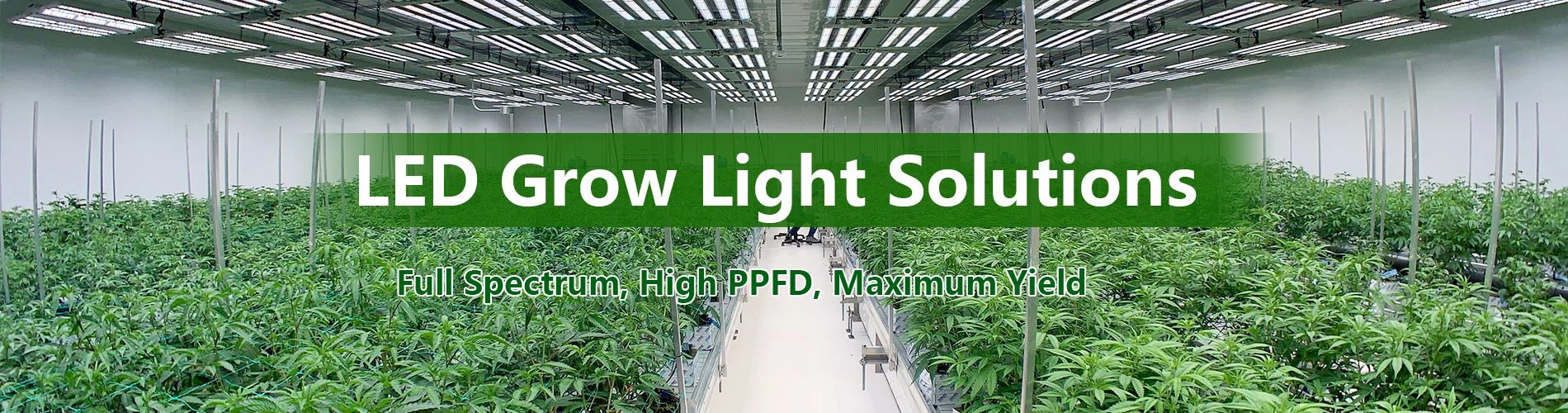
Even with the same number of photons, poor optical design can directly halve the yield. Some plant grow lights, to create an aesthetically pleasing PPFD (Photonic Photodiode Filter), have extremely narrow beam angles, resulting in an exceptionally high centre beam and extremely weak edges, making the PAR map a typical hotspot. How can a plant grow in such a "scorched centre, poorly nourished edges" light environment? Commercial-grade LED grow lights always emphasise coverage and uniformity because what truly sustains a canopy is the "entire light field", not just a single red dot for a screenshot. Growers know that the more uniform the light, the easier it is to grow; the more uniform the light, the more stable it is; the more uniform the light, the better the harvest.


Heat Dissipation Structure Determines Stable Lamp Output
Then there's heat dissipation. This is the easiest way I've seen to distinguish cheap lights from commercial lights. For every 10°C increase in chip junction temperature, the light decay rate accelerates by 20-30%. Cheap grow lights are typically hot, very hot, and extremely hot. They're incredibly bright when you first buy them, but the light starts to dim after three months, drops significantly after six months, and reaches a point where you question your life choices after a year. While they appear bright, the plants are actually receiving less and less light, leading to a decline in growth vigour, flower column density, and oil quality. Commercial-grade LED grow lights, on the other hand, feature optimally designed aluminium materials, heat dissipation areas, heat pipes, and airflow structures to keep the chip, driver, and the entire light source cool. Coolness translates to performance, stability, and lifespan.
The Impact of the Driver Power Supply
As for the driver power supply, that involves deeper technical logic. Cheap grow lights often use high-ripple, low-efficiency, and high-heat drivers, resulting in fluctuating light levels and rapid stress on the plants. Commercial-grade LED grow lights use constant current for stable output, almost like an IV drip – remarkably stable. Growers may not understand this, but they can sense whether the light is stable, whether there are any erratic fluctuations, and whether there's a noticeable decline in plant growth during the latter half of the flowering period.

Why Choose JT Grow Light?
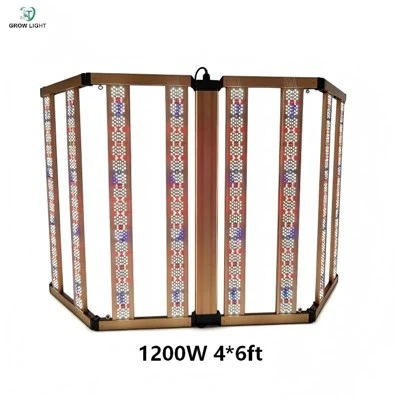
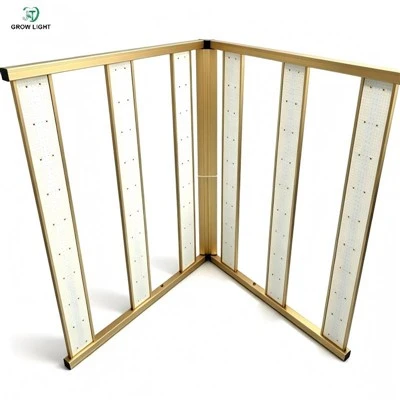
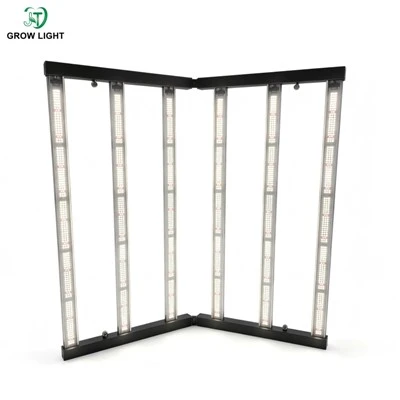
Today, we'll use this 1000W Foldable Commercial LED Grow Light as an example. Its design logic is the kind that anyone in the know will immediately recognise as a professional LED grow light. First, it's not the common type where each 1000W LED chip exactly reaches 1000W; instead, the total power is 1500W, but the driver only outputs 1000W. With 10 light boards, each with 306 LED chips, totaling 3,060 LED chips, and each chip theoretically producing 0.5W, we've only utilized about 70%. What does this mean? This is the margin design exclusive to commercial LED grow lights.
1) Extremely Slow Light Decay: The LED chips aren't pushed to their limits; they operate within a very comfortable, low-stress range. Because of the low chip heat load, light decay is essentially negligible, which is crucial for growers.
2) Longer lifespan than ordinary lamps: With LED chips not fully loaded, drivers not strained, and ample heat dissipation, the internal structure experiences less stress, significantly extending the overall system lifespan. JT Grow Light's LED grow lights are designed for commercial growers who require stability every cycle and every year.
3) High and stable luminous efficacy: We achieve 2.9~3.2 μmol/J full-spectrum LED grow lights. This isn't the kind of high luminous efficacy achieved through testing techniques, but rather because the chips are not fully loaded, the temperature is low, the optics are spread out, and the driver is stable, so the luminous efficacy operates within its optimal range.
The foldable structure, large-area LED strip layout, and distributed light source ensure that 1000W isn't a concentrated burst but rather a "gentle yet abundant rain of photons pushing the entire canopy up." This is extremely valuable in commercial cultivation, making foldable LED grow lights the most widely used product among commercial growers.
So why can JT Grow Light's LED grow lights directly increase yield with the same 1000W output? Because our design is not based on the low-end approach of "pushing the LEDs to 1000W", but rather on "ensuring a 1500W system only runs at 1000W, runs cool, runs stably, runs consistently, and runs accurately." Naturally, the production volume will be different.