
There's a strange phenomenon in the growing community: when buying LED grow lights, everyone focuses on just one number-PPFD. It seems the more exaggerated the PPFD, the more professional the grower, and the more likely they are to produce explosive plant growth. They're constantly showing pictures of bright red areas, like an explosion.
But ask a true commensurate grower, and they'll roll their eyes. They know all too well that the PPFD number is easily fooled by beginners.
Some lights have a center point saturated with 1800 or 2000 ppm, which looks amazing, but the result is 60% of the room is dimly lit, and the plants grow unevenly, with the edges and corners showing inconsistent height and shape. Can you really expect high yields? Does anyone believe that?
Frankly, high PPFD doesn't equal high yield; high coverage and high uniformity equal high yield.
Many people believe that the higher the PPFD (Photonic Photon Dispersion Factor), the better, and the more professional the result. However, the truth is…
PPFD is instantaneous data at a single point; it doesn't represent the photon distribution across the entire canopy, nor does it represent the plant's light intake throughout its entire life cycle.
Here are a few scenarios you've likely encountered:

01
The light is too close to the canopy, resulting in extremely high PPFD, but the leaves curl up. It looks bright, but the plant is practically screaming for light.
02
The beam angle is too narrow, with the center being extremely bright, while the surrounding areas are extremely dark. This is a classic example of hotspot damage-the heat spot is too strong, while the edges are too weak.
03
Putting commercial LED grow lights from a greenhouse into a 4x4 tent makes it as bright as an interrogation room. Plants obviously can't handle it; their cellular structure isn't strong enough for that.
04
Leaves become thinner in the latter half of the flowering period, indicating more pronounced phototoxicity.
The heat spots with excessively high PPFD directly scorch the terminal buds and cause them to flower.
So you see, PPFD isn't inherently bad, but it's too one-sided. It might tell you that "a certain spot" is bright, but it won't tell you "how much light the plant actually receives." Growers' biggest fear isn't insufficient light, but being killed by hotspots.
Coverage is the core determinant of yield
If you ask any commercial grower: What do you care about most about plant grow lights?
- PPFD Average (Plant Growth Factor Difference)
- PPFD Uniformity
- Canopy Coverage
In other words: Does the entire canopy receive stable, uniform, and sustainable light?
There's a saying in the commercial world: A 20% increase in uniformity directly increases yield by 10-15%.
This is because you're not feeding a few individual plants; you're feeding an entire canopy.
Even a few areas with weak light will lower the overall yield.
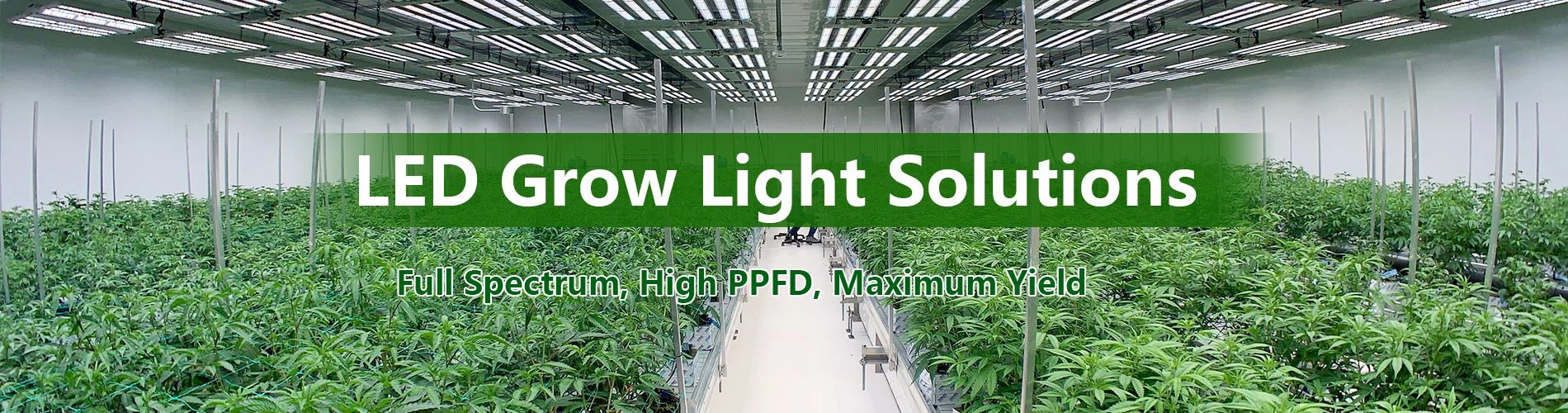
Furthermore, modern cultivation has evolved to vertical grow racks, with layers stacked on top of each other and narrower spaces, requiring grow lights to be "thin, cool, and uniform."

Commercial-grade LED grow lights prioritize uniformity
Many people believe that large manufacturers simply focus on wattage and luminous efficacy, aiming for impressive PPFD figures.
However, the key to truly commercial-grade lighting is never just brightness, but stability. Brightness is a one-second thing, while stability is a continuous process.
To achieve stable coverage, lights must focus on these areas:
1) Optical design (beam angle, lens, light diffusion)
2) Chip layout (distributed light output vs. centralized light source)
3) Number of LED strips (more strips, fewer hot spots)
4) Geometric structure (folded lights vs. COB array lights)
5) Light distribution adaptable to different ceiling heights.
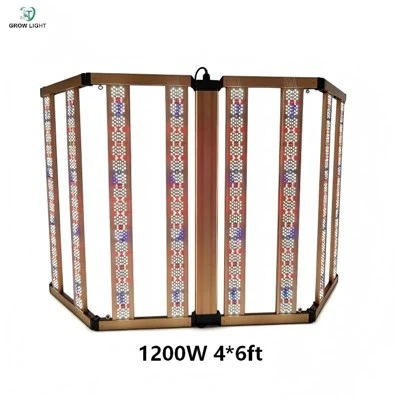
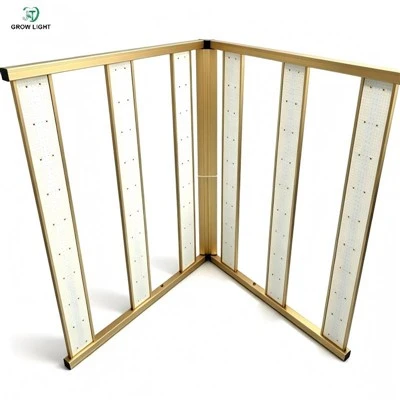
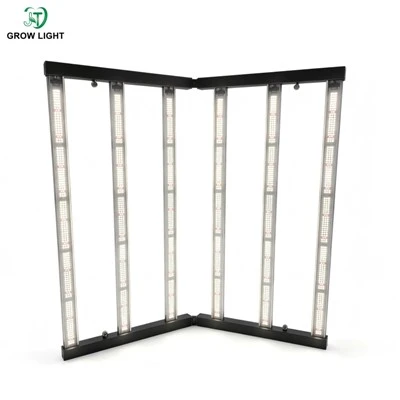
This explains why foldable LED grow lights have been a major trend in commercial applications. Their light output method makes it easier to create large-area, hot-spot-free light distribution.
JT Grow Light's advantage lies here
Our LED grow lights' structure is specifically designed for commercial-grade needs.
1. Multi-strip light layout → Distributed light output
The light is spread out, reducing the likelihood of hotspots.
2. Optical optimization → No overexposure at the center, even in high canopies
Even in a 20ft canopy, the light actually falls on the canopy, instead of being wasted on the ground.
3. High luminous efficacy without harshness → A softer and more stable full spectrum of 2.8–3.2 μmol/J.
4. Uniform leaf color across the entire canopy after installation
Growers love this feeling of "I don't need to adjust the lights, the plants grow obediently on their own."
Growers aren't concerned with numbers, but rather "whether the plants can grow steadily throughout the room." Plants don't thrive on a single burst of bright light; they thrive on a stable, uniform, and long-term light environment.
High uniformity:
– No burning of seedlings
– No uneven growth
– No need for constant light adjustments
– Stable flowering period
– Increased total yield
– Improved overall ROI