
"How many lights do I need for this row?" is probably the single most common question I get asked about under canopy lighting, and it's also the one I have the hardest time answering with just one number. The honest answer is: it depends on your fixture length, your row length, and the wattage you're running - and a lot of growers only think about one of those three before placing an order.
So let's actually work through the math, size by size and wattage by wattage, so you can walk into your next order knowing exactly what to ask for.
Why "How Many Lights Do I Need" Is Harder to Answer Than It Sounds
If you've already gone through the process of choosing the right fixture length for your row, you know the length decision comes first. But length alone doesn't tell you your fixture count - that depends on how that length divides into your actual row, and how the wattage you pick affects real coverage, not just linear footage. Two rows of the same length can need a different fixture count depending on whether you're running 4ft, 6ft, or 8ft units, and depending on whether you're running 120W or 250W versions of them.
The Basic Math: Row Length Divided by Fixture Length
The starting point is simple division: take your usable row length and divide it by the fixture length you're considering. A 24ft row divided by 6ft fixtures gives you 4 units. The same row divided by 8ft fixtures gives you 3.
Why this is a starting point, not the final answer
This calculation only tells you how many fixtures physically fit end to end. It doesn't account for canopy density, wattage, or whether the light is actually reaching the lower bud sites evenly - which is why the wattage section further down matters just as much as this division.
Rounding up vs rounding down
Rows rarely divide evenly. A 22ft row divided by 6ft fixtures comes out to 3.67 - which means you're choosing between 3 fixtures (with a gap at the end) or 4 fixtures (with some overlap). In under canopy applications, I generally recommend rounding up rather than leaving a dark gap, since uneven lower-canopy light tends to show up as inconsistent bud development at harvest.
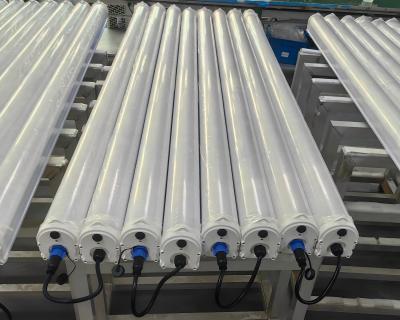
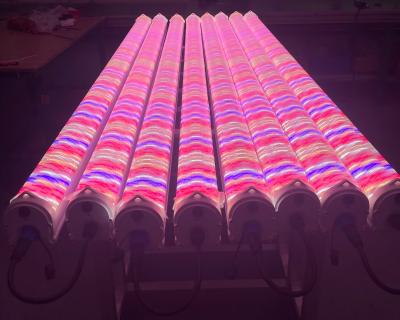
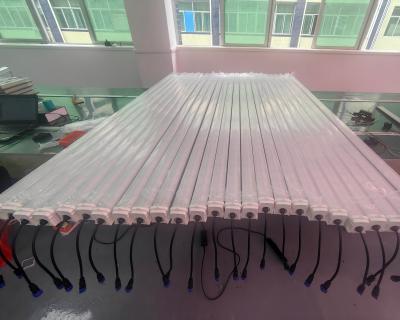
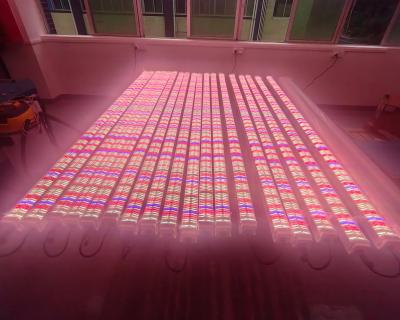
Fixture Count Per Row: 4ft, 6ft, and 8ft Compared
Here's how fixture count plays out across common commercial row lengths for each size of under canopy lighting.
| Row Length | 4ft Fixtures Needed | 6ft Fixtures Needed | 8ft Fixtures Needed |
|---|---|---|---|
| 16 ft | 4 | 3 | 2 |
| 20 ft | 5 | 4 (rounded up from 3.3) | 3 (rounded up from 2.5) |
| 24 ft | 6 | 4 | 3 |
| 32 ft | 8 | 6 (rounded up from 5.3) | 4 |
4ft under canopy lighting fixture count
4ft fixtures tend to fit narrower rows and retrofit setups cleanly, but on longer commercial rows the fixture count climbs fast - an 8-fixture count on a 32ft row means 8 sets of brackets, 8 units to wire, and more total connection points than the same row would need in 6ft or 8ft fixtures.
6ft under canopy lighting fixture count
6ft fixtures hit a middle ground that divides cleanly into a lot of common commercial row lengths - 24ft rows in particular come out to an even 4 fixtures with no rounding needed, which is part of why 6ft has become a popular default length.
8ft under canopy lighting fixture count
8ft fixtures bring the fixture count down further on longer rows, which is where the labor and wiring savings really start to add up. On a 32ft row, you're looking at 4 fixtures instead of 8 - half the connection points to install and maintain.
How Wattage Changes the Real Answer: 120W vs 150W vs 250W
Fixture count based on length alone assumes every fixture puts out the same amount of usable light per foot, which isn't quite true once wattage enters the picture.
Why fixture count alone doesn't tell you if coverage is adequate
120W under canopy lighting and 250W under canopy lighting fixtures of the same length don't deliver the same intensity to the canopy. A 6ft fixture at 120W is generally suited to lighter canopy density or supplemental use, while the same 6ft footprint at 150W to 200W is built for denser canopies that need more total light reaching the lower bud sites.
When lower wattage means you need tighter spacing
If you're using 120W or 150W under canopy lighting in a dense, high-yield setup, you may need to run fixtures closer together, or add a second row, to hit the same effective coverage that a single higher-wattage row would deliver - which changes your total fixture count even though your row length hasn't changed.
When higher wattage lets you space fixtures further apart
On the other end, 250W fixtures can sometimes let you get away with slightly wider spacing between rows in very dense canopies, since each fixture is pushing more total output into the space. This is very setup-dependent, though, and it's worth confirming with real PPFD expectations for your specific canopy rather than assuming higher wattage always means fewer total fixtures.
What Makes Our Under Canopy Lighting a Reliable Choice
Once you've worked out roughly how many fixtures your row needs, the next question is usually which supplier to actually order from - so here's where we fit into that picture.
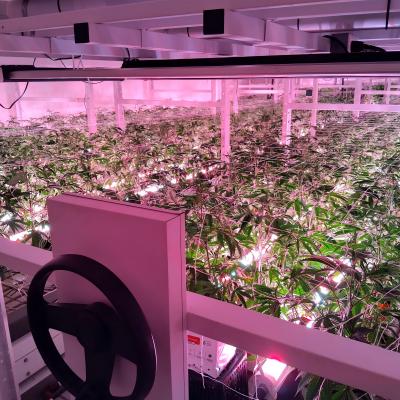
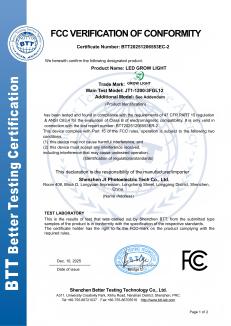
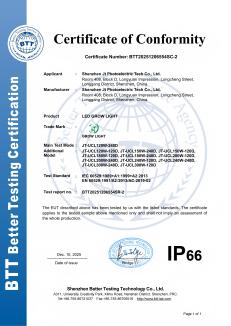
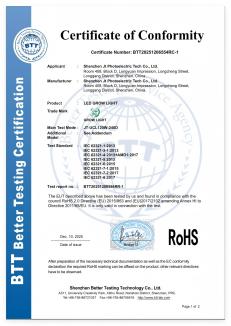
We manufacture our under canopy lighting across the full 4ft, 6ft, and 8ft range, at 120W, 150W, 180W, and 250W, with both 2-side and 3-side emission options depending on your canopy density and bench layout. Every fixture installs tool-free - it rests directly on height-adjustable brackets and daisy-chains to the next unit, up to 5 fixtures per power cord, which keeps wiring simple even on long commercial rows. The double-side emission version carries an IP65 rating for humid grow environments, and our certifications include CE, RoHS, and FCC, with IP66-rated options also available - if you'd like the certification documents to review before ordering, just ask and we'll send them over.
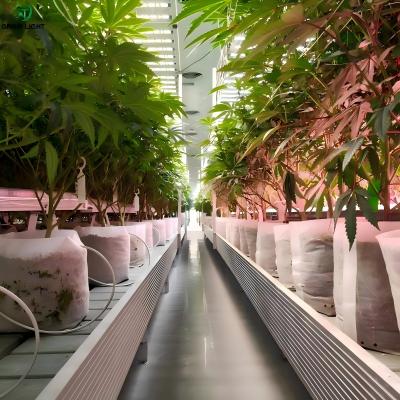
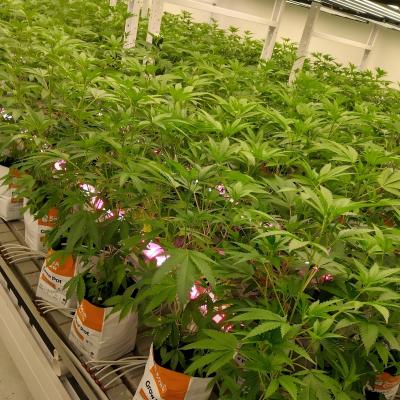
On the results side, growers who've switched to our under canopy lighting have reported yield increases in the 20–25% range, along with a shift in lower-canopy bud quality - flower that used to grade out as B-grade material coming in as A-grade once the lower bud sites finally got adequate light.


FAQ
Q: What's the difference between 2-side and 3-side under canopy lights?
A: 2-side lighting emit light out to the left and right at roughly 180°, while 3-side fixtures add a downward or rear-facing angle to reach closer to 270° of coverage - 3-side is generally the better fit for denser canopies or narrower row spacing.
Q: Can under canopy lights be dimmed?
A: Yes, our under canopy grow lights support dimming so growers can adjust output based on canopy stage and density rather than running at full output the entire cycle.
Q: How close should under canopy lights be to the canopy?
A: This depends on your specific plant spacing and canopy density, but as a general rule, fixtures are positioned close enough to reach the lower bud sites without direct contact with foliage - we can help confirm proper placement based on your row layout.
Q: Are under canopy lights safe to use in humid grow environments?
A: Our double-side emission under canopy fixtures are IP65-rated specifically for this reason, and IP66-rated versions are also available for growers dealing with higher humidity or occasional water exposure.
Q: Can I mix different wattages or lengths within the same row?
A: It's possible, but we generally recommend keeping wattage and length consistent within a single row to avoid uneven coverage - if your facility has rows of different lengths, we can help plan out the right combination across your whole space.
The math itself isn't complicated, but it's easy to skip a step - rounding the wrong way, or not factoring wattage into your coverage expectations. Work through row length, fixture length, and wattage together before you place an order, and if you'd rather have someone run the numbers with you, that's exactly the kind of planning we do for growers before finalizing a quote.