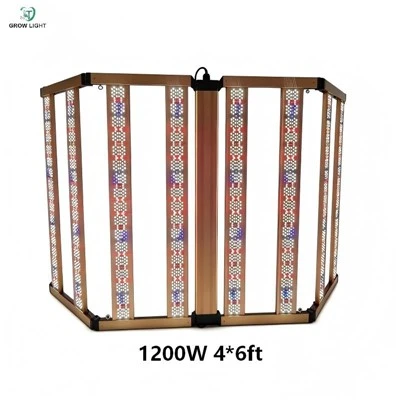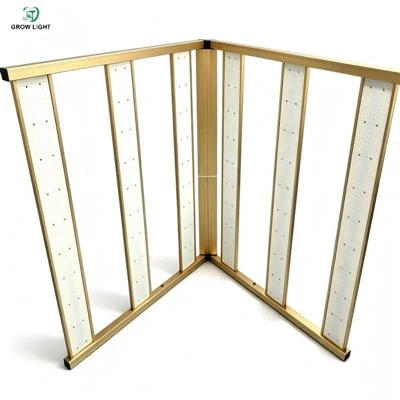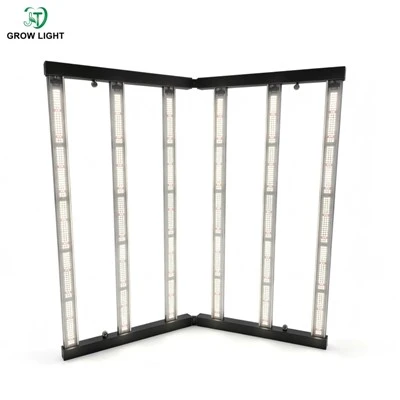
For most pepper greenhouses, running under canopy grow lights costs about $0.05 to $2.60 per day. That range covers 100 W to 800 W of connected load, 6 to 16 hours of operation and electricity prices of $0.08 to $0.20 per kWh. A typical 1,000 sq ft (about 93 m²) greenhouse with roughly 1,800 W of under canopy lighting, run 10 hours a day at $0.12 per kWh, uses 18 kWh and costs about $2.16 per day.
Why Greenhouse Peppers Benefit from Under Canopy Lighting
Peppers are tall, high-wire crops. By mid-season the canopy can reach 2.5 to 3.5 m, and the leaf layer at the top is dense. Overhead lights and sunlight reach the top leaves well, but the middle and lower part of the plant sits in shade for much of the day, especially in winter when the sun is low and cloud cover is common
That shaded zone matters for three reasons
Lower leaves stop contributing. Leaves that receive little light photosynthesize poorly and may yellow and drop earlier than you would like.
Fruit set and sizing on lower trusses suffer. Fruit hanging in the shade of the upper canopy gets less light energy to work with.
Humidity and disease pressure rise in dense, dim canopies. Light that moves air-warmed leaf surfaces and dries them helps a little, though this is a secondary effect.
Under canopy lights (often called inter-canopy or interlighting) hang between plant rows or along the stems and put light directly onto the middle and lower leaves. For peppers this is usually used as a supplement to overhead light, not a replacement. The goal is to lift the light level in the part of the plant that overhead fixtures cannot reach.
Quick AnswerDaily Electricity Cost Formula
Daily cost = (watts ÷ 1,000) × hours per day × electricity price per kWh
Example: 400 W of fixtures running 12 hours at $0.12 per kWh.
400 ÷ 1,000 = 0.4 kW
0.4 kW × 12 h = 4.8 kWh
4.8 kWh × $0.12 = $0.58 per day
Table 1 applies the same formula to a range of power levels, run times and prices. Figures are rounded to the nearest cent.
Table 1: Daily electricity cost by power, run time and electricity price
|
Connected load |
Hours per day |
Energy per day |
At $0.08/kWh |
At $0.12/kWh |
At $0.20/kWh |
|
100 W |
6 |
0.6 kWh |
$0.05 |
$0.07 |
$0.12 |
|
100 W |
12 |
1.2 kWh |
$0.10 |
$0.14 |
$0.24 |
|
200 W |
12 |
2.4 kWh |
$0.19 |
$0.29 |
$0.48 |
|
400 W |
12 |
4.8 kWh |
$0.38 |
$0.58 |
$0.96 |
|
800 W |
12 |
9.6 kWh |
$0.77 |
$1.15 |
$1.92 |
|
800 W |
16 |
12.8 kWh |
$1.02 |
$1.54 |
$2.56 |
Two things to keep in mind when reading the table. First, the figures use the power measured at the wall, not the nominal wattage printed on a fixture label. Second, your utility bill may add demand charges, fixed fees or time-of-use rates that the simple formula does not capture. Check your tariff before you finalize a budget.
Quick Answer: Daily Electricity Cost Formula
There is no single correct number. The right wattage depends on the plant density, row spacing, the amount of natural light at your site, the variety, and the light level you want at the lower canopy. A lighting designer or an experienced agronomist should confirm the final layout, ideally with a PPFD map of the proposed design.
As a starting point for budgeting, Table 2 shows planning ranges that are commonly used for supplemental inter-canopy lighting. Treat them as rough estimates, not guarantees. [Confirm ranges against your own fixture efficacy and PPFD targets before publishing.]
Planning ranges for under canopy power by planting density
|
Planting layout |
Typical density |
Suggested under canopy power (per m² of floor) |
Suggested power per metre of row |
|
Lower density, wider rows |
about 2.5 plants/m² |
10–15 W/m² |
20–30 W/m |
|
Standard commercial layout |
2.5–3.0 plants/m² |
15–25 W/m² |
30–40 W/m |
|
Dense, high-wire, multi-stem |
3.0 plants/m² or more |
25–35 W/m² |
40–50 W/m |
If you have a 1,000 sq ft (93 m²) house in the standard layout, 15 to 25 W/m² works out to roughly 1,400 to 2,300 W. The example later in this article uses 1,800 W, which sits in the middle of that range.
A note on dimming: it is often better to install slightly more capacity and run it at partial output than to install too little and run it flat out. A dimmable system gives you room to adjust through the season.
Factors That Change Your Electricity Bill
The formula looks fixed, but the inputs move all year. These are the factors that change the real number most.
Hours of operation. Under canopy lights usually run only when natural light is below a target. In many climates that means long hours in winter and very few in summer. Total photoperiod for peppers is often in the range of 12 to 16 hours, but the lights themselves may only supply part of that. [Confirm target photoperiod and DLI with the grower or agronomist.]
Season and latitude. A greenhouse at a higher latitude may need supplemental light for five to six months. One in a sunnier region may need it for a few weeks of the year. The seasonal total can differ by a factor of three or more.
Dimming and control. Fixtures that can be dimmed or zoned let you reduce output on bright days instead of switching everything on or off. Lower output also lowers the electrical load almost proportionally for LED drivers.
Electricity price and time-of-use tariffs. If your utility charges less overnight or at certain hours, scheduling the lights into those windows can reduce the bill without changing the light dose. Some regions also charge for peak demand, which makes staged start-up worth considering.
Interaction with top lighting. Under canopy lights add to what overhead lights and sunlight already deliver. If your overhead system is already providing enough light at the top, the under canopy system can be sized smaller. If overhead lights are old or weak, you may need to rebalance both.
Heat. LED fixtures release less radiant heat than HPS lamps, so greenhouse heating loads can go up slightly in winter when HPS is replaced. This is a real cost in cold climates and is worth including in the comparison.
Factors That Change Your Electricity Bill
Under canopy fixtures are normally mounted vertically or at an angle between rows. A single side fixture emits light from one face. A dual side emission fixture emits from both faces, so one fixture lights the plants on both sides of it.
In a row-based pepper layout, that matters. One dual side bar between two rows can do the work that otherwise needs two single side bars, one per row.
Dual side vs single side emission under canopy lights
|
Factor |
Single side emission |
Dual side emission |
|
Fixtures needed per row pair |
Two (one facing each row) |
One shared between two rows |
|
Power draw per fixture |
Lower |
Higher, but total system load is often similar or lower for the same coverage |
|
Coverage |
One side of the fixture |
Both sides, covering two rows |
|
Uniformity along the plant |
Good on the lit side, little on the back |
Good on both sides when spacing is correct |
|
Wiring and mounting points |
More |
Fewer |
|
Best fit |
Outer rows, single rows against a wall |
Interior rows, paired rows, high-density layouts |
[Add measured power, PPFD and uniformity figures from your own test report before publishing. Do not state them as general facts.]
In practice, the total connected load for equal light on the plants will often be comparable. What changes is the number of fixtures, mounting points and cables, and the evenness of the light from row to row. Outer rows next to a wall or the end of a bay are usually still better served by single side fixtures.
Real-World Example A 1,000 sq ft Pepper Greenhouse
The numbers below are estimates built from stated assumptions. They are not measured results, and your own figures will differ.
Assumptions
Greenhouse floor area: 1,000 sq ft (about 93 m²)
Under canopy load: 1,800 W (about 19 W/m², inside the standard-layout range in Table 2)
Average run time: 10 hours per day when in use
Supplemental season: 150 days
Electricity price: $0.08, $0.12 and $0.20 per kWh
Energy use
Per day: 1.8 kW × 10 h = 18 kWh
Per 30 days: 540 kWh
Per season (150 days): 2,700 kWh
Electricity cost
At $0.08/kWh: $1.44 per day, $43 per 30 days, $216 per season
At $0.12/kWh: $2.16 per day, $65 per 30 days, $324 per season
At $0.20/kWh: $3.60 per day, $108 per 30 days, $540 per season
Yield and payback, illustrative only
Suppose baseline yield is 20 kg/m², or about 1,860 kg for the house, and the sale price is $3.00 per kg. A 10% yield gain is 186 kg, worth about $558. Subtracting a season of electricity at $0.12 ($324) leaves about $234 before fixture cost, labor and maintenance.
The result is sensitive to the yield gain:
5% gain: about $279 in extra revenue, which is less than the $324 electricity cost
10% gain: about $558 in extra revenue, about $234 net of electricity
15% gain: about $837 in extra revenue, about $513 net of electricity
Simple payback in seasons is the installed system cost divided by the net gain per season. [Insert your installed system cost per fixture or per sq ft here so the payback figure can be calculated.]
The honest takeaway is that under canopy lighting does not pay for itself in every case. It tends to make the most sense where winter production is valuable, where the yield response has been shown in trials for the variety in use, and where electricity is not at the top of the price range. A small trial section before a full installation is a sensible way to check.
Key Specs That Affect Running Cost
Two fixtures with the same wattage can deliver very different amounts of usable light. These are the specs that decide how much light you get for each unit of electricity.
Specs that affect running cost
|
Parameter |
What it tells you |
What to ask for |
|
Photon efficacy (µmol/J) |
Light output per unit of electrical energy; higher means less power for the same light |
Value at the system level, with the test condition stated. [Insert your fixture value] |
|
Driver efficiency |
Share of input power that reaches the LEDs |
Rated efficiency at the operating load, and power factor |
|
Thermal design |
How well heat is removed from the LEDs; poor cooling shortens life and lowers output |
Housing material, heat sink design, operating temperature range |
|
Lifetime (L90 or L70) |
Hours until output drops to 90% or 70% of initial |
LM-80 / TM-21 data for the LED package, and the hours claimed. [Insert your figure] |
|
Spectrum |
Light colour mix delivered to lower leaves |
Spectrum chart and PPF in the red, blue and far-red ranges |
|
Ingress protection |
Resistance to moisture and spray in a humid house |
IP rating, sealing method, cable gland type |
|
Housing and lens materials |
Corrosion and UV resistance over many seasons |
Aluminium grade, coating, polymer type for lenses |
|
Dimming interface |
Whether you can reduce load without hardware changes |
0–10 V, PWM or other, and controller compatibility |
A higher efficacy rating lowers the watts needed for a target light level, so it directly lowers the daily electricity cost. Between two fixtures that are otherwise similar, the one with the higher efficacy and the lower failure rate tends to be the cheaper one to own, even if its price is higher.
Industry Trends in Greenhouse Lighting Costs
Three developments are shaping how growers think about lighting costs. [Add dated figures and sources from a current report if you want to state numbers here; the points below are general.]
Electricity price pressure. In many regions, energy is one of the largest line items in a greenhouse budget. When prices rise, growers look harder at efficiency and at running lights only when they are needed.
Steady gains in LED efficacy. Newer fixtures deliver more light per watt than earlier generations, so the same light target can be met with less power. That helps both electricity cost and cooling load.
Smarter dimming and control. Systems that read outside light and adjust output, or that follow a schedule built around cheaper tariff periods, can cut energy use without reducing the light delivered to the plant. Zone control also makes it possible to light only the rows that need it.
Safety and Compliance
Greenhouses are humid, and lighting equipment is wired in places that people touch and water reaches. Certifications show that a fixture has been tested against recognised standards. Which ones you need depends on where the system is installed.
Common certifications for greenhouse LED lighting
|
Certification |
What it covers |
Typical market |
Relevance to running cost |
|
UL (such as UL 8800 for horticultural lighting) |
Electrical and fire safety |
United States, Canada |
Often required by inspectors and insurers |
|
ETL |
Safety testing to North American standards |
United States, Canada |
Accepted alternative to UL in many cases |
|
DLC (Horticultural Lighting listing) |
Efficacy and performance thresholds |
United States, Canada |
Often a condition for utility rebates and energy incentives |
|
CE |
Conformity with EU safety, EMC and related directives |
European Union |
Required to sell and install in the EU |
|
RoHS |
Limits on restricted substances in electrical products |
EU and many other markets |
Required for market access, no direct effect on energy cost |
[Confirm which of these your products actually hold, and add certificate numbers. Do not list a mark you cannot document.]
If you plan to apply for an energy incentive, check the programme rules first. Many utility and government schemes require a DLC listing or a minimum efficacy, and some require that the fixture be installed by a licensed contractor. Rules differ by region and change often, so confirm them with the programme administrator before you buy.
Choosing a Manufacturer
If you are buying in volume or planning a private-label line, a few questions help separate a capable factory from a trading company reselling someone else's product.
Factory capability. Ask about in-house SMT, assembly, ageing and test lines, and whether the factory makes its own housings or buys them in. [Add your factory size, production lines and monthly capacity.]
Minimum order quantity (MOQ). Ask for MOQ on standard models and on custom versions. [Insert your MOQ.]
OEM and ODM support. Check whether the supplier can change length, power, spectrum, lens, housing colour, cable and connector type, and add your branding. [List the options you offer.]
Samples. Ask for a sample you can test in a real row, not only on a bench. Check lead time and whether sample cost is credited against a later order.
Test reports. Ask for photometric data (PPF, PPFD map, spectrum), electrical data (input power, power factor, efficiency), LM-80 / TM-21 for the LEDs, and the safety certificates. Reports should show the fixture model and test date.
Warranty and spares. Ask for the warranty term, what it covers, and how replacements are handled for a greenhouse with hundreds of fixtures.
For wholesale under canopy grow lights, it also helps to ask about packaging, lead time on repeat orders and how the supplier handles firmware or driver changes between batches.
FAQ
Q: How much does it cost per day to run under canopy lights in a pepper greenhouse?
A: Usually between about $0.05 and $2.60 per day for 100–800 W, depending on run time and electricity price. A 1,800 W system running 10 hours at $0.12 per kWh costs about $2.16 per day. Use the formula: watts ÷ 1,000 × hours × price per kWh.
Q: How many hours a day do peppers need supplemental light?
A: It depends on the season, the site and the target daily light integral. Many growers aim for a total photoperiod of around 12 to 16 hours, with the lights supplying whatever natural light does not. On bright days they may not run at all. Confirm the target with your agronomist.
Q: Can under canopy lights replace overhead lights?
A: In most cases, no. Under canopy lights are designed to put light on the middle and lower leaves, and they are normally added to overhead lighting or sunlight, not used instead of it.
Q: Do I need certifications to install these lights?
A: Usually yes. UL or ETL is commonly expected in North America and CE in the EU. If you want to claim an energy rebate, a DLC listing is often a requirement. Check local electrical codes and programme rules before you order
Get a Quote and Samples
If you want a rough running-cost estimate for your own house, send us the greenhouse area, row spacing, plant density, supply voltage and your local electricity price. With those, we can suggest a fixture count, a power level and a dimming approach, and calculate daily and seasonal electricity cost for you. Samples are available for testing in your own rows before a larger order