A Good-Looking Website Doesn't Tell You If a Factory Can Actually Deliver
Most procurement teams face the same situation: several suppliers look professional on paper, prices are close, and everyone claims high PPE. The problem is that visuals and marketing language cannot distinguish a genuine manufacturer from a trading company or a workshop that cannot scale. Relying only on the catalog and the quote is how buyers later discover mismatched spectrums, inflated performance numbers, or production delays. A structured evaluation of capability, documentation, quality systems, and commercial reliability is the only reliable filter.
Check One - Production Capability, Not Just a Product Catalog
In-House Manufacturing vs Trading Company Reselling Others' Products
A real LED grow light manufacturer controls its own SMT lines, assembly process, aging equipment, and testing stations. Trading companies frequently present themselves as factories while sourcing finished or semi-finished goods. Ask for the business license and confirm that the registered scope includes manufacturing. Request a live video tour of the production floor that shows active SMT machines, reflow ovens, aging racks, and QC stations in operation. If the supplier hesitates, claims the factory is "in another province," or can only show an office, treat that as a significant warning.
Questions That Reveal Whether They Actually Build What They Sell
Useful questions include:
How many SMT lines do you run and what is the realistic monthly capacity for commercial grow lights?
Can you show the specific line that would produce our order?
Who supplies your LED chips and drivers, and can you provide lot-traceable records?
What share of production is done in-house versus subcontracted?
Do you hold ISO 9001 or an equivalent quality system certification, and can we review a recent summary?
Clear, specific answers backed by visual evidence point to a genuine factory. Vague or changing replies usually indicate a trading operation.
Check Two - Product Range and Technical Depth
Does Their Line-Up Cover Your Actual Application, Not Just High-Wattage Fixtures
Many suppliers concentrate only on high-wattage toplight fixtures because those are easiest to list and sell. A factory that understands commercial horticulture will also address different canopy heights, under-canopy needs, and multi-layer or greenhouse supplemental applications. Ask whether they design and manufacture for vertical systems, greenhouse supplemental lighting, and varied form factors rather than only standard indoor high-output units.
Example - A Factory That Genuinely Understands Commercial Horticulture Offers More Than One Format
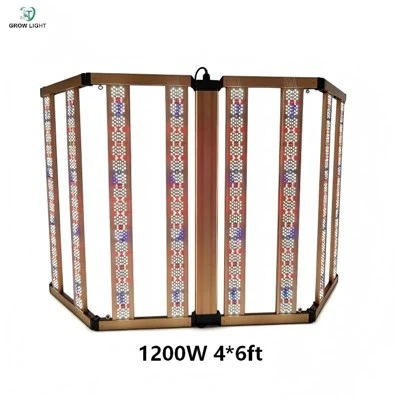
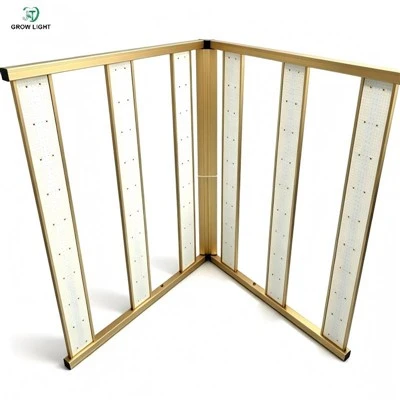
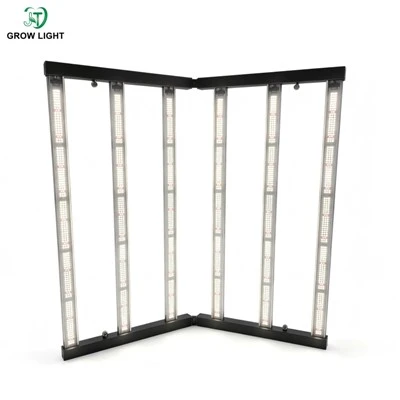
Factories with real technical breadth typically maintain concurrent product lines covering main high-output fixtures such as a 1100W LED Full Spectrum Commercial Grow Light, linear solutions like a Full Spectrum LED Grow Light Bar for uniform coverage or multi-tier racks, and specialized under-canopy options such as an LED Under Canopy Supplemental Grow Light with full spectrum for Indoor Plants. Offering these formats together is one practical signal that the engineering team understands photon distribution, thermal management across different housings, and actual grower requirements instead of simply assembling generic high-wattage boards.
Check Three - Test Reports and Certification Documentation
PPE, PPFD, and SPD Data - Ask to See the Actual Test Reports
High PPE claims are common; independent verification is less so. Request complete third-party reports (typically aligned with LM-79 or horticultural test methods) that include:
Photosynthetic Photon Efficacy (PPE) in µmol/J
Total Photosynthetic Photon Flux (PPF) in µmol/s
Spectral Power Distribution (SPD) across the relevant range (usually 400–700 nm or 400–800 nm)
PPFD maps or intensity distribution data at the stated mounting heights
Electrical data (input power, power factor, THD)
Relevant thermal information
The report should name the accredited laboratory, test conditions, and date. Internal data without third-party identification carries limited weight. Confirm that the model and configuration in the report match the product being quoted.
DLC Horticultural Listing and Why It's a Meaningful Filter
The DesignLights Consortium Horticultural Qualified Products List remains a useful filter for commercial projects, particularly those targeting utility rebates. Under Horticultural Technical Requirements V4.0 the minimum PPE threshold is 2.5 µmol/J. Listing also requires appropriate safety certification (typically UL 8800 or equivalent). Verify any claimed listing directly on the official DLC QPL by manufacturer name and exact model number. Products that only reference older versions or cannot be located on the current list should be treated cautiously for rebate-eligible work.
Check Four - Quality Control Process
What a Real QC Process Looks Like on the Factory Floor
A functioning system normally includes Incoming Quality Control for LEDs, drivers, and PCBs; In-Process checks during SMT and assembly; burn-in or aging (commonly 24–168 hours depending on the product); and Outgoing Quality Control covering functional, electrical, and visual inspection. Ask to see aging racks in use and recent reject-rate data. Factories that cannot describe or show these steps usually have weak process control.
Sample Evaluation Before Bulk Ordering
Always test physical samples before committing to volume. Sample lead times typically range from 7–15 days for standard configurations and longer for custom spectrums or housings. Measure actual power draw, thermal performance under continuous operation, spectral match to the claimed SPD, and basic reliability through continuous burn-in. For larger projects, independent laboratory verification of PPE and PPFD is still the safest approach.
Check Five - MOQ, Lead Time, and Order Flexibility
Why Unrealistically Low MOQ Claims Are a Red Flag
Claims of "1-piece MOQ with full customization" almost always signal a trading company or a factory unwilling to run dedicated production. Realistic minimums for commercial LED grow lights usually start at 50–100 units for standard or lightly customized models and rise when new tooling, custom spectrums, or private labeling is involved. Extremely low MOQs frequently come with higher unit prices or hidden quality risks.
Typical Lead Times for Custom Commercial Grow Light Orders
For standard commercial models, production lead times after deposit and sample approval commonly fall in the 15–35 day range, depending on quantity and component availability. Fully custom OEM/ODM projects that require new housings or optics can extend to 40–55 days or more when tooling is needed. Confirm component lead times (especially specialized LEDs or drivers) before locking schedules, and allow buffer for peak seasons or Chinese New Year.
Check Six Communication and After-Sales Support
Response Time and Technical Understanding During the Quote Process
Reliable partners answer technical questions accurately and without long delays. Test this by asking about spectrum design choices, thermal management approach, dimming protocols, or how a particular PPE figure was derived. Slow, generic, or contradictory answers during the quoting stage almost always continue after the order is placed.
Warranty Terms and What They Actually Cover
Clarify the warranty length (commonly 3–5 years for commercial fixtures), which components are covered, whether labor or shipping is included, and the process for replacements. Ask how field failures are handled and whether spare parts are kept in stock. Vague warranty language is a practical warning sign.
Real-World Scenario A Buyer Who Skipped Due Diligence and Paid for It
One commercial grower selected a supplier largely on price and attractive PPE claims without requesting or verifying full third-party test reports. After installation, independent measurements showed the actual PPE well below the marketed figure. Yields fell short relative to energy costs, and the fixtures proved ineligible for the expected utility rebates because the documentation could not be validated. The combination of downtime, replacement costs, and lost production exceeded the original purchase savings by a wide margin. This pattern-overstated performance data that only becomes visible after bulk delivery-remains one of the more expensive outcomes of incomplete supplier evaluation.
Reliable Factory vs Risky Supplier A Quick Comparison
|
Aspect |
Reliable Factory |
Risky Supplier |
|
Production Capability |
Owns SMT lines, assembly, aging; transparent video tours |
Trading company or rented space; vague about location |
|
Documentation |
Full third-party PPE/PPF/SPD reports; verifiable certs |
Marketing sheets only; certificates that cannot be verified |
|
Quality Control |
Documented IQC/IPQC/OQC + burn-in |
Minimal or no visible process |
|
Communication |
Technical, consistent, responsive |
Slow, generic, or changing answers |
|
Commercial Terms |
Realistic MOQ and lead times |
Unrealistically low MOQ or shifting timelines |
Industry Trend Why More Buyers Are Requesting Third-Party Test Verification
As more commercial growers and facility operators have experienced underperforming fixtures, demand for independent laboratory reports has risen. Buyers increasingly treat manufacturer-provided data as a starting point only and require third-party verification of PPE, PPFD uniformity, and spectral accuracy before approving large orders. Stricter DLC thresholds and utility rebate requirements that demand documented performance have reinforced this shift.
Regulatory and Documentation Notes for International Buyers
CE, ETL/UL, and DLC - What Each Certification Actually Confirms
CE: Self-declared conformity with European health, safety, and environmental requirements (including LVD and EMC). Necessary for EU market access but does not equal independent performance testing.
ETL or UL: Safety certification issued by an OSHA-recognized Nationally Recognized Testing Laboratory. For horticultural lighting, ANSI/UL 8800 is the relevant standard. ETL and UL are treated as functionally equivalent by most inspectors.
DLC: Not a safety mark. It is a performance and efficiency qualification on the Horticultural QPL. Current V4.0 requires a minimum PPE of 2.5 µmol/J plus supporting safety certification. It remains critical for many North American utility rebate programs.
Why Documentation Matters More for Rebate-Eligible Commercial Projects
Most rebate programs require both current safety listing and active DLC Horticultural QPL status for the exact model and configuration. Incomplete or unverifiable documentation can disqualify an entire project from incentives, which is why thorough pre-order verification is essential for any rebate-dependent installation.
A Simple Checklist Before You Place Your First Order
Before sending a deposit to any LED grow light manufacturer, LED grow light factory, wholesale LED grow light supplier, or custom commercial grow light / OEM ODM grow light supplier, confirm the following:
What to Request Before Sending a Deposit
Business license and clear evidence of manufacturing scope
Live or recent video of the actual production lines
Full third-party photometric/photon reports for the quoted models
Current certification documents (UL/ETL, CE, and DLC listing verification)
Sample units for independent evaluation
Written confirmation of MOQ, lead time, payment terms, and warranty
Clear process for quality disputes and after-sales support
FAQ
Q: How can I verify LED grow light test reports?
A: Request the full report from an accredited lab, confirm the lab name and accreditation, match the model and configuration to the quote, and cross-check key metrics (PPE, PPF, SPD) against independent measurements when possible.
Q: What is a reasonable MOQ for commercial LED grow lights?
A: Typically 50–100 units for standard or lightly customized models; higher for full custom tooling or complex spectrums. Extremely low MOQs paired with full-customization claims are usually red flags.
Q: What are typical lead times?
A: Samples usually take 7–15 days. Production for commercial volumes commonly runs 15–35 days after approval, longer for fully custom designs or during peak periods.
Q: How do I verify a DLC certification is genuine?
A: Search the official DesignLights Consortium Horticultural Qualified Products List by manufacturer and exact model number. Do not rely solely on certificates supplied by the seller.
Q: What is the difference between OEM and ODM for grow lights?
A: OEM generally means manufacturing to the buyer's existing design or branding. ODM involves the factory providing design and engineering support in addition to manufacturing. Clarify intellectual-property and tooling ownership in either case.
Q: What should I ask before placing an order?
A: Cover production capability, test reports, certifications, sample evaluation results, commercial terms (MOQ, lead time, payment), quality process, and after-sales support. Document the answers in writing
Evaluating a commercial LED grow light factory is ultimately about confirming consistent performance, verifiable documentation, and reliable delivery rather than chasing the lowest unit price. A structured approach protects both crop outcomes and capital.
If you have a specific project, spectrum requirement, or volume target, feel free to share the details. We can provide quotations, samples, and the corresponding full test documentation for review.