
1000Won the Box Rarely Means 1000 Watts from the Wall
Walk into almost any indoor facility that still runs older inventory and you'll hear the same complaint: "These were supposed to be 1000W lights." The label said one thing. The breaker panel and the monthly bill said another. That difference is not always a defect. It is usually the result of how the industry has marketed fixtures for more than a decade-by comparing them to the high-pressure sodium lamps they were meant to replace rather than stating the true wall draw.
Why LED Grow Light Wattage Labels Can Be Misleading
Equivalent Wattage" Marketing vs Actual Draw
"1000W equivalent" still appears on far too many product pages. In practice that phrase can mean anything from a 250W budget panel to a genuine high-output commercial fixture. The marketing number is a size class, not an electrical specification. Once you start measuring, the real input power is what shows up on your power bill and what determines how many fixtures you can safely put on a circuit.
How to Read a Driver's Rated Input Power Instead of Guessing
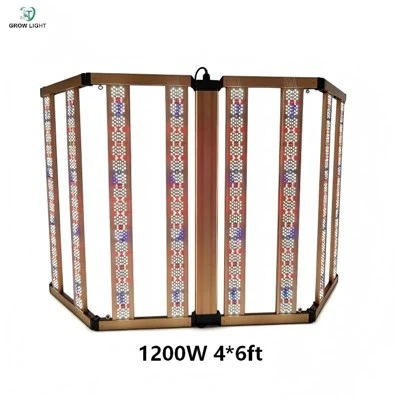
Ignore the big number on the front of the box for a moment and look for the driver's rated input power or the fixture's measured AC watts at full load. For a Commercial 1000W LED Grow Light the actual draw usually lands between 850W and 1050W. A Commercial 1200W LED Grow Light typically pulls 1050–1250W. An 1100W LED Full Spectrum Commercial Grow Light sits in the 950–1150W range under normal operating conditions. If the only wattage figure supplied is the theoretical maximum of the LED chips, ask for the real input power before you place a bulk order.
What Actually Determines a Grow Light's Real Power Draw
LED Chip Efficiency (Measured in μmol/J)
Wattage alone tells you almost nothing about how much usable light reaches the canopy. Efficacy-micromoles of photosynthetic photons per joule-does. Modern commercial fixtures commonly deliver 2.5–3.2 μmol/J. Elite models push past 3.3. A higher-efficacy fixture produces more PPF for the same electrical input, which is why two lights with nearly identical wattage ratings can deliver very different results.
Driver Efficiency Losses
The driver converts AC to the DC the diodes need. Quality commercial drivers run at 90–95% efficiency. That 5–10% loss turns into heat at the driver itself. Cheaper drivers can drop well below 90%, raising both power consumption and thermal load for the same optical output.
Dimming Settings and Real-World Operating Load
Almost every commercial fixture is dimmable. Running at 80% intensity rarely costs you 20% of the light, yet it lowers wall draw and reduces stress on the diodes and capacitors. Ambient temperature, thermal derating, and the exact dimming schedule all influence the number your meter ultimately records. Lab numbers at 25°C and full power are useful, but they are not the whole story once the lights are hanging in a warm grow room.
Actual Power Consumption by Product Class
These ranges reflect measured input power for well-designed commercial fixtures at full intensity under normal conditions. Exact figures vary by driver, thermal design, and test method.
|
Nominal Class |
Typical Actual Input Power |
Typical Efficacy (μmol/J) |
Representative PPF |
|
Commercial 1000W LED Grow Light |
850–1050 W |
2.6–3.1 |
2300–3200 μmol/s |
|
Commercial 1200W LED Grow Light |
1050–1250 W |
2.6–3.1 |
2800–3800 μmol/s |
|
1100W LED Full Spectrum Commercial Grow Light |
950–1150 W |
2.7–3.2 |
2600–3500 μmol/s |
The table makes the point clearly: the label and the wall draw are related but not identical. Always request the independent test data that shows both input power and PPE at the same operating point.
Calculating Your Actual Monthly Electricity Cost
A Simple Formula for Estimating Running Cost
Monthly cost ≈ (Actual watts ÷ 1000) × hours per day × days × electricity rate.
Use the measured input power. Marketing wattage will only give you a wrong answer.
Real-World Scenario - Monthly Cost for a Mid-Size Commercial Grow Room
Ten fixtures, each drawing 950W at full power, 12-hour flowering cycle, 30-day month, commercial rate between $0.12 and $0.18 per kWh:
Daily energy = 10 × 0.95 × 12 = 114 kWh
Monthly energy ≈ 3,420 kWh
Lighting-only cost ≈ $410–$616
Raise the efficacy from 2.6 to 3.0 μmol/J and you can often reduce intensity or fixture count while holding the same canopy PPFD. That difference compounds across every room and every cycle.
Higher Wattage Doesn't Always Mean Better Growth Per Watt
Comparing Efficacy (μmol/J) Across Wattage Classes
A 1200W fixture is not automatically better than an 800W one. If the higher-wattage unit runs at 2.4 μmol/J while the lower-wattage unit hits 3.1, the smaller light will usually deliver more usable photons per kilowatt-hour and better uniformity. LED grow light PPFD per watt is the number that actually drives yield and energy cost.
Why Two "1000W" Lights from Different Manufacturers Can Have Very Different Actual Output
Diode binning, secondary optics, heat sinking, and driver matching create large spreads. Two fixtures with almost the same nameplate wattage can differ by 20–30% in total PPF and even more at the edges of the canopy. Full-spectrum design and optical control matter at least as much as total power.
LED Grow Lights vs HPS A Power Consumption Comparison
|
Metric |
Modern Commercial LED (≈650–750 W) |
1000 W DE HPS (incl. ballast) |
|
Typical input power |
650–750 W |
1050–1100 W |
|
Efficacy |
2.6–3.2 μmol/J |
1.7–2.1 μmol/J |
|
Heat load |
30–40% lower |
Baseline |
|
Cooling energy impact |
Noticeably reduced |
Higher HVAC demand |
|
Practical lifespan |
50,000+ hours |
10,000–20,000 hours (bulb) |
For comparable photosynthetic photon flux, a well-designed LED system routinely cuts lighting electricity 30–45% and lowers the cooling load on top of that. Over a multi-year facility life the difference is substantial.
Industry Trend - Rising Efficacy Standards in Commercial Horticulture Lighting
Average efficacy on commercial fixtures has climbed steadily. What used to be considered strong performance at 2.2–2.4 μmol/J is now baseline. Most serious new installations target 2.7 μmol/J and above, with premium systems regularly clearing 3.0. The energy intensity of indoor production continues to fall as a result.
Regulations and Energy Rebate Programs Tied to Grow Light Efficiency
DLC Horticultural Lighting Qualification and Why It Matters for Rebates
The DesignLights Consortium Horticultural Qualified Products List sets the minimum efficacy most North American utilities accept for rebates. Version 4.0 raised the floor to 2.5 μmol/J. Specifying currently listed fixtures is often the difference between receiving a meaningful incentive and receiving nothing. Always verify the exact model is on the current QPL before you lock in a purchase.
How to Choose a Reliable LED Grow Light Manufacturer for Accurate Power Specs
When you are talking to an LED grow light manufacturer or evaluating a factory for wholesale or custom commercial grow light production, the single most useful filter is transparency of measured data.
What Test Data to Ask For Before Buying in Bulk
Ask for independent LM-79 (or equivalent) reports that show AC input power, PPE, and total PPF at the stated operating condition. Request the driver model and efficiency curve, thermal performance data at full load, and spatial PPFD maps at your intended mounting height. Factories that supply this information without hesitation and allow third-party verification are far less likely to leave you with a surprise on the utility bill.
F A Q
Q: Does a 1000W LED grow light really use 1000 watts?
A: Only if the measured input power is close to 1000W. Many products labeled 1000W draw far less; true commercial fixtures often draw near the stated figure.
Q: How much does it cost to run an LED grow light per month?
A: Calculate from actual watts, not the marketing number. A 950W fixture running 12 hours a day at $0.15/kWh costs roughly $51 per month.
Q: Is a higher wattage grow light always better?
A: No. Higher efficacy and better uniformity almost always outperform simply adding more watts.
Q: How should I choose between a 1000W and 1200W commercial fixture?
A: Match total PPF and target PPFD to your canopy area and crop, then compare efficacy and uniformity. Choose the higher-wattage unit only when you actually need the extra photons and your electrical infrastructure can handle it.
Q: How do I interpret driver efficiency?
A: Look for 90–95% at the intended load. Anything significantly lower raises both energy use and heat at the driver.
Q: Are PPFD and wattage the same thing?
A: No. Wattage is electrical input. PPFD is the photon flux density at the canopy. Efficacy links the two.
Q: What is typical MOQ and customization availability?
A: Most factories will discuss custom spectra, form factors, and branding once minimum order quantities are met. Confirm production consistency and test data first.
Q: How can I verify a manufacturer's claimed power data?
A: Request independent photometric reports, measure a sample with a calibrated power meter, and cross-check against current DLC listings when available.
Knowing the real wall draw turns lighting from an unpredictable cost into a controllable one. When you evaluate suppliers, ask for measured input power, PPE test reports, and sample fixtures. The numbers that matter are the ones that appear on your power bill and in your canopy, not the ones printed on the marketing sheet