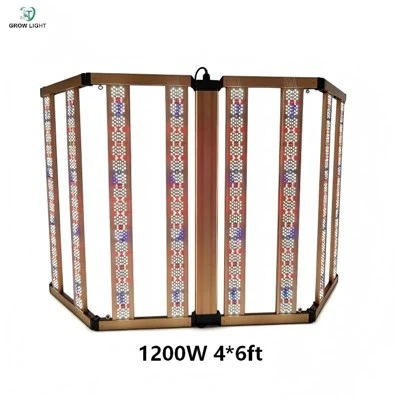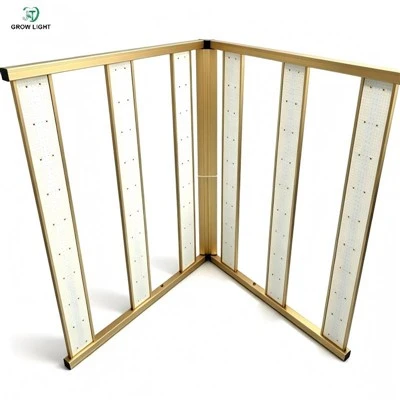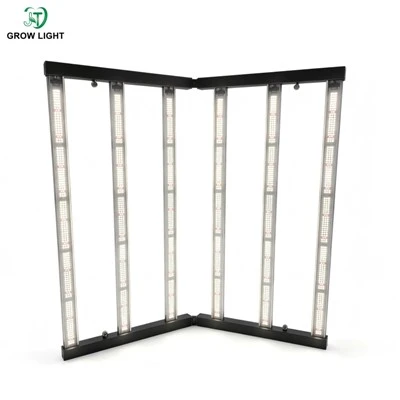

If you've been shopping for grow lights for more than five minutes, you've probably noticed something: every spec sheet has a PPFD number on it, and every one of those numbers looks impressive. The problem is, a lot of them are just math on paper. Nobody actually put a sensor under the fixture and measured anything.
We do things differently, and honestly, it's not because we're trying to win a marketing argument. It's because we build fixtures for people who are running real commercial grows, and a wrong number on a spec sheet doesn't just embarrass us - it costs a grower a chunk of their harvest. So every fixture that leaves our facility gets PPFD testing done on a bench, point by point, before it ever gets boxed up.
What Is PPFD, and Why Should You Actually Care About It
Let's keep this simple, because it doesn't need to be complicated.
PPFD stands for Photosynthetic Photon Flux Density. All that really means is: how many photons of usable light are landing on a specific spot of your canopy, every second. It's measured in µmol/m²/s (micromoles per square meter per second) - don't worry about memorizing that, just know it's the unit you'll see on every test report.
Here's why it matters more than almost any other number on a grow light spec sheet: your plants don't care how many watts your fixture pulls, and they don't care what the total light output of the whole fixture is. They only care about how much usable light is actually hitting their leaves, at their specific height, in their specific spot in the room. That's PPFD.
Two fixtures can have the exact same wattage and the exact same "total light output" claim, and still deliver completely different results in your grow room - because one has even, well-distributed light across the whole canopy, and the other has a hot spot in the middle and weak corners. You won't see that difference on a spec sheet with just one number. You only see it with a real PPFD map.
That's the whole reason why PPFD matters for plant growth: it's the closest thing to a direct line between your lighting investment and your actual yield.

How We Test PPFD on Every LED Grow Lights
This is the part most manufacturers skip talking about, mostly because they skip doing it. Here's what actually happens on our bench.
The Equipment We Use
We test with a calibrated quantum PAR sensor mounted on a motorized or manually indexed measuring rig, positioned at a fixed, repeatable distance from the grow lights (typically matching common commercial hanging heights, such as 12", 18", and 24", depending on the fixture class). The sensor and the fixture sit in a controlled dark environment so we're not picking up ambient light contamination that would throw off the reading.
Before any testing session starts, the sensor gets checked against a reference standard. A sensor that's drifted out of calibration will give you numbers that look fine but are quietly wrong - and that defeats the entire purpose of testing in the first place.
The Grid Mapping Process
Here's where it gets more thorough than most people expect. We don't just hold a sensor under the center of the grow lights, get one number, and call it done. We map the canopy area in a grid - usually somewhere between a 3x3 and 5x5 pattern, depending on fixture footprint - and record a PPFD reading at every single point.
That gives us a full PPFD map, not a single headline number. It shows us:
- The center reading (usually the highest point)
- The corner and edge readings (usually the lowest, and the most telling)
- The uniformity ratio - basically, how even the light spread is across the whole canopy
A fixture with a strong center reading but weak corners will still show a high "peak" PPFD on a lazy spec sheet. Our grid testing catches that immediately, because we're averaging and reporting the whole footprint, not just cherry-picking the best point.
A Real Example From Our Test Bench
On a recent test run, one of our engineers walked through this exact process on camera - sensor mounted, fixture powered up, grid points measured one by one, with the readings logged live as they came off the sensor rather than typed in afterward from a spreadsheet. That's the standard we hold every fixture to before it's approved to ship. No fixture gets a published PPFD spec until it's been through this process on our actual bench, under our actual sensor, with someone actually standing there watching the numbers come in.

Why We Don't Just Calculate PPFD - We Measure It
The Problem With "Theoretical" PPFD Numbers
There's a shortcut a lot of suppliers take: they calculate PPFD using the chip's rated output, the driver's rated wattage, and a formula, and they publish that number as if it came off a real fixture. On paper, this looks fine. In practice, it ignores everything that happens between "rated chip output" and "light actually hitting your canopy" - optical losses, driver efficiency variance, thermal derating, diode-to-diode inconsistency, even how the reflector or lens is designed.
A calculated number tells you what a fixture might do under perfect lab conditions with zero real-world variance. A measured number tells you what it actually does.
What Real Point-by-Point Testing Actually Catches
This is the part that actually protects you as a buyer. Physical, grid-based testing catches things a formula simply can't:
- Light decay from heat buildup during extended run time
- Uneven diode performance across the array, especially on lower-quality boards
- Driver output drift, which shows up as inconsistent readings across a burn-in period
- Poor optical design, where the beam angle or lens creates hot spots and dead zones
None of that shows up in a spreadsheet calculation. All of it shows up the moment you put a calibrated sensor under a real fixture and start walking the grid.
PPFD vs PAR vs PPF - Clearing Up the Confusion
This trips up a lot of buyers, so let's clear it up in plain terms:
PAR (Photosynthetically Active Radiation) is the range of light wavelengths (roughly 400–700nm) that plants can actually use for photosynthesis. It's a range, not a number.
PPF (Photosynthetic Photon Flux) is the total amount of PAR light a fixture produces per second, measured in µmol/s. This is a fixture-level number - it tells you total output, not what's landing on your plants.
PPFD is what actually lands on a specific point of your canopy, measured in µmol/m²/s. This is the number that matters for your grow.
Simple way to remember it: PAR is the type of light, PPF is how much light the fixture makes in total, and PPFD is how much of that light actually reaches your plants at a given spot. A fixture can have a great PPF number and still deliver mediocre, uneven PPFD if the optical design is weak.
How This Affects You as a Buyer
Tested Data vs Marketing Numbers - What's the Real Difference
A calculated PPFD number costs a supplier nothing to produce - it's just a formula in a spreadsheet. A tested PPFD map costs time, equipment, calibration, and labor. That difference in effort usually tells you a lot about how seriously a supplier takes accuracy in general, not just on this one spec.
When you're comparing two similar fixtures with similar published PPFD numbers, the real question isn't "what's the number" - it's "how was that number produced."
Questions to Ask Any Grow Light Supplier Before You Order
Next time you're evaluating a grow light factory PPFD test report, these are worth asking directly:
Was this PPFD number measured on a physical unit, or calculated from chip specs?
Can I see the full grid map, not just the peak or average number?
What hanging height and testing distance was used?
Is every unit tested, or just a sample batch?
Can you provide a PPFD testing report specific to the model I'm ordering?
Any supplier confident in their numbers will answer these without hesitation. If you get vague answers or just a single re-quoted spec sheet number, that's useful information too.
Why Verified Photometric Data Is Becoming the Standard
This isn't just a "nice to have" anymore. Commercial cultivators, vertical farm operators, and greenhouse projects are increasingly building their lighting decisions around actual measured data rather than headline wattage or peak PPFD claims - especially as facilities scale up and even small inefficiencies get multiplied across hundreds of LED grow lights.
At the same time, more buyers are asking for canopy-level uniformity data instead of a single center-point number, because uneven light distribution directly affects crop consistency across a grow room - which matters a lot when you're trying to hit a consistent harvest across thousands of plants, not just one test bench sample.
The direction is pretty clear: wholesale grow light verified PPFD data is turning into a baseline expectation for serious commercial buyers, not a bonus feature a few manufacturers offer.
How to Read a PPFD Report When You're Comparing Suppliers
When a supplier hands you a report, here's a quick, practical way to read it:
- Check if it shows a grid map or just a single number - a grid map is the real signal of legitimate testing.
- Look at the spread between the highest and lowest points, not just the average.
- Confirm the testing distance matches your actual hanging height plans - a fixture tested at 12" will show very different numbers at 24".
- Ask whether the report reflects a specific unit tested, or an averaged/estimated figure across a product line.
A report that gives you all of this without you having to ask is usually a good sign the LED grow light manufacturer behind it takes PPFD testing seriously.
FAQ
Q: What is PPFD in grow lights?
A: PPFD measures how much usable light is actually reaching a specific point on your plant canopy, expressed in µmol/m²/s. It's the most direct indicator of how much light your plants are receiving in a real grow environment.
Q: Why does PPFD matter more than total wattage?
A: Wattage tells you power draw, not light delivery. Two fixtures with identical wattage can produce very different PPFD results depending on optical design, diode quality, and driver efficiency.
Q: How accurate is grow light PPFD data on most spec sheets?
A: It varies significantly. Calculated figures based on chip ratings tend to overstate real-world performance, while measured, grid-based data reflects what a fixture actually delivers under test conditions.
Q: How is grow light PPFD actually measured?
A: Using a calibrated quantum PAR sensor positioned at a set distance from the fixture, with readings taken across multiple grid points on the canopy area rather than a single center-point reading.
Q: What's a good PPFD uniformity ratio for commercial cultivation?
A: Ratios closer to 0.7–0.8 (minimum or average versus maximum) generally indicate solid, usable canopy-wide light distribution for commercial-scale grows.
PPFD testing isn't a glamorous part of building grow lights. It's slow, it's repetitive, and it happens behind the scenes long before a fixture ever gets photographed for a product page. But it's also the single most honest thing a manufacturer can do for the growers who depend on that number being right.
If you're sourcing lights for a commercial project and want to see what an actual grid-tested PPFD report looks like for a specific fixture, that's something we're always glad to share - real data, not a spreadsheet estimate.