If you're new to LED grow lights, one of the most common confusions is: what exactly are the differences in spectrums? Why do some lights advertise "full spectrum" while others emphasize "enhanced red light"? Today, I'll break it down and explain several common spectrums in layman's terms.
1. Blue Light (400–500nm)
Blue light is a plant's "appetizer," particularly suitable for use during the seedling and vegetative growth stages. Its effects are simple:
1) helps leaves grow thicker and greener.
2) helps the root system grow deeper.
3) helps stems grow stronger and resist lodging.
One of my clients grows leafy vegetables in a factory. They previously used cheap red and blue lights, which resulted in thin, small, and yellowish vegetables. Later, I switched to full-spectrum lights with a higher proportion of blue light, which sped up seedling growth by at least 20%. The leaves were noticeably greener and looked fresher.
A quick reminder: Don't use too much blue light. If the proportion is too high, the plants will tend to grow short, with small leaves and a timid appearance.
2. Red Light (600–700nm, core 660nm)
Red light is an accelerator for flowering and fruiting. If you're growing crops like tomatoes, peppers, and marijuana, red light is essential.
It can:
1) Promote flowering and fruiting;
2) Improve photosynthesis efficiency;
3) Increase yields.
I worked with a client who grows tomatoes in a greenhouse. He increased the proportion of red light during the flowering period, which increased fruit set by nearly 15%. However, he also made a mistake-he got too greedy at first and used red light for almost all of his lights. As a result, the plants grew leggy, with long, thin stems, and he had to prune a batch.
👉 Tip: Red light must be used in conjunction with blue light; otherwise, it will easily cause excessive growth.
3. Far-red light (700–750nm, 730nm is common)
Far-red light is a "regulator." It changes a plant's perception of the photoperiod, promoting flowering, and it can also lengthen internodes, giving the plant a more relaxed shape.
For example, flower growers particularly like to use 730nm to promote flowering. Many ornamental plants will experience delayed flowering if they lack far-red light. However, pay attention to the ratio. Too much far-red light can cause excessive growth, stretching internodes excessively, and affect yield.
I know a strawberry grower who used far-red light to supplement his light before flowering. As a result, the number of flowers increased significantly, and the fruit set was more even. However, he also cautioned: Far-red light should not be used indiscriminately; it must be used in conjunction with red light.
4. Green Light (500–600nm)
Green light is often overlooked because plants don't absorb it as well as blue and red light. However, it actually has a hidden benefit-it can penetrate upper leaves and reach the branches and foliage below.
For example, in tall crops like tomatoes or marijuana, dense upper leaves can block light from reaching the lower leaves. In these situations, green light can provide supplemental light to the lower leaves, allowing for more even photosynthesis throughout the plant.
So, don't underestimate green light. In some tall crops, an appropriate amount of green light can effectively increase overall yield.
5. Ultraviolet Light (280–400nm)
UV light is more like a "seasoning" for plants. It's not essential, but adding a little can yield surprising results:
1) It can induce plants to produce substances like anthocyanins and flavonoids;
2) For cannabis, it can increase THC and CBD content.
3) It can improve stress tolerance and enhance resistance to pests and diseases.
A cannabis client told me that adding a small amount of UV light near the end of flowering resulted in noticeably better flavor and potency than without it.
A quick reminder: Be careful with UV dosage. Excessive dosage can not only damage the plant but also burn human eyes. Therefore, UV lamps are more of a decorative supplement in commercial applications.
6. IR (Infrared, >750nm, commonly 800–850nm)
IR light's primary function isn't to directly promote photosynthesis, but rather to provide a thermal effect. Simply put, it helps plants regulate temperature and metabolism.
In some colder regions, IR supplemental lighting can boost plant metabolism, especially in greenhouses during winter. However, it's not a required spectrum for plants; it's more of a supplement.

7. Full Spectrum
At this point, some might ask, "Shouldn't I just buy a full-spectrum light?"
Yes, the benefit of a full-spectrum light is that it simulates natural sunlight, blending blue, green, red, far-infrared, and even UV and IR.
It has three advantages:
1) Suitable for all growth stages: From seedling to flowering, it can be used without frequent lamp changes.
2) Closer to natural light: Plants grow in a more natural state.
3) More comfortable growing environment: Especially in large commercial greenhouses, it won't irritate the eyes of those working for long periods.

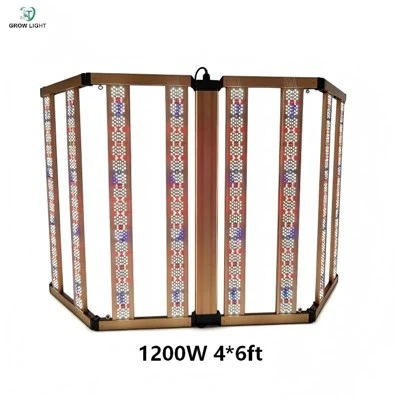
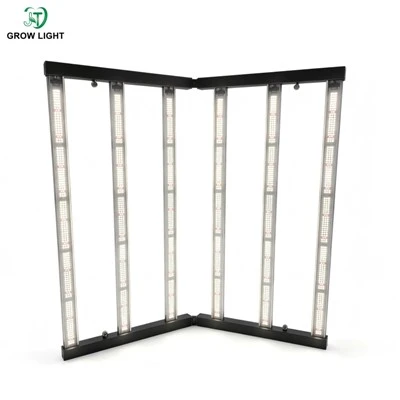
Many commercial growers now choose full-spectrum, high-power folding lights. One light covers the entire growing cycle, saving time and effort.
8. 3 Tips for Beginners
Don't be blinded by a single wavelength. Strong red light doesn't guarantee high yields, and more blue light doesn't guarantee health. Spectral matching is key.
Phase Matching
1) Vegetative Growth Stage: Increase the proportion of blue light.
2) Flowering and Fruiting Stage: Increase the proportion of red light.
3) Flowers, Fruits, and Vegetables: Add a touch of far-red light for better results.
4) Cannabis: Moderate UV light enhances flavor and potency.
Choose Based on the Crop
1) Leafy Vegetables: Full spectrum with a blue tint and white;
2) Fruits and Vegetables: More red light, combined with far-red light;
3) Flowers: Red and far-red light, with moderate UV light for enhanced color.
9. Summary
The spectrum of LED grow lights is like a plant's "recipe." Different spectrums are like different nutrients, each essential. For beginners, it's easiest to start with full-spectrum lighting. Once you're familiar with it, you can then study the spectrum ratios and fine-tune it for your crop.
If you're a commercial grower, pay even more attention to the spectrum's compatibility with PPF and PPE, rather than simply focusing on price. A good spectrum configuration can often significantly improve yield and quality.
Remember one thing: planting will be easy if the spectrum is matched correctly.