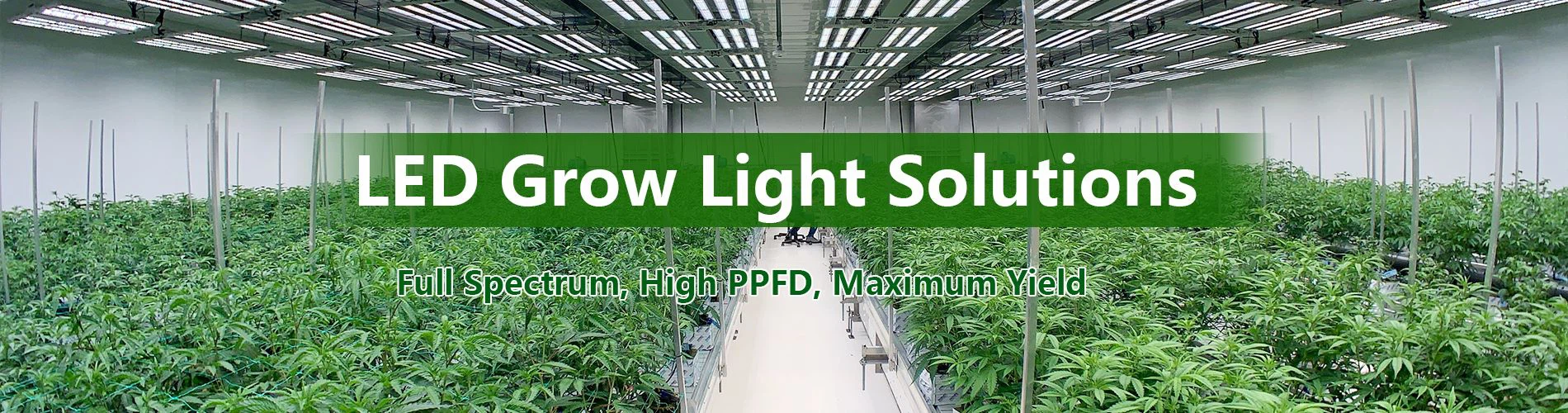
For a long time, choosing grow lights in cannabis cultivation felt like a preference. Some growers trusted HPS. Others experimented with LEDs. A few mixed systems and adjusted as they went.
In 2025, that freedom has quietly disappeared.
- Not because regulations forced it.
- Not because technology suddenly became exciting.
- But because of the economics, scale, and expectations of commercial cannabis cultivation, there is no longer room for inefficiency.
LED grow lights are no longer a "better option." They are the baseline. In the previous article, we introduced "Cannabis Lighting Market 2025" in detail
And once you look closely at how commercial facilities actually operate today, it becomes clear why going back to HPS is no longer a realistic decision.
HPS Worked-Until the Industry Changed
High-pressure sodium lighting earned its place. For years, it delivered reliable flowering performance, strong penetration, and predictable results. Many of today's experienced growers built their early success under HPS.
The problem isn't that HPS stopped working. The problem is that the surrounding industry has changed.
Facilities got larger. Canopies became denser. Energy costs became less predictable. Labor became pricier. Margins tightened. What used to be "acceptable inefficiency" became a measurable liability.
HPS systems generate significant radiant heat. In smaller rooms, that heat was manageable. In large-scale commercial facilities, it turns into a constant battle with HVAC systems, airflow balance, and environmental consistency.
Every grower who scaled up under HPS learned the same lesson eventually: the light wasn't the only thing working harder. Everything else had to work harder too.
Energy Is No Longer a Background Cost
One of the biggest reasons growers moved away from HPS has little to do with light quality and everything to do with energy reality.
Electricity is no longer a stable input. Rates fluctuate. Demand charges punish peak usage. Utility infrastructure limits expansion. In many regions, energy costs now rival labor as a top operational expense.
LED grow lights didn't win this battle because they were slightly more efficient. They won because they changed the entire energy profile of a facility.
- Lower wattage for the same usable output.
- Less heat load transferred into the room.
- Reduced strain on cooling systems.
- More flexibility during peak pricing windows.
In isolation, those gains might seem incremental. In a facility operating multiple rooms year-round, these benefits accumulate rapidly.
This is also where dimming LED grow lights became more than a nice feature. It became a management tool.
Growers can now reduce intensity during peak utility hours, respond to seasonal temperature changes, and fine-tune output without destabilizing the environment. HPS never offered that level of flexibility.
Control Became More Valuable Than Raw Output
For years, lighting decisions revolved around intensity. More PPFD meant better results-at least in theory.
In practice, raw output without control often created new problems. Hot spots. Uneven canopies. Increased stress. Inconsistent results across rooms.
LED systems changed that equation by making control accessible. In practice, features like dimming and centralized control systems have become essential tools for managing energy, heat, and consistency at scale.
Modern commercial grow lighting is rarely just a fixture hanging from the ceiling. It's part of a broader control ecosystem. Timers with sunrise and sunset functions. Environmental controllers are tied to temperature and humidity. Centralized platforms that allow adjustments room by room.
This level of control matters because commercial cultivation isn't about growing one outstanding crop.
It's about growing the same crop, over and over again, with minimal variation.
1. Consistency is what allows forecasting.
2. Consistency is what supports contracts.
3. Consistency is what keeps teams efficient.
HPS systems, by design, were static. LEDs are adjustable by nature. And in a market that rewards predictability, that difference matters more than most growers expected a few years ago.
Maintenance, Downtime, and Operational Risk
Another reason LED is no longer optional is that it rarely appears in spec sheets. Downtime.
In commercial cannabis cultivation, lighting failure isn't a minor inconvenience. It's a direct threat to crop health, scheduling, and revenue. Replacing HPS bulbs, managing ballasts, and dealing with heat-related component stress all add friction.
LED systems reduce that friction, with fewer consumables. LED systems also have a longer service life. Lower operating temperatures. More stable output over time.
That doesn't mean LEDs never fail. It means failures are less frequent, easier to predict, and less disruptive when systems are designed properly.
As facilities scale, operational risk becomes just as important as yield potential. Growers who have lived through unexpected outages or cascading equipment issues tend to value stability more than theoretical performance gains.
Labor Efficiency Is an Underrated Driver
Lighting choices influence labor more than most people realize.
HPS systems require regular bulb changes. They demand more attention to fixture height due to the heat. They often force growers to work around hot equipment, especially in flowering rooms.
LED grow lights reduce many of those constraints. Lower surface temperatures make adjustments safer and easier. Slimmer designs improve access in dense rooms. Dimming and scheduling reduce the need for constant manual intervention.
None of this replaces skilled labor. But it reduces unnecessary labor friction - the kind that adds up quietly over time.
In an industry where experienced cultivation staff are difficult to replace, any system that supports efficiency without sacrificing results becomes attractive quickly.
The Quality Conversation Changed
One of the more subtle shifts behind the move to LED has been the industry's evolving relationship with quality.
Early skepticism around LEDs often centered on flower density, structure, and expression. At the time, some of that skepticism found justification. Early LED systems were inconsistent, poorly designed, or mismatched to real cultivation needs.
That landscape has changed.
Modern LED grow lights offer more consistent spectra, better uniformity, and improved penetration when paired with proper layout and supplemental strategies. More importantly, they allow growers to maintain stable conditions throughout the entire cycle.
Quality issues are rarely caused by light alone. They emerge when light interacts poorly with temperature, humidity, or airflow. LEDs, by reducing thermal stress, make it easier to maintain those balances.
That's one reason many growers now rank quality as equal to or even above yield when evaluating lighting systems. LEDs didn't just catch up. They integrated better into the whole system.
Incentives Accelerated the Transition
Utility rebates didn't create the LED transition, but they accelerated it.
A growing percentage of commercial growers have explored energy incentives when upgrading lighting systems. Some have already received rebates. Others are planning upgrades with incentives in mind.
HPS systems simply don't fit into these programs anymore. LED upgrades, especially when paired with controls and dimming strategies, align naturally with utility goals.
For operators planning expansions or renovations, this matters. Rebates reduce upfront costs. Incentives shorten payback periods. And both favor LED-based systems almost exclusively.
Why the Debate Is Over
In theory, growers can still choose HPS.
In practice, that choice comes with trade-offs most commercial operations can no longer justify.
- Higher energy costs.
- Greater heat load.
- Less control.
- More maintenance.
- Limited scalability.
LED grow lights don't solve every problem. Poorly designed systems still perform poorly. But LEDs give growers the flexibility to respond to problems without rebuilding their entire infrastructure.
That flexibility is the real reason LED is no longer optional.
Commercial cannabis cultivation has matured. The market rewards efficiency, consistency, and predictability. Lighting systems must support those goals, not fight against them.
HPS helped build the industry. LED is what allows it to operate sustainably at scale.