Many growers mistakenly believe that light decay simply means "the light gets dimmer," assuming that reduced brightness or a lack of glare signal decay. But those with long-term growing experience know that the first sign of decay isn't brightness at all-it's the spectral ratio. In other words, decay isn't a "uniform decline", but rather "certain wavelengths fading much faster than others". This is especially evident in full-spectrum LED grow lights. Once they pass the 500-hour and 1500-hour usage milestones, growers notice an indescribable shift: plants continue growing, yet lose the neat, harmonious, synchronised growth pattern seen in the first week. Slightly looser internodes, more scattered leaf angles, and a canopy no longer as uniform as under a new light-these are almost always signs that light decay is beginning to "favour specific wavelengths."

Blue light is invariably the most sensitive. Its decay is always the fastest, dictated by the physical structure of all LEDs. Blue light chips carry high energy and generate significant thermal load, leading to material fatigue far exceeding that of red light after prolonged operation. When blue light declines by 5%, plants may exhibit more pronounced behavioural responses than when red light drops by 15%. So when you observe that "the lights look fine", plants have already detected an imbalance in the blue light spectrum. This phenomenon explains why commercial growers often notice mid-cycle: despite unchanged photosynthetically active radiation flux density (PPFD), plant canopies become uneven. Blue light decay triggers internode elongation, increased leaf spreading, and loosening plant posture, ultimately creating subtle growth rhythm differences across all plants.
To help you understand this logic, there's an article that explains it very thoroughly: How LED Light Decay Disrupts Spectrum Balance in Full Spectrum Grow Lights
Comparing the SPD curves of a full-spectrum grow light at 500 hours versus 1500 hours reveals a startling difference: while brightness might drop from 100% to 96% (barely noticeable to the naked eye), blue light could plummet from 100% to 88%, and red light to 92%, while green light remains largely stable at 95-97%. This is the classic pattern of light decay. In other words, while light decay superficially appears as "diminished brightness", its essence is spectral restructuring. The world perceived by plants is no longer the same as during the initial week-this is the true starting point of growth disruption.
This also explains why JT consistently emphasises: the harm of light decay to LED plant lights is never "dimming", but "proportional imbalance". When blue light declines too rapidly, plants instantly interpret it as "changing sunlight angles" or "seasonal shifts". Especially with prolonged blue light band decay, plants automatically shift toward reproductive growth patterns without any formula changes-accelerated flowering, elongated internodes, thinner leaves, and more open apical postures. Many growers mistakenly attribute this change to nutrient issues or variety conditions, when it's actually light signals becoming imbalanced.
During late light decay, canopy consistency becomes markedly uneven. Due to uneven spectral decline, each plant receives a non-homogeneous spectrum-some areas cool faster with slower light decay, while others concentrate heat and decay quicker. Some fixtures near aisles dissipate heat efficiently, while central ones accumulate more heat. Ultimately, you'll observe the canopy appearing gently pulled apart-some plants prematurely entering flowering mode while others remain stuck in vegetative growth. This is a classic side effect of light decay, not an environmental issue. This article details how light decay affects canopy consistency: How Light Decay Quietly Breaks Growth Sync
Most intriguingly, this proportional shift can be detected without a spectrophotometer. Growers themselves can observe light decay signs, especially in the white light variation of full-spectrum lighting. Open your phone's camera, point the lens at the fixture, take several photos at fixed ISO and shutter speed, then compare the results from 500 hours versus 1500 hours. You'll be surprised to find the images appear warmer, redder, and lower in contrast. This is the "warming effect" caused by phosphor decay + blue light decay. You won't notice this change with the naked eye because human eyes automatically compensate for white balance, but smartphones don't. Commercial growers particularly love this technique because it's simple, effective, and faster than using a spectroradiometer to assess light decay trends.
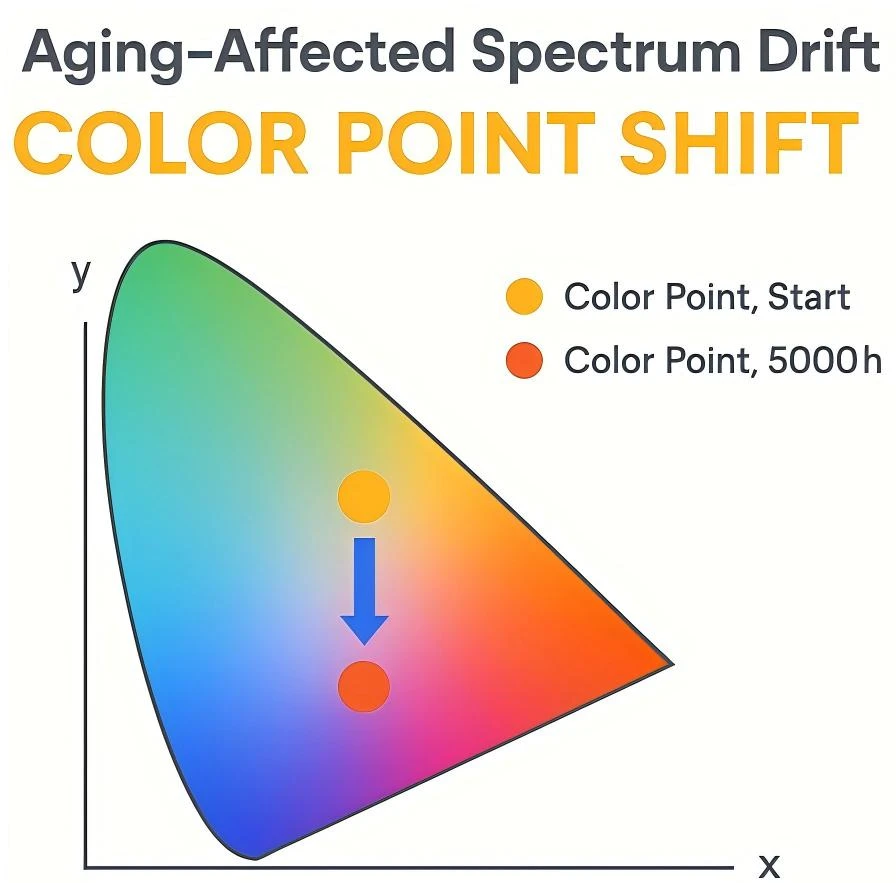
At this point, you may be curious about how light decay specifically affects yield. Truthfully, you needn't analyse academic data. The essence of spectral stability is already clearly explained in our main article: plants care not about light intensity but about light stability. Once the signal becomes unstable, plant behaviour becomes abnormal, and abnormal behaviour inevitably leads to yield fluctuations. (Natural internal link to the main article: Stable Spectrum Philosophy.)
This explains why budget LED grow lights often "crash and burn" after 1000–1500 hours. It's not that the lights stop working-it's that the spectrum loses its original balance. Cheap lights use inferior phosphor materials with short lifespans and poor heat resistance. Blue light decays rapidly, while red light fades unevenly, causing the spectrum to fragment prematurely. The chaotic growth patterns you observe aren't a model issue-they're a price issue. Conversely, highly stable full-spectrum lights (like the JT Grow Light commercial series) are engineered with "uniform decay" in their light decay curves, not "spectral chaos". Light can fade, but it mustn't skew-this is the foundational principle underpinning the entire commercial cultivation industry.
Light decay is never merely "the lamp getting dimmer". It signifies "the meaning of light changing".
For plants, these two states represent worlds apart.