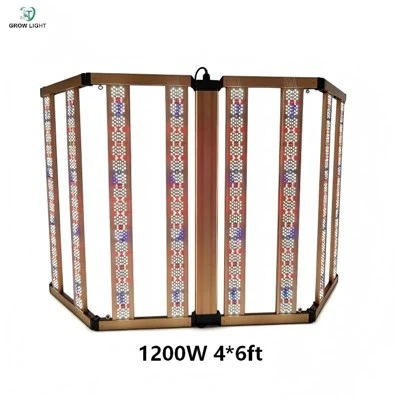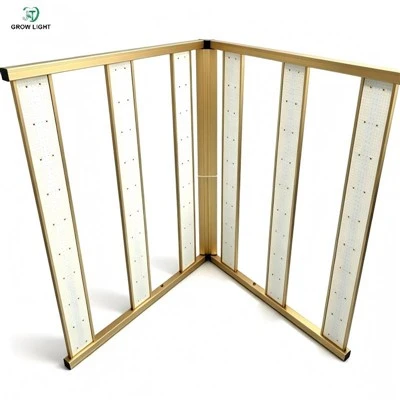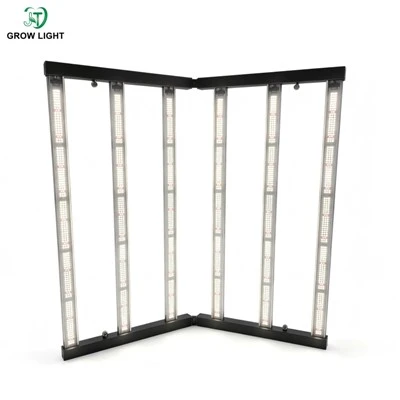
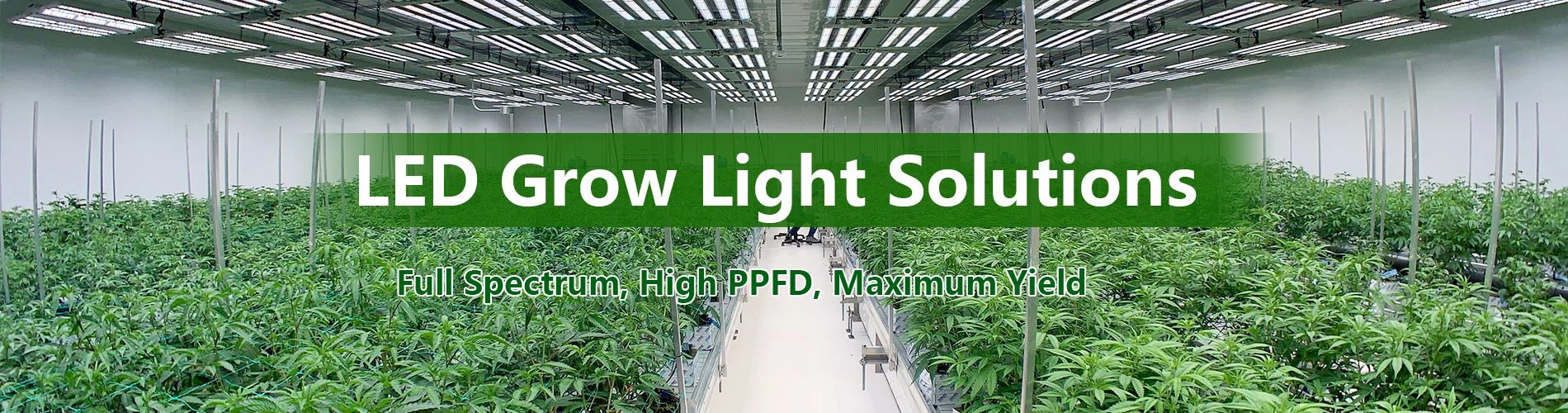
As a key branch of modern agriculture, the concept of plant factories has become increasingly popular. In indoor growing environments, plant lighting is an essential energy source for photosynthesis. LED grow lights offer overwhelming advantages over traditional supplemental lighting and are poised to become the preferred choice for primary or supplemental lighting in large-scale commercial applications such as vertical farms and greenhouses.
Plants are among the most complex life forms on the planet. Growing plants is both incredibly simple and challenging. Beyond plant lighting, numerous variables influence each other, and balancing these factors is a masterful art that growers must understand and master. However, when it comes to plant lighting, many other factors require careful consideration.
First, let's understand the solar spectrum and how plants absorb it. The solar spectrum is a continuous spectrum, with blue and green being stronger than red. The visible light spectrum ranges from approximately 380 to 780 nm. Plants have several key absorption factors, and several key growth hormones that influence plant growth have distinct light absorption spectra. Therefore, the application of LED grow lights is not a simple task but rather a highly targeted one.
When designing and selecting LED grow lights,
several key misconceptions to avoid.
1. The Red-Blue Wavelength Ratio
As the two primary absorption regions for plant photosynthesis, the spectrum emitted by LED grow lights should be primarily red and blue. However, this cannot be simply measured by a red-blue ratio, such as 4:1, 6:1, or 9:1.
Plant species vary greatly, with distinct habits and specific light requirements at different growth stages. The spectrum required for plant growth should be a continuous spectrum with a certain distribution width. Light sources made with chips that have narrow spectra of red and blue wavelengths are clearly inappropriate.
Experiments have found that plants can develop yellowish tints, have light and thin leaf stems, and so on. Extensive research has examined plant responses to different light spectra, such as the effects of infrared light on photoperiods, the effects of yellow-green light on shadowing, and the effects of violet light on pest control and nutritional content.
In actual applications, seedling burns and wilting are common. Therefore, the design of these parameters must be tailored to the plant species, growing environment, and conditions.
Thus, JTGL has established a professional spectral research team to customize specialized spectral solutions based on the needs of each client's plants. Only when the spectrum matches can plants achieve efficient photosynthesis.
2. Ordinary White Light and Full Spectrum
The light that plants "see" differs from that seen by the human eye. Commonly used white light lamps, such as the tri-color white light tubes widely used in Japan, do have some benefits for plant growth, but the effect is not as good as that of LEDs.
Although tri-color fluorescent lamps, which were widely used in recent years, synthesize white light, their red, green, and blue spectra are discrete, and the spectral width is very narrow, with relatively weak spectral intensity in the continuous portion. Furthermore, they consume 1.5 to 3 times more power than LEDs. Full-spectrum LEDs designed specifically for horticultural lighting optimize the light spectrum. While still visually white, they contain the critical light components required for plant photosynthesis.
As a professional LED grow light manufacturer, JTGL clearly guides which lighting system is suitable for each scenario and which spectrum solution is best for each plant. We have successfully provided thousands of solutions to customers worldwide. Therefore, choosing JT Grow Lights is a crucial decision for your plant growth.
3. Light Intensity Parameter PPFD
Photosynthesis flux density (PPFD) is a key parameter for measuring plant light intensity. It can be expressed in terms of photons or radiant energy. It refers to the effective radiant flux density of light used in photosynthesis. It represents the total number of photons within the 400-700 nm wavelength range incident on plant leaves and stems per unit time and per unit area. Its unit is μE·m-2·s-1 (μmol·m-2·s-1). Photosynthetically Active Radiation (PAR) refers to the total solar radiation within the wavelength range of 400-700 nm.
A plant's light compensation point, also known as the PPFD, refers to the point above which photosynthesis must exceed respiration, and plant growth must exceed consumption, allowing for growth. Different plants have different PPFDs, and achieving a single indicator, such as a PPFD greater than 200 μmol·m-2·s-1, is not sufficient.
Previously, illuminometers measured light intensity in terms of brightness. However, because the light spectrum of plant growth varies depending on factors such as the height of the light source from the plant, the area covered by the light, and whether the light can penetrate the leaves, it is not an accurate indicator of light intensity when studying photosynthesis. PAR is now commonly used.
Generally, sun-loving plants require a PPFD greater than 50 μmol·m-2·s-1 to initiate photosynthesis; shade-loving plants require only 20 μmol·m-2·s-1. Therefore, when installing LED grow lights, use this reference value for installation and setup, choosing the appropriate mounting height to achieve the ideal PPFD value and uniformity on the leaves.
4. Light Formula
Light formula is a recently proposed concept encompassing three key factors: light quality, light quantity, and duration. Simply put, light quality is the spectrum optimal for plant photosynthesis; light quantity is the appropriate PPFD value and uniformity; and duration is the cumulative exposure and the ratio of daylight to nighttime. Dutch agricultural scientists have found that plants use the ratio of infrared to red light to determine the cycle of day and night. At sunset, the infrared ratio increases significantly, prompting plants to quickly enter sleep in response. Without this process, plants would take hours to complete.
When designing LED grow lights, it's possible to artificially simulate natural spectral variations. For example:
1) Incorporating an adjustable far-red light channel (730nm) to simulate sunset;
2) Controlling the time-of-day spectrum: predominantly blue light in the morning (to stimulate photosynthesis), increasing the proportion of far-red light in the evening (to help plants transition to nightfall quickly);
3) Using light recipes to control crop cycles. For example:
For short-day plants like hemp and chrysanthemums, shortening the light duration can trigger flowering.
For long-day plants like lettuce and strawberries, extending the light duration can maintain vegetative growth.