Why is sunlight not that "efficient," even though it's complete?
Sunlight includes ultraviolet light, infrared light, and visible light. Plants have no use for the rest of the light, known as photosynthetically active radiation (PAR), particularly blue light and red light.
However, plants' conversion efficiency to these lights was very low; even under bright light, plants cannot be "satisfied."
Even under the most optimal conditions (bright sunshine, moderate temperature, and appropriate humidity), the efficiency of light energy conversion in plants is maximally 12%. That is, from every 100 units of light, plants are capable of utilizing only 12 units, the rest 88 units. Plants do not absorb them.
Considering the sunlight energy in general (and also the ultraviolet and infrared rays that could not be used by plants), its utilization rate will have to be reduced again, only about 3.3%! You are seeing a whole table of gourmet food, but you only eat a couple of mouthfuls (just plain white rice); that is a real waste.
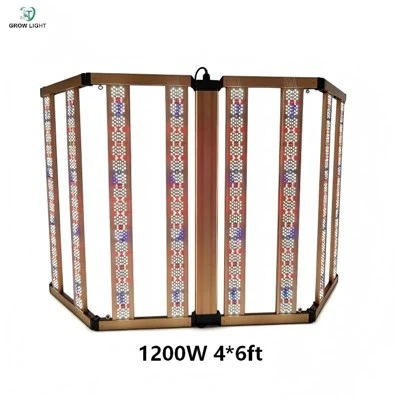
What can make the LED Grow Light spectrum more effective?
Because sunlight is so "wasteful", clever humans have provided a solution - can we "tailor" the spectrum for plants? Simply put, do not let them eat "buffet", you ordered a platter that plants like, convenient and economical. Hence, the invention of the artificial spectrum.
Targeting: The light of plant lamps is mainly concentrated in the wavelength of red light and blue light. It is these two types of light that are most relevant to plant photosynthesis. That cannot be used by plants, namely ultraviolet and infrared light can be eliminated directly!
High energy use rate: After customizing the spectrum, plants can absorb and use these lights to the greatest extent, which is more efficient than direct sunlight.
This is all-weather and controllable: The artificial spectrum can be switched on and off at any time, regardless of day and night or wind and rain; you can turn it on and off as you want, and this flexibility is completely beyond the reach of the sun.
To describe it by analogy:
The light coming from the sun is like an extravagant buffet; it looks rich, but only a few snacks are chosen and eaten wastefully by the plants. Artificial spectrum means that we invite a top chef to do a "customized meal" for plants. Every bite is perfect.
Are plants grown under sunlight and LED Grow Light, different in nutrition and taste?
Plants don't care if the light is coming from LED or the sun; they only see the "content".
Plants complete their photosynthesis with light of certain wavelengths. They have no way to know: "This is sunlight" or "this is light from LED lamps" As long as the wavelengths are compatible (such as blue light and red light bands), they can be absorbed and used accordingly. So:
Nutrients: Under the same environment there (such as soil nutrients, temperature, humidity, and so on), the nutrients of plants and different light sources will not become little, or red, so the nutrient content in the plant, will not have too big a difference.
Taste: In the same way, the source of light will not directly influence the flavor of any plants.
It's like plants eat "nutrients of light" and couldn't care less what kitchen prepares it.
The actual difference is caused by "environmental control."
Sunlight cannot be controlled, while artificial light can be nuanced, with the most significant difference between the two. This control will influence the growth rhythm of plants, which could in turn alter the taste or nutritional content.
✅ Characteristics of sunlight:
Seasonal variations: The intensity of the sunlight will change depending on the time of year (sunlight intensity is different in the morning, noon, and evening), and the weather will also impact sunlight (more sunny days and fewer cloudy days).
Plants grow in the seasons of nature; the intensity and duration of the light is not possible to artificially intervene. It may take more time for flavorsome matters (like sugars and smell matters) to be more situated.
✅ LED Plant Grow Light Features:
Controlled and stable: LEDs can be illuminated for 12–18 hours a day, with a consistent intensity and spectrum. This means that plants cannot be affected by any outside weather conditions.
Quality: The plants will grow in controlled conditions, leading to a shorter growing cycle. Strawberries and leafy vegetables, for instance, can return only after a matter of weeks.
✅ Impact of time effect:
Has a more rapid growth rate; therefore, some flavor compounds of plants may not provide sufficient time to accumulate. For example:
Actual sugar found in the tomatoes might be slightly less since the fruit ripens too quickly.
Some of the aromatic compounds are less, and the flavor is a little worse than plants grown naturally.
But these changes are not due to the light source itself, but with time has been compressed or the environment (temperature and humidity) has changed.
In reality, the situation is different for each crop
✅ Different crops will respond differently:
Green leafy vegetables (e.g. lettuce, spinach): The spectrum requirements are well defined, artificial light can preserve freshness and taste, and nutritional changes are negligible.
Fruits (e.g. tomatoes, strawberries): The flavor is more susceptible to time effect, and rapid growth can lead to a slight loss in sweetness and fragrance.