Why this upgrade started with a customer order
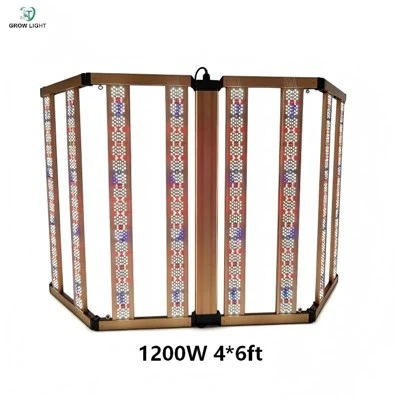
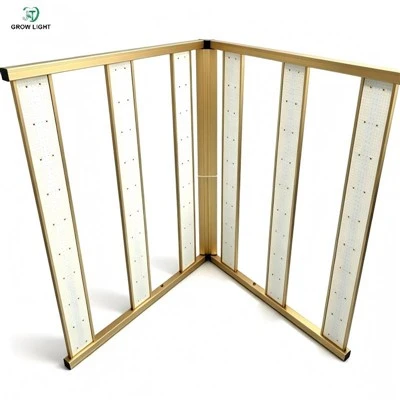
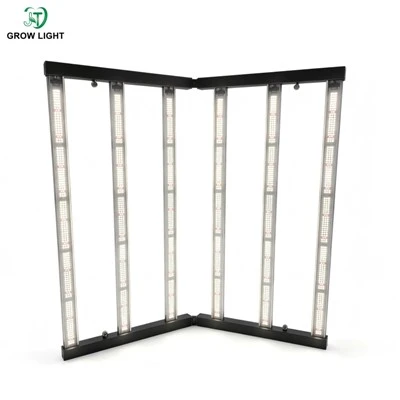
A few weeks ago we shipped out a batch of our 1060W detachable LED grow light, the pluggable bar-style unit that covers a full 4x6ft canopy. Nothing unusual about that on its own - we ship this model regularly to commercial growers in North America and Europe. What made this order worth writing about is what the buyer asked for during the spec conversation: he wanted to know exactly how our UV and IR spectrum worked together.
On our previous generation of pluggable bars, UV ran on its own single, independent dimming channel. You could turn it up or down, but it had no relationship to anything else in the fixture. On the current 1060W unit, we've merged UV and IR into one combined dimming channel. It sounds like a small wiring change. In practice, it changes how growers think about flowering-stage spectrum control, and it's worth walking through why.
The old design: a single, independent UV channel
Older LED grow light in our lineup - and honestly, most of the industry's older fixtures - treated UV as an isolated add-on. You'd have a main white/red spectrum channel doing the bulk of the photosynthetic work, and then a separate UV channel bolted on with its own dimmer, running at whatever ratio the grower set it to, completely disconnected from the far-red output.
This worked, but it had two practical limitations:
First, UV and far-red serve genuinely different biological functions during flowering, and running them independently meant growers rarely tuned them together on purpose. Most operators set UV once at the start of flower and forgot about it. Far-red, if the fixture even had it, was either always-on or not adjustable at all.
Second, a standalone UV channel adds a driver, a wiring loop, and a control point - more hardware, more cost, more things that can fail on a fixture running 12+ hours a day for months.
What combined UV/IR dimming actually changes
On the 1060W pluggable unit, UV and IR now share a single dimming channel and driver output. Turning that channel up increases both UV and far-red output together, in a fixed ratio engineered specifically for flowering-stage response. Turning it down reduces both proportionally.
This is a hardware-and-control-logic change, not just relabeling. The two wavelength ranges are now driven off the same current path, so the fixture has one fewer independent control loop, one fewer driver stage, and one fewer failure point compared to running UV and IR as two separate channels.
For the grower, the practical difference shows up at the controller. Instead of tuning two unrelated dials and hoping you land on a combination that works, you're tuning one channel that was already engineered around how UV and far-red behave together during bud development. It's a simpler interface, but the simplification is backed by a specific reason - which brings us to the plant science.

The plant science: what UV and far-red light each do during flowering
To understand why combining these two ranges makes sense, it helps to separate what each one is actually doing inside the plant.
UV light (mostly UVA, with a small, carefully dosed UVB component in horticultural fixtures) is a stress signal as much as it is a light source. Plants respond to UV exposure by upregulating protective secondary metabolites - this is well documented in cannabis and other high-value crops. Growers commonly report denser trichome coverage and stronger aromatic profiles when UV is present during late flower, which tracks with UV's known role in stimulating resin gland density and terpene concentration as a plant defense response.
Far-red / IR light works through an entirely different mechanism. It interacts with phytochrome, the plant's internal light-sensing pigment system, and shifts the red-to-far-red ratio the plant perceives. A higher far-red presence pushes phytochrome toward its inactive state, which signals shortening photoperiod conditions - this is part of what triggers and reinforces flowering response in short-day and day-neutral cultivars. Far-red also plays into what's known as the Emerson enhancement effect, where adding far-red alongside red and blue light increases overall photosynthetic efficiency beyond what either range achieves alone, because it engages both photosystem I and photosystem II more effectively together than red light does by itself. On top of the photosynthetic benefit, far-red's longer wavelength penetrates deeper into a dense canopy, reaching lower bud sites that shorter wavelengths can't reach as effectively.
So UV is largely a stress-and-secondary-metabolite trigger, and far-red is a flowering-signal-and-canopy-penetration tool. On paper they don't overlap - but in flowering-stage timing, they're both ramped up during the same window: late flower, when growers want denser resin production and stronger flowering signaling simultaneously. That overlap in timing, even without overlap in mechanism, is exactly why merging them into one channel makes practical sense instead of forcing growers to manage two separate dimmers pointed at the same growth stage.
Comparison: single UV channel vs combined UV/IR dimming
Old design vs current design
| Factor | Single independent UV channel (previous generation) | Combined UV/IR dimming (current 1060W unit) |
|---|---|---|
| Control complexity | Two separate dimmers to manage | One dimmer covers both ranges |
| Driver/hardware count | Additional standalone UV driver | Shared driver output, fewer components |
| Flowering-stage tuning | Manual, easy to set-and-forget | Pre-engineered ratio matched to flowering timing |
| Failure points | More independent circuits | Fewer independent circuits |
| Typical grower feedback | "I never really adjusted UV after week 1" | "One channel, easier to dial in late flower" |
The honest tradeoff here is flexibility versus simplicity. A fully independent UV and IR setup theoretically lets an advanced grower fine-tune each range separately down to the percentage point. In practice, most commercial growers don't have the time or the data to do that precisely, and a combined channel engineered around a tested ratio gets closer to optimal results with far less operator error.
Real customer scenario
The client who placed this 1060W order runs a mid-sized commercial flowering room, roughly a dozen 4x6ft canopy sections. His previous fixtures used the old single-UV-channel design, and by his own account, he set UV output once during his first flowering cycle and never touched it again - partly because he wasn't confident about what ratio actually helped, and partly because managing a second dimmer across a dozen rooms wasn't worth the labor.
With the combined UV/IR channel, his operation now adjusts a single dimming input as flowering progresses - lower in early flower, ramped up through mid-to-late flower alongside his red channel increase. That's the real value of merging these two ranges: it turns a spectrum decision that was previously ignored into one that gets used, because it's simple enough to actually manage at scale.
Industry trend: why more manufacturers are merging spectrum channels
This isn't unique to our lineup. Across the horticultural lighting industry, the broader trend over the past few product cycles has been toward channel consolidation rather than channel proliferation. Early-generation full-spectrum fixtures competed on how many independent channels they offered - sometimes four, five, or more separate dimmers. What manufacturers and growers both learned is that channel count doesn't equal usability. A fixture with six independent channels that nobody adjusts correctly delivers less real-world value than a fixture with three well-engineered channels that growers actually use.
Combined dimming - UV/IR merged, or in some fixture designs blue/UV merged - reflects this shift toward fewer, smarter channels rather than more, harder-to-manage ones.
On the regulatory and quality side, this consolidation trend also lines up with tightening expectations around energy efficiency reporting (relevant for DLC-listed commercial fixtures in North America) and UV exposure safety standards for enclosed grow environments. Fewer independent high-output UV sources, run at engineered ratios instead of arbitrary grower-set levels, is generally an easier profile to document and certify consistently - a practical reason manufacturers have leaned this direction, separate from the plant-science argument.
FAQ
Q: Does UV light actually increase trichome production?
A: Growers commonly report denser trichome coverage under UV-supplemented spectrum during late flower, which lines up with UV's known role as a plant stress signal that upregulates protective resin and terpene production.
Q: What is the Emerson enhancement effect in grow lights?
A: It's the documented increase in photosynthetic efficiency that occurs when far-red light is added alongside red and blue light, because it engages both photosystem I and photosystem II more effectively than red light alone.
Q: Is UV light safe to run in an indoor grow room?
A: Horticultural UV channels are engineered at controlled, low-intensity doses specifically for plant response rather than germicidal use, but growers should still avoid prolonged direct eye exposure and follow the fixture's rated safe distance guidance.
Q: What's the difference between a single UV channel and combined UV/IR dimming?
A: A single UV channel adjusts UV output independently with no relationship to far-red; a combined channel adjusts both together at an engineered ratio, simplifying control while targeting the same flowering-stage window both ranges are most useful in.
Q: Is a 1060W LED grow light enough to cover a 4x6ft flowering room?
A: Yes - a 1060W fixture in this class is sized specifically for 4x6ft canopy coverage at flowering-stage PPFD targets, which is the standard density spec commercial growers use for this footprint.
The move from a single independent UV channel to combined UV/IR dimming isn't a marketing repackaging - it's a response to how growers actually use their fixtures. UV and far-red serve different biological purposes, but they get needed during the same flowering window, and merging them into one engineered channel means that window actually gets used instead of set once and forgotten.
If you're sourcing LED grow light for a new flowering build, or evaluating whether your current setup's UV channel is doing anything useful at all, it's worth asking your LED grow light manufacturer exactly how their UV and IR channels are wired - independent, or combined. As a commercial LED grow light factory running this exact spec across our pluggable bar lineup, that's the first question we'd want you to ask, because the answer changes how much value you actually get out of the spectrum you're paying for.