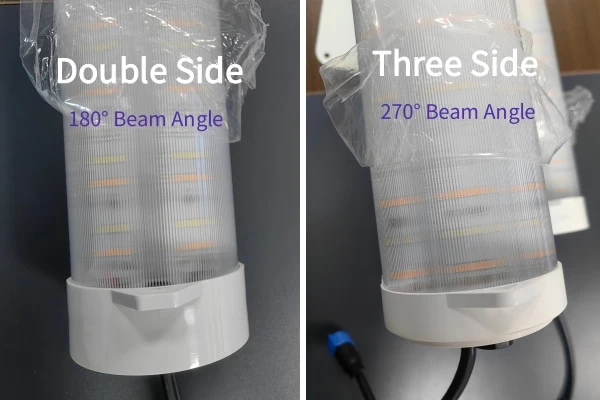
I get this question almost every week now: "Why do you sell two versions of the same under canopy light?" A customer will be looking at our catalog, see one under canopy light listed as 180° and another as 270°, and assume it's just a spec sheet difference that doesn't really matter. Then they ask which one they should order, and the honest answer is - it depends entirely on how your plants are spaced and how thick your canopy gets.
So let's actually walk through this properly. Not a marketing pitch, just what these two options do differently, where each one makes sense, and where growers get it wrong.
What Is Under Canopy Lighting, and Why Growers Are Adding It
Under canopy lighting (sometimes called inter-canopy or sub-canopy lighting, depending on where the fixture sits) means placing light sources inside or below the plant canopy instead of only overhead. The idea is simple: a top light does a great job lighting the upper cola, but by the time that light works its way down through fan leaves and side branches, there isn't much left for the lower third of the plant.
This isn't a small effect. Growers and researchers working on cannabis canopy penetration have found that lower canopy zones can end up receiving only a fraction of the PPFD hitting the top of the plant, because upper leaves absorb and scatter most of the usable light before it reaches the bottom. That's exactly why those lower buds often turn into small, airy "popcorn" nugs instead of dense, sellable flower.
A LED under canopy light solves this by putting light sources horizontally inside the plant structure - at the mid and lower canopy levels - so the lower zones get direct light instead of leftover light. Instead of one fixture trying to do everything from above, you're splitting the job: top light handles the upper canopy, and under canopy grow light bars handle everything underneath.
This is also part of a bigger shift happening across commercial cultivation. As more operations move toward denser plant counts per square foot to maximize output per room, uniform light distribution - not just total light output - has become the thing separating A-grade rooms from B-grade rooms.
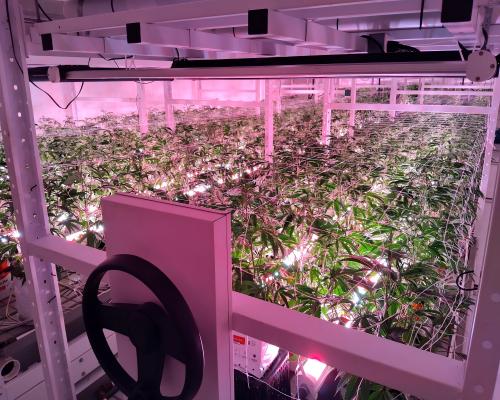
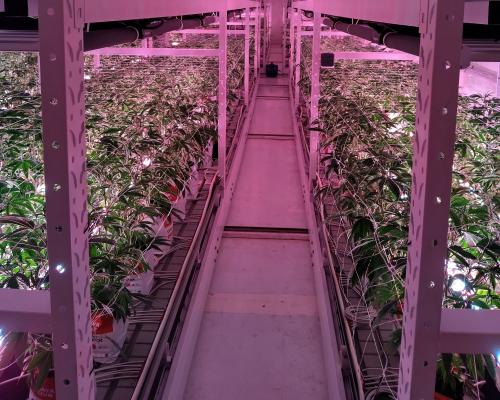
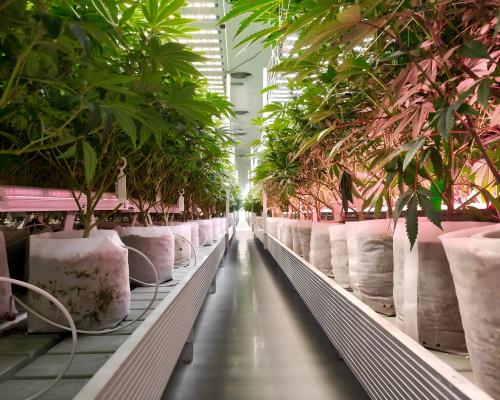
Why Light Penetration Matters for Bud Quality
Peer-reviewed research on supplemental canopy lighting in cannabis has shown that adding light at the middle and lower canopy levels - instead of relying only on overhead fixtures - measurably increases inflorescence yield, cannabinoid content, and terpene concentration compared to top lighting alone. One controlled study comparing traditional top lighting against inter-canopy supplementation recorded close to a 30% increase in dry flower yield, along with meaningfully higher THC and terpene levels in the inter-canopy treatment. Just as importantly, the lower canopy flowers became far more consistent in size and potency across the whole plant - not just heavier, but more uniform, which matters a lot when you're grading and pricing flower.
We've seen the same pattern from our own clients using under canopy lighting in commercial cannabis rooms: growers commonly report yield increases in the 20–25% range, and - maybe even more valuable commercially - a noticeable shift in grade distribution. Buds that used to get sorted as B-grade or trim start finishing dense enough to sell as A-grade. That grade shift alone often pays for the lighting upgrade faster than the raw yield number does.
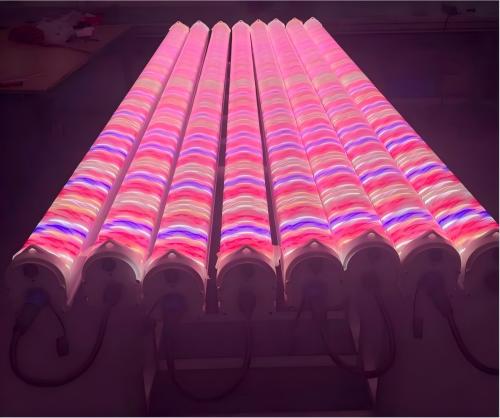
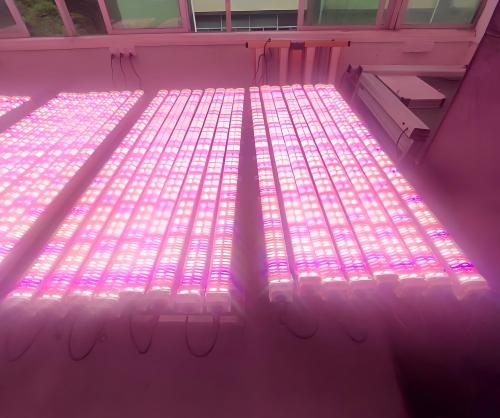
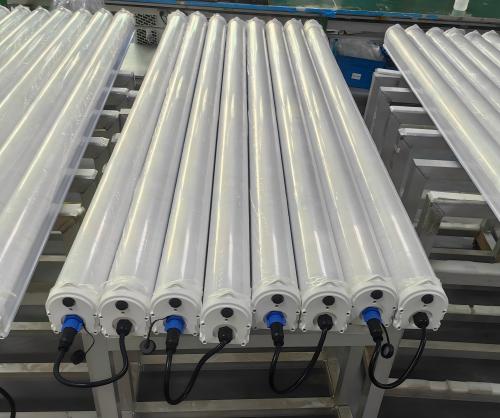
180° Under Canopy Light - Two-Side Emission Explained
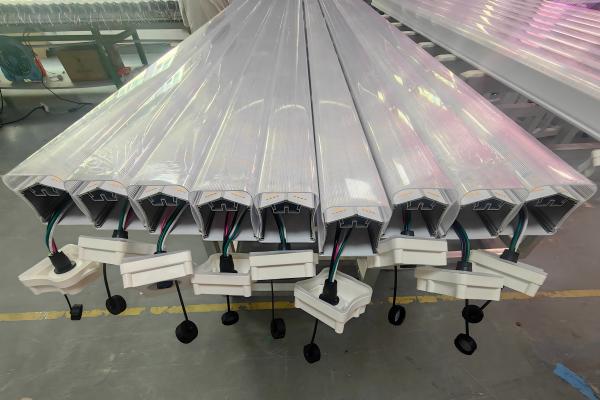
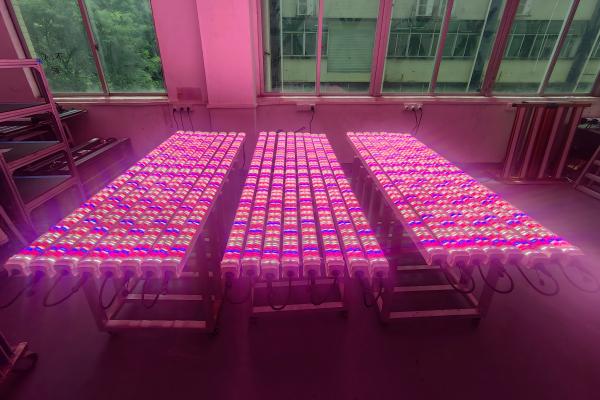
A 180° under canopy light is a double-side emission fixture. Light comes out of two opposite faces of the bar, covering the left and right sides of the canopy row it sits in. Picture the light bar running down the middle of a plant row - one side throws light into the canopy on its left, the other side throws light into the canopy on its right.
This is the setup you want when plant spacing is on the more open side - rows with visible gaps between plants, or canopies that haven't fully closed in yet. In that kind of layout, the light has a clear path to travel sideways into the foliage without immediately running into a wall of overlapping leaves. Two-side coverage is enough to reach the mid and lower bud sites because there's actual space for the photons to travel through.
On the hardware side, our 180° units ship with a black, height-adjustable bracket - three brackets per fixture - so the light bar rests securely without needing to be clamped or fixed to the grow rack itself. That bracket adjusts across four height positions, from 22 cm up to 38 cm, in 5 cm steps, so you can raise or lower the light as the canopy fills in during the grow cycle. Installation is tool-free: the bar sits on the brackets, and multiple units daisy-chain together on a single power run, with up to five fixtures supported per power cord. All current units are IP66 rated, which matters a lot in cultivation environments where humidity and irrigation runoff are a daily reality.
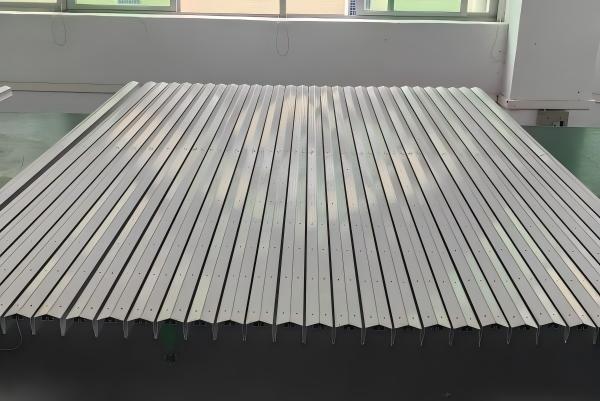
270° Under Canopy Light - Three-Side Emission Explained
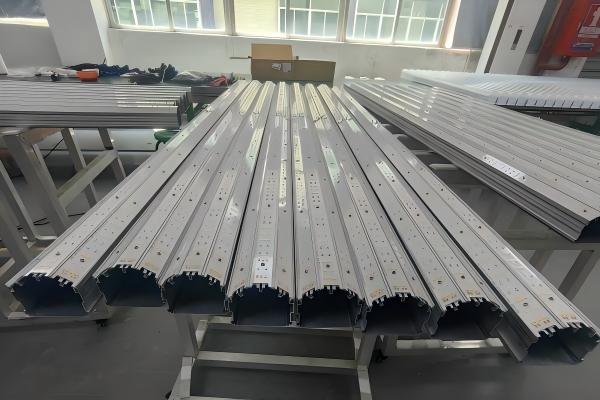
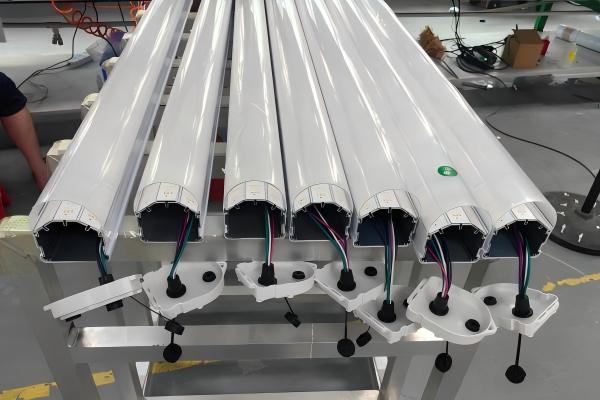
A 270° under canopy light takes that same two-side coverage and adds a third emission face, so light is distributed across the left side, the right side, and upward into the space directly above the fixture. That third face is what makes the real difference - it's not just "a bit more light," it changes the fixture from a strictly side-lighting tool into something that also fills in the space directly around and above it inside a tightly packed canopy.
That third face matters most when the canopy is dense - branches overlapping, minimal daylight visible between plants, leaf cover on multiple sides of the fixture at once. In that kind of environment, a two-side light can end up with one face throwing photons into a wall of leaves that just reflects most of it back, while the third emission face on a 270° unit gives the light another route into the canopy that a double-side fixture simply doesn't have. Growers running tight spacing or heavily trained canopies (think SCROG-style dense mats) get noticeably better coverage from the wider angle simply because there are fewer "dead zones" for the light to fail to reach.
Hardware-wise, 270° units use a white bracket (as opposed to the black bracket on the 180° line), with a height adjustment range of 22 cm up to 32 cm. Everything else - tool-free installation, daisy-chaining, IP65 rating - carries over from the 180° line.
One more thing worth mentioning: we used to offer a single-side (120°) emission version as well, but that's been phased out of regular production. It's been replaced by the double-side (180°) IP66 version as the new baseline, since almost every customer who was buying single-side eventually asked for double-side coverage anyway. Single-side is still available, but only as a custom production run for orders of 500+ units.
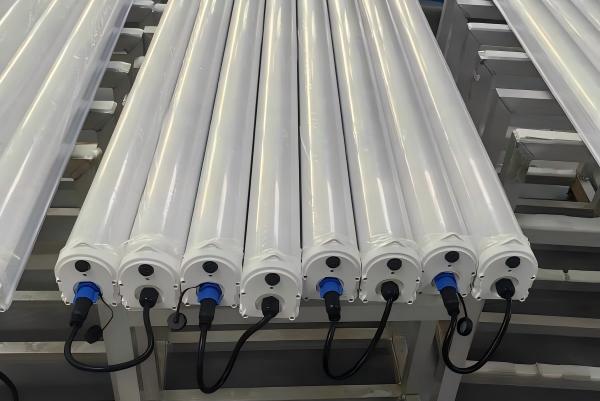
180° vs 270°: Side-by-Side Comparison
| Feature | 180° Under Canopy Light | 270° Under Canopy Light |
|---|---|---|
| Emission faces | 2 (left/right) | 3 (left/right/up) |
| Coverage style | Side-only | Side + overhead-adjacent |
| Bracket color | Black | White |
| Height range | 22–38 cm | 22–32 cm |
| Ideal plant spacing | Wider row spacing | Tight, overlapping canopy |
| Typical use case | Open canopy, gaps between plants | Dense canopy, SCROG/heavy training |
| Installation | Tool-free, daisy-chain up to 5 | Tool-free, daisy-chain up to 5 |
The table looks simple, but the decision really comes down to one question: does light traveling sideways from the fixture have a clear-ish path through your canopy, or is it going to hit a wall of leaves almost immediately? If it's the former, 180° usually does the job. If it's the latter, that third emission face on the 270° unit is what keeps light from getting trapped on one side of the plant.
How to Choose Between 180° and 270° for Your Grow Room
A few practical questions to run through before ordering:
- Plant spacing. Wider spacing, visible gaps between canopies → 180° is usually enough. Tight spacing, canopies touching or overlapping → lean toward 270°.
- Canopy density and training style. Untrained or lightly trained plants with a more open structure → 180°. SCROG, heavy topping, or anything that creates a dense, flat mat of foliage → 270°.
- Crop type. This isn't only a cannabis product - vertical farms and dense leafy-green or vine crop setups deal with the same penetration problem, and the same logic applies. Denser plant walls need the third emission face.
- Existing top-light setup. Under canopy lighting is meant to supplement, not replace, your top fixtures. If your top lighting already delivers strong PPFD to the upper canopy, the under canopy units are specifically filling in the gap underneath - so match the under canopy angle to the gap you're actually trying to fill, not to your top light spec.
Why More Commercial Growers Are Adding Under Canopy Lighting
Top-only lighting is increasingly treated as the baseline, not the finished setup, in commercial cannabis and controlled-environment agriculture. As facilities push plant density higher to get more yield per square foot, the industry's own research is pointing the same direction: canopy uniformity, not just total light output, is what determines whether a room finishes with mostly premium flower or a mixed bag of grades.
There's also a quality-grading angle to this. As legal cannabis markets mature and buyers get more selective, the price gap between top-shelf and lower-grade flower keeps widening. A lighting setup that converts a meaningful share of what used to be B-grade or trim into sellable, uniform flower has a direct line to revenue - not just a "nice to have" efficiency upgrade. That's part of why under canopy and inter-canopy lighting adoption has moved from early-adopter research trials into standard equipment lists for new commercial builds.
On the regulatory and certification side, commercial buyers - especially in North America and Europe - are increasingly asking for ETL, CE, DLC, and RoHS certification on any LED fixture going into a licensed cultivation facility, along with IP65 or better for anything installed in a humid grow environment. That's become close to a baseline requirement rather than a nice extra, particularly for facilities that need to pass electrical and safety inspections as part of their license renewal.
Real-World Data: Yield and Quality Impact of Under Canopy Lighting
To put some real numbers around this instead of just describing it:
| Metric | Reported Range | Source Type |
|---|---|---|
| Dry flower yield increase | ~20–30% | Grower-reported / commercial trials |
| THC accumulation increase | Up to ~24% | Peer-reviewed cannabis trial |
| Terpene concentration increase | ~12–13% | Peer-reviewed cannabis trial |
| Grade shift (B-grade → A-grade) | Commonly reported | Grower feedback, commercial installs |
Our own customers running LED under canopy light fixtures across North American commercial cannabis rooms have reported yield increases landing in that same 20–25% window, along with denser bud structure on the lower and mid canopy - the part of the plant that used to get written off as low-value flower. Since we started shipping under canopy fixtures at scale, we've moved well over 100,000 units into the North American market alone, largely on the strength of that grade-shift result rather than the yield number by itself.
FAQ
Q: What is the difference between 180° and 270° under canopy lights?
A: A 180° unit emits light from two opposite faces (left and right), while a 270° unit adds a third emission face, covering left, right, and the space above the fixture. The 270° version is built for denser canopies where two-side light doesn't have a clear path through the foliage.
Q: Can I mix 180° and 270° fixtures in the same grow room?
A: Yes, and it's actually common. Some growers run 270° fixtures in the densest sections of a room - like the center of a SCROG table - and 180° fixtures along more open edge rows, matching the fixture to the local canopy density rather than using one spec for the whole room.
Q: Is under canopy lighting necessary for every canopy type?
A: Not always. Low-density or widely spaced canopies may get enough penetration from top lighting alone. Under canopy lighting earns its cost mainly in denser commercial setups where lower bud sites are visibly light-starved.
Q: What IP rating do I need for under canopy grow lights?
A: IP66 is the standard for cultivation environments, since these fixtures are installed close to irrigation, humidity, and regular foliar contact. Anything lower than that is a real risk in a working grow room.
Q: How many under canopy lights can I daisy-chain together?
A: Our current 180° and 270° lines both support daisy-chaining up to five fixtures on a single power cord, which keeps wiring simple across long plant rows without needing a dedicated outlet for every unit.
Matching Under Canopy Light to Your Canopy, Not the Other Way Around
Going back to that original question - why sell two versions of the same light - the honest answer is that they're not really "two versions of the same light." They're two tools for two different canopy situations. A 180° under canopy light is built for canopies with room to breathe. A 270° under canopy grow light is built for canopies that have grown into each other.
If you're not sure which one fits your setup, the fastest way to figure it out is to look at your canopy from the side, at the height where the fixture would sit, and ask whether light traveling straight out from that point would hit open space or a wall of leaves within the first few inches. That answer tells you almost everything you need to know.
We manufacture both the 180° and 270° lines in-house as a factory, supply wholesale volumes for commercial cultivation projects, and support OEM/ODM configurations for growers and distributors who need something built to a specific spec. If you're weighing this decision for an actual grow room, send over your plant spacing and canopy density and we can tell you plainly which one makes sense - not just sell you whichever one's in stock.