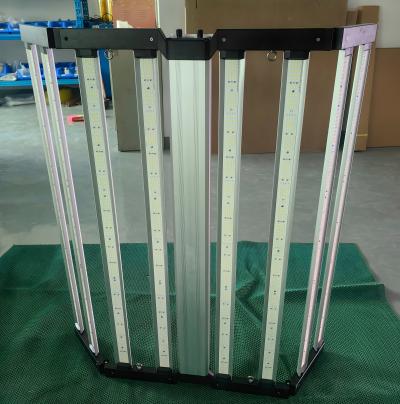
Most growers pick a trifold LED grow light based on one number: wattage. Higher wattage, more light, better yield - that's the assumption. But a commercial customer of ours in Canada recently placed an order that challenged that assumption directly, and it's worth walking through, because the logic behind it applies to almost anyone comparing foldable LED grow light options right now.
A Grower Who Wanted Answers, Not Assumptions
Instead of picking one fixture and hoping for the best, this customer ordered four separate custom builds at once, specifically to compare how two variables - bar count and spectrum - affect real growing results.
Here's exactly what he ordered:
An 850W trifold LED grow light, originally built as a 1000W unit, custom-configured with 8 light bars in one batch and 10 light bars in another
A 1000W trifold LED grow light, originally built as a 1200W unit, custom-configured with 10 light bars in one batch and 12 light bars in another
On top of that, within each wattage tier, the two bar-count versions were also built with two different spectrums between them: one with an added blue light channel, one without. That's four distinct configurations total - each one a specific combination of wattage, bar count, and spectrum - ordered together to be run side by side in the same growing environment.
This isn't a typical order. Most buyers ask "what's your best 1000W light," get a spec sheet, and place a PO. This customer built his own controlled comparison before committing to a large-scale purchase. That approach tells us a lot about where commercial cultivation buying decisions are heading - and it gives us a genuine, real-world case to explain what bar count and spectrum actually do inside a trifold LED grow light.
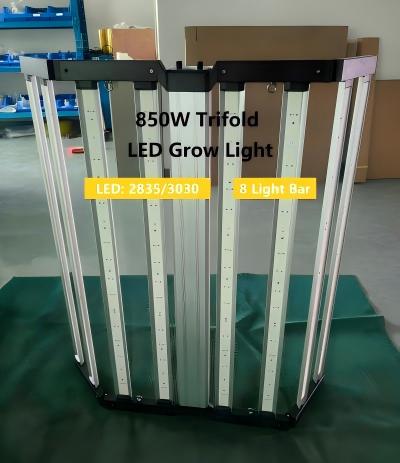
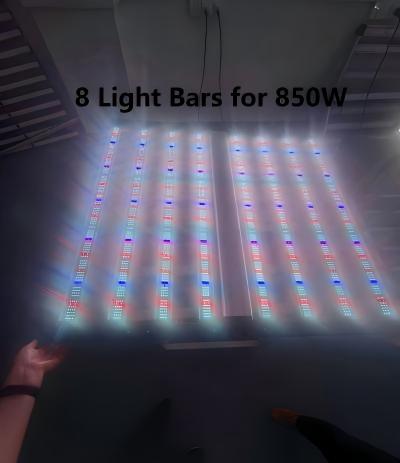
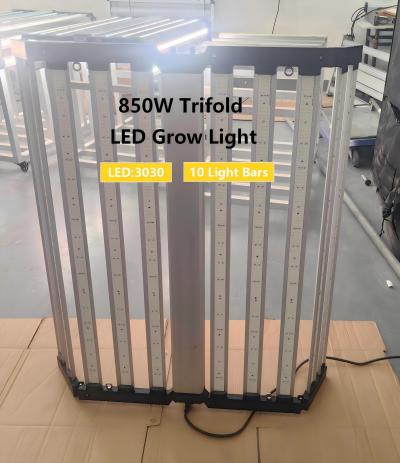
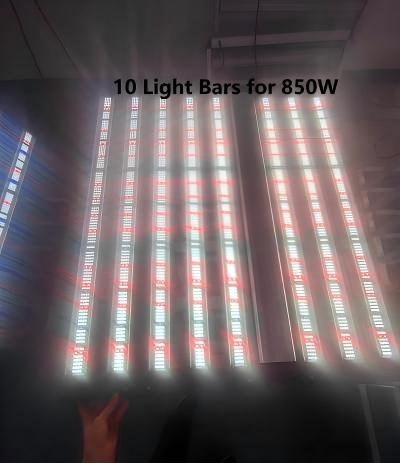
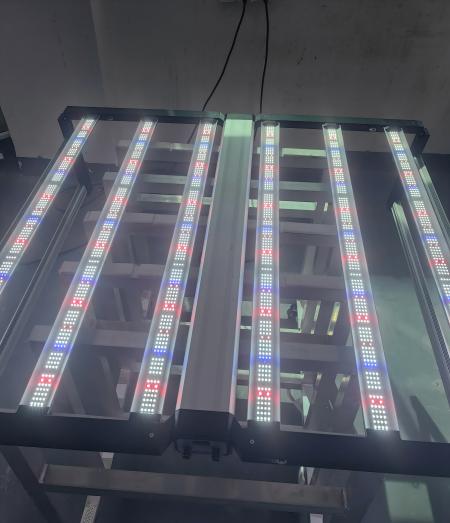
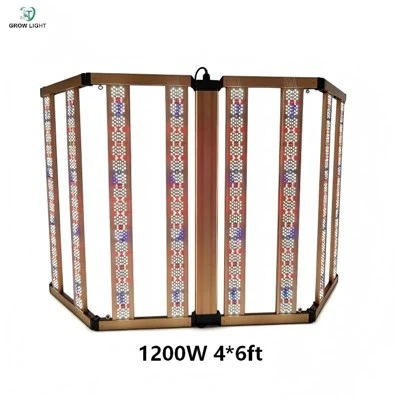
10 Light Bars with 1000W
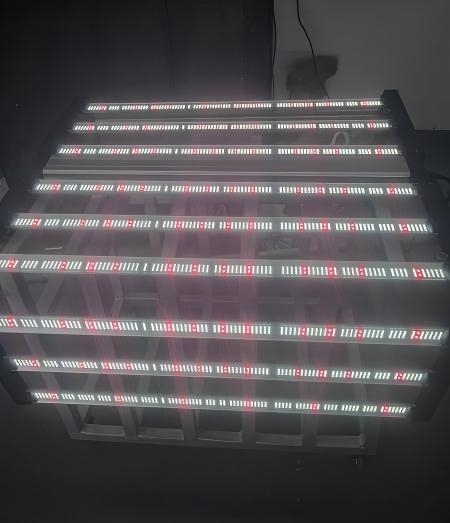
12 Light Bars with 1000W
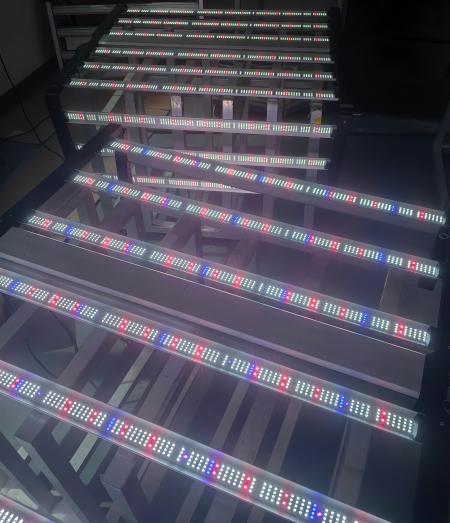
Compare the Spectrum
What Bar Count Actually Changes in a Trifold LED Grow Light
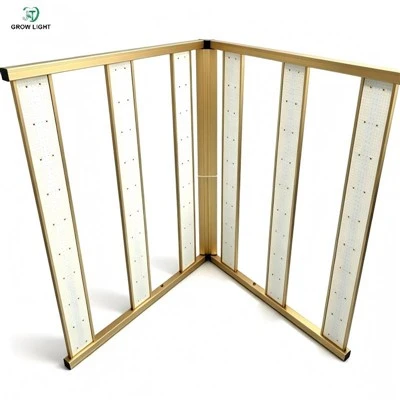
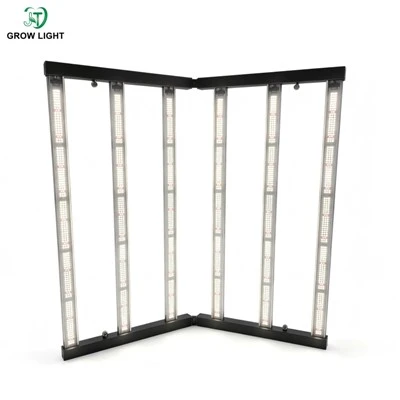
A trifold LED grow light gets its name from the folding frame - three hinged sections that fold flat for shipping and unfold into a wide, flat panel at installation. The light bars themselves are mounted across that frame, and the number of bars used to hit a given wattage is a design choice, not a fixed spec.
That choice matters more than most buyers realize.
Fewer Bars, Higher Output Per Bar
When a fixture is built with fewer bars - say, 8 bars instead of 10 for the same 850W target - each bar has to carry more diodes or run at higher current to make up the wattage. That typically means:
- Higher peak PPFD (light intensity) directly under each bar
- Slightly less uniform light distribution across the canopy, since there's more space between bars
- A marginally lower per-bar cost, since fewer bars means less frame hardware and wiring
More Bars, Wider Even Coverage
Spread the same wattage across more bars - 10 bars instead of 8, or 12 instead of 10 - and the light source becomes more distributed:
- Lower peak intensity per bar, but more even PPFD across the canopy
- Reduced hot-spotting directly under the fixture
- Slightly better light penetration into side canopy areas, since bars are spaced closer together
Neither configuration is objectively "better." A grower running dense, uniform canopy rows in a commercial cannabis flowering room often prioritizes even coverage - favoring more bars. A grower dealing with higher ceiling height or wider row spacing may prioritize higher peak intensity to punch light further down into the canopy - favoring fewer bars.
This is exactly why our Canadian customer ordered both bar counts at both wattage tiers. He's not guessing which matters more for his specific facility - he's measuring it directly.
Bar Count Comparison Reference Table
| Configuration | Bar Count | Wattage | Typical Light Behavior |
|---|---|---|---|
| 850W trifold LED grow light | 8 bars | 850W | Higher peak intensity, wider bar spacing |
| 850W trifold LED grow light | 10 bars | 850W | More even canopy distribution |
| 1000W trifold LED grow light | 10 bars | 1000W | Higher peak intensity, wider bar spacing |
| 1000W trifold LED grow light | 12 bars | 1000W | More even canopy distribution |
The Second Variable: Spectrum With and Without Blue Light
Bar count changes how light is distributed. Spectrum changes what the plant does with it.
For each wattage and bar-count combination, this customer also ordered two spectrum versions: one with an added blue light channel, one without. This is one of the most researched variables in horticultural lighting, and for good reason - blue light (typically in the 400–500nm range) plays a direct role in plant morphology.
What Added Blue Light Typically Does
- Promotes more compact internodal spacing (shorter distance between leaf nodes)
- Encourages thicker, more robust leaf structure
- Tends to support tighter, denser vegetative growth patterns
What Removing or Reducing Blue Light Typically Does
- Shifts plant energy allocation more toward stretch and canopy height
- In flowering-stage-focused spectrums, a lower blue ratio is often paired with a higher red and far-red proportion to push flowering response
Neither is universally correct - it depends on the strain, the growth stage being targeted, and the physical space constraints of the grow room. A facility with tight vertical space between canopy tiers, for example, often prefers a higher blue ratio specifically to control stretch. A facility running longer flowering cycles with more vertical headroom may prefer a lower blue, red-heavy spectrum to maximize flowering response.
By pairing a different spectrum with each bar-count version across both wattage tiers, this customer built four real-world comparison points instead of guessing at a single combined effect. That's a testing methodology you'd expect from a research facility, not a typical grow room - and it reflects a broader shift happening across commercial cultivation right now.
Why More Commercial Growers Are Testing Before Scaling
This kind of pre-purchase testing isn't unique to one customer. Across the commercial cultivation industry - especially in regulated markets like Canada, where facilities operate under Health Canada cultivation licensing and are expected to demonstrate consistent, repeatable growing conditions - buyers are increasingly unwilling to scale a lighting purchase across an entire facility without validating performance first.
A few factors are driving this trend:
Capital risk. A full-facility lighting retrofit at commercial scale can run into six or seven figures. Testing 8 units before committing to 800 removes a lot of that risk.
Regulatory documentation. Licensed cultivation facilities are often required to show consistent environmental conditions, including lighting, as part of compliance reporting - which pushes growers toward measurable, repeatable lighting setups rather than "close enough" fixtures.
Yield-per-watt scrutiny. As electricity costs rise across North America, growers are paying much closer attention to how much usable yield they get per watt consumed, rather than just chasing the highest wattage number available.
This mirrors a pattern we've seen across other markets too - including in the United States, where growers switching from older HPS lighting to modern LED fixtures have reported yield improvements in the range of 15–20%, but only when the fixture's spectrum and light distribution were properly matched to the growing environment first. A high-wattage light with the wrong bar spacing or spectrum for the room can underperform a lower-wattage fixture that's correctly matched.
What This Means If You're Comparing Foldable LED Grow Light Options
If you're currently comparing foldable LED grow light fixtures for a commercial buildout, a few practical takeaways from this case are worth applying to your own decision:
- Don't compare fixtures on wattage alone. Ask about bar count at that wattage, and how it affects PPFD uniformity across your specific row width.
- If your facility has tight vertical space or you're managing stretch-prone strains, ask about spectrum options with a higher blue ratio.
- If you're scaling to a full facility, consider testing a small batch across your actual canopy before committing to volume - the capital risk of guessing wrong at scale is far higher than the cost of a proper test order.
Custom Bar Count and Spectrum Builds: What's Involved
Requests like this Canadian order - custom bar count at a given wattage, plus a spectrum variant with or without an added blue channel - are something we build to order rather than treat as a special exception. As a trifold LED grow light manufacturer, our standard OEM/ODM process supports:
- Bar count adjustments within a given wattage tier, built on request
- Spectrum customization, including added or removed blue and far-red channels
- OEM MOQ starting from 1 unit for testing and sampling
- Standard lead time of 10–15 days for custom builds
- Monthly production capacity of 8,000–12,000 units, so test orders and full-scale reorders both fit within normal production planning
For growers who want to test before they scale - the same way this customer did - that low sampling MOQ is often the deciding factor. It turns a lighting decision from a guess into a measured comparison, run in your own facility, under your own conditions.
We'll be following up on this case once the customer's side-by-side results come in, comparing yield and canopy structure across all four configurations. For now, this order itself is a useful snapshot of how serious commercial growers are approaching trifold LED grow light and foldable LED grow light purchasing decisions in 2026 - with data, not assumptions.