
First, many growers encounter spectral ageing in that inexplicable moment when "something's not right with the plants." It's not a problem with nutrition or VPD (Vacuum-Damping Power) failure, but rather that the plants' behaviour in the greenhouse begins to slowly become "not as pure as it was in the first week." Internodes loosen slightly, leaf direction changes subtly, and some strains may even suddenly move in a generative direction without warning. What you're actually seeing isn't a problem with the plants, but rather that the LED grow lights are ageing. And the first thing to change in full-spectrum lights after ageing isn't brightness, but the spectral proportions themselves.
Light decay never happens all at once. Each wavelength decays at a different rate; blue light always drops the fastest, followed by red light, while green light is relatively the most stable. So you'll find that those lights that seem bright at first glance start to behave like a "different spectrum" in plants after two months. Many growers mistakenly believe the result is a change in varietal performance or nutrient stimulation, but it's actually a shift in the spectrum; the plant is simply interpreting a different signal. Especially in the white-light region, phosphor degradation causes the white-light colour point to gradually drift towards warmer areas. What initially appeared to be a 5000K full-spectrum light might have quietly become 4300K after three months and even dropped to 4100K later. While it may go unnoticed by the human eye, the plant will undoubtedly notice it.
Plants are extremely sensitive to this shift because they don't focus on "brightness" but on "the meaning of the light". As the white light becomes warmer, it's like a changing season for the plant; they automatically switch strategies, shifting towards reproductive growth. A commercial grower once said he couldn't understand why his tomatoes suddenly flowered 3-4 days earlier, only to discover that the light's colour temperature had drifted from 4800K to 4350K. The plant isn't at fault; the light is telling it, "It's autumn."
Many LED grow lights undergo spectral ageing over six months to a year, which is enough to cause behavioural changes in plants because spectral drift always outpaces brightness decline. This is why you might see a PPFD (Pressure Producer Filter) that still appears to be a PPFD, but the plant's posture is completely different from the first week. Insufficient blue light causes internodes to loosen and leaves to angle more widely; an increased proportion of red light causes plants to prematurely enter flowering signal states, and the warming effect of phosphors almost causes plants to "misjudge the season". When you see "unstable growth" in a grow room, eight out of ten times it's related to spectral ageing.
To save costs, manufacturers must use cheap raw materials. Common characteristics of low-cost LED chips include:
1) Uneven phosphor layer
2) Rapid thermal ageing
3) Poor temperature resistance of blue light chips
4) Severe colour point drift
5) The spectrum becomes erratic after only 2 months of operation.
The phosphor quality in cheap LEDs is extremely poor, with poor heat resistance, unstable light mixing, and rapid material ageing. After 2–3 months of operation, the spectrum becomes unstable. The brightness may appear acceptable, but the spectral proportions are no longer the original full spectrum. The light decay curve of low-end LED chips is never linear; they often show a significant blue drop in the first two to three months. This phenomenon is the core reason why plants under cheap LEDs are always "unstable" after prolonged use-it's not that the grower doesn't know how to cultivate them, but that the signal from the light is different every day.


How to predict spectral ageing trends?
The most reliable method is not using a spectrometer but observing the plant itself. Plants are the most sensitive sensors.
If you observe the following behaviours:
1) Previously compact internodes begin to loosen.
2) The growth rhythm becomes "unstable", varying daily.
3) New leaves are lighter in colour than normal.
4) Flowers bloom earlier than expected.
5) Unusual inconsistencies occur within the same batch.
Then the LED grow lights' spectrum started to malfunction. A spectrally stable LED grow light will result in stable plant performance, while a light with severe spectral drift will make the plant's daily behaviour resemble a "random mode".
JT Grow Light emphasises that spectral stability is not just a bonus; it's the core of growth stability. If you haven't read our article on stable spectrum philosophy, I recommend you do; it explains "stable spectrum = stable behaviour = stable yield" very thoroughly. Ageing drift is essentially another version of "spectral instability", except this time it's not a short-term change caused by temperature but a long-term shift due to material ageing. The combination of both results in unstable yield.
If you want to compare thermal drift vs. ageing drift, you can refer to this article: Thermal Spectrum Drift.

How does JT Grow Light slow down spectral ageing?
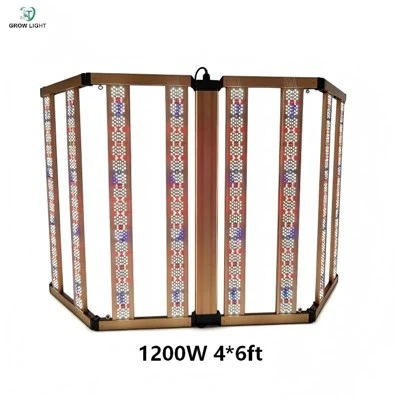
JT Grow Light's full spectrum LED grow light does three crucial things to ensure spectral stability:
① High heat-resistant phosphor
Ordinary lamps show colour shift after 2-3 months, while ours maintain colour point stability for 8-12 months.
② Constant current drive to avoid current fluctuations amplifying ageing effects
Stable current → stable peaks → stable plant behaviour.
③ One-piece CNC heat dissipation structure for uniform temperature
Uniform temperature = slower ageing, avoiding the strange phenomenon of "drifting in the middle but not at the edges".
It's not about making the lamp look better but about ensuring plants see the "same signal" every day.
For commercial cultivation, this is the true ROI. The brightness of the lamp is not the key factor; instead, the stability of the spectrum is what matters. Truly professional growers are never afraid of lamp failure but rather of lamp instability.