
PPE Is the Number That Actually Tells You If a Grow Light Is Efficient
Two fixtures can post almost the same wattage and similar average PPFD. One will cost noticeably less to run while delivering equal or better light at the canopy. The difference almost always sits in PPE. Ignore it and you end up paying more for electricity and cooling without gaining any extra growth.
What PPE Actually Measures
Photon Efficacy Explained - μmol/J in Plain Terms
PPE measures how many micromoles of photosynthetic photons a fixture produces for every joule of electricity it consumes. The unit is μmol/J. Higher is better. A fixture rated 3.0 μmol/J turns the same power into roughly 20 % more photons than one rated 2.5. Over thousands of operating hours that gap becomes real money.
PPE vs PPFD - Why They're Not the Same Thing
PPFD is intensity-the photons landing on a square meter of canopy each second. PPE is efficiency-the photons generated per watt of input power. You can raise PPFD by hanging more fixtures or running them harder. You only raise PPE by improving diodes, optics, thermal design and the driver. Confusing the two is how facilities overspend on power while still under-lighting the crop.
What Counted as "Good" PPE a Few Years Ago vs Now
The Efficacy Baseline in 2020-2022
Back then 2.0–2.3 μmol/J was considered solid commercial performance. Many fixtures that replaced 1000 W HPS sat comfortably in that range and still delivered meaningful savings. Clearing 2.5 put a product in the premium tier.
Where the Bar Has Moved by 2026
The floor has risen. 2.5 μmol/J is now the minimum most serious projects will accept. Mid-tier commercial fixtures commonly land between 2.7 and 2.9. High-efficacy designs regularly hit 3.0–3.2, and the best systems push 3.3–3.5. What looked competitive five years ago is simply outdated today.
What PPE Should a Commercial Grow Light Hit in 2026 to Be Considered Competitive
Entry-Level vs High-Efficacy Product Tiers
|
PPE Range (μmol/J) |
2026 Positioning |
Practical Guidance |
|
Below 2.5 |
Behind current standards |
Avoid for new commercial installs |
|
2.5–2.7 |
Entry-level / meets DLC floor |
Acceptable only if budget is extremely tight |
|
2.7–3.0 |
Solid commercial performance |
Preferred for most new projects |
|
3.0–3.3+ |
High-efficacy / premium |
Target for large facilities and high-light crops |
Why Anything Meaningfully Below the Current Baseline Is Now a Red Flag
Once DLC moved the threshold to 2.5 and the bulk of new commercial quotes cleared 2.7, lower numbers became hard to defend. The electricity savings and rebate eligibility simply favor higher-efficacy options. Installing a fixture that was efficient in 2022 can lock a facility into higher operating costs for the next five to seven years.
How PPE Requirements Differ Across Product Wattage Classes
Wattage class does not dictate PPE, but buyers still need realistic expectations for the sizes they actually purchase.
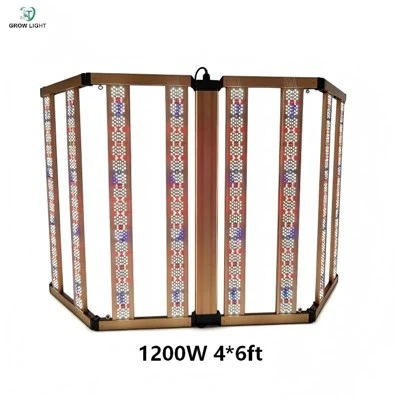
A well-designed Commercial 1000W LED Grow Light should deliver 2.7–3.1 μmol/J in 2026, with stronger units reaching 3.2. The same range applies to a Commercial 1200W LED Grow Light. An 1100W LED Full Spectrum Commercial Grow Light typically sits in the 2.7–3.1 band; adding UV or far-red can trim the pure number slightly while still improving plant response.
|
Wattage Class |
2026 Reference PPE |
Approximate PPF Band |
|
1000 W class commercial |
2.7–3.2 μmol/J |
2700–3200+ μmol/s |
|
1200 W class commercial |
2.7–3.2 μmol/J |
3200–3800+ μmol/s |
|
1100 W full-spectrum commercial |
2.7–3.1 μmol/J |
2900–3400+ μmol/s |
These are realistic targets for competitive quotes, not laboratory peaks.
Why Full-Spectrum Products Sometimes Show Slightly Different PPE Numbers
Spectrum Composition and Its Effect on Measured Efficacy
Red diodes convert electricity into photons more efficiently than blue or phosphor-converted white. A spectrum weighted toward 660 nm will often post a higher PPE than a broader mix that includes more blue, green, UV or far-red. The measurement itself is spectrum-sensitive.
Why This Isn't Necessarily a Downside for Plant Response
Plants do not only care about the highest possible μmol/J figure. Morphology, secondary metabolites and overall crop quality frequently improve with a more complete spectrum even when the pure efficacy number drops a few tenths. The real question is whether the spectral trade-off produces better results for the specific crop, not whether the PPE number is the highest on the page.
Real-World Scenario - Comparing Two Quotes with the Same Wattage, Different PPE
A 20-light flowering room receives two quotes for 1000 W class fixtures. Fixture A is rated 2.6 μmol/J. Fixture B is rated 3.0 μmol/J. Both claim similar average PPFD at the recommended hang height.
To deliver the same total photon flux, Fixture A must run closer to full power. Fixture B can run at lower intensity or the room can use fewer fixtures. At $0.14/kWh and 12-hour flowering cycles, the higher-efficacy option typically saves 12–15 % on lighting electricity alone-roughly $1,800–$2,400 per year for that single room before counting the reduced cooling load. The lower-priced fixture on the quotation is often the more expensive one to own.
DLC Horticultural Qualification and PPE Thresholds
What DLC's Technical Requirements Currently Specify
DLC Horticultural Technical Requirements V4.0 set the minimum PPE at 2.5 μmol/J. New applications under this version began in April 2025; products still listed only under the previous version were delisted in early 2026. The threshold is measured under standardized methods and includes a small tolerance, but the floor is firm.
Why DLC Listing Matters for Rebate Eligibility
Most North American utility rebate programs require current DLC Hort listing. Without it the project frequently receives nothing. For larger facilities the rebate can offset a meaningful share of fixture cost, turning the PPE threshold into both a performance and a financial filter.
Higher PPE vs Higher PPFD - Which Should You Prioritize
|
Scenario |
Lean Toward Higher PPE |
Lean Toward Higher PPFD |
|
Energy cost dominates operating expenses |
Strong preference |
Secondary |
|
High-light flowering crops under CO₂ |
Both required |
Critical |
|
Leafy greens or lower-light crops |
Strong preference |
Less critical |
|
Electrical capacity is limited |
Preferred |
May force compromises |
|
New build with long ownership horizon |
Preferred |
Balance with uniformity |
In practice the better sequence is to lock in strong PPE first, then size the system to hit the required PPFD with good uniformity. Chasing peak intensity with inefficient fixtures simply raises the monthly bill.
Industry Trend - Where Commercial Grow Light Efficacy Is Headed Next
Diode packages keep improving, thermal designs are tighter, and drivers are more efficient. Average PPE on new commercial fixtures has climbed steadily for several years. Gains are becoming incremental rather than dramatic, yet the practical ceiling continues to rise. Facilities installing lights today should assume that 3.0 μmol/J will look ordinary within a few more product cycles.
Regulatory and Rebate Programs Tied to Efficacy Standards
Utility Rebate Programs That Set Minimum PPE Requirements
Beyond DLC, many utilities and state programs set their own minimums or simply adopt the current DLC threshold. Some offer higher incentives for fixtures that clear 2.8 or 3.0 μmol/J. Checking the specific program rules before finalizing a purchase order remains essential.
How to Verify a Manufacturer's PPE Claims Before You Buy
When you evaluate an LED grow light manufacturer or LED grow light factory for wholesale LED grow light or custom high-efficacy grow light work, treat the PPE number as a claim that needs proof.
What Test Reports a Reliable LED Grow Light Factory Should Provide
Request independent LM-79 (or equivalent) photometric reports that list PPE, total PPF and input power measured at the same operating condition. Confirm the test was performed on the production configuration, not a lab prototype. Cross-check the exact model against the current DLC Hort QPL when rebate eligibility matters. Factories that supply this documentation without hesitation and allow sample testing are far more reliable than those that only offer marketing sheets.
F A Q
Q: What is a good PPE for an LED grow light in 2026?
A: 2.7 μmol/J and above is competitive for most commercial work. 3.0+ is strong performance.
Q: Is 2.5 μmol/J good for a grow light?
A: It meets the current DLC minimum and is acceptable for entry-level use, but most new projects target higher.
Q: What's the difference between PPE and PPFD?
A: PPE is efficiency (photons per joule). PPFD is intensity at the canopy (photons per square meter per second).
Q: Does higher PPE always mean better results?
A: It lowers energy cost for the same light output. Plant response still depends on spectrum, uniformity and environment.
Q: What PPE range should I expect from 1000 W, 1200 W or 1100 W commercial fixtures?
A: Competitive units in these classes commonly deliver 2.7–3.2 μmol/J.
Q: What PPE does DLC currently require?
A: 2.5 μmol/J under Horticultural Technical Requirements V4.0.
Q: How do I verify a manufacturer's PPE claims?
A: Request independent photometric test reports and check current DLC listing status.
Q: Does a full-spectrum design lower PPE?
A: It can, because broader spectra include less efficient wavelengths. The trade-off is often worthwhile for crop quality.
Knowing the PPE target for 2026 removes most of the guesswork from lighting decisions. When you request quotes, ask for measured PPE data alongside wattage and PPFD maps. Samples and independent test reports remain the most reliable way to confirm that the numbers on the quotation will match the numbers on your power bill and in your canopy
.Contact now