

Most cannabis grow rooms don't fail because they lack light. They fail because light is distributed unevenly.
This is usually not obvious at the beginning. Early in a growth cycle, plants look healthy enough. Leaf color is acceptable. Growth appears vigorous. On paper, PPFD readings look impressive-sometimes even higher than recommended targets. But as the canopy fills in and the room matures, problems begin to surface quietly.
Plants in the center start to look stressed earlier than expected. Leaf edges curl. Some tops stop stacking properly. Meanwhile, plants near the edges lag, stretch longer, and never quite catch up. By the time harvest approaches, the room no longer behaves like one system, but like several zones that require different management strategies.
At that point, many growers instinctively blame genetics, nutrients, or climate control. Lighting is rarely questioned-after all, the numbers looked good. This is exactly where most misunderstandings about PPFD begin.
For growers who want a clearer reference on PPFD ranges and measurement basics, this practical PPFD guide explains how light intensity is typically evaluated in grow rooms.
In commercial cannabis cultivation, uneven PPFD rarely shows up as an immediate disaster. Instead, it introduces friction into every stage of the grow.
When the center of a grow room receives significantly higher PPFD than the perimeter, plants in that zone often hit light saturation earlier. Photosynthesis stops responding proportionally to additional photons, but heat and stress continue to accumulate. These plants don't necessarily grow faster-they simply consume more resources to maintain balance.
At the same time, edge plants operate below optimal intensity. They stretch, mature more slowly, and demand extra attention to keep pace. This creates a management dilemma: adjust the entire room to protect the center, or push harder to support the edges.
Either choice introduces inefficiency.
Harvest timing becomes inconsistent. Some plants are ready earlier, others later. Labor increases because selective harvesting or differential treatment becomes necessary. In a commercial environment, where consistency and predictability define profitability, this variability becomes a silent cost.

Why High Center PPFD Often Reduces Total Yield
One of the most counterintuitive truths in cannabis lighting is that higher peak PPFD does not automatically mean higher total yield.
When a fixture concentrates a large portion of its output in the center, the room's average PPFD may look acceptable, but plant response is not averaged. Plants respond locally.
In center-heavy setups, the strongest plants often reach a physiological ceiling early. Additional light no longer contributes meaningfully to biomass accumulation, but it does increase stress sensitivity. Meanwhile, weaker plants at the edges never reach their full potential.
The net result is a harvest where gains in one zone fail to compensate for losses elsewhere. Yield may appear respectable, but it is rarely maximized relative to energy input and space utilization.
This is why experienced growers eventually stop asking "How high is the PPFD?" and start asking "How evenly is it delivered?"
Why Adjusting Dimming and Height Rarely Solves the Problem
When uneven PPFD becomes noticeable, the first response is often adjustment.
Growers dim fixtures, raise mounting heights, or change spacing. These interventions can reduce extremes, but they rarely eliminate the root cause. The fundamental issue is structural.
A fixture designed to emit light from a centralized body will always struggle to cover wide canopies evenly. Raising it spreads light outward but reduces intensity efficiency. Dimming protects the center but further penalizes the edges.
These are compromises, not solutions. This is where many growers realize that PPFD uniformity is not a tuning problem-it is a design problem.
Why Multi-Bar and Foldable Designs Changed the Equation
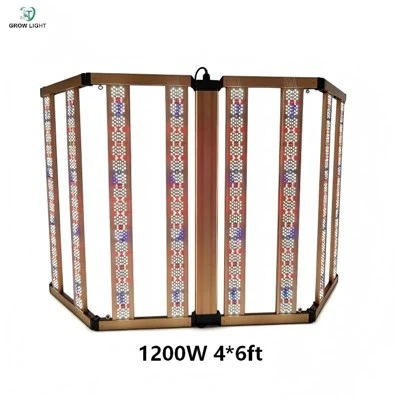
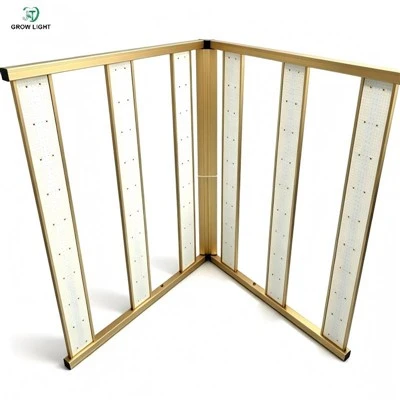
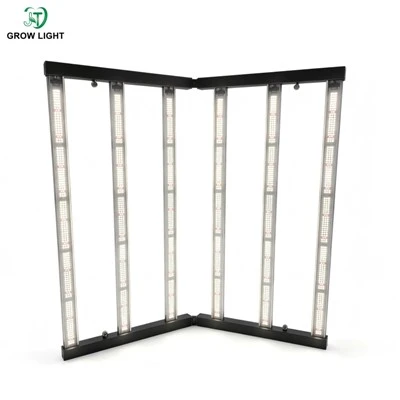
Multi-bar and foldable-style lights approached the problem from a different angle. Instead of asking how to project more light from a single source, they asked how to place multiple light sources across the canopy. By distributing output physically rather than electronically, these designs align light delivery with plant geometry.
When unfolded, foldable LED grow lights spread their bars across nearly the entire grow footprint. Each bar contributes a portion of the total output, reducing the need for extreme intensity in any single zone. The result is a flatter PPFD map, where differences between center and edge are minimized.
This is not a cosmetic improvement. It directly affects how plants behave over time.
Uniform PPFD leads to synchronized growth stages, more consistent flower development, and harvest windows that align naturally. In commercial settings, this consistency often matters more than chasing absolute peak values.
PPFD Uniformity Becomes More Critical as Scale Increases
Small grow rooms can tolerate uneven PPFD more easily.
In a tent or small room, growers can manually compensate. Plants can be rotated. Zones can be managed individually. At scale, this flexibility disappears.
As rooms grow larger, the cost of uneven PPFD multiplies. Manual intervention becomes impractical. Variability spreads across dozens or hundreds of plants. Labor and complexity increase exponentially.
This is why large commercial facilities tend to converge on similar lighting formats. It's not groupthink-it's economic pressure.
Uniformity simplifies operations. It reduces decision fatigue. It allows growers to treat rooms as systems rather than collections of exceptions.
Vertical Farming Amplified the Need for Uniform Distribution
In multi-tier environments, the margin for error shrinks. Lights operate closer to the canopy. Light overlap behaves differently. Any unevenness is amplified because layers stack variability on top of variability.
In these setups, center-heavy fixtures become liabilities. Heat accumulation, uneven penetration, and inconsistent development quickly surface.
Multi-bar, foldable LED grow lights adapt naturally to vertical systems. Their distributed structure complements grow racks and close-to-canopy operation, making uniform PPFD not just desirable, but necessary.
This is one reason vertical cannabis facilities almost universally adopt spider-style layouts-they simply scale better.
A Manufacturer's Perspective on Why Uniformity Wins
From the manufacturing side, feedback patterns are consistent. At JT Grow Light, growers rarely complain about insufficient maximum PPFD. Instead, they describe uneven rooms, difficult harvest timing, and the frustration of managing plants that behave differently under the same roof.
These issues are structural, not electronic.
This is why foldable LED grow lights are designed around distribution first. Output, spectrum, and efficiency matter-but they are secondary to how light is physically delivered across the canopy. Uniformity is not an accessory feature. It is the foundation.
There is a qualitative difference between uniform and uneven rooms that experienced growers immediately recognize.
Uniform rooms feel calmer. Plants respond predictably. Adjustments produce expected results. Problems are easier to diagnose because fewer variables are competing for attention.
In uneven rooms, every decision feels risky. Fixing one area often worsens another. Over time, this erodes confidence and increases workload.
This emotional dimension rarely appears in technical discussions, but it strongly influences long-term preferences.
Growers don't just want higher yields. They want systems they can trust.
Why This Shift Redefined Industry Standards
As cannabis cultivation matured, the industry collectively moved away from chasing peak numbers and toward managing systems.
PPFD uniformity emerged as a defining metric because it aligned with scale, labor efficiency, and consistency. Fixtures that could not deliver uniformity gradually lost favor, regardless of their headline specifications.
This is why foldable LED grow lights became dominant. Not through marketing, but through alignment with real operational needs. If uneven growth persists in your room despite strong PPFD readings, the issue is unlikely to be power or spectrum alone. It is probably a distribution.
Before adjusting dimming curves or changing mounting heights again, it's worth stepping back and evaluating fixture structure. Ask whether light is being delivered where plants actually need it, or merely where the fixture happens to emit it.
In most modern commercial environments, uniform PPFD is no longer optional-it is foundational. This is why foldable style LED lights became the preferred format in commercial cannabis cultivation.