
Most cannabis growers don't start their lighting journey looking for a "foldable" fixture. They start with a problem.
Uneven plants across the canopy. One side always finishes earlier than the other. Plants in the center look stressed while edge plants lag. HVAC systems are working harder than expected. Ceiling height limits expansion. Labor costs are creeping up every time a room is built or modified.
For years, growers tried to solve these problems by chasing higher wattage, stronger PPFD numbers, or newer diode brands. On paper, the fixtures improved. In practice, the problems stayed.
That gap between specification sheets and real grow-room behavior is exactly where Foldable LED Grow Lights quietly took over the market. Not because they looked different, but because they solved problems growers were already tired of fighting.
What follows is not a product story. It's an explanation of how industry consensus formed-and why foldable, spider-style, multi-bar fixtures became the most trusted format in commercial cannabis cultivation.
PPFD Uniformity Became More Important Than Total Output
One of the biggest shifts in cannabis lighting over the past decade has been the industry's understanding of PPFD.
Early on, many growers focused on total output: higher µmol numbers, higher wattage, stronger center readings. The assumption was simple-more light equals more yield. That assumption didn't survive large-scale commercial rooms.
As facilities scaled, growers began noticing a pattern. High-output fixtures created strong center zones and weak edges. Plants directly under the hotspot showed signs of light saturation, while plants near the perimeter lagged. Harvest timing became inconsistent. Labor increased because plants needed to be managed differently within the same room.
This is where PPFD uniformity became the real metric that mattered.
Industry engineers and cultivation specialists-especially those working on commercial cannabis projects-started emphasizing that even light distribution across the entire canopy produced more consistent results than peak intensity. Yield predictability, not maximum PPFD, became the goal.
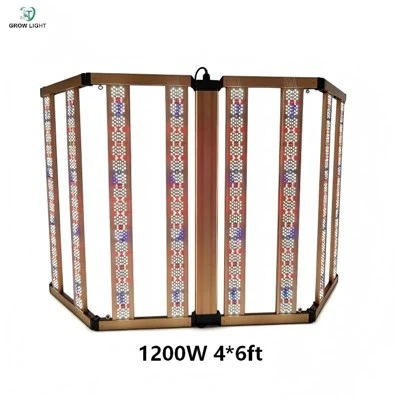
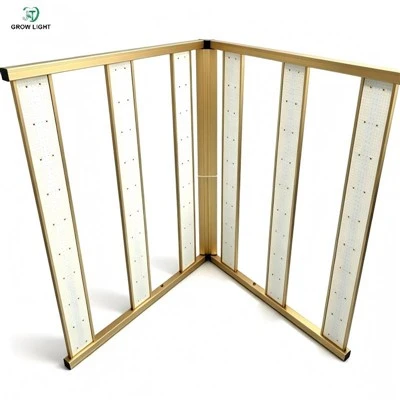
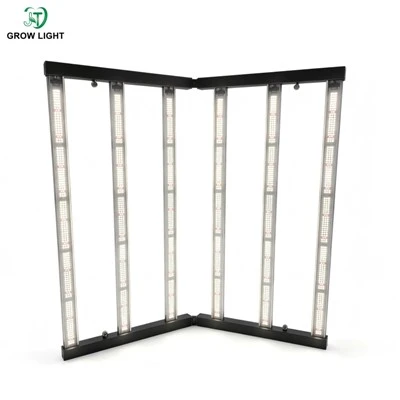
Foldable LED Grow Lights addressed this problem structurally, not electronically. When unfolded, their multi-bar layout spreads light across nearly the entire grow area, closely matching the footprint of the canopy. Instead of one intense source fighting physics, light is delivered evenly from multiple positions.
The result is not just better numbers on a map. It's synchronized plant development, uniform flowering, and harvests that behave like a system instead of a collection of exceptions.
Once PPFD uniformity became a priority, another pressure followed quickly: space efficiency.
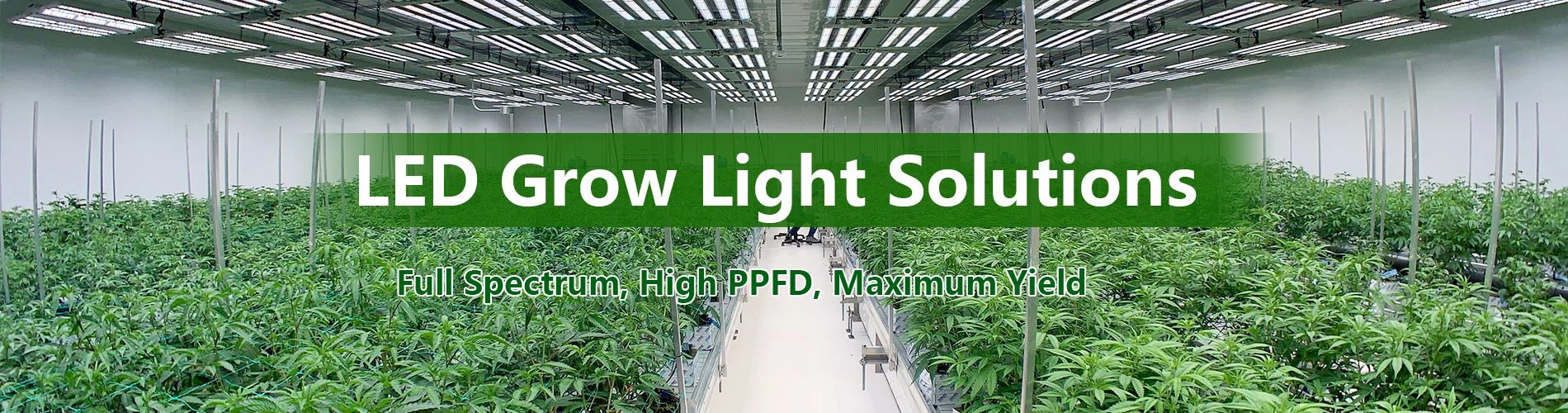
As cannabis operations matured, the economics shifted. The most expensive part of a facility was no longer just energy-it was square footage. This drove rapid adoption of Vertical Farming concepts, especially in regions where real estate and compliance costs were high. Lighting performance changes dramatically once vertical grow racks are introduced, especially in multi-tier cannabis facilities.
Grow racks made it possible to stack production vertically, but they also exposed a critical limitation of traditional fixtures: distance.
Conventional high-power fixtures typically require 60–100 cm of clearance to avoid heat stress and light burn. That distance is manageable in single-layer rooms. It becomes a deal-breaker when growers attempt two, three, or even four tiers.
Foldable LED Grow Lights introduced what the industry now calls close-to-canopy operation. By distributing heat across multiple slim aluminum bars instead of concentrating it in a single housing, these lights can operate much closer, often 30–60 cm from the canopy, without creating thermal stress. Close-to-canopy operation plays a critical role in making vertical cannabis cultivation viable, especially in multi-tier grow rack systems.
This single structural advantage unlocked vertical farming at scale. With foldable lights, growers could install grow racks without sacrificing plant health, turning fixed building height into a multiplier rather than a constraint. In multi-layer cultivation systems, foldable grow lights integrate perfectly with modern grow racks and close-to-canopy layouts.

Passive Cooling Quietly Solved Multiple Problems at Once
Cooling is one of the least glamorous but most expensive aspects of cannabis cultivation.
Many high-output fixtures rely on active cooling-fans, moving air inside housings, complex thermal management. Fans fail. Dust accumulates. Noise increases. Maintenance becomes routine instead of occasional.
Foldable LED Grow Lights took a different path. Their bar-style construction functions as a passive heat sink. Heat spreads naturally across a wide surface area and dissipates without mechanical assistance.
This has two long-term effects that growers feel more than they measure.
First, reliability improves. With no fans to fail, the number of moving parts drops dramatically. Maintenance cycles become calmer, more predictable.
Second, environmental control becomes easier. Because heat is not concentrated in a single hotspot, HVAC systems don't have to compensate aggressively. Large commercial facilities consistently report smoother temperature gradients and lower cooling loads when switching to multi-bar designs. Cooling design plays a critical role in long-term lighting reliability, especially in commercial cannabis grow rooms.
This is one reason foldable fixtures are often favored in large indoor facilities-not because they are "cooler," but because they create less thermal chaos.
Logistics and Labor Costs Became Impossible to Ignore
Lighting decisions don't end at performance. They extend into logistics, storage, installation, and human time. Shipping size and packaging design play a much larger role in commercial grow light ROI than most buyers expect.
As projects grew larger, growers, distributors, and integrators began noticing how much money was lost outside the grow room. Oversized lights consumed warehouse space. Shipping damage increased. Installation required multiple workers and a complex assembly.
Foldable LED Grow Lights addressed these issues almost accidentally.
When folded, their shipping volume is often half or less than rigid fixtures with similar coverage. This improves warehouse efficiency, lowers freight costs, and reduces last-mile damage risk, especially for facilities located far from major logistics hubs.
Installation also changed. Most foldable fixtures are designed to be plug-and-play. One person can hang and deploy a fixture in minutes, without assembling multiple components overhead. Over dozens or hundreds of fixtures, the labor savings become substantial. These operational efficiencies rarely appear on a datasheet, but they directly impact project ROI. Installation labor is often underestimated when selecting grow light designs for large commercial projects.
The "Professional Look" Became a Signal of Serious Operations
There is one factor few manufacturers like to talk about, but every experienced grower understands it.
Appearance matters.
In North America and Europe, foldable spider-style fixtures have become visually associated with professional cannabis cultivation. Investors, consultants, and experienced operators recognize the format instantly. It signals that the room was designed intentionally, using solutions optimized for cannabis rather than adapted from general horticulture.
This psychological signal reinforces trust. When a grower chooses Foldable LED Grow Lights, they are not just choosing performance-they are aligning with what the industry now recognizes as the commercial standard.
That perception matters when facilities scale, seek investment, or bring in external partners.
Why These Factors Converged at the Same Time
None of these shifts happened in isolation.
PPFD uniformity, vertical farming, passive cooling, logistics efficiency, and professional standardization all emerged as priorities as cannabis cultivation matured from experimentation into industrial production.
Foldable LED Grow Lights didn't create these needs. They simply aligned with them better than previous formats.
That alignment is why the market moved collectively, not suddenly, toward multi-bar designs.
From a manufacturing standpoint, these trends are easy to recognize after the fact.
At JT Grow Light, feedback from commercial cannabis projects consistently highlights the same themes: consistency over peak output, structural tolerance over theoretical perfection, and systems that scale without friction.
This is why foldable LED grow lights are designed not just as fixtures, but as part of a cultivation system-compatible with vertical racks, close-canopy operation, and large-scale deployment.
The market didn't adopt foldable designs because they were new. It adopted them because they removed recurring pain points growers were no longer willing to accept.

The Real Reason Growers Prefer Foldable LED Grow Lights
In the end, cannabis growers didn't choose foldable fixtures because of a single feature.
They chose them because these fixtures respect reality.
They respect how plants grow across a canopy.
They respect the limits of buildings.
They respect the cost of labor and logistics.
They respect the need for predictable, repeatable results.
Foldable LED Grow Lights became the preferred choice not through marketing, but through alignment with how commercial cannabis cultivation actually works.
That is what makes them the industry standard-and why they continue to dominate new builds and retrofit projects alike.